

Guide
A Guide to Improving Patient Experience in Your Clinic
Discover actionable strategies for improving patient experience. This guide provides real-world tips to boost patient satisfaction, loyalty, and clinic growth.

Apr 2, 2026 · 17 min read
Free tool
AI Survey Generator
Describe what you want to learn and get a ready-to-send survey in seconds.
Improving the patient experience is more than just a box to check for customer service. It's what directly fuels your clinic's reputation, builds patient loyalty, and ultimately, supports your financial health. As a busy hospitality and service owner, you know a positive experience doesn't just make people feel good; it encourages them to stick with their treatment and become active partners in their own care. This guide will show you how to make that happen.
Why Patient Experience Is Your Most Valuable Asset

Let's be direct—the days of treating patient experience as a "soft" metric are long gone. In today’s competitive healthcare world, how your patients feel during their visit is just as important as the clinical outcome itself. It’s a core driver of your practice's reputation and financial stability.
The top-performing practices don't treat service as an afterthought. They build their entire strategy around it. Every single interaction, from the first call to a post-visit survey, adds up to an impression that defines loyalty, referrals, and your bottom line.
The Financial Impact of a Superior Experience
The link between how you treat patients and how well your practice performs financially is concrete. The data proves it.
Hospitals that deliver an excellent patient experience consistently outperform their peers. Research shows these facilities enjoy average net margins of 4.7%, a stark contrast to the 1.8% seen at facilities with low ratings. This isn't a fluke; it's a direct result of stronger patient loyalty, a better reputation that pulls in new patients, and a steady flow of positive word-of-mouth. You can dig into the numbers yourself in this detailed analysis from Deloitte on the financial link.
Focusing on the patient journey reshapes how your clinic operates and how it performs. The table below shows the shift from a traditional, clinical-only mindset to an experience-centric one.
The Impact of Patient Experience on Key Clinic Metrics
Focus Area | Traditional Approach | Experience-Centric Approach | Business Outcome |
|---|---|---|---|
Patient Retention | Assumes good clinical care is enough to keep patients. | Actively measures satisfaction and resolves issues to build loyalty. | Higher patient lifetime value and lower churn. |
New Patient Acquisition | Relies on traditional marketing and physician referrals. | Generates positive online reviews and word-of-mouth referrals. | Lower marketing spend and a stronger brand reputation. |
Staff Engagement | Views staff as clinical providers first and foremost. | Empowers staff with tools and training to improve interactions. | Reduced staff turnover and a more positive work environment. |
Operational Efficiency | Focuses on throughput and billing cycles. | Identifies and removes friction points in the patient journey (e.g., wait times, scheduling). | Smoother operations and fewer patient complaints. |
This shift doesn't just make patients happier; it creates a more resilient and profitable practice.
Key Takeaway: A superior patient experience isn't about satisfaction scores alone. It’s a core business function that directly translates to higher margins, better retention, and sustainable growth for your clinic.
Collect Smarter, Act Faster, and Grow Stronger
The secret to turning patient service into a growth engine is simple: listen better and act quicker. This is our guiding philosophy at FeedbackRobot. You must collect smarter feedback at every touchpoint, act faster on that information to fix problems, and ultimately grow stronger as a practice.
This means ditching the old annual surveys and starting to capture the patient’s voice in real time. What did they think of the new online booking tool? Was the front desk staff efficient and welcoming? Did their doctor explain the treatment plan in a way they understood?
Answering these questions gives you a clear view of your practice through your patients' eyes. It turns vague feelings into hard data, showing you the friction points that cause frustration and the "wow" moments that build true loyalty. When you treat every piece of feedback as a growth opportunity, you move from a reactive, problem-fixing mode to a proactive, experience-building one.
Map Your Current Patient Journey From Every Angle
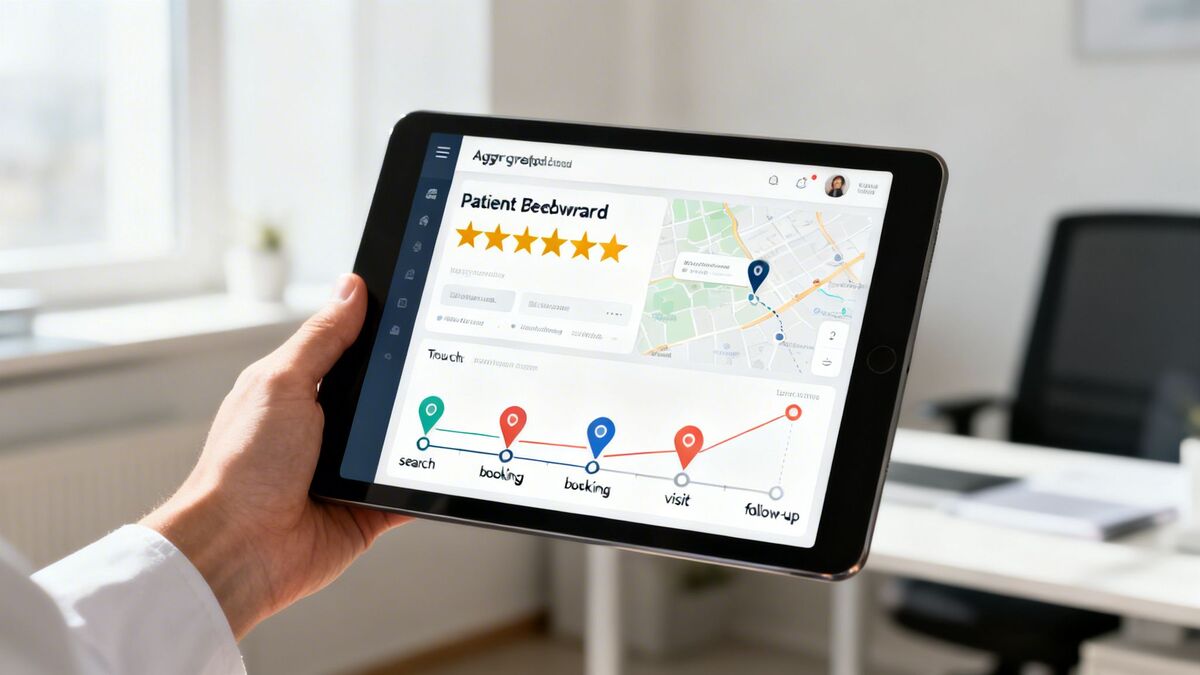
Before you can improve anything, you need to see your practice through your patients' eyes. This means looking at the entire experience, from the moment they first search for a new doctor on Google to the follow-up message they get weeks after their visit.
This isn’t about sending out one big, generic survey once a year. It's about digging into the small details, uncovering the little friction points that cause frustration, and finding those hidden chances to create genuinely positive moments.
There's a clear disconnect happening right now. Recent studies found that only 64% of people rated their healthcare experiences as good or very good—the lowest level in years. That gap is where you have an opportunity. It shows a real need for practices to figure out exactly where things are falling short. You can find more details in these patient experience statistics that break down the numbers.
Unify Your Feedback Intelligence
Let's be honest: your patients are already talking about you. Their opinions are scattered across Google, Healthgrades, Zocdoc, and social media. Trying to keep up with all of it manually is a losing battle. You're bound to miss things, and it's just plain frustrating.
This is where having a unified review intelligence dashboard becomes your mission control. We built our Radar feature at FeedbackRobot for this exact problem. Radar is a unified review intelligence feature that automatically pulls all your public reviews and mentions into a single, clean dashboard. Forget bouncing between ten different browser tabs; you get a full 360-degree view of your reputation in one spot.
Our motto is simple: collect smarter, act faster, and grow stronger. Radar is the "collect smarter" piece—it does the grunt work of finding feedback so you can focus on what it means.
This consolidated view immediately helps you spot patterns. Are patients always praising your front desk staff but complaining about the confusing parking signs? Is your Zocdoc profile full of five-star reviews while your Google Business Profile is getting hit with complaints about phone wait times? Radar makes these insights impossible to ignore.
From Data Points to Actionable Insights
Once you have all your feedback in one place, you can start connecting the dots. The real magic happens when you link what patients are saying to specific moments in their journey.
Start by breaking down their experience into clear stages:
Discovery & Scheduling: How do people find you and book their appointments?
Pre-Visit: What’s the communication like between booking and arrival? (Think reminders, digital paperwork.)
Arrival & Check-in: The first impression they get when they walk in the door.
The Wait: How long are they waiting, and what's the waiting room environment like?
The Consultation: The actual time spent with nurses, PAs, and doctors.
Check-out & Billing: The last in-person or administrative step before they leave.
Post-Visit Follow-up: How you handle test results, check-ins, and future appointment reminders.
If you want a deeper look at this, our guide on how to create a patient journey map offers a framework you can follow step by step.
By sorting feedback into these buckets, you go from a vague "3.5-star average" to a specific diagnosis. You might find out that your low rating has nothing to do with your quality of care but everything to do with a clunky online payment portal. That’s the kind of specific, actionable insight that lets you make targeted fixes that actually improve the patient experience and help your practice grow.
Design a Patient-First Improvement Plan

You’ve done the hard work of mapping out your current patient journey. Now for the fun part: making it better. This is where you move from just having data to actually taking action.
The best improvement plans always zero in on three things: your people, your processes, and your technology.
Your plan doesn't need to be some hundred-page document that gathers dust. It just needs to be specific. Instead of a vague goal like "improve communication," you need a real target, like "reduce phone wait times by 30% and train front-desk staff on a new empathetic greeting script." One is a wish; the other is a plan.
Empower Your People with Better Communication Skills
Your team is on the front lines, and their interactions can make or break a patient's experience. Investing in their skills is a direct investment in your clinic's reputation and success.
The data on this is overwhelming. A staggering 96% of people see clear communication and attentive listening as vital for a positive healthcare experience. And when communication between providers is strong, it can slash serious complications by 33% and cut readmissions by 56% in trauma cases. As this guide on patient outcomes points out, better communication directly leads to better health.
This is exactly why targeted training works so well. Focus on:
Active Listening: Train your staff to repeat a patient’s concern back to them—"So, what I'm hearing is you're worried about..." It's a simple technique that proves they were heard and understood.
Empathetic Language: Small script changes make a huge difference. Instead of a flat, "You have to wait," try, "I know waiting is frustrating. We expect a room to be ready in about 15 minutes, and I'll keep you posted."
Setting Expectations: Teach your team to get ahead of common questions about wait times, billing, or next steps. Uncertainty is a massive source of patient anxiety.
Your team is your greatest asset. Empowering them with the right communication skills and tools isn't just a 'nice-to-have'—it’s the highest-impact, lowest-cost way to start improving patient experience immediately.
Streamline Your Processes to Reduce Friction
Next up, take a hard look at your daily workflows. Where do things get clunky, confusing, or just plain slow for patients? The feedback you gathered earlier should point you right to these trouble spots.
Common areas ripe for improvement include:
Appointment Booking: Is your online scheduler a pain to use? Are people stuck on hold forever when they call?
Check-in Procedures: Can patients fill out paperwork digitally before they arrive to speed things up?
Wait Time Management: Do you have a clear system for letting patients know about delays, or are they left guessing?
Let’s say patients constantly complain that your check-in process is a mess. Your goal is to simplify it. Maybe that means redesigning a form, or creating a simple one-page guide for new patients. These small process tweaks remove daily frustrations for both your patients and your staff.
Choose Technology That Simplifies the Journey
The right tech should make life easier, not more complicated. And one of the most important choices you'll make is how you gather feedback. Annual surveys are too little, too late. To really get a feel for the patient experience, you need to hear from them in the moment.
This is exactly why we built Prompt to Survey into FeedbackRobot. Prompt to Survey is a feature that captures in-the-moment feedback by tying directly into your existing systems, like your Mews or Toast integration. The instant a patient's appointment is marked complete, Prompt to Survey can automatically send them a quick, targeted survey via SMS or email.
This simple automation turns a routine interaction into an immediate, valuable data point. The timely request dramatically boosts response rates and gives you insights while the experience is still fresh in their minds.
If you’re building out these surveys, our guide on mastering patient satisfaction survey questions has plenty of proven examples. By automating this critical step, you create a steady stream of feedback that fuels your entire improvement plan, helping you collect smarter and act faster.
Implement Changes and Automate for Maximum Impact
A great plan is a solid start, but execution is what separates good from great. This is where you roll up your sleeves and put your patient experience strategies into practice. A smooth rollout isn’t just about new policies; it’s about getting your team bought-in and, critically, using technology to automate the repetitive work.
This frees up your staff to focus on what they do best: high-touch, human-centric patient care.
The goal isn't to work harder; it's to work smarter. We know that over 43% of patients list long wait times as their biggest headache. While you can't always eliminate waits, you can absolutely manage the frustration around them. Automation is your best tool for handling predictable tasks, so your team can handle the unpredictable needs of your patients.
Turn Your Feedback Data into Instant Insights with AI
You’re already collecting feedback from reviews, surveys, and social media. But sifting through all of it to find the real story is a full-time job. It’s time to stop wasting valuable hours on manual analysis and let AI do the heavy lifting.
This is exactly why we built AI Summaries into FeedbackRobot. AI Summaries is a feature that delivers instant insights and sentiment analysis by pulling from all your feedback sources. Instead of reading every single comment, you get a clear, concise summary of the key themes and overall patient mood.
Imagine this scenario:
At the end of the week, an automated report lands in your inbox.
The AI Summary instantly shows you that 75% of patient comments were positive, with specific praise for your new nurse practitioner.
But it also flags a recurring negative theme: patients are confused by the new billing statements.
Without spending a single minute in a spreadsheet, you know exactly who to praise and which fire to put out first. This is how you act faster on the feedback you worked so hard to collect.
Automate Service Recovery Before Problems Escalate
Let's be realistic—not every patient experience will be perfect. That’s a given in any busy practice. What truly defines your practice is how quickly and effectively you respond when things go wrong. A fast, empathetic response can turn a frustrated patient into your biggest fan. But you can't be everywhere at once.
This is where automated service recovery becomes a game-changer. Our Resolutions Engine was designed for this exact challenge. The Resolutions Engine enables automated service recovery that works around the clock. You set the rules, and the system acts on your behalf so no negative experience ever slips through the cracks.
Think about how this works in the real world:
A patient leaves a 2-star review on Google, mentioning a long wait and a rushed check-out.
The Resolutions Engine immediately detects the low rating and negative sentiment.
It automatically triggers a pre-set workflow: an alert is sent to the practice manager, and a personalized, empathetic email is sent directly to the patient.
That email can be simple and direct: "We're so sorry to hear your recent visit didn't meet expectations. We value your feedback and would like to make it right." It can even include a small, automated gesture, like a digital coupon for the coffee shop next door.
You've just acknowledged the issue, shown you care, and offered a resolution—all within minutes, and without any manual effort. This is how you stop a negative comment from becoming a permanent stain on your online reputation.
By setting up these workflows, you build a safety net that protects your brand and proves to patients you're listening. It's a powerful way to improve the patient experience at scale. You can explore more tactics in our deep dive on feedback resolution automation. It’s all about building a system that helps you grow stronger, one resolved issue at a time.
Measure Your Success and Close the Feedback Loop

You’ve put in the hard work to upgrade your people, processes, and technology. But the job isn't over. Improving the patient experience is a continuous cycle, not a one-and-done project. Now it’s time to measure the impact of your efforts and—most importantly—prove to your patients that you’re actually listening.
There's an old saying: you can't manage what you don't measure. It’s time to move beyond simple star ratings. By tracking the right Key Performance Indicators (KPIs), you can draw a straight line from your operational changes to real business outcomes and show a clear return on your investment.
Defining Your Key Performance Indicators
The KPIs you pick should directly tie back to the goals you set in your improvement plan. Think bigger than just "patient satisfaction." You need metrics that give you a full 360-degree view of your practice's health. To do this well, you’ll need solid healthcare analytics to turn raw data into insights you can actually use.
Consider tracking a mix of these critical indicators:
Patient Retention Rate: What percentage of your patients come back for their next appointment? This is one of the truest measures of loyalty.
Net Promoter Score (NPS): This classic metric asks, "How likely are you to recommend our practice to a friend or colleague?" It's a powerful predictor of future growth.
Online Review Sentiment: Are your Google and Healthgrades reviews getting more positive? Our AI Summaries feature can automatically quantify this for you.
Internal Service Recovery Metrics: How many negative feedback reports did your team successfully resolve? Tracking this shows how effective your Resolutions Engine workflows really are.
By keeping an eye on these numbers, you’ll see if your efforts to shorten wait times or improve staff communication are actually moving the needle on loyalty and your public reputation.
Your goal is to create a dashboard of metrics that tells a story. When NPS goes up and negative sentiment goes down, you have concrete proof that your strategy for improving patient experience is working.
This data-first approach lets you double down on what’s working and pivot away from initiatives that aren't getting results. It’s the final piece of the "act faster" puzzle, letting you fine-tune your strategy in near real-time based on what your patients are telling you.
The Ultimate Goal: Closing the Feedback Loop
Getting feedback and making internal changes is only half the battle. The final, most crucial step is to close the loop by showing your patients that you heard them loud and clear. When someone sees that their suggestion led to a real improvement, it builds an incredible amount of trust and deepens their connection to your practice.
This is how you turn your happy patients into your best marketing tool. Don't just fix the problems they highlight; celebrate the positive changes they helped inspire. This public acknowledgment proves you’re a practice that listens and genuinely cares.
This is exactly why we built the Spotlight: Feedback Wall. It’s not just another website widget; it’s a tool designed to close the feedback loop at scale. The Spotlight: Feedback Wall lets you showcase your best reviews and feedback right on your website or on screens in your waiting room.
Think about how powerful that is:
A patient leaves a 5-star review, specifically praising your new, simplified check-in process.
With a single click, you can feature that review on your Spotlight: Feedback Wall.
Now, every potential patient who visits your website sees authentic social proof from a real person, validating your commitment to a great experience.
This simple act hits two critical goals at once. First, it gives you compelling social proof that attracts new patients. Second, it shows your existing patients that their feedback truly matters. They see their own words—or their peers' words—being celebrated, which reinforces their choice to stay with you and encourages them to share more feedback in the future.
This virtuous cycle—collecting feedback, acting on it, and showcasing the results—is the engine that drives continuous improvement. It perfectly captures our core value: collect smarter, act faster, and grow stronger. By making patient feedback visible, you build a brand that's trusted, transparent, and always getting better.
Tired of posting boring screenshots of Google Reviews? Use our free Urgent Care Center Review Visualizer to create high-impact graphics for Instagram and LinkedIn. Create Yours Now →
Explore the healthcare and wellness reputation guide for more patient experience tactics and review management tools.
Answering the Tough Questions About Patient Experience
As a practice owner, you know patient experience is everything. But knowing where to start—and what to expect—can feel overwhelming. Let’s walk through the questions I hear most often from owners who are ready to make a change.
Where Should I Start If My Budget Is Limited?
When you’re watching every dollar, focus on the low-cost changes that deliver the biggest wins. The best opportunities are almost always in your people and processes, not in pricey tech.
Start with communication training for your staff. It’s a small investment that pays off immediately in patient satisfaction. You can also make simple process tweaks—like setting clear expectations for wait times or trimming down your check-in forms—that cut down on patient frustration without costing a dime.
Key Insight: You don't need a huge budget to start seeing improvements. The most powerful changes often come from training your team and streamlining frustrating processes, both of which are highly cost-effective.
Free tools can also give you a running start. A free trial of a platform like FeedbackRobot lets you start collecting crucial feedback right away with simple tools like QR codes and SMS surveys. The data you get will show you exactly where to point your limited budget for the greatest impact.
How Do I Get My Staff Onboard with New Initiatives?
Getting your team to embrace change is absolutely everything. If your staff isn't bought in, even the most brilliant strategy is doomed. The secret is to show them how these changes make their jobs easier and more fulfilling, not just add more work to their day.
Start with the data. Show them, from the patient's point of view, what's not working—it's incredibly eye-opening. Then, bring them into the solution-building process. Your frontline team knows what will actually work. Most importantly, tie their efforts directly to the good stuff. When a glowing review mentions a team member by name, celebrate it publicly. Use your feedback system’s reporting to spotlight these wins and show how their focus on service is fueling the clinic's success.
How Quickly Can I Expect to See Results?
You can see some results almost immediately. While creating a deep, lasting cultural shift takes time, quick wins are possible and they build crucial momentum for your team.
For instance, implementing an automated workflow with our Resolutions Engine—which enables automated service recovery—can turn a negative experience around in minutes. You might save a patient relationship that very same day. You’ll likely see a bump in your online review sentiment within just a few weeks of launching targeted feedback collection.
Broader KPIs, of course, are longer-term indicators:
Patient Retention: You'll likely see a measurable change within 6 to 12 months of consistent effort.
Net Promoter Score (NPS): Improvements can start showing up in the first quarter after you implement changes.
Profitability: This is a lagging indicator, but positive trends often emerge within a year.
The trick is to track both the short-term wins that motivate your team and the long-term trends that prove your strategy is working. When considering common questions about improving patient experience, it's also essential to understand external challenges that impact patients, including understanding why drug shortages occur, as these factors can influence their perception of care.
Ready to turn patient feedback into your most powerful growth engine? FeedbackRobot helps you collect smarter, act faster, and grow stronger.
Don't just listen—act. Start your 14-day free trial today and see the difference in your first week.
Generate an Expert-Vetted Urgent Care Center Patient Survey.
How does prioritizing the patient experience directly influence a clinic’s financial viability beyond simple satisfaction scores?
Transitioning from a clinical-only mindset to an experience-centric model is a strategic move that yields measurable fiscal results. Research from Deloitte highlights that high-performing healthcare facilities enjoy average net margins of approximately 4.7%, nearly triple the 1.8% seen in clinics with lower experience ratings. This financial delta is driven by increased patient lifetime value, lower churn rates, and a reduction in marketing spend as positive word-of-mouth becomes a primary engine for new patient acquisition.
Managing a reputation across platforms like Google, Healthgrades, and Zocdoc is labor-intensive; how can a clinic unify this intelligence efficiently?
Modern practices utilize a centralized "mission control" approach, such as the Radar feature, which automatically aggregates public reviews and social mentions into a single dashboard. This consolidation eliminates the need to manually monitor dozens of browser tabs and allows management to spot cross-platform patterns instantly. For example, you might discover that while clinical care is rated highly on Zocdoc, your Google Business Profile reveals a recurring friction point regarding phone wait times, allowing for a targeted operational fix.
Why is the timing of feedback collection critical, and how does automation bridge the gap between a visit and a response?
Capturing the patient's voice in real-time is essential because the nuances of the interaction—such as the clarity of a doctor's explanation or the efficiency of the front desk—are freshest immediately following the appointment. Features like Prompt to Survey integrate directly with existing systems, such as Mews or Toast, to trigger automated SMS or email surveys the moment a session is marked complete. This automation not only boosts response rates but also provides the granular data needed to move from a reactive problem-fixing mode to a proactive experience-building strategy.
In a high-volume environment, how can a practice manager ensure negative feedback is addressed before it damages the clinic's online reputation?
Automated service recovery acts as a 24/7 safety net through tools like a Resolutions Engine. By setting specific rules for sentiment analysis, the system can instantly detect a low-star review and trigger a pre-set workflow: alerting the practice manager while simultaneously sending a personalized, empathetic response to the patient. This immediate acknowledgment often prevents a single negative experience from escalating into a permanent brand stain and demonstrates to the patient that their concerns are a priority.
What is the strategic value of "closing the feedback loop," and how does it assist in attracting new patients?
Closing the loop is the process of showing patients that their feedback has resulted in tangible improvements, which builds deep institutional trust. Tools like the Spotlight: Feedback Wall allow clinics to showcase these successes by displaying authentic reviews on their website or waiting room screens. This serves two purposes: it reinforces the loyalty of existing patients who see their input valued, and it provides potential patients with powerful social proof that validates your clinic’s commitment to a superior patient journey.
Stop reading about it. Let your agent handle it.
25 free AI actions · no credit card required
Start Free