

Guide
A Guide to Patient Journey Mapping
Master patient journey mapping. Learn how to identify pain points and improve healthcare outcomes with our actionable 5-step guide.

Nov 19, 2025 · 19 min read
Free tool
AI Survey Generator
Describe what you want to learn and get a ready-to-send survey in seconds.
Patient journey mapping is a way of seeing the entire healthcare experience through your patient’s eyes. Forget clinical flowcharts for a moment. Think of it more like a detailed travel diary, capturing every single step from the moment a symptom appears to their ongoing care. In today’s fast-paced environment, you need to collect smarter, act faster, and grow stronger to stay ahead.
Unlocking a Deeper Patient Perspective

This is where you move beyond simple process diagrams and get to the human side of care. Patient journey mapping is a strategic tool that helps you pinpoint service gaps, understand emotional highs and lows, and ultimately deliver more compassionate and effective care.
Instead of just tracking the operational steps, a patient journey map documents what a person is thinking, feeling, and doing at every touchpoint. This empathetic approach is the only way to find the friction that spreadsheets and efficiency reports will never show you.
Moving Beyond Clinical Flowcharts
For years, healthcare focused on "patient flow analysis." This was all about operational efficiency—how fast can we move someone from check-in to discharge? It's a useful metric, but it’s entirely internal. It’s about the process, not the person.
Patient journey mapping completely flips the script.
"A patient journey map reveals the experience as your patients live it. It uncovers the moments of anxiety, confusion, and relief that define their perception of care, giving you a clear roadmap for meaningful improvement."
This approach helps you see the whole picture, not just isolated interactions. It connects every touchpoint, from seeing a social media ad for your clinic to receiving a follow-up call, into one cohesive story. Understanding this full narrative is the first step in learning how to improve the patient experience in ways that build real trust and loyalty.
Patient Journey Mapping vs Traditional Patient Flow Analysis
Aspect | Patient Journey Mapping | Traditional Patient Flow |
|---|---|---|
Focus | The patient’s emotional and practical experience. | The efficiency of internal clinical processes. |
Perspective | External (from the patient’s point of view). | Internal (from the organization’s point of view). |
Data Captured | Emotions, thoughts, actions, pain points. | Wait times, throughput, resource use. |
Goal | Improve patient satisfaction and emotional well-being. | Reduce bottlenecks and increase operational speed. |
Example Metric | 85% of patients feel anxious about billing. | Average wait time reduced by 15 minutes. |
As you can see, one is about human experience, the other is about process mechanics. Both have a place, but only journey mapping tells you why patients feel the way they do.
Why Patient Journey Mapping Matters
Adopting this patient-centric view brings tangible benefits that directly impact your ability to provide better care and grow your practice. By visualizing the entire journey, your organization can:
Pinpoint Hidden Friction: Uncover pain points you never knew existed, like a confusing billing statement or the anxiety caused by a long wait for lab results.
Align Your Entire Team: Give every department—from the front desk to the clinical staff—a shared understanding of the patient’s reality. This breaks down silos and gets everyone working together.
Make Data-Driven Decisions: Stop guessing. Ground your improvements in what real patients are actually experiencing and saying.
Enhance Patient Outcomes: When you improve communication and reduce logistical hurdles, you can increase treatment adherence and overall health outcomes.
Patient journey mapping has emerged as a vital research method in healthcare, designed to understand and visualize these experiences across multiple touchpoints. It captures patient perspectives through stories, visuals, and data. Research shows these maps can reveal overlooked barriers, like diagnostic delays or fragmented care transitions, which allows for highly targeted improvements. This method gives you the tools to not just see problems, but to collect smarter feedback and act on it much faster.
Understanding the Five Stages of the Patient Journey
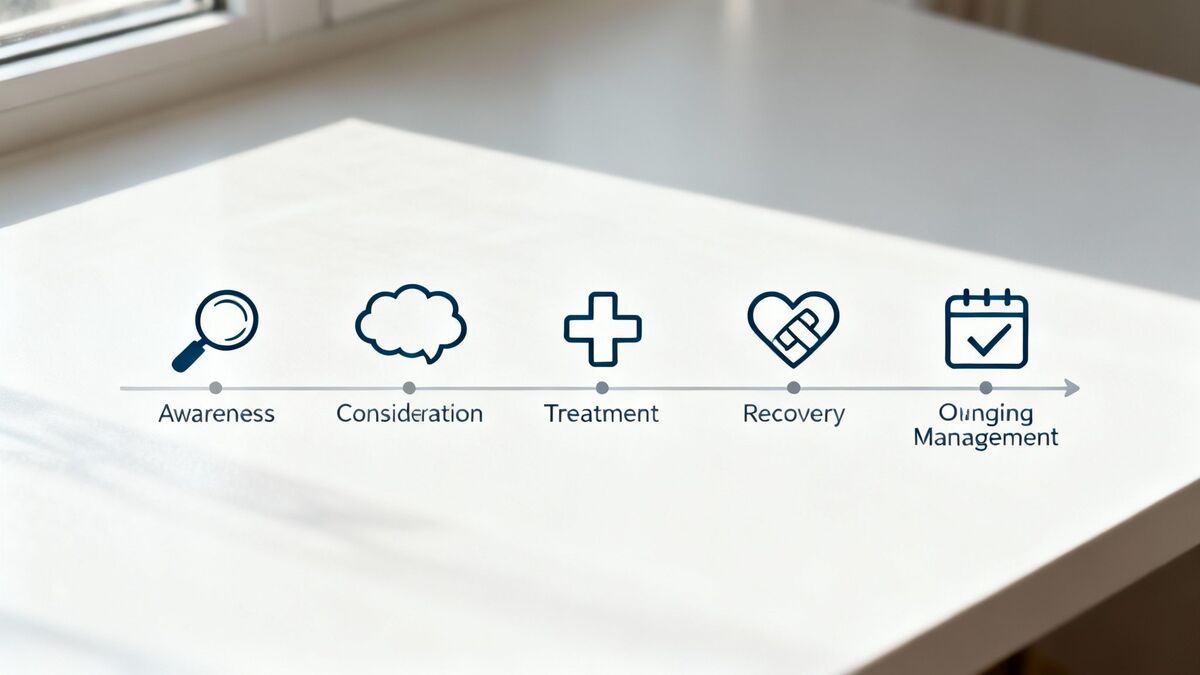
To build a patient journey map that actually works, you have to see the world through your patient’s eyes. Their experience isn’t just one single appointment; it’s a whole sequence of stages, each packed with different feelings, questions, and actions. When you break it down this way, you can see exactly where to gather smarter feedback and what to fix first.
Let’s walk through the five core stages using a relatable example. Meet "Alex," who’s dealing with chronic back pain. His story will help you see the moments that truly matter.
Stage 1: Awareness
This is the very beginning, where someone first realizes they have a health issue. For Alex, his back pain has morphed from a minor annoyance into a real problem that's messing with his daily life. Right now, his main goal is just to figure out what’s going on.
During this stage, Alex is probably feeling anxious and unsure. His actions are all about finding information. He might be:
Googling "causes of lower back pain."
Asking friends or family if they know a good specialist.
Skimming online reviews for local clinics and physical therapists.
Your digital front door is everything here. A potential patient’s first impression comes from your website, your online reviews, and any helpful content you share. If your information is confusing or hard to find, they’ll move on before you even know they exist.
Stage 2: Consideration
Now that Alex understands he has a problem, he’s actively looking for a solution. He's no longer just gathering general info; he's comparing his options and seriously weighing specific providers.
At this point, Alex’s mindset is more analytical, though he's still a bit worried. He’s digging into factors like:
Expertise: Does this clinic actually specialize in back pain?
Logistics: How hard is it to get an appointment? What are their hours?
Cost: Will they take my insurance? What am I going to have to pay out-of-pocket?
He'll be exploring your website, reading patient stories, and seeing how you stack up against other local practices. Every little thing, from how easy your online booking is to the tone of your social media, plays a role in his decision.
Stage 3: Treatment
This is it—the hands-on part. This stage kicks off the moment Alex books his first consultation and covers everything from diagnosis to the treatment itself. It has the biggest impact on how he feels about the quality of your care because it’s all about direct interactions with your team and your facility.
Every step, from check-in to the actual procedure, is a "moment of truth." Alex’s emotions can swing from hopeful after a good consultation to frustrated by long wait times or confusing medical jargon. Getting feedback right here is a goldmine for improving how your clinic runs. You can learn more about asking the right questions in our guide to patient satisfaction survey questions.
Stage 4: Recovery
The journey doesn't stop when a patient walks out the door. The recovery phase is where they experience the results of their care, and your follow-up support can make a huge difference in their long-term satisfaction.
Alex is now at home, focused on healing and sticking to his treatment plan. He needs clear aftercare instructions, easy ways to ask follow-up questions, and a realistic idea of his recovery timeline. A quick follow-up call or a simple, easy-to-read email can turn a good experience into an exceptional one, showing you’re still committed to his well-being.
Stage 5: Ongoing Management
For a chronic issue like Alex’s back pain, the final stage is all about long-term care and loyalty. The goal here is to shift from being a one-time provider to becoming a trusted health partner for the long haul. This stage is built on follow-up appointments, preventative care, and staying engaged.
By keeping the lines of communication open and providing real value, you build a lasting relationship. A satisfied patient like Alex won't just stick to his care plan—he'll also leave great reviews and recommend you to friends and family. This is where you turn a successful treatment into sustainable growth for your practice.
How to Build Your First Patient Journey Map
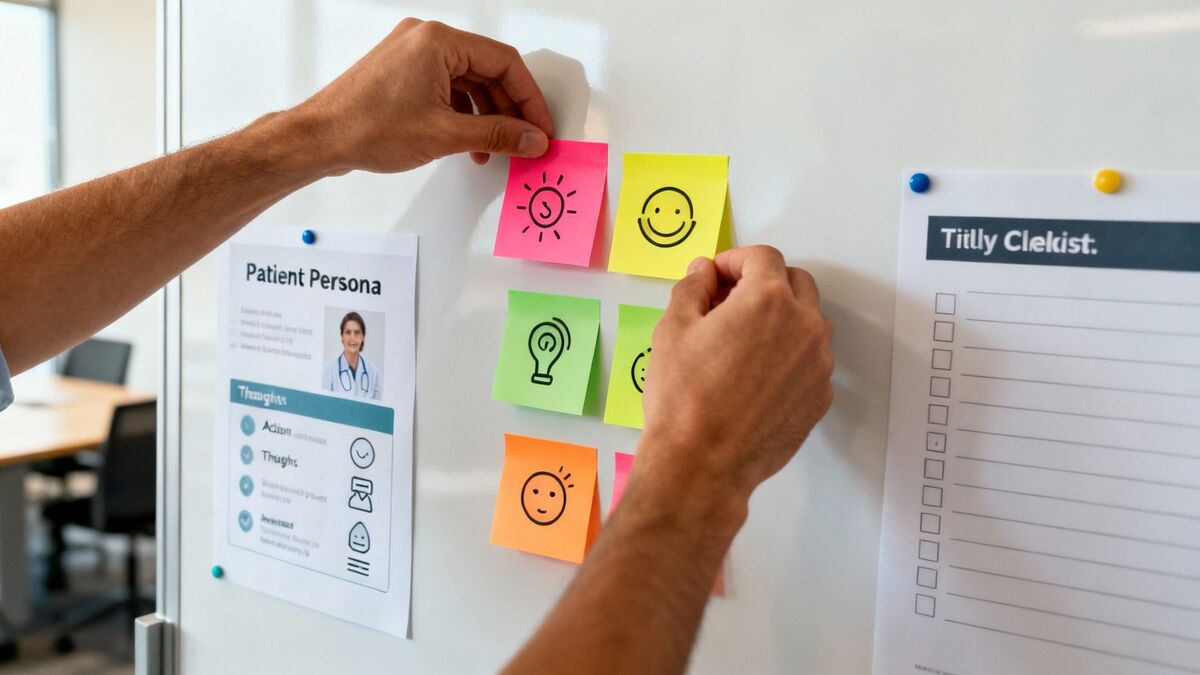
Now that you understand the theory, it’s time to roll up your sleeves and build a tool that can genuinely transform your practice. Creating your first patient journey map is all about asking the right questions and then listening—really listening—to the answers. This isn't a one-and-done project. It’s the start of a smarter, more empathetic way of delivering care.
Let's walk through the six essential steps to create a map that drives real change. This framework will help you move from abstract ideas to concrete actions.
Step 1: Set Clear Objectives and Define Your Patient Persona
Before you map a single touchpoint, you have to know why you're doing it. A map without a clear goal is just a pretty diagram collecting dust. Start by defining a specific business problem you want to solve.
Are you trying to:
Reduce the no-show rate for initial consultations?
Improve the experience for patients in post-operative recovery?
Boost positive online reviews from your telehealth appointments?
Once you have a goal, focus on a specific patient persona. A single map can't represent everyone. The needs of a 70-year-old managing a chronic condition are worlds apart from a 30-year-old seeking an elective procedure. Ground your persona in real data, not assumptions, to ensure your map reflects a genuine experience.
Step 2: Outline the Stages and Touchpoints
With your goal and persona locked in, sketch out the high-level stages of their journey. The five stages we discussed earlier—Awareness, Consideration, Treatment, Recovery, and Ongoing Management—are a great foundation to build on.
Next, start listing every single touchpoint within each stage. These are the specific interactions the patient has with your practice. Think broadly and get detailed.
A touchpoint can be anything from:
Seeing a targeted ad on social media.
Navigating your website’s booking portal.
The check-in process at the front desk.
Receiving a post-appointment email.
Trying to understand the billing statement.
Right now, you’re just creating the skeleton of your map. The human element comes next.
Step 3: Gather Real Patient Feedback
This is, without a doubt, the most critical step. A patient journey map built on internal assumptions is doomed to fail. To make your map accurate and actionable, you must collect feedback directly from your patients. You need to understand what they actually do, think, and feel along the way.
Your goal is to collect smarter, act faster, and grow stronger. Authentic, in-the-moment feedback is the fuel for this entire process. Without it, you’re just guessing.
So, how do you get this data? A multi-channel approach is best. Tools like Prompt to Survey let you place a simple QR code at checkout or send an automated SMS link right after an appointment. This captures immediate, unfiltered feedback while the experience is still fresh.
Combine this with other sources like online reviews, social media comments, and even direct patient interviews. The more data points you have, the richer and more reliable your map will be. If you need some inspiration, check out these patient satisfaction survey templates to get started.
Step 4: Plot the Patient’s Actions, Thoughts, and Emotions
It’s time to bring your map to life with the data you've gathered. For each touchpoint you identified, document three key things from your patient persona’s perspective:
Actions: What is the patient physically doing? (e.g., "Filled out new patient forms online," "Waited 25 minutes in the exam room.")
Thoughts: What is running through their mind? (e.g., "I hope I brought the right documents," "Is this specialist actually going to listen to me?")
Emotions: How is the patient feeling? (e.g., Anxious, confused, relieved, hopeful.)
This is where you visualize the emotional rollercoaster of their healthcare experience. Adding an "emotion line"—a simple graph showing the highs and lows across the journey—can powerfully illustrate where your experience shines and where it breaks down.
Step 5: Identify Pain Points and Moments of Truth
With the patient’s experience plotted out, the friction points will jump right off the page. Look for the dips in the emotion line and the touchpoints filled with negative thoughts or frustrating actions. These are your pain points.
At the same time, identify the moments of truth. These are pivotal interactions that have a disproportionate impact on how a patient feels about your practice. A moment of truth could be a compassionate conversation with a clinician or, conversely, a surprisingly difficult billing issue. These are the make-or-break moments you absolutely have to get right.
Step 6: Analyze Insights and Develop an Action Plan
The final step is to turn all these insights into action. A journey map collecting dust on a shelf is useless. Gather your team, walk through the completed map, and identify the most critical opportunities for improvement.
Don't try to fix everything at once. Prioritize the pain points that have the biggest negative impact on patients and are most feasible for your team to address right now. Assign ownership for each initiative and set clear, measurable goals. Your patient journey map is now more than a visualization—it’s your strategic roadmap for delivering exceptional care.
Using Technology to Enhance Patient Journey Insights

Mapping a patient’s experience on a whiteboard feels like drawing a still-life. It looks nice, but it doesn’t move. To keep up with real-world shifts in patient needs, you need live data feeding into your map. A Feedback Operating System becomes your heartbeat monitor—turning that static sketch into a real-time dashboard.
Plus, with pre-built integrations for systems like Mews and Toast, you can unify your front-desk and service data directly into your feedback dashboard. Whether you’re managing check-ins or meals, this connectivity ensures your patient insights align with operational metrics.
With the right platform, your team stops waiting weeks for survey results. Instead, you collect feedback continuously, spot trends in minutes, and respond before small issues become big headaches. In fact, organizations using dynamic feedback tools report 15-25% lifts in care plan adherence and patient satisfaction. Read more about the digital transformation of the patient journey to see the full story.
Unify Your Feedback Into a Single Source of Truth
Feedback lives everywhere—Google reviews, post-visit surveys, social media comments, even hallway chats. It’s like trying to catch rain with a broken bucket.
That’s why Radar, FeedbackRobot’s unified review intelligence feature, is so valuable. Radar gathers every snippet of patient input—from public reviews to private surveys—and displays it in one clear dashboard. No more juggling half a dozen tools to see the full picture.
Pulls feedback from all channels into one view
Highlights top praise and urgent concerns instantly
Tags comments by department or patient journey stage
A unified dashboard transforms fragmented data points into a cohesive narrative. You can finally see how a negative review on Google connects to a specific pain point you identified in your treatment stage, allowing you to address root causes, not just symptoms.
By centralizing feedback, Radar breaks down silos and gives every team the same set of facts. Your patient journey map then becomes a true team effort—everyone knows where to focus next.
Instantly Pinpoint What Matters Most With AI
Collecting feedback is one thing; making sense of thousands of comments is another. Manually diving into each note feels like searching for a needle in a haystack.
That’s where AI Summaries, FeedbackRobot’s text analysis feature, step in. AI Summaries read every piece of feedback and surface the themes that matter, so you spend time fixing problems—not finding them.
Discover Recurring Issues: Spot if “long wait times” or “unclear billing” keeps popping up.
Track Sentiment Over Time: Watch patient mood shift after each process change.
Filter By Journey Stage: Zero in on troubles at pre-appointment, treatment, or follow-up.
With these insights in hand, you move from data to action in one fluid motion. The AI points you to the highest-impact fixes right now, so your team can improve care faster and smarter with every new comment.
Close the Loop Instantly With Automated Service Recovery
Uncovered a critical pain point? You need to fix it before it snowballs into a bad review. Enter the Resolutions Engine—FeedbackRobot’s automated service recovery system.
Instant Alerts: The moment a patient flags an issue, the Resolutions Engine notifies the right manager.
Automated Actions: Pre-set workflows send personalized apology emails or offer compensation.
Tracked Resolution: Every issue is logged, assigned, and monitored until it’s fully resolved.
By using the Resolutions Engine, your patient journey map transforms from a simple diagnostic tool into a powerful operational engine. You’re not just finding problems; you’re fixing them in real-time, turning would-be detractors into your most loyal advocates.
Common Mapping Mistakes and How to Avoid Them
Mapping the patient journey is a powerful exercise, but it's also surprisingly easy to get wrong. A map can quickly become a feel-good project that accomplishes nothing if you fall into a few common traps. Let's be honest: creating a map is the easy part. Creating one that actually drives meaningful change is a different ballgame.
The biggest mistake? Building your map based on internal assumptions. Your team lives and breathes your clinic's operations, but they don’t experience it with the vulnerability and uncertainty of a patient. A map based on what you think patients feel isn't a tool—it's fiction.
Another classic error is creating the map in silos. When just one department, like marketing or clinical staff, takes the lead, the result is a skewed and incomplete picture. The real patient journey cuts across every single department, and your map has to reflect that shared reality.
The Pitfall of One-and-Done Mapping
Thinking of your patient journey map as a one-off project is a guaranteed way to waste everyone’s time. It’s not a static document you frame and hang on the wall. It's a living, breathing tool that needs regular check-ups, just like your patients.
A patient journey map should be a dynamic blueprint for continuous improvement, not a static snapshot of a single moment in time. When you stop listening, you stop improving.
Patient expectations shift, technology evolves, and your own services change. Treat your map as the starting line, not the finish. Schedule regular reviews and feed it a constant stream of new feedback to keep it relevant and accurate. This commitment is what separates the practices that just collect data from those that use it to get better every day.
Failing to Close the Feedback Loop
Here it is: the most critical mistake of all. Uncovering major patient pain points and then doing absolutely nothing about them. A map that highlights problems without an action plan is just a well-designed document of patient frustration. The goal is to move from insight to impact.
When you systematically map out every touchpoint, you can pinpoint the exact moments of friction that hurt patient satisfaction. In fact, research shows that up to 30-40% of patients feel they lack critical information at key transition points in their care. You can discover more research on mapping's impact and see how addressing these gaps can dramatically lift satisfaction scores and even cut down readmission rates.
This is exactly where technology becomes your best friend. A tool like FeedbackRobot’s Resolutions Engine is designed specifically to close this gap. It turns feedback into immediate action by creating alerts and workflows the moment a problem is detected.
Here’s how that works in the real world:
Instant Alerts: A patient mentions a long wait time in a post-visit survey. The Resolutions Engine immediately pings the clinic manager.
Automated Actions: The system can be configured to automatically send a personalized apology email, maybe even offering a small credit for a future visit.
Tracked Resolution: The issue is logged, assigned to the right person, and tracked until it’s fully resolved. No more patient concerns falling through the cracks.
By using the Resolutions Engine, your patient journey map transforms from a simple diagnostic tool into a powerful operational engine. You’re not just finding problems; you’re fixing them in real-time, turning would-be detractors into your most loyal advocates.
Got Questions About Patient Journey Mapping? We Have Answers.
If you’re thinking about mapping your patient journey, you’re bound to have a few questions. It can feel like a big project to take on, but with the right mindset, it becomes a manageable—and incredibly valuable—process. Let's tackle some of the most common questions we hear from healthcare providers just like you.
What's the Difference Between a Patient Journey Map and a Process Map?
This is a fantastic question, and the distinction is critical. A process map is an internal document. It’s all about your clinic's operational steps, viewed from your team's perspective. It answers, "How do we efficiently move a patient from check-in to check-out?"
A patient journey map, on the other hand, flips the camera around. It visualizes the entire experience from the patient's point of view, capturing what they do, think, and feel at every single touchpoint. It answers a much more powerful question: "What does it feel like for a patient to move through our care system?"
Process Map Focus: Internal efficiency, workflows, staff actions.
Journey Map Focus: Patient experience, emotions, pain points.
Think of it this way: a process map is the architectural blueprint of a house, showing where the plumbing and wiring are supposed to go. A journey map is a video tour led by the person who lives there, pointing out the drafty window and the squeaky floorboard you'd never see on a blueprint.
How Much Data Do We Really Need to Get Started?
You don’t need a mountain of data to create your first map. In fact, many successful patient journey mapping studies start with fewer than 50 participants. The real key here is quality over quantity. Your goal is to get rich, authentic feedback that tells the true story of the patient experience.
A great starting point is to blend two types of data:
Qualitative Data: This is the emotional heart of your map. You can gather it from patient interviews, open-ended survey questions, and online reviews. Tools like FeedbackRobot’s AI Summaries are perfect for instantly analyzing this kind of text-based feedback to find recurring themes and sentiment trends.
Quantitative Data: This provides the "what" and "where" of problem areas. Use data from your appointment software (like no-show rates), website analytics (page drop-offs), and survey scores (NPS or CSAT) to identify friction points at scale.
Start small. Focus on a specific patient persona and one particular journey. You can always expand and refine your map as you gather more feedback over time.
How Often Should We Update Our Patient Journey Map?
A patient journey map is not a "one-and-done" project. It’s a living document that needs to evolve right alongside your practice and your patients' expectations. Stale data just leads to stale insights.
Treat your map as a dynamic blueprint for continuous improvement, not a static snapshot. It’s a tool you should be using regularly to guide decisions, not a poster you hang on the wall and forget.
As a rule of thumb, plan to revisit and update your map in a few key scenarios:
On a Schedule: Give it a thorough review quarterly or semi-annually to make sure it still reflects reality.
After a Major Change: Any time you launch a new service, implement new technology (like a patient portal), or change a core process, it’s time for an update.
When KPIs Change: If you notice a sudden dip in patient satisfaction scores or a spike in negative reviews, use the map to diagnose what’s gone wrong.
Continuously feeding new feedback into your map is essential for keeping it relevant. A platform with a unified dashboard, like Radar, makes this effortless. Radar consolidates all your reviews and survey feedback in real time, so you always have a current pulse on the patient experience, ensuring your map never gets outdated.
How Do We Get Buy-In From Our Entire Team?
This is vital. The patient journey touches every single department, so you need everyone on board for it to work. The absolute best way to get buy-in is to make the process collaborative from day one.
Don't create the map in a silo and then present it as a finished product. Instead, build a cross-functional team with people from the front desk, clinical staff, billing, and even marketing. When everyone has a hand in building the map, they feel a sense of ownership over the findings and are far more motivated to help implement solutions.
Frame the map not as a critique of past performance, but as a shared roadmap for future success. Use it to tell a compelling story, showing how specific improvements will not only make patients happier but also make everyone's jobs easier by reducing friction and repetitive complaints. When your team sees how their individual actions directly impact a patient’s emotional journey, they become partners in creating a better experience for everyone.
Ready to turn patient feedback into your biggest growth driver? With FeedbackRobot, you collect smarter insights with Prompt to Survey, act faster with AI Summaries, and grow stronger—instantly resolving issues via our Resolutions Engine. Plus, explore our Spotlight: Feedback Wall launch to showcase real-time patient stories and reviews. Start your Free 14-Day Trial now, and see how easy it is to listen, act, and thrive.
Build your Medical Practice Patient Satisfaction Survey today.
What is the first step in mapping a patient journey?
Identifying the 'Entry Point.' Is it a Google search, a referral, or an emergency visit? Understanding how they find you sets the stage for the rest of the map.
How does journey mapping improve clinic efficiency?
It reveals 'Hidden Bottlenecks'—like a 20-minute wait in the exam room before the doctor enters. Once mapped, these can be targeted for improvement.
Should I involve patients in the mapping process?
Yes. Use your survey data to validate your map. If your map says 'Check-in is easy' but 20% of patients complain about it, your map needs an update.
What are 'Touchpoints' in a healthcare journey?
Any moment of interaction: Booking an appointment, arriving at the clinic, the consultation, the pharmacy stop, and the follow-up call.
Can journey mapping reduce patient 'no-shows'?
Yes. By identifying where patients lose momentum or get confused, you can implement automated reminders and clearer instructions at those specific 'drop-off' points.
Stop reading about it. Let your agent handle it.
25 free AI actions · no credit card required
Start Free