
Guide
50 Patient Satisfaction Survey Questions (2026)
Copy 50 patient satisfaction survey questions across care quality, wait times, and staff communication. Free template — ready to send in 3 minutes.

Mar 30, 2026 · 21 min read
Free tool
Likert Scale Generator
Generate custom rating scales and survey questions tailored to your feedback needs.
The era of passively collecting patient satisfaction scores is over; today's market demands proactive engagement and immediate resolution. With AI-driven feedback analysis now a standard expectation, clinic managers who fail to act swiftly on patient insights will quickly fall behind, especially as the pace of digital health accelerates into 2026. FeedbackRobot understands this critical shift, providing the 24/7 AI agent that connects to every system, turning every piece of feedback—positive or negative—into an actionable step for retention and an impenetrable reputation.
While understanding overall satisfaction is crucial, delving deeper into the 'why' behind patient behavior can unlock significant growth opportunities. To truly understand your patient base and attract new ones, consider exploring psychographic questions. These questions help uncover patient motivations, values, and lifestyles, providing richer insights than traditional satisfaction metrics alone. You can learn more about how to craft effective psychographic questions for patient surveys to drive patient growth.
We'll break down the 10 most crucial patient satisfaction survey questions, categorize them for clarity, and show you exactly how to implement them. We’ll move beyond theory and give you actionable templates you can use today to transform patient feedback from a simple score into your most powerful growth engine. To truly get to the heart of what drives patient satisfaction, it's essential to first understand what goes into defining excellent customer service, as these principles underpin quality patient care.
While understanding specific survey questions is crucial, a holistic approach to patient experience encompasses more. Learn how to systematically improve every touchpoint of your patient's journey by exploring strategies that enhance overall satisfaction and foster loyalty. Discover actionable insights on how to cultivate a positive and supportive environment for your patients at every stage of their care.
For deeper insights into enhancing your patient interactions, explore our comprehensive guide on how to improve patient experience in your practice.
1. Overall Satisfaction Rating (Net Promoter Score - NPS)
The Net Promoter Score (NPS) is the foundational, single-item question that acts as a powerful barometer for patient loyalty. It boils down complex satisfaction into one direct question: "On a scale of 0 to 10, how likely are you to recommend our practice/hospital/service to a friend or family member?" This simple query is a staple in patient satisfaction survey questions for its ability to provide a quick, reliable health check of your patient relationships.
To truly grasp the nuances of patient satisfaction, diving into specific survey questions is key. Understanding how to craft and deploy these questions effectively can significantly enhance patient care and gather actionable insights. For a comprehensive look at the essential questions that drive growth, explore our guide on 8 Essential Patient Satisfaction Survey Questions to Drive Growth in 2025.

Based on their 0-10 rating, patients are categorized into three distinct groups:
Promoters (9-10): Your most enthusiastic and loyal patients. They are likely to become advocates for your practice.
Passives (7-8): Satisfied but not truly loyal. They are vulnerable to offers from competing providers.
Detractors (0-6): Unhappy patients who can damage your reputation through negative word-of-mouth.
Your final NPS score is calculated by subtracting the percentage of Detractors from the percentage of Promoters. This gives you a score from -100 to +100. Leading institutions like the Mayo Clinic and Cleveland Clinic track NPS by department to pinpoint specific areas needing improvement and drive quality initiatives.
How to Implement NPS Effectively
To make this metric actionable, it must be paired with strategy. The initial score is just the starting point.
Always ask the follow-up question: "What is the primary reason for your score?" This open-ended feedback is where the most valuable insights live, explaining the "why" behind the number.
Within FeedbackRobot's Feedback Operating System, you can automate this entire process. Use our Radar dashboard for unified review intelligence, allowing you to monitor real-time NPS trends across different locations, providers, or service lines. More importantly, you can set up automated workflows with the Resolutions Engine for automated service recovery, immediately contacting Detractors. This rapid response allows you to resolve their issues, turning a negative experience into a positive one and preventing patient churn.
2. Staff Courtesy and Professionalism
While clinical outcomes are vital, a patient’s perception of care is heavily influenced by the interpersonal skills of your team. This set of patient satisfaction survey questions measures the courtesy, respect, communication style, and professional demeanor of every staff member, from the front desk to the clinical team. It isolates the human element of the patient experience, which often determines whether a patient feels truly cared for or simply processed.

Questions in this category are often phrased on a 1-5 or 1-10 scale (e.g., "Please rate the courtesy of our nursing staff from 1-Very Poor to 5-Very Good"). These metrics are critical for evaluating the patient-provider relationship. Top institutions recognize this connection; Johns Hopkins includes staff courtesy in its Compassionate Care initiative feedback, and the Cleveland Clinic’s 'Patients First' program directly links staff satisfaction scores to performance incentives, proving that a positive staff attitude translates to better patient care.
These questions help you identify if a negative patient experience stems from a clinical issue or an interpersonal one. They provide direct feedback on behaviors that can be coached and improved.
How to Implement Staff Courtesy Questions Effectively
Actionable feedback requires a system to connect patient ratings to specific individuals and departments. The goal is to reinforce positive behaviors and address negative ones promptly.
Always ask for specifics: A low score is a signal, but a comment is a roadmap. Follow up with, "Could you please tell us more about your interaction with our staff?" to get actionable details.
With FeedbackRobot's Feedback Operating System, you can manage this with precision. Our AI Summaries feature provides instant insights & sentiment analysis, analyzing open-ended comments and distinguishing between feedback on professional competence and interpersonal warmth, so you know exactly what to address. Use the Radar dashboard to track courtesy trends by department or even by specific staff members. Furthermore, by setting up alerts in the Resolutions Engine for any score below a set threshold (e.g., 7/10), managers are instantly notified. This allows for immediate service recovery with the patient and provides a clear opportunity for staff coaching, turning a moment of friction into a catalyst for growth.
3. Cleanliness and Facility Condition
The physical environment of your healthcare facility is a powerful, non-verbal communicator of quality and safety. Questions about cleanliness and facility condition evaluate the patient’s perception of the physical space, including waiting rooms, exam rooms, and restrooms. A clean, well-maintained environment directly influences patient confidence in your infection control standards, attention to detail, and overall operational competence, making it a critical component of patient satisfaction survey questions.

A patient’s perception of cleanliness forms almost instantly upon arrival. This metric is so important that The Joint Commission includes environmental cleanliness in its accreditation standards. Leading healthcare systems, like those in Singapore, use facility cleanliness as a key performance indicator with real-time corrective actions. Asking "How would you rate the cleanliness of our facility?" on a 1-5 or 1-10 scale provides a quantifiable score for this critical first impression.
How to Implement Facility Feedback Effectively
To turn these scores into operational improvements, you need a system for continuous monitoring and rapid response. Vague complaints about a "dirty facility" are not actionable, but specific, targeted feedback is.
Always ask for specifics: Follow a low rating with, "Could you please tell us which area of our facility needed attention?" This helps you pinpoint whether the issue was in the waiting room, a specific exam room, or the restroom.
Within FeedbackRobot's Feedback Operating System, you can manage this with precision. Use our AI Summaries to analyze open-ended comments and automatically detect recurring themes like "restroom smelled bad" or "waiting room floor was sticky." Set up a dedicated Radar dashboard to display facility cleanliness scores, and configure automated alerts via the Resolutions Engine to notify your environmental services or facility manager the moment a score drops below a set threshold. This allows your team to address the issue immediately, often before the next patient even notices.
4. Wait Time Experience
Few operational factors impact patient perception more directly than wait times. These patient satisfaction survey questions measure how patients feel about the entire scheduling and waiting process, from booking an appointment to being seen by the provider. Because long or unpredictable waits signal a lack of respect for the patient's time, this metric is a critical indicator of your practice's operational efficiency and a major driver of overall satisfaction.
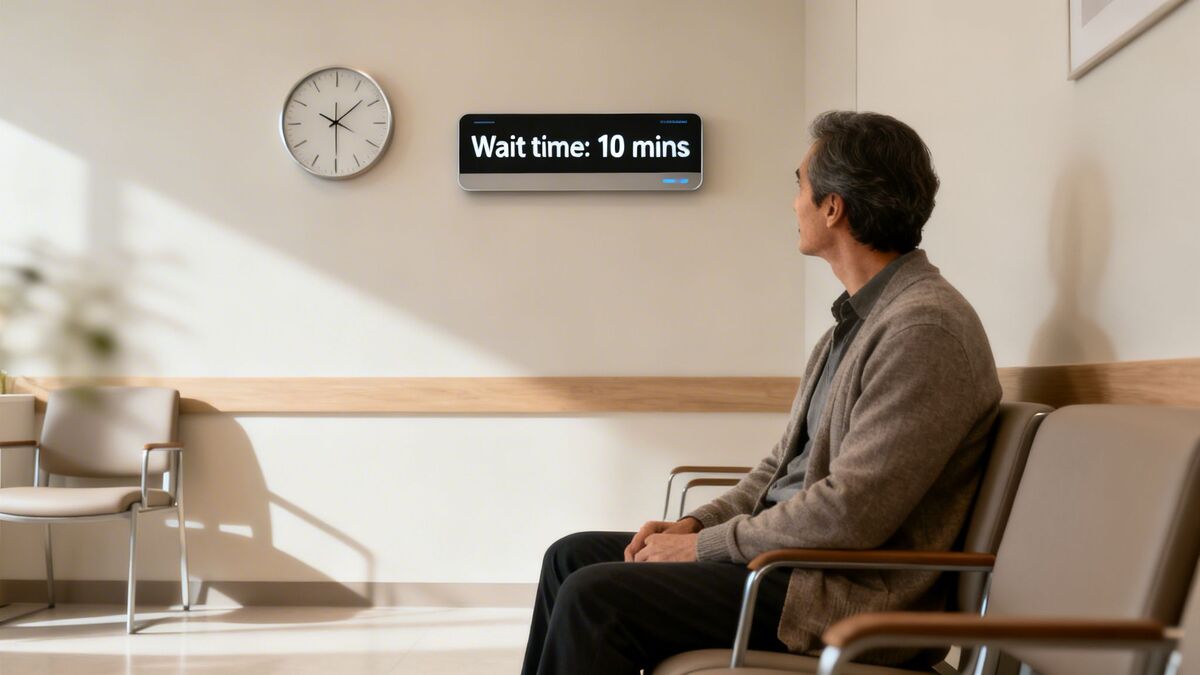
Effective management of this experience is a hallmark of leading healthcare organizations. The NHS in the UK uses wait time targets as key performance indicators subject to public reporting. Similarly, Indian healthcare chains manage expectations with appointment reminders and live wait-time updates. By asking about this experience, you can identify process bottlenecks and discover if patient perception aligns with your internal operational data, especially if you have a Mews or Toast integration.
Key questions to ask include:
How satisfied were you with the ease of scheduling your appointment?
How would you rate the time you spent in the waiting room before being seen?
How would you rate the overall check-in process?
Your goal is to gather specific feedback on different stages of the pre-consultation journey. A patient could be happy with scheduling but frustrated by a long in-office wait, and these separate questions help you pinpoint the exact problem area.
How to Implement Wait Time Questions Effectively
Collecting data on wait time satisfaction is only the first step. The real value comes from connecting this feedback to your operational reality to drive improvements.
Always segment your questions: Separately ask about the ease of scheduling, the check-in process, and the actual wait time in the facility. This gives you a much clearer picture of where breakdowns are occurring.
In FeedbackRobot's Feedback Operating System, you can build a comprehensive view of this experience. Use our Radar dashboard to create visualizations that show wait time satisfaction trends by clinic location, day of the week, or even time of day. By correlating this patient feedback with your actual operational metrics, you can identify gaps between perception and reality. Furthermore, our Resolutions Engine can be configured to send automated SMS notifications to patients, providing them with real-time updates on their wait status to proactively manage expectations and reduce frustration.
5. Doctor/Provider Communication and Listening
The quality of a patient's interaction with their doctor or provider is often the single most memorable part of their healthcare experience. This set of patient satisfaction survey questions zeroes in on communication effectiveness, assessing whether the provider explained conditions clearly, listened actively, and involved the patient in decisions about their care. Measuring this is essential, as strong communication directly correlates with better patient compliance, improved outcomes, and higher overall satisfaction.
To gauge communication, you can move beyond a single question and ask a series of related items using a Likert scale (e.g., Strongly Disagree to Strongly Agree):
My provider explained things in a way that was easy to understand.
My provider listened carefully to me.
My provider gave me as much information as I wanted about my health.
My provider involved me in decisions about my care and treatment.
Institutions like Kaiser Permanente integrate these communication scores into provider advancement criteria, while Cleveland Clinic's 'Patients First' initiative embeds these standards directly into provider evaluations. This demonstrates a system-wide commitment to making every patient feel heard and respected.
How to Implement Communication Feedback Effectively
Tracking these metrics gives you a powerful tool for staff development and quality improvement. The goal is to get specific, actionable data for coaching.
Always look for patterns: Do certain providers consistently score lower on "listening carefully"? Does a specific department struggle with "clarity of explanations"? These patterns reveal targeted training opportunities.
Inside FeedbackRobot's Feedback Operating System, you can make this process precise. Use AI Summaries to instantly analyze open-ended comments and automatically tag themes related to communication, such as "rushed," "clear explanation," or "didn't listen." You can then build provider-specific reports in the Radar dashboard, trending these scores over time. This data provides concrete, objective feedback for one-on-one coaching sessions, helping your team master the communication skills that build patient trust. For guidance on structuring these queries, you can review best practices on how to write effective survey questions.
6. Pain Management and Symptom Relief
Effective pain and symptom management is a critical indicator of clinical quality, directly impacting a patient's quality of life. Questions focused on this area measure how well a treatment plan has alleviated the discomfort or primary symptoms that prompted the visit. This makes it one of the most essential patient satisfaction survey questions for evaluating the direct outcome of care from the patient's point of view.
Assessing symptom relief is fundamental for any practice where pain or specific symptoms are the chief complaint. For example, NHS chronic pain programs often tie provider quality metrics directly to patient-reported pain reduction, while cancer centers meticulously track satisfaction with nausea and side effect management for chemotherapy patients. This feedback is not just for satisfaction; it’s a direct measure of treatment effectiveness.
A simple yet powerful question to start with is: "On a scale of 0 (no relief) to 10 (complete relief), how much relief did our treatment provide for your symptoms?"
How to Implement Pain Management Questions Effectively
To get meaningful data, your approach must be strategic and timely. The initial rating provides a benchmark, but the true value comes from digging deeper and acting on the feedback.
Go beyond the single score: "Which of the following symptoms improved after your visit? (Select all that apply)." Follow this with, "Please rate the level of improvement for your primary symptom."
This multi-part query gives you specific, actionable data. Within FeedbackRobot's Feedback Operating System, you can build these nuanced surveys and use the Scheduler to automatically send them at crucial intervals, such as one week or one month post-treatment, to track long-term efficacy. Use the Radar dashboard to segment these results by treatment type or provider, helping you identify which protocols and practitioners are most effective. For any patient rating their relief below a set threshold (e.g., 5/10), you can configure the Resolutions Engine for automated service recovery. This automatically triggers a follow-up from a nurse or care coordinator, enabling timely intervention and demonstrating a profound commitment to patient well-being.
7. Billing Clarity and Insurance Process
A positive clinical outcome can be quickly overshadowed by a negative financial experience. Questions about billing clarity and the insurance process evaluate how well patients understand their costs, the transparency of your pricing, and the ease of financial transactions. This administrative touchpoint is a frequent source of frustration and a critical component of the overall patient journey, making it a vital area to measure in your patient satisfaction survey questions.
To assess this area effectively, ask specific questions about different stages of the financial process:
Cost Transparency: "How satisfied were you with the explanation of potential costs before your treatment?"
Billing Clarity: "How easy was it to understand your final bill?"
Payment Process: "How easy was it to make a payment for your services?"
Leading organizations recognize the power of financial clarity. The Mayo Clinic provides detailed pre-visit cost estimates, while some hospital groups like Apollo Hospitals use itemized billing as a competitive advantage. Ensuring patients clearly understand their medical bills and insurance statements is vital, especially when they need to know how to effectively read their Explanation of Benefits (EOB).
How to Implement Billing Feedback Effectively
Actioning feedback on financial processes can directly reduce patient anxiety and improve satisfaction. The key is to separate clinical feedback from administrative feedback and route it to the right team.
Don't let billing complaints fall through the cracks. A single unresolved billing issue can erase all the goodwill earned during a clinical visit and lead to a negative online review.
This is where FeedbackRobot’s Feedback Operating System becomes essential. When a patient survey response indicates a billing problem, our Resolutions Engine can automatically create a ticket and assign it directly to your finance department. This ensures immediate follow-up from the correct team member. Furthermore, you can use our AI Summaries to analyze open-ended comments about billing, instantly identifying recurring themes like "confusing EOB" or "surprise fee," so you can proactively improve your communication and financial counseling processes.
8. Access to Care and Appointment Availability
A patient's ability to easily schedule and receive timely care is a fundamental component of their overall experience. Questions about access to care and appointment availability measure how frictionless this process is. These patient satisfaction survey questions assess everything from the simplicity of booking an appointment to the suitability of available times, locations, and modalities like telehealth. If patients struggle to get through the door, their satisfaction plummets before the consultation even begins.
Leading healthcare systems recognize this as a critical performance indicator. The NHS, for example, tracks referral-to-treatment times as a public accountability metric. In the private sector, UK practices often advertise 48-hour appointment availability as a key competitive advantage. Similarly, the rise of providers like Teladoc shows how a virtual care model can dramatically improve the perception of appointment availability and convenience for patients.
These questions help you identify operational bottlenecks that create friction. By understanding where patients face delays or difficulties, you can adjust staffing, extend hours, or optimize your booking systems to meet demand and improve accessibility, directly impacting patient retention and positive reviews.
How to Implement This Effectively
To gain clear, actionable data, you must ask specific questions rather than a single, broad one. Separate the ease of scheduling from the timeliness of the appointment itself.
Always ask the follow-up question: "If you were not satisfied with our appointment availability, what times or days would have been more convenient for you?" This open-ended feedback provides concrete suggestions for operational changes.
Within FeedbackRobot's Feedback Operating System, you can build a specialized dashboard using our Radar feature to monitor satisfaction with appointment availability. Filter responses by appointment type (urgent vs. routine), location, or even the day of the week to pinpoint specific pain points. You can then use the Resolutions Engine to automatically trigger a follow-up for patients who express difficulty, offering them a priority booking link for their next visit and turning a frustrating experience into a show of excellent customer service.
9. Likelihood to Return and Recommend
While NPS measures general loyalty, asking directly about future behavior provides a clear, predictive metric of patient retention and advocacy. This pair of patient satisfaction survey questions zeroes in on two critical outcomes: "How likely are you to return to our practice for future care?" and "How likely are you to recommend our practice to others?" Separating them gives you more specific insights into patient intent.
These questions are powerful because they measure behavioral intention, a strong predictor of actual patient actions. For instance, a primary care practice can use the "likelihood to return" score to identify churn risk and intervene before a patient leaves for good. Similarly, specialty clinics can track "likelihood to recommend" to gauge the strength of their patient advocacy and referral pipeline.
Asking these as two distinct questions reveals different drivers:
Likelihood to Return: Often tied to convenience, insurance acceptance, specific provider relationships, and clinical outcomes. A patient might return out of necessity even if they aren't an enthusiastic promoter.
Likelihood to Recommend: Reflects a deeper level of trust and satisfaction, connected to the overall patient experience, communication, and perceived quality of care.
How to Implement This Effectively
To turn these intentions into actionable data, you need a strategy that closes the loop on both positive and negative responses. The initial rating is just the signal.
Always ask the follow-up question: "What is the main reason for your rating?" or more specifically, "What would need to improve for you to be more likely to [return/recommend]?" This open-ended feedback uncovers the specific barriers you need to address.
Within FeedbackRobot's Feedback Operating System, you can automate interventions based on these responses. Our Resolutions Engine can be configured to trigger an immediate outreach workflow for any patient who answers "Unlikely." This might involve a special "win-back" offer or a personal call from a practice manager. Simultaneously, use our AI Summaries to analyze all the open-ended comments, instantly identifying the most common reasons patients are hesitant to return or recommend, helping you prioritize operational improvements.
10. Overall Experience and Outcome Satisfaction
This question moves beyond individual touchpoints to capture a patient's holistic perception of their entire care journey and its result. Questions like, "Overall, how would you rate the quality of care you received?" or "How satisfied are you with the outcome of your treatment?" provide a crucial bookend metric. This single, comprehensive rating gives you a top-level view of performance, acting as a counterpart to more granular, specific dimension scores.
Major healthcare systems rely on this type of patient satisfaction survey question. The CMS Hospital Compare program prominently features an overall hospital rating, and private providers often use overall satisfaction as a primary quality indicator in their annual reports. It summarizes the complete patient story, from the initial appointment booking to the final clinical outcome, into one powerful data point.
How to Implement Overall Experience Questions Effectively
To make this metric meaningful, it must be used to diagnose, not just to measure. The overall score tells you what patients think, but it needs context to explain why.
Always pair the overall rating with two open-ended questions: "What is one thing we did particularly well during your visit?" and "What is one thing we could improve upon?"
This approach gives you both quantitative and qualitative data. Within FeedbackRobot's Feedback Operating System, you can use AI Summaries to instantly analyze the sentiment and identify recurring themes in these open-ended responses. This allows you to see exactly what drives high and low overall scores. You can also create provider-specific dashboards with our Radar feature to track overall satisfaction trends over time, helping you pinpoint opportunities to improve the patient experience and celebrate top-performing staff.
10-Item Patient Satisfaction Comparison
Item | Implementation complexity | Resource requirements | Expected outcomes | Ideal use cases | Key advantages |
|---|---|---|---|---|---|
Overall Satisfaction Rating (Net Promoter Score - NPS) | Low — single-question deployment | Minimal — simple survey channels and tracking | Quick, comparable loyalty indicator and trend tracking | All healthcare settings for benchmarking and tracking | High response rate, easy benchmarking, predictive of retention |
Staff Courtesy and Professionalism | Medium — requires targeted questions and attribution | Moderate — monitoring, reporting, and training programs | Identifies interpersonal training needs and morale issues | Hospitals, clinics, dental practices where staff interactions are frequent | Direct link to satisfaction and compliance; identifies staff for recognition |
Cleanliness and Facility Condition | Low–Medium — straightforward questions by area | Moderate — coordination with operations and housekeeping | Rapid, actionable operational improvements and perception gains | Hospitals, clinics, waiting areas, surgical centers | Visible improvements quickly boost confidence and safety perception |
Wait Time Experience | Medium — needs timing data integration and perception questions | Moderate — scheduling systems, real-time updates, dashboards | Operational efficiency insights and faster patient satisfaction wins | Primary care, urgent care, emergency departments, diagnostics | Clear actionable fixes; correlates strongly with overall satisfaction |
Doctor/Provider Communication and Listening | Medium–High — detailed sub-questions and provider-level reporting | Moderate–High — training, coaching, provider review processes | Improved compliance, outcomes, and provider performance identification | Primary care, specialty clinics, mental health, chronic care | Strong predictor of loyalty and health outcomes; identifies coaching needs |
Pain Management and Symptom Relief | High — requires time-delayed follow-up and clinical context | High — follow-up scheduling, clinical review, outcome tracking | Measures clinical efficacy from patient perspective and treatment gaps | Pain clinics, orthopedics, surgery centers, chronic disease management | Directly meaningful to patients; reveals treatment effectiveness over time |
Billing Clarity and Insurance Process | Medium — timing at billing stage and multi-part questions | Moderate — finance coordination, communication materials | Reduced disputes, improved payment experience, administrative clarity | All providers, especially private clinics and hospitals | Actionable administrative improvements that increase satisfaction without clinical change |
Access to Care and Appointment Availability | High — needs capacity analysis and telehealth integration | High — scheduling optimization, staffing, telehealth infrastructure | Identifies capacity constraints and drives access improvements | Primary care, specialties, mental health, urgent care, telehealth services | Direct impact on retention and timeliness of care; competitive differentiator |
Likelihood to Return and Recommend | Low — simple behavioral intent questions | Minimal — basic survey routing and follow-up workflows | Predicts churn risk and advocacy; enables retention actions | All providers, chronic care and specialty practices concerned with loyalty | Clear business impact metric; easy to interpret and act upon |
Overall Experience and Outcome Satisfaction | Low — single holistic question alongside dimensions | Minimal–Moderate — requires pairing with dimension scores for insight | Broad baseline for quality; identifies need for deeper diagnostics | All healthcare settings and integrated care networks | Provides definitive overall baseline and supports priority-setting when paired with drivers |
Turn Patient Feedback into Your Strongest Asset with FeedbackRobot
You now have a foundational library of patient satisfaction survey questions designed to uncover the core drivers of the patient experience. From the clarity of a diagnosis to the cleanliness of a waiting room, these questions provide the starting point for a deeper conversation with your patients. We've explored how to structure inquiries about staff professionalism, wait times, billing, and the overall quality of care, providing templates and scales you can adapt for hospitals, clinics, and telehealth appointments.
The critical takeaway is that the right questions do more than just measure satisfaction; they build a bridge of communication, demonstrating to patients that their voice matters. By asking specific, well-phrased questions, you gather precise data that moves beyond gut feelings and into the realm of actionable intelligence. However, the questions themselves are only one half of the equation. The true value emerges not from the act of asking, but from the speed and intelligence with which you act on the answers.
From Data Collection to Operational Excellence
Simply collecting responses on a spreadsheet is a recipe for missed opportunities and data overload. To truly improve patient outcomes and build a loyal patient base, you need a system that translates feedback into immediate, organized action. This is where a dedicated Feedback Operating System becomes essential, turning raw data from your patient satisfaction survey questions into your most powerful tool for growth and service recovery.
Imagine this scenario: a patient leaves a 2-star review on Healthgrades mentioning long wait times. Instead of that negative feedback sitting online, our Prompt to Survey feature automatically sends them a private, detailed survey to understand the full context of their experience. This one action prevents public escalation and gives you the specific details needed to fix the root cause.
This is the core principle of an active feedback strategy: collect smarter, act faster, and grow stronger.
Activating Your Patient Feedback with the Right Tools
A modern healthcare practice cannot afford to manage feedback passively. You need an automated, intelligent system that works for you. FeedbackRobot was built for this exact purpose, with features designed to put your patient feedback to work instantly.
Unified Intelligence with Radar: Stop logging into multiple sites. Radar provides unified review intelligence, consolidating patient feedback from public review sites like Google and Healthgrades, social media, and your internal surveys into one single, easy-to-read dashboard. You get a complete, 360-degree view of patient sentiment without the manual effort.
Instant Insights with AI Summaries: Don't spend hours reading through hundreds of open-ended comments. Our AI Summaries deliver instant insights & sentiment analysis, analyzing all your text-based feedback in seconds to identify key themes and trends. Instantly know what patients are saying about "staff communication" or "billing confusion" across all your locations.
Automated Service Recovery with the Resolutions Engine: What happens when a patient reports a poor experience with pain management? Instead of that feedback getting lost, our Resolutions Engine enables automated service recovery. It can automatically trigger an alert and create a task for a nurse manager to follow up. This system allows you to resolve issues in real time, turning a negative experience into a demonstration of exceptional care and preventing patient churn.
By connecting these powerful tools, you create a seamless loop. You ask the right patient satisfaction survey questions, gather intelligence from every channel, instantly understand the core issues, and automatically trigger the right actions to fix problems and delight patients. It’s a system that not only improves your operations but also builds a reputation for outstanding patient care.
Ready to stop just collecting data and start building a better practice? FeedbackRobot transforms your patient satisfaction survey questions from a simple checklist into a dynamic engine for growth. See for yourself how our Feedback Operating System can help you automate service recovery, gain instant insights from reviews, and build unbreakable patient loyalty. Start your free trial today or check out our brand new Spotlight: Feedback Wall to see your patient praise in real-time.
How does the Net Promoter Score (NPS) specifically drive operational decision-making in a modern clinical setting?
NPS acts as a high-level barometer for patient loyalty by categorizing respondents into Promoters, Passives, and Detractors. Its real power lies in the Delta—calculating the gap between your most enthusiastic advocates and those who may cause reputational harm. Within a platform like FeedbackRobot, this score triggers specific workflows; for example, Detractor scores (0-6) can automatically alert the Resolutions Engine to initiate immediate service recovery, allowing management to address grievances before they escalate into negative public reviews or patient churn.
In what ways do AI Summaries improve the handling of open-ended qualitative feedback compared to traditional manual review?
Manual review of thousands of comments is not only labor-intensive but also susceptible to human bias and oversight. AI Summaries utilize advanced sentiment analysis to instantly distill vast amounts of text into high-level recurring themes, such as "billing confusion" or "front desk courtesy." This allows healthcare consultants and practice managers to identify systemic issues across multiple locations or departments in seconds, providing a clear roadmap for operational changes without the need to read every individual transcript.
Why is it necessary to separate "Staff Courtesy" from "Clinical Outcomes" in patient surveys?
Patients frequently conflate the quality of their medical treatment with the interpersonal warmth of the staff. By isolating professionalism and communication as distinct metrics, a facility can determine if a low satisfaction score is rooted in a provider's bedside manner or a genuine clinical failure. This distinction is vital for leadership because it differentiates between areas requiring clinical protocol adjustments and those that simply need staff coaching or performance-based incentives centered on compassionate care.
How can the Resolutions Engine be used to manage high-stakes clinical feedback like inadequate pain management?
Clinical feedback regarding symptom relief is time-sensitive and requires a more urgent response than administrative complaints. The Resolutions Engine automates this urgency by flagging any score that falls below a predetermined threshold—such as a 5/10 on the pain relief scale—and instantly generating a task for a nurse or care coordinator. This proactive intervention ensures that the patient feels heard and supported during their recovery, effectively turning a potential clinical disappointment into a demonstration of superior care and attention.
How should a practice reconcile the difference between internal wait-time data and the patient's reported "Wait Time Experience"?
Internal logs often measure efficiency from check-in to exam room, but they fail to capture the psychological weight of the wait. If a practice's internal data shows a 10-minute wait while survey scores remain low, the friction likely exists in the scheduling process or the "perceived" wait. By segmenting survey questions to cover booking ease, check-in efficiency, and physical wait time, managers can identify if they need to fix a logistical bottleneck or simply improve patient communication through tools like real-time SMS updates to better manage expectations.
Put this on autopilot
Patient Satisfaction Survey
A ready-made FeedbackRobot automation that runs this for you — deploys free in under 5 minutes.
Stop reading about it. Let your agent handle it.
25 free AI actions · no credit card required
Start Free