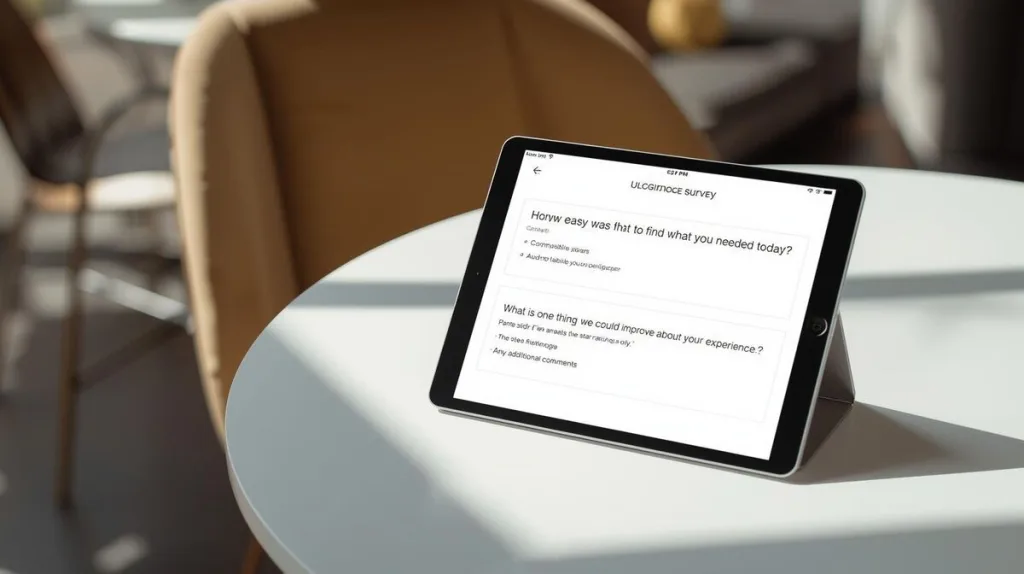
How to Write Effective Survey Questions That Drive Real Growth
Discover how to write effective survey questions that elicit honest feedback and help hospitality and service businesses grow.

Feb 21, 2026 · 18 min read
Free tool
Likert Scale Generator
Generate custom rating scales and survey questions tailored to your feedback needs.
Crafting survey questions that actually work is all about asking clear, unbiased questions tied directly to a business goal. This is how you collect smarter data that tells you what customers really think and gives you solid ground to make improvements and grow stronger.
Why Your Current Surveys Are Hurting Your Business

You’re asking for feedback, but the answers you get are vague, weirdly positive, or just don't lead anywhere useful. For busy hospitality and service owners, this is a familiar and frustrating cycle.
Let’s be honest: poorly designed surveys don't just fail—they actively hurt your business by feeding you useless data.
These broken surveys are usually full of common mistakes that quietly poison your efforts to understand what customers need. This creates a loop of bad data leading to bad decisions, and you never get to the root of a complaint or spot a real opportunity.
The Hidden Dangers of Flawed Questions
Two of the worst offenders are leading questions and double-barreled questions. They look innocent enough, but they completely wreck the quality of the feedback you receive.
Leading Questions: These questions subtly push a customer toward the answer you want to hear. Asking, "How amazing was our friendly staff?" already frames the staff as "amazing" and "friendly," pressuring the respondent to just agree.
Double-Barreled Questions: These try to cram two different ideas into one question. A classic example is, "Was your meal delicious and the service prompt?" It’s impossible to answer if the food was great but the service was painfully slow.
When your surveys are littered with questions like these, you’re not getting an accurate picture of the customer experience. You’re just collecting noise.
And this isn't a minor problem. One deep analysis found that poorly worded questions can introduce measurement errors in up to 30% of all responses, which is enough to throw off all your results. The study also showed that leading questions alone can inflate positive feelings by 15-20%—a huge issue when you need accurate data to trigger automated actions. You can read more about the research on survey design here.
How Bad Data Breaks Your Feedback Operating System
This kind of flawed data has real consequences, especially when you’re using modern tools built to take action. Inaccurate feedback pollutes your entire system, making even the most powerful features less effective.
The goal isn't just to ask questions; it's to start a conversation that leads to action. Biased data stops that conversation before it even begins, providing a false sense of security while real problems go unsolved.
Take our AI Summaries feature in FeedbackRobot, for instance. It's a core part of our Feedback Operating System that provides instant insights and sentiment analysis from thousands of open-ended comments. But if the questions that prompted those comments were biased, the summaries will just echo that bias, hiding the real issues.
You might think everything is fine with your checkout process because a leading question gave you great scores, when in reality, guests are deeply frustrated. This is how you collect smarter—by feeding your tools clean, honest data so you can act faster and grow stronger.
Define Your Goal Before You Write a Single Question
Great feedback starts with a clear purpose. Before you even think about phrasing a question, you need to ask yourself one simple thing: "What specific business decision will this survey help me make?"
Without a focused goal, your survey becomes a rambling checklist of things you're curious about. This not only wastes your customers' valuable time but also leaves you with a mountain of data that doesn't point you in any clear direction. It’s the difference between collecting information and collecting intelligence.
From Vague Ideas to Specific Targets
Let’s move away from broad, fuzzy objectives. A goal like "improve customer satisfaction" sounds good on paper, but it's not actionable. It's too big and undefined. How would you even measure that?
Instead, you need a sharp, measurable target. Think about a specific pain point or opportunity in your business. A much better goal would be "identify the top three reasons for negative checkout experiences at our hotel front desk" or "understand why lunch sales have dropped 15% on weekdays at our cafe."
This level of clarity changes everything. It dictates who you should survey, what questions you must ask, and what data you can ignore. To make sure your questions hit the mark, start by clearly defining your Ideal Customer Profile. Knowing exactly who you're talking to makes it much easier to frame a goal that matters to both your business and your customers.
A focused goal leads to a focused survey. That respects your customer’s time and gives you data you can actually use.
Let Your Goal Guide the Questions
Once your goal is set, every single question must serve it directly. If a question doesn't help you achieve your objective, cut it. It’s just noise.
Let's see how a clear goal sharpens your survey design:
Goal: Pinpoint why our new online ordering system gets abandoned at the payment stage.
Actionable Questions: "On a scale of 1-5, how easy was it to find your items?" or "At what step in the payment process did you experience an issue?" or "What was the primary reason you did not complete your order?"
Irrelevant Questions: "How would you rate our in-store service?" or "What new menu items would you like to see?"
This focused approach is the magic behind FeedbackRobot's Prompt to Survey feature. It’s a core part of our Feedback Operating System, designed to help you act faster.
You give our AI a clear, one-sentence goal—like "Figure out why guests aren't using our hotel spa services"—and it instantly generates a targeted, effective survey draft. This saves you hours of work and ensures you're not starting with a blank page.
This feature works so well because it’s built on the principle that a well-defined problem is already halfway solved. By beginning with the end in mind, you guarantee every piece of feedback you collect is a step toward a smarter business decision. This is how you stop guessing and start building a strategy based on what your customers are telling you they need.
Pick the Right Question Types for Actionable Data

The format of your questions completely shapes the quality of your answers. Getting this right isn't just a technical detail; it’s the difference between collecting clean, trend-worthy data and getting a messy pile of opinions that are impossible to analyze.
To really understand the customer experience, you need a mix of question types to uncover both the "what" and the "why."
Think of it this way: quantitative questions give you the scoreboard, while qualitative questions deliver the post-game analysis from the players themselves. You need both if you want to win.
Balancing Quantitative and Qualitative Questions
Quantitative questions are your workhorses for tracking trends. They produce structured, measurable data that’s easy to chart over time. These are your multiple-choice, rating scale (e.g., 1-5), and Net Promoter Score (NPS) questions. They tell you what is happening.
On the other hand, qualitative questions are your secret weapon for uncovering deep insights. These are your open-ended questions where customers explain their ratings in their own words. This is where you find the game-changing details that numbers alone can't provide—the why.
For instance, a guest giving you a "2 out of 5" for room cleanliness is a useful data point. But following that with an open-ended question like, "What could we have done to improve the condition of your room?" might reveal a recurring issue with dusty vents you never would have guessed.
You can see more examples of this in action in our guide to survey question examples for different industries.
Choosing Your Survey Question Type
The type of question you ask determines the kind of answers you'll get back. Each format has its strengths, and a well-designed survey uses a thoughtful mix of them. Here's a quick breakdown to help you choose the right tool for the job.
Question Type | Best For | Example Insight |
|---|---|---|
Multiple-Choice | Segmenting your audience and collecting clean, comparable data. | "75% of our first-time customers chose our premium package." |
Rating Scales (1-5, 1-10) | Measuring satisfaction or agreement on a standardized scale. | "Our average checkout speed rating improved from 3.8 to 4.5 this quarter." |
Net Promoter Score (NPS) | Gauging overall customer loyalty with a single, benchmarked question. | "Our NPS score dropped by 5 points after the recent pricing change." |
Open-Ended | Uncovering the "why" behind a rating or specific customer stories. | "Customers who rated support below 3 frequently mentioned 'long wait times'." |
As you can see, blending these formats gives you a complete picture—the hard numbers and the human stories behind them.
Finding the Best Mix for Your Survey
Let’s dig a bit deeper into when to deploy each type.
Multiple-Choice Questions: Perfect for when you have a set of predefined answers. They’re fast for customers to complete and give you clean data for segmentation. Research shows that clinics using multiple-choice questions to compare patient groups saw 22% higher satisfaction scores from repeat patients versus new ones.
Rating Scales (e.g., 1-5, 1-10): Ideal for gauging satisfaction on specific aspects of your service, like "How would you rate the speed of our checkout process?" These scales provide clear benchmarks you can track week-over-week.
Open-Ended Questions: Use these sparingly but strategically. The best place for an open-ended question is immediately after a rating to dig deeper into a particularly high or low score. This is where the real gold is hidden.
This blend is where a tool like FeedbackRobot truly shines. The quantitative data feeds directly into FeedbackRobot’s Radar, our unified review intelligence dashboard that tracks performance across all your feedback channels. You can see your survey NPS score right next to your Google rating, all in one place.
But here’s the magic: instead of you spending hours reading through hundreds of open-ended comments, our AI Summaries feature does the heavy lifting. It instantly analyzes all that text to identify recurring themes and sentiment.
You no longer have to manually count how many people mentioned "slow service" or "uncomfortable beds." AI Summaries will surface those insights in seconds, telling you not just that your ratings dropped, but exactly why.
This is how you get to the root cause of issues faster than ever before. It lets you move directly from insight to action, which is the key to real growth.
Writing Questions That Uncover the Truth
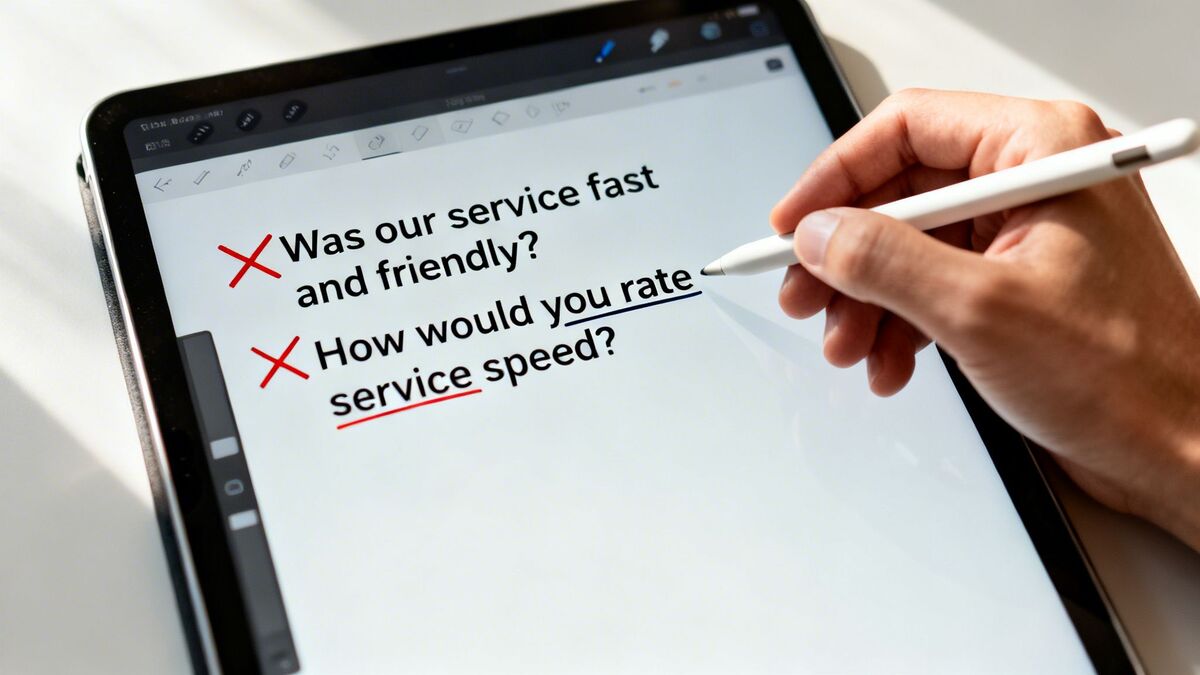
Here's a simple truth: how you ask a question is just as important as what you ask. The right wording gets you honest answers. The wrong wording can accidentally lead customers astray, polluting the very data you need to make smart business decisions.
The goal is to write questions that are simple, neutral, and impossible to misinterpret. Each one should feel effortless for the customer to answer. When you get this right, the feedback you collect is clean, trustworthy, and gives you a true picture of the customer experience.
This kind of reliable data is exactly what powers FeedbackRobot's Radar. Think of it as your unified review intelligence dashboard, pulling insights from surveys, online reviews, and social media. When your survey data is accurate, Radar gives you a crystal-clear view of your business performance, letting you spot trends and act faster on them.
Keep It Simple and Direct
Your customers are busy, and they aren’t survey design experts. Avoid industry jargon, internal acronyms, or complicated language they won't recognize.
A hotel guest probably doesn't know what "turndown service efficiency" means, but they can easily answer, "How would you rate the evening housekeeping service in your room?"
Simple language gets you better data. Here are a few quick tips:
Be Specific: Instead of a generic "How was your visit?" try asking, "How would you rate the check-in process today?"
Avoid Vague Words: Terms like "often" or "regularly" mean different things to different people. Use concrete timeframes like "in the past week" or "on this visit."
Write for a Fifth-Grader: A good rule of thumb is to aim for a reading level a 10-year-old could easily understand. It guarantees clarity for everyone.
Avoid Double-Barreled Questions
This is one of the most common mistakes I see: asking about two different things in a single question. It's the classic "double-barreled" question, and it makes it impossible for customers to give you a clear answer.
For example, asking, "Was our server prompt and courteous?" puts the respondent in a bind. What if the server was super friendly but incredibly slow? Any answer they give—yes or no—is misleading.
The rule is simple: one idea per question. By splitting the double-barreled question, you get much more accurate and actionable data.
Here's how to fix it:
Before: Was our server prompt and courteous?
After (Question 1): How would you rate the promptness of your service?
After (Question 2): How would you rate the courtesy of your server?
Now you can see precisely where you’re excelling and where you need to improve. Maybe your team is nailing the friendliness but needs coaching on speed. You’d never find that specific insight with a flawed, two-in-one question. This principle is key for any survey, including the more conversational open-ended surveys that uncover rich, qualitative insights.
Eliminate Leading and Loaded Language
Leading questions subtly nudge respondents toward a particular answer—usually the one you want to hear. They introduce bias and destroy the credibility of your feedback.
A loaded question is similar but uses emotionally charged words to influence the response. Both lead to skewed results that can hide real problems.
Let's look at some real-world examples from the service industry:
Leading Question: "How much did you enjoy our award-winning steak?"
The Problem: The phrase "award-winning" sets a high expectation and pressures the customer to agree.
Neutral Version: "How would you rate the quality of your steak?"
Loaded Question: "Do you agree that our restrictive checkout policy is inconvenient?"
The Problem: Words like "restrictive" and "inconvenient" are emotionally charged and assume the experience was negative.
Neutral Version: "How would you rate the convenience of our checkout policy?"
By stripping out bias, you create a space for customers to share their honest opinions. That unfiltered truth is the foundation of any feedback system that actually helps you grow. When you collect smarter, you get the real story.
Design Surveys People Actually Want to Complete

A great survey feels less like an interrogation and more like a conversation. Once you've polished your questions, the next challenge is arranging them in a way that encourages people to actually finish. Your survey's structure and flow directly impact completion rates—and better completion rates mean more data to fuel smart decisions.
The secret is to make the experience feel effortless. You want to build momentum from the very first question and guide your customer through a logical path. A clunky, confusing survey gets abandoned, leaving you with incomplete data and, worse, a frustrated customer.
Start Easy to Build Momentum
The first few questions set the tone for the entire survey. Always kick things off with broad, easy-to-answer questions to warm up your respondent. Think of it as the small talk before you get to the important stuff.
For example, a hotel could start with a simple question like, "Overall, how would you rate your stay with us?" This eases the customer into the feedback process, making them far more likely to stick around for the more detailed questions that follow.
Group Similar Topics for a Logical Flow
Nothing is more jarring than a survey that jumps randomly between unrelated topics. One moment you're asking about the restaurant's appetizer quality, and the next you're on to the cleanliness of the hotel lobby bathroom. This kind of disorganization is confusing and can sabotage the quality of your responses.
In fact, research shows that surveys with a logical flow reduce respondent errors by 28%. Why? Because scattered questions confuse nearly 40% of participants, leading to unreliable data.
Organize your survey into clear sections:
Section 1: Check-in Experience
Section 2: Room and Amenities
Section 3: Dining Experience
Section 4: Overall Impressions
This thematic grouping creates a smooth, intuitive path, making the survey feel more like a coherent conversation. It also helps you get more thoughtful answers, as your customer can focus on one aspect of their experience at a time.
Place Sensitive Questions Last
Questions about demographics—like age, income, or gender—can feel personal. If you ask them too early, you risk making respondents uncomfortable and causing them to drop out before they’ve shared the most valuable feedback.
Always save these questions for the very end. By this point, you've already built rapport, and the customer has invested time in providing their thoughts. They are much more likely to answer these optional, sensitive questions after they’ve completed the core part of the survey.
Just be sure to explain why you're asking. A simple note like, "This helps us better understand our guests," goes a long way.
A well-designed survey respects your customer's time and intelligence. The flow should feel so natural that they don't even think about it, allowing them to focus purely on giving you honest feedback.
This steady stream of high-quality feedback is precisely what powers FeedbackRobot's Resolutions Engine. When our system detects negative feedback from a well-structured survey, it can instantly trigger automated service recovery. This could mean sending a heartfelt apology with a discount code for a future visit.
This turns a negative experience into an opportunity to win back a customer’s loyalty—all because your survey was designed to get the honest, complete feedback needed to act faster.
For more tips on structuring your surveys for maximum impact, check out our guide on the best practices for survey design.
From Smart Feedback to Faster Growth
You’ve built the perfect survey—now it's time to turn all that data into actual growth. While crafting solid survey questions is the critical first step, the real magic happens when you create an automated feedback loop where insights drive immediate action. This is how you stop just collecting information and start building a system for continuous improvement.
It all begins with having a crystal-clear goal. That goal is exactly what allows FeedbackRobot’s Prompt to Survey feature to instantly generate a targeted draft for you. Once you have that solid foundation, you can fine-tune the simple, unbiased questions that deliver clean, honest data.
Powering Your Feedback Operating System
High-quality data is the fuel for your entire feedback strategy. Before you can turn raw data into tangible growth, it helps to explore the best ways to gather it. A good starting point is these 10 proven ways to collect customer feedback. When your survey questions are well-worded, they feed reliable information straight into our Feedback Operating System, making every single feature more powerful.
This is where everything comes together:
Clean Data for AI Summaries: Your clear questions generate easy-to-digest open-ended responses. Our AI Summaries instantly analyze this text, spotting recurring themes and sentiment without you lifting a finger. You’ll know in seconds if "slow check-in" or "cold food" are popping up over and over.
True Signals for Radar: Well-phrased questions give you an accurate pulse on customer happiness. This data flows directly into Radar, our unified intelligence dashboard, giving you a true signal of your performance across all channels—from your own surveys to Google reviews.
Turning Insights Into Action and Advocacy
Collecting smart feedback is only half the battle. Acting on it faster is what really sets you apart. This is where your hard work pays off in real-time, turning potential problems into opportunities and happy customers into your biggest promoters.
The ultimate goal of any feedback program is to create a cycle of improvement: collect smarter insights, act on them faster, and watch your business grow stronger as a result.
When a customer leaves negative feedback, our Resolutions Engine puts those insights into immediate motion. It can automatically trigger a service recovery workflow, like sending an apology and a discount, addressing the issue before it ever has a chance to escalate. This automated response shows customers you’re actually listening and turns a poor experience into a chance to rebuild loyalty.
On the flip side, what about your biggest fans? A well-timed survey can capture that glowing feedback, which you can then showcase with our Spotlight: Feedback Wall. This feature turns positive experiences into powerful social proof, displayed right on your website to attract new customers.
This whole process isn't just about writing better survey questions. It’s about building an engine for growth where every single piece of feedback helps you collect smarter, act faster, and grow stronger.
A Few Common Questions, Answered
Over the years, I've heard the same questions pop up from hospitality and service owners. Here are a few quick answers to help you fine-tune your feedback strategy.
What’s the Sweet Spot for Survey Length?
Honestly? Shorter is always better. The best survey is one people actually finish.
In the hospitality world, where quick QR code scans are everything, keeping your survey under 10 questions is the magic number. We've seen this alone boost response rates from a meager 15% to a solid 40%. You can dig into the research on survey length and response rates here if you're curious.
Think of it this way: a shorter survey respects your customer's time. In return, you get higher completion rates and more thoughtful answers, not just rushed clicks. That’s the kind of clean data that really makes tools like FeedbackRobot's AI Summaries shine, turning raw feedback into insights you can use immediately.
How Often Should I Be Sending These Out?
This really boils down to your business model and how often you see your customers. There's no single right answer, but here are my rules of thumb:
For transactional businesses (like hotels or restaurants): You have to ask for feedback right after the experience. Strike while the memory is fresh. The best way to do this is to integrate your feedback tool with your POS system like Toast or a PMS like Mews to automate the whole thing.
For relationship-based services (think clinics or agencies): Bombarding clients with surveys will just annoy them. A quarterly or semi-annual check-in is usually enough to track satisfaction over time without causing fatigue.
The goal is to get a steady stream of timely feedback without becoming a nuisance. This keeps your Radar dashboard in FeedbackRobot current, giving you a real-time pulse on how customers are feeling.
How Can I Put My Feedback Process on Autopilot?
Automation is the only way to handle feedback at scale without losing your mind. A truly effective feedback loop should feel effortless for both you and your customers.
A great place to start is by defining one clear goal. From there, you can use a tool like Prompt to Survey to instantly generate a draft survey that’s already targeted and ready to go.
But collecting feedback is only half the battle. What happens next? This is where the Resolutions Engine comes in. It can automatically detect when someone leaves negative feedback and immediately kick off a service recovery workflow. Imagine it automatically sending a genuine apology with a small discount code.
That’s how you close the loop. You show customers you’re not just collecting data—you're listening and taking action. It turns a potentially bad experience into a genuine opportunity to earn back their loyalty.
Ready to stop just collecting feedback and start using it to grow? FeedbackRobot gives you everything you need to build a powerful, automated feedback loop. Collect smarter, act faster, and grow stronger.
What is the #1 mistake when writing survey questions?
Asking 'Double-Barreled' questions. For example: 'How was the food and service?' If the food was great but service was bad, the guest can't answer accurately. Split them up.
How do I avoid 'Bias' in my survey phrasing?
Don't ask 'How much did you enjoy the show?' Ask 'How would you rate the show?' Using neutral language ensures the data you get is honest and actionable.
Should I use 'Jargon' in my questions?
Never. Write for a 5th-grade reading level. Clear, simple language ensures that every guest—regardless of background—understands exactly what you are asking.
What is the benefit of using 'Likert Scales'?
A Likert scale (1-5 or 1-7) allows for 'Nuance.' It’s much more useful to know that a guest was 'Somewhat Satisfied' than just 'Satisfied' vs. 'Unsatisfied.'
How do I write an 'Effective' open-ended question?
Be specific. Instead of 'Any other comments?', ask 'If you could change one thing about your experience today, what would it be?' This triggers the brain to find a specific fix.
Stop reading about it. Let your agent handle it.
25 free AI actions · no credit card required
Start Free