16 Best Reputation Management Software (2026 Buyer's Guide)
Compare 16 reputation management tools on pricing, automation and industry fit — honest picks for restaurants, hotels, healthcare and multi-location brands.

Aug 16, 2026 · 14 min read
Free tool
Business Reputation Calculator
Get an instant score of your online reputation across all major review platforms.
Your online reputation is the first thing a potential customer checks before choosing you over a competitor. A single trending negative review can cost you dozens of bookings — and you will never know which ones, because the people it cost you never got in touch.
Running a retail operation? We've also published a dedicated guide to the best customer review management platforms for retail — ranked by store count, review volume, and budget fit.
Reputation management software centralises the work: it monitors every platform, automates review requests, and gives you one dashboard to respond, analyse, and fix issues before they escalate. But with dozens of platforms competing for your budget, choosing wrong means paying for features you will never use.
We evaluated 16 platforms against five criteria that matter to hospitality, retail, and service businesses. This guide gives you the shortlist, the industry-by-industry verdict, and the honest trade-offs — including where our own product is the wrong choice.
Before comparing platforms, find out where you stand. Our free reputation report card benchmarks your review volume, response rate, and recency in 60 seconds — so you know which features to prioritise before you spend anything.
What Is Reputation Management Software?
Reputation management software monitors, collects, and helps you respond to customer reviews across multiple sites — Google, Yelp, and industry platforms like TripAdvisor, Zocdoc, or G2. Instead of logging into each site separately, you get one dashboard that surfaces new reviews, tracks sentiment, and routes issues to the right person.
Modern platforms go further. The better tools automate review requests via SMS or email, draft AI-assisted responses, manage listings across directories, and trigger service-recovery workflows when a negative review lands. That shifts reputation management from a reactive chore to a proactive system.
The market splits into three categories:
Review generation and monitoring (NiceJob, BrightLocal, GatherUp) — focused on getting more reviews and tracking what customers say. Light on automation and CRM depth.
All-in-one reputation platforms (Birdeye, Podium, FeedbackRobot) — review generation, response automation, listings, and customer messaging in one stack.
Enterprise reputation suites (Reputation, SOCi, Chatmeter, Uberall) — built for 50+ locations, with governance controls and competitive benchmarking.
Working out which category fits your scale eliminates two thirds of the market immediately. For the underlying discipline rather than the tooling, our complete guide to reputation management covers the five pillars.
Quick Pick: Best Reputation Software by Use Case
Use case | Best pick | Why |
|---|---|---|
Solo or small team (1–2 locations) | FeedbackRobot or NiceJob | Fast setup, published pricing, automated from day one |
Growing SMB (3–20 locations) | FeedbackRobot or BrightLocal | End-to-end automation plus local SEO tools that scale |
Agency managing clients | ReviewGrower or GatherUp | White-label included, multi-client dashboards, predictable per-client cost |
Enterprise (50+ locations) | Reputation, SOCi, or Chatmeter | Governance controls, brand-safe AI, cross-location benchmarking |
E-commerce or online-only | Trustpilot Business | Verified-buyer badge is the strongest on-page trust signal available |
Hotel or hospitality group | FeedbackRobot or Birdeye | OTA review monitoring, AI response automation, PMS integrations |
Field service / trades | NiceJob or Liftify | Job-close SMS triggers, no marketing staff required |
PR and brand monitoring | Brand24 | Tracks news, forums, and social — not just review sites |
How We Evaluated These 16 Platforms
We scored each platform on five criteria:
Automation depth — does it automate requests, responses, and service recovery, or just alert you to act manually?
Integration coverage — does it connect to your PMS (Mews, Opera), POS (Toast, Square), or CRM out of the box?
Pricing transparency — are plans published, or does every evaluation start with a sales call?
Scale fit — is it useful at your current size, or are you funding enterprise features you will never open?
Actionability — does it help you close the loop on negative feedback, or stop at monitoring?
Two notes on method. First, pricing shown is list pricing as published at the time of writing; quote-based vendors are marked as such rather than estimated. Second, we build one of the platforms in this guide. We have flagged the categories where competitors are the better choice, and there are several.
One scoping note: this guide covers software you run yourself. If you are comparing done-for-you providers instead, where an agency writes the replies on your behalf, that is a different purchase with different pricing — see our guide to review management services and what they cost.
Best Reputation Management Software by Industry
The right platform depends on which review sites your customers actually use, how fast you need to respond, and how many locations you run. Here is the verdict across the eight industries where reputation has the clearest revenue impact.
Food & Beverage
Best pick: FeedbackRobot. Runner-up: NiceJob.
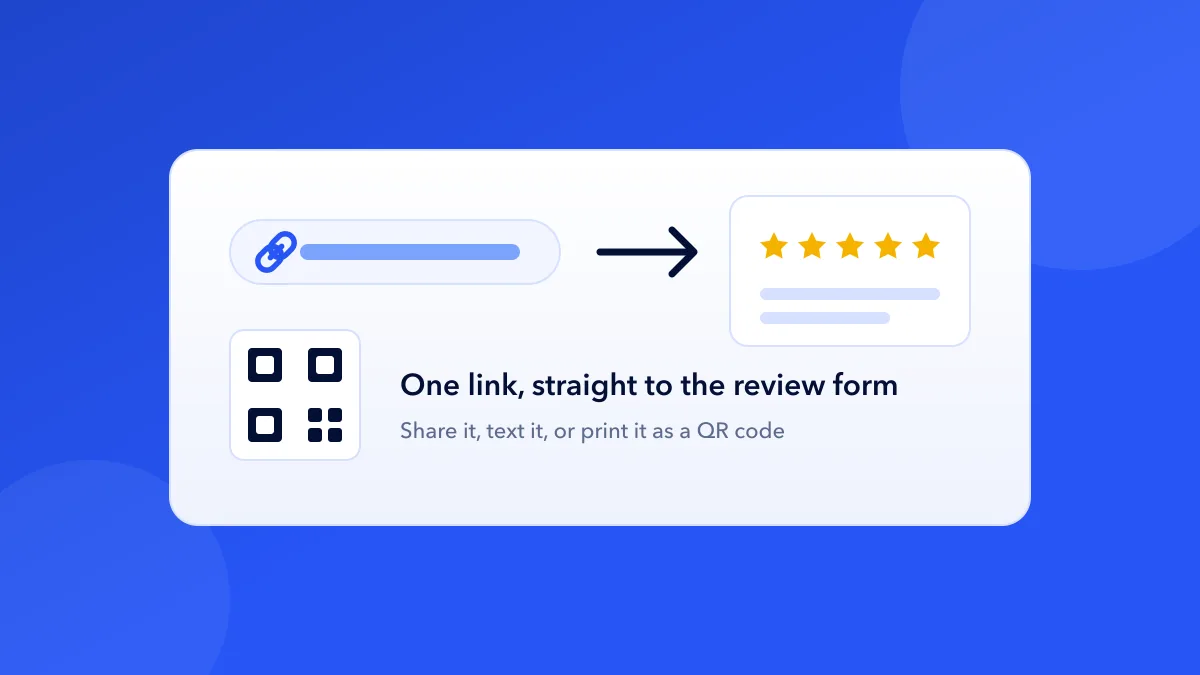
Restaurants live and die by Google, Yelp, and TripAdvisor — and response speed matters as much as the response itself. A negative review left unanswered overnight costs more than the original complaint did. FeedbackRobot monitors all three and auto-responds in under two minutes, with QR-code table feedback that catches sentiment before it becomes public. NiceJob is the stronger pick for solo owner-operators who want set-and-forget review generation without managing a response workflow. See the food and beverage guide.
Hospitality & Travel
Best pick: FeedbackRobot. Runner-up: Reputation.
Hotels and tour operators need OTA coverage — TripAdvisor, Booking.com, Agoda — alongside Google and Facebook. FeedbackRobot covers all four OTA sources in a single inbox with hospitality-tuned response tone. Response rate feeds directly into TripAdvisor's Popularity Ranking, which makes the two-minute window commercially significant rather than cosmetic. Reputation is the enterprise alternative for chains with dedicated marketing staff and multi-brand reporting requirements. See the hospitality guide.
Healthcare & Wellness
Best pick: NiceJob. Runner-up: FeedbackRobot.
Medical and dental practices operate under HIPAA constraints that shape everything about a public response — you cannot confirm someone is a patient, reference treatment, or acknowledge details even when the reviewer raised them first. NiceJob's automated SMS and email requests suit practices without a marketing function, at $75/month with a 14-day trial. FeedbackRobot fits wellness businesses better — gyms, spas, physiotherapy — where the priority is multi-platform monitoring and fast response rather than clinical data handling. See the healthcare guide.
Professional Services
Best pick: BrightLocal. Runner-up: FeedbackRobot.
Law firms, accountants, and consultants win through referral and local search. Review volume is low, so each review carries disproportionate weight. BrightLocal gives small firms review monitoring, Google Business Profile management, and local SEO context in one place from $39/month. FeedbackRobot is the better fit across multiple office locations or where you need faster response than a once-daily check. See the professional services guide.
Retail & E-commerce
Best pick: Trustpilot Business. Runner-up: FeedbackRobot.
Retail needs reviews that convert at checkout, not social proof after the fact. Trustpilot's verified buyer badge is the highest-trust signal you can put on a product page, and the Shopify and WooCommerce integrations automate post-purchase collection. FeedbackRobot is the right call when the priority is monitoring and responding across Google, Trustpilot, and Facebook from one inbox — particularly with a physical store alongside the online one. See the retail guide.
Home Services & Trades
Best pick: NiceJob. Runner-up: Liftify.
Plumbers, HVAC techs, and electricians need to capture the review in the moment — right after the job closes, before the customer forgets. NiceJob is built for the owner-operator model: SMS review requests fired automatically at job close, $75/month flat, no marketing staff. Liftify is the managed alternative if you run ServiceTitan or Jobber and want their team to handle the integration. See the home services guide.
Events & Entertainment
Best pick: FeedbackRobot. Runner-up: Trustpilot.
Venues collect reviews in bursts — concentrated spikes after a show or season rather than a steady flow. That changes the tooling requirement: you need on-site capture while the experience is fresh, not a drip campaign. FeedbackRobot's QR-code collection handles the spike, and the social sharing feature turns the best reviews into branded posts before momentum fades. See the events guide.
Education & Community
Best pick: FeedbackRobot. Runner-up: BrightLocal.
Schools, tutoring centres, and childcare providers need parent feedback and Google presence without enterprise budgets. FeedbackRobot covers multi-platform monitoring, post-session surveys, and auto-response, and the free tier makes it workable for nonprofits. BrightLocal suits education businesses focused primarily on local search rank. See the education guide.
The 16 Platforms
1. FeedbackRobot
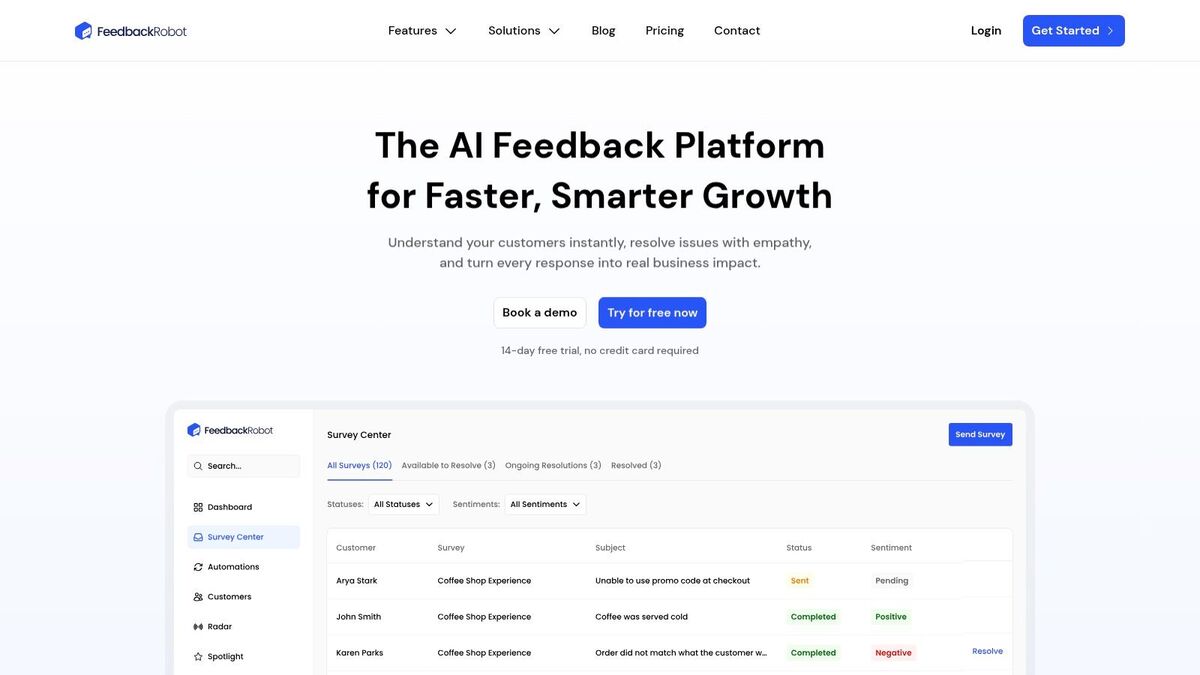
FeedbackRobot works as a complete feedback operating system rather than a review monitor. Four components do the work: Prompt to Survey generates a ready-to-send survey from one sentence; Radar unifies reviews and mentions from Google, Yelp, TripAdvisor and social into one dashboard; AI Summaries surface recurring themes without anyone reading hundreds of comments; and the Resolutions Engine detects negative feedback and triggers a recovery workflow — drafting an empathetic reply, offering a remedy, and assigning follow-up.
Pricing: Free starter (25 actions, no card required, no time limit) · Agent Pro $99/mo (1,000 actions, 2 touchpoints) · Agent Advanced $199/mo (5,000 actions, 10 touchpoints) · Agent Enterprise $399/mo (20,000 actions, 50 touchpoints). Priced per business/workspace; 15% off on annual billing.
Strengths: AI drives the whole workflow, not just response drafting. Published pricing. Genuine free tier. Radar and Spotlight turn feedback into marketing assets.
Limitations: API access, single sign-on, and custom AI training sit in the Agent Enterprise tier. Fewer published third-party case studies than the incumbents.
2. Reputation
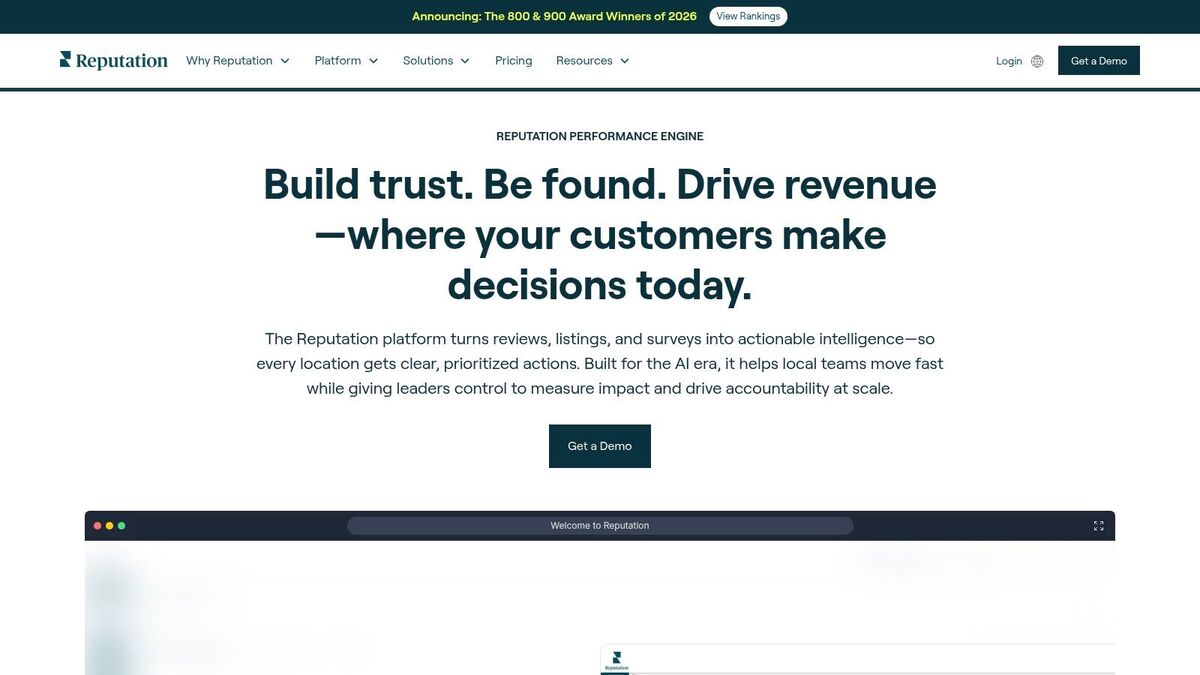
Built for scale — multi-location automotive, retail, and healthcare. Centralises reviews, listings, and surveys into one governable dashboard so corporate teams can benchmark hundreds of locations and enforce brand standards. Monitors 250+ sites. Its proprietary Reputation Score gives an at-a-glance per-location benchmark, and its mobile app — listed separately on Google Play — lets location managers monitor and respond from the field.
Pricing: Per-location tiers, quote required.
Strengths: Best-in-class benchmarking. Per-location pricing model is unusually transparent for enterprise.
Limitations: Overkill below roughly 20 locations. SMS and competitive insights are paid add-ons.
3. Birdeye
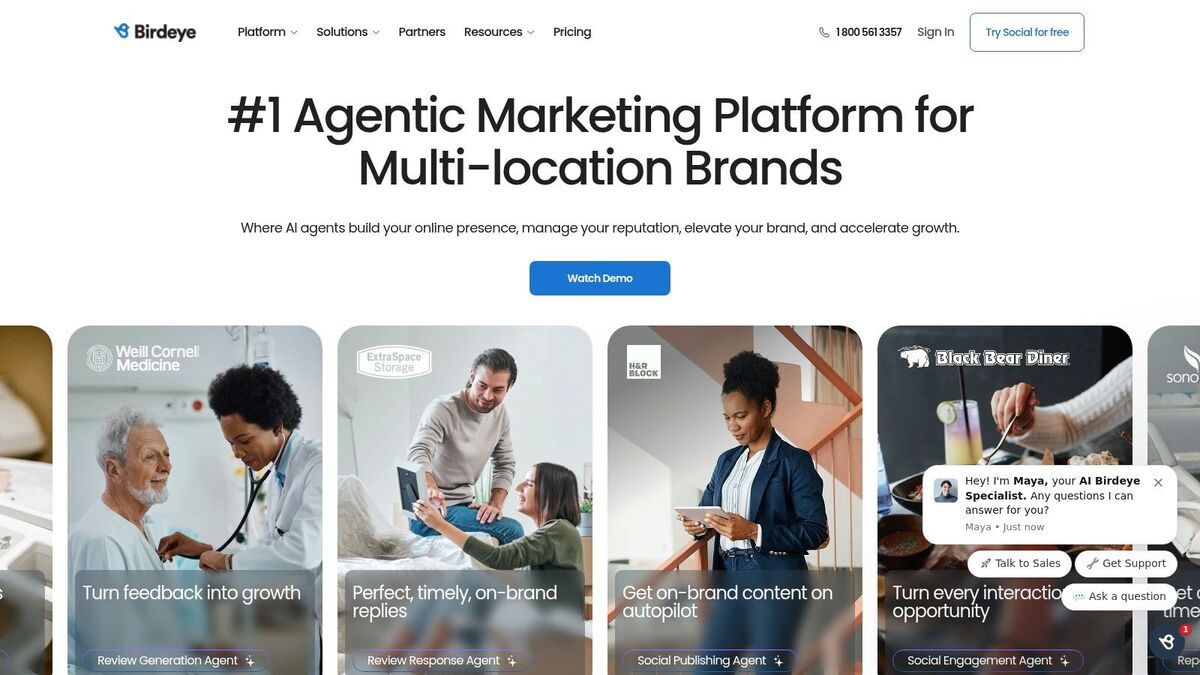
All-in-one platform with a strong local SEO orientation. Combines review generation and monitoring across 200+ sites with listings management and a unified inbox for SMS, webchat, and social — available on desktop and through the Birdeye mobile app for iOS and Android. Its review generation workflows are among the most mature in the category.
Pricing: Quote-based. See our Birdeye pricing breakdown.
Strengths: Deep multi-location capability. Broad review source coverage. Effective request workflows.
Limitations: Quote-based pricing runs above SMB tools. Contract terms are heavy for small teams.
4. Podium
<!-- IMAGE REPLACE — currently duplicates Reputation's image (JZ1WSB9QFOTzgSFj2JG5CwHOUis.jpg). Upload a Podium screenshot. -->
Messaging-first. Shifts reputation management from monitoring to SMS-based engagement — review requests, customer conversation, and payment collection in one text thread, manageable from Podium’s mobile app as well as the desktop dashboard. Webchat-to-text converts site visitors into SMS conversations; Text-to-Pay closes the loop on payment.
Pricing: Quote-based. See our Podium pricing breakdown.
Strengths: Excellent SMS review capture rates. Proven in local service and retail. Low learning curve.
Limitations: A significant price step up from entry-level tools. Advanced automation gated to higher tiers.
5. Yext Reviews
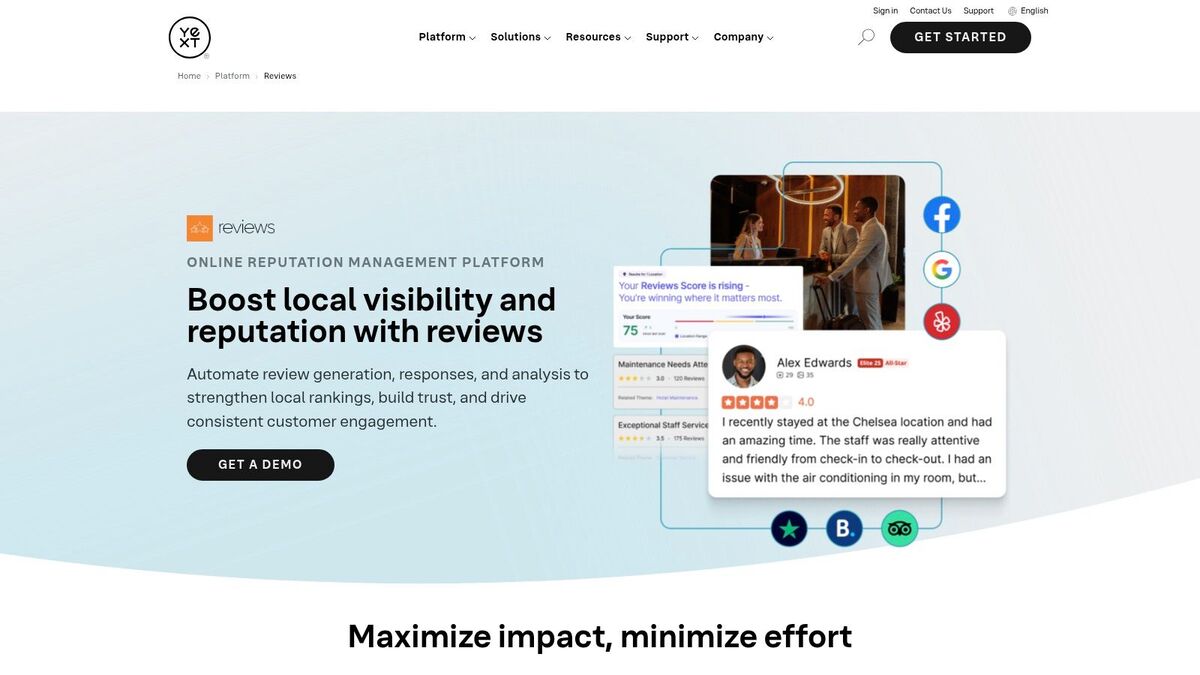
A component of Yext's broader digital presence platform, which is the point — review management wired into listings, local pages, and search analytics. Strong governance and approval workflows for franchises. Reply templates auto-populate local details like manager name and store hours.
Pricing: Quote-based, mid-market and enterprise.
Strengths: Best governance controls in the category. Scales to thousands of locations.
Limitations: Only makes sense if you are already committed to the Yext stack. Complex for single-location use.
6. SOCi
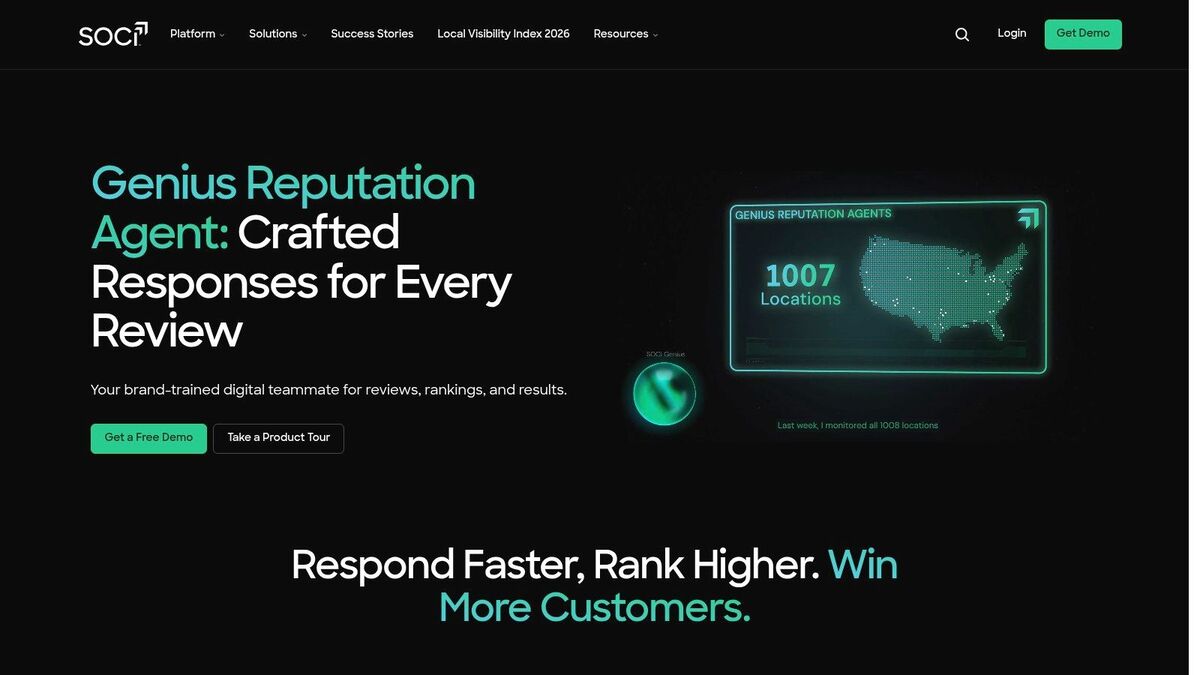
Multi-location marketing and reputation platform. The Genius Reputation Agent uses brand-trained AI to draft responses at scale while holding to compliance and brand voice, with escalation rules for human review. Insight detection flags review volume spikes and thematic trends automatically.
Pricing: Enterprise, quote-based.
Strengths: Purpose-built for franchise scale. SOC 2 Type II and ISO certified, which matters in regulated sectors.
Limitations: No pricing transparency. Too heavy for single-location businesses.
7. Chatmeter
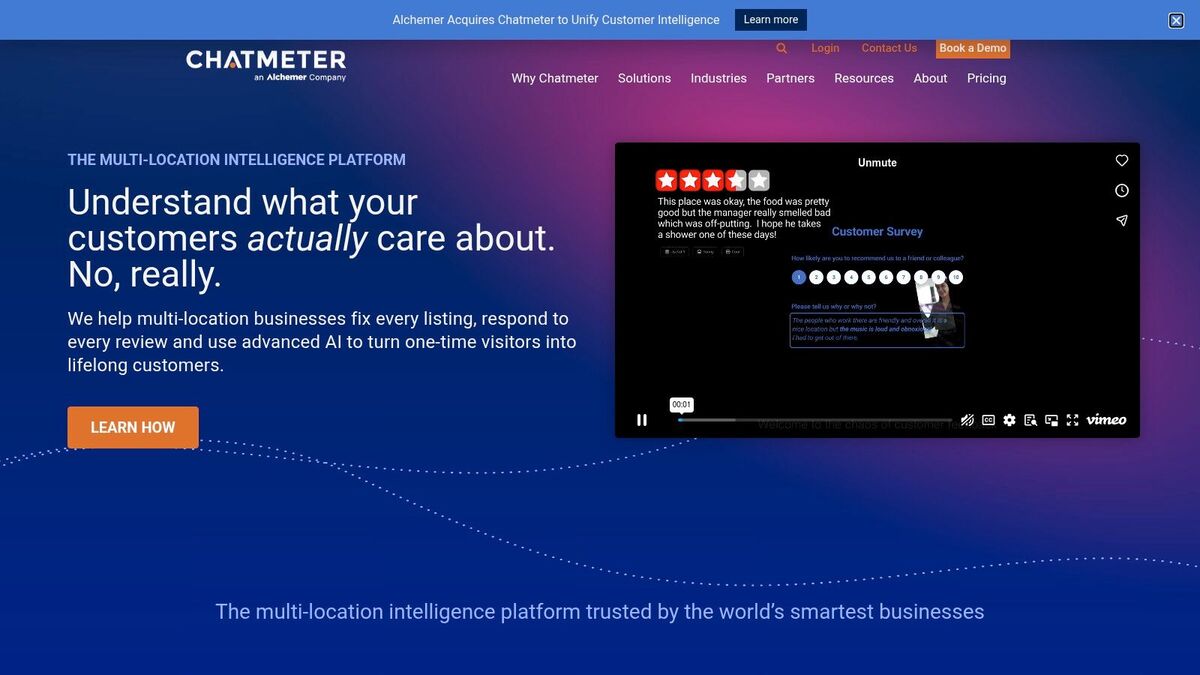
Now part of Alchemer. Delivers hyper-local competitive intelligence — performance against direct competitors location by location. Its Pulse AI engine provides real-time local market and sentiment analysis, which is genuinely differentiated in this list.
Pricing: Location-based, quote required. Unlimited users included.
Strengths: Best competitive intelligence for enterprise. Unlimited-user model keeps costs predictable across large teams.
Limitations: Priced for multi-location budgets. Feature set exceeds SMB needs.
8. Uberall
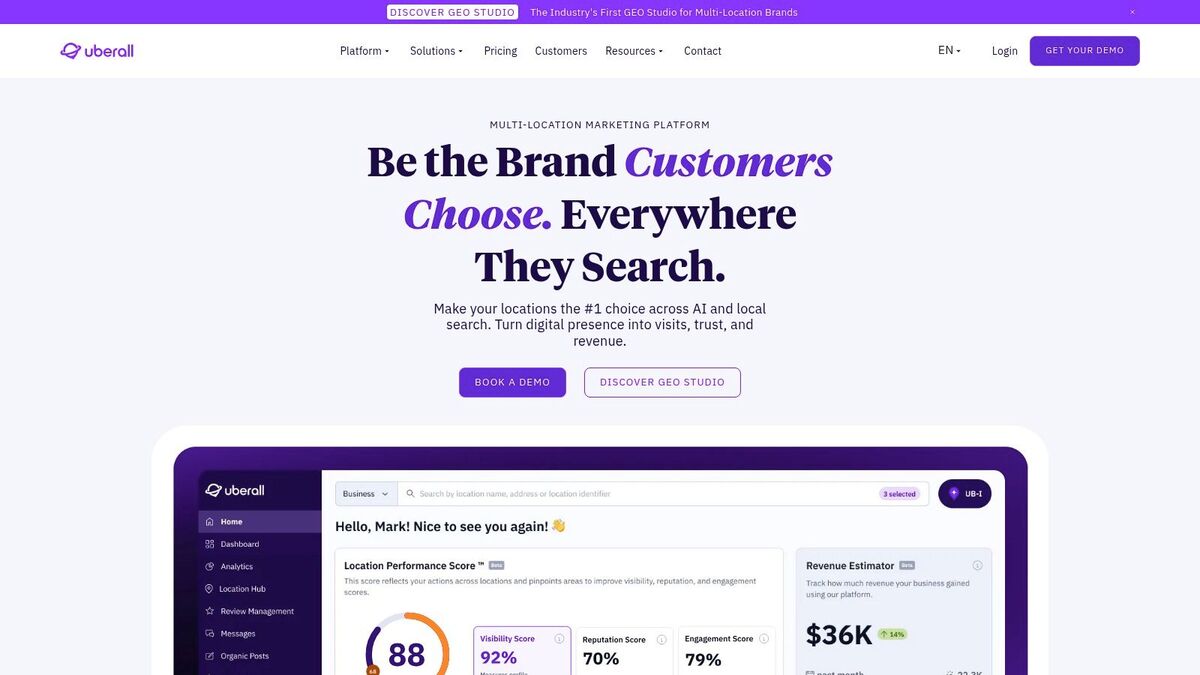
A "near me" brand experience platform focused on local search visibility. Unifies listings, reviews, and local social to help multi-location brands win proximity searches. Creates SEO-optimised landing pages per location.
Pricing: Enterprise, quote-based.
Strengths: Excellent presence management across large directory networks. Strong international footprint.
Limitations: Value only materialises multi-location. No published pricing.
9. BrightLocal
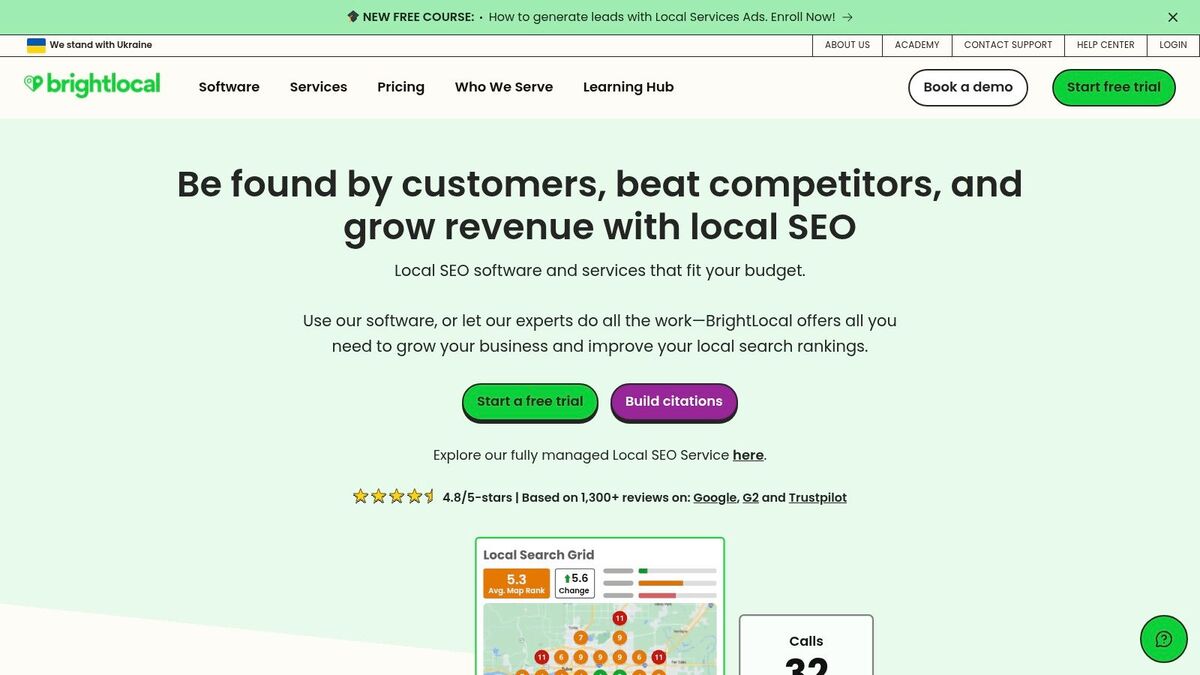
A local SEO platform with solid reputation management attached, which is the right way round for professional services and agencies. Connects review generation to rank tracking and citation management. Monitors 80+ sites.
Pricing: From $39/month, scaling by location. Pay-as-you-go citation building.
Strengths: Best value for local SEO plus reputation in one tool. Fully transparent pricing.
Limitations: Not a unified messaging inbox. Lacks enterprise workflow tooling.
10. NiceJob
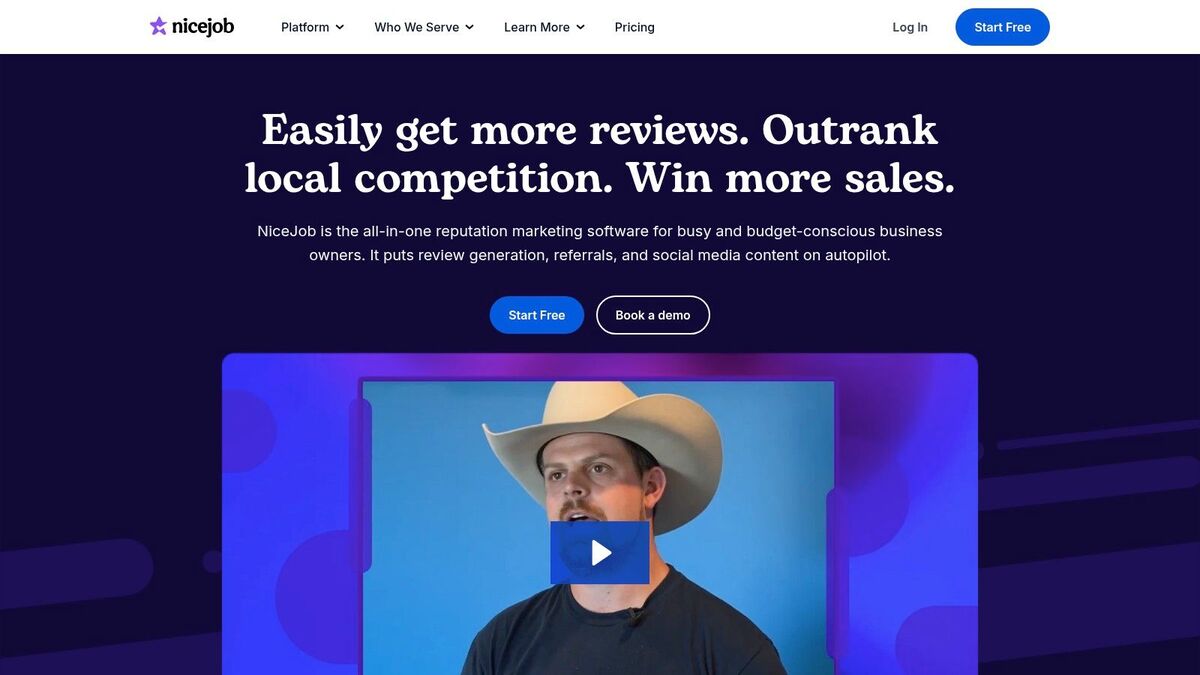
Deliberately simple and focused on automating review growth for small businesses. Automates SMS and email requests after a job completes. Stories turns positive reviews into shareable social content; widgets display a live review feed on your site.
Pricing: From $75/month, no contract, 14-day trial.
Strengths: Fastest implementation in this list. Contract-free. Strong social proof tooling.
Limitations: Weak listings management. No multi-location analytics.
11. Trustpilot Business
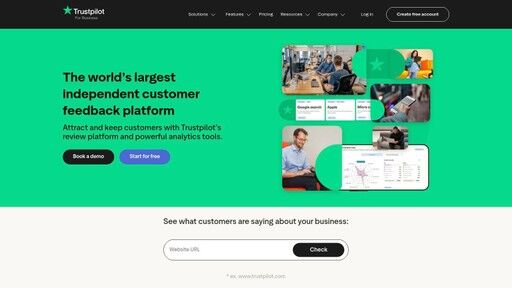
A licensed review platform built almost entirely around third-party trust. Generates verified reviews through automated invitations and displays them on a public profile. A high TrustScore is a recognised credibility signal for online shoppers, and the TrustBox widget measurably lifts on-site conversion.
Pricing: Tiered, typically 12-month contracts priced per domain. See our Trustpilot pricing breakdown.
Strengths: Strongest third-party trust signal available. Transparent tiers.
Limitations: Not a local SEO or listings tool. Per-domain pricing punishes multi-site businesses.
12. ReviewTrackers
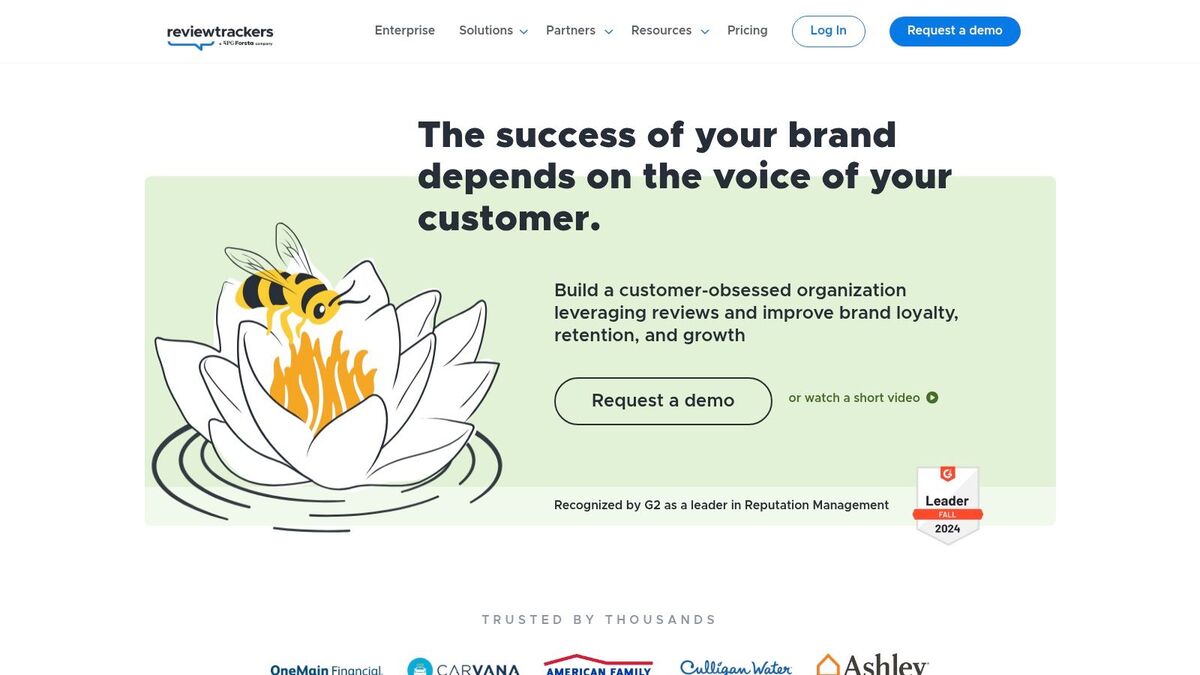
An InMoment company, purpose-built for review operations and sentiment analysis. Dashboards break down specific issues mentioned in reviews — "slow service", "room cleanliness" — turning unstructured text into operational intelligence. Amplify widgets surface positive reviews on your site.
Pricing: Location-based, contact sales.
Strengths: Best-in-class experience analysis. White-label and managed service options suit agencies.
Limitations: Pricing not published. May need add-ons for full listings coverage.
13. Liftify
Managed review generation for local service businesses. Automates Google review requests via SMS and email immediately after a service appointment, with white-glove onboarding — their team handles the integration into ServiceTitan, Jobber, or HousecallPro.
Pricing: Quote only.
Strengths: Managed onboarding removes the integration work. Strong SMS conversion. Built for job-close workflows.
Limitations: No transparent pricing, typically enterprise-tier. Generation only — limited monitoring or response. No free tier.
14. Brand24
Real-time brand monitoring and social listening rather than review management. Tracks mentions across social, news, blogs, forums, and podcasts as well as review platforms, with AI sentiment classification and trending topic alerts.
Pricing: $119/month (3 keywords, 2,000 mentions) to $299/month (25 keywords, unlimited).
Strengths: Broadest monitoring coverage here — 25+ source types. Competitor monitoring at every tier.
Limitations: You monitor mentions but respond in the native platform. No review generation. Pricing scales steeply with volume.
15. GatherUp
Formerly GetFiveStars. Review generation plus first-party feedback for local businesses and the agencies serving them. Collects NPS and satisfaction data before routing customers to Google or Facebook, with white-label reporting.
Pricing: From $99/month per location, agency volume pricing available.
Strengths: First-party and public review data in one workflow. Strong agency white-label tooling.
Limitations: Monitoring is thinner than dedicated tools. No AI response drafting. Weak OTA coverage.
16. ReviewGrower
Competes on value. $199/month covers up to 20 locations with white-label included and a free single-location plan. Handles requests via email and SMS, monitors Google, Facebook, Yelp, and Trustpilot, and provides a unified response dashboard.
Pricing: Free (1 location) to $199/month (20 locations).
Strengths: Best per-location economics for agencies. White-label at no extra cost.
Limitations: Less AI depth than FeedbackRobot or Birdeye. Limited OTA coverage. Fewer integrations.
How to Choose: Six Questions
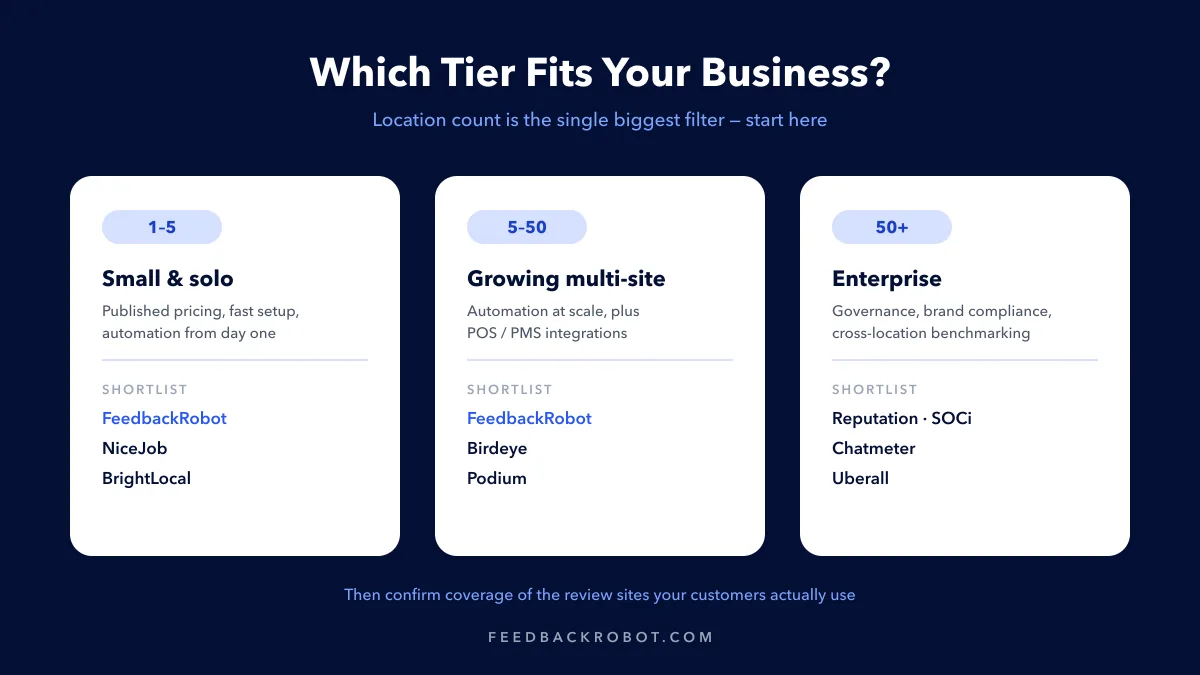
1. How many locations do you run?
The single biggest filter. At 1–5, you want published pricing and fast setup — NiceJob, BrightLocal, FeedbackRobot. At 5–50, you need automation at scale and POS/PMS integration — Birdeye, Podium, FeedbackRobot. At 50+, you need governance: approval workflows, brand compliance, benchmarking — Reputation, SOCi, Chatmeter, Uberall.
2. Which platforms do your customers actually use?
Not every tool covers every site. Restaurants need Yelp and TripAdvisor. Healthcare needs Zocdoc and Healthgrades. SaaS needs G2 and Capterra. List the three sites where your reviews actually land and confirm each tool monitors and responds on all three. This one question disqualifies more platforms than any other.
3. Do you need generation, or monitoring?
Monitoring is passive. Generation is active — the platform prompts customers after a transaction. If your volume is low, generation is far more valuable than analytics. If you already have volume, response automation and analysis matter more. Most businesses under 50 reviews should buy for generation and ignore the analytics feature lists entirely.
4. What does your stack look like?
The best platform is the one that plugs into what you already run. A hotel on Mews needs the PMS integration. A restaurant group on Toast needs POS-triggered requests. Without native integrations you end up exporting CSVs by hand, which defeats the point.
5. Is pricing published?
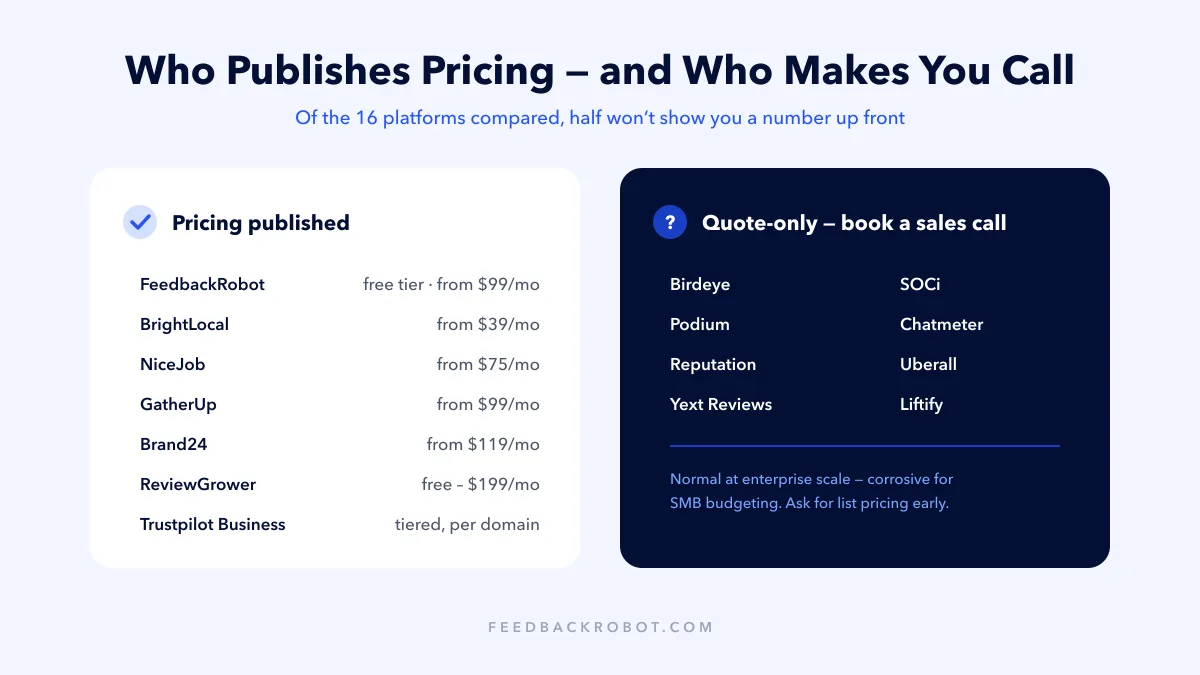
A surprising number of platforms here are quote-only. Fine at enterprise; corrosive for SMB budgeting. FeedbackRobot, NiceJob, BrightLocal, Brand24, GatherUp, and ReviewGrower publish rates. Birdeye, Podium, Yext, SOCi, Chatmeter, Uberall, Reputation, and Liftify require a call.
6. Does it close the loop?
The most overlooked question. When a negative review arrives, does the platform flag it, assign it, and trigger outreach — or email you an alert and leave the work on your desk? Platforms with genuine resolution workflows turn complaints into retention. Tools without them just tell you faster that you have a problem.
Free Reputation Management Tools Worth Knowing
Not every business needs a paid platform on day one:
Google Business Profile — your most important reputation asset, and free. A verified listing lets you respond to Google reviews, post updates, and appear in the Local Pack. Claim and optimise this before buying anything.
Google Alerts — email notifications whenever your brand is mentioned. A zero-cost monitoring baseline for news, blogs, and forums.
FeedbackRobot Free — a free starter allotment of 25 AI actions (10 drafts, 10 surveys, 5 assets), no card required and no time limit.
Reputation Score Calculator — benchmark your review volume, response rate, and recency against industry averages before committing budget.
You outgrow free tools when you need automated requests, multi-platform monitoring, or AI response at volume. Below that threshold, paid software mostly buys you dashboards you will not open.
Reputation Management Apps: Managing Reviews from Your Phone (and Your App Store)
“App reputation management” means two different things, and it pays to know which one you need before you shortlist anything. If you want an app to manage your business’s reputation from your phone, the first section below covers which of the 16 platforms ship mobile apps. If your product is an app and you need to manage its App Store or Google Play reviews, that is a specialist category with its own tools — covered right after.
Which reputation management tools have mobile apps?
Most of the mid-market and enterprise platforms in this guide ship companion mobile apps. Reputation’s app — listed on Google Play — gives location managers monitoring and response on the go. Birdeye and Podium both offer iOS and Android apps, a natural fit for their messaging-first workflows: review replies and customer texts from the same device that’s already in your pocket. NiceJob also offers a mobile app aimed at owner-operators. For the other platforms, app availability varies by plan and changes often — check the current App Store or Google Play listing before you commit. FeedbackRobot takes a mobile-web approach instead: the dashboard and the free AI review response tool run in any phone browser — no app install needed, nothing to update. Where a dedicated app genuinely matters is multi-location management: a regional manager clearing the response queue same-day from between site visits. For a single location, a mobile-friendly web dashboard covers the same ground.
App store reputation management (for mobile-app businesses)
If “app reputation management” means your product is a mobile app, none of the 16 platforms above is the right tool — they are built for location and service businesses whose reviews live on Google, Yelp, and industry sites. The specialist category is app-store review management: AppFollow, Appbot, and AppTweak are the established tools for monitoring and responding to App Store and Google Play reviews, analyzing review sentiment at scale, and connecting ratings to store-ranking performance. They solve a different problem with different data sources, which is why no general reputation platform replaces them. If your business runs physical locations and a customer-facing app, you will likely end up pairing one tool from each category — the two review ecosystems barely overlap.
Where to Go Next
Software handles monitoring and notification. You still need a process for what to say — the guide to responding to negative reviews covers the five-step process and the phrases that make things worse despite good intentions.
Volume is a separate problem from response. The guide to getting more Google reviews covers why most businesses plateau around 12 reviews and what moves the number consistently.
For Google specifically: how to ask for reviews, how to respond, and how to remove one — including what actually qualifies.
Narrowing to specific vendors: Birdeye alternatives covers what else exists at each tier.
The Short Version
There is no single best platform, and any guide that names one is selling something. The decision comes down to three things: how many locations you run, which review sites your customers actually use, and whether you need more reviews or better handling of the ones you have.
Get those three answers straight and the list of 16 collapses to two or three real candidates. Start free trials on those, and involve the people who will use it daily — the most feature-rich platform is worthless if your front-desk team finds it confusing.
If you want a baseline before you start, the Reputation Score Calculator takes 60 seconds and tells you which of the three questions above matters most for your business right now.
How much does reputation management software cost?
From free (FeedbackRobot's free starter, Google Alerts) to $75/month for small business tools like NiceJob, $99–$399/month for AI-powered platforms, and $1,000–$5,000+/month for enterprise suites like Reputation, SOCi, or Uberall. SMB-focused platforms generally publish pricing; enterprise platforms require a sales call.
What is the best free reputation management tool?
Google Business Profile, without close competition — it is where most local search decisions actually happen. For broader brand monitoring, Google Alerts covers the web at no cost. For AI-assisted review response, FeedbackRobot's free tier is the most capable among dedicated platforms.
What is the difference between monitoring and management?
Monitoring is watching. Management is responding, requesting, resolving, and building strategy from the data. Most platforms do both, but some entry-level tools only monitor. If you want more reviews and higher ratings rather than better-informed anxiety, you need management.
Is it worth it for a small business?
Usually, if you depend on local search. Harvard Business School research associates a one-star Yelp improvement with a 5–9% revenue increase. For a restaurant or clinic drawing most new customers from Google, the break-even is typically one to two additional customers per month.
How long until I see results?
Review generation shows movement within 30 days as automated requests go out. Star rating shifts take 60–90 days from a low base — the maths of averaging means early reviews move the number far more than later ones. Local ranking improvements from a higher rating take 3–6 months.
Can this software remove negative reviews?
No. Only the review platform can remove a review, and only where it violates their content policy. What good software does is help you respond professionally, flag genuine policy violations, and generate enough new positive reviews to shift the average. Any vendor promising removal is misrepresenting what they can do.
Stop reading about it. Let your agent handle it.
25 free AI actions · no credit card required
Start Free