What Is Reputation Management? (2026 Guide)
What is reputation management? Learn the 5 pillars, how AI changed the game in 2026, and how to build a strategy that works for your business.

Jun 2, 2026 · 12 min read
Free tool
Business Reputation Calculator
Get an instant score of your online reputation across all major review platforms.
Your business has a reputation whether you manage it or not.
Ready to pick tooling? Compare the best reputation management software and apps across 16 platforms.
Someone left a 2-star review at 11pm last Tuesday. By Wednesday morning it had been read by 40 people searching for exactly what you sell. You didn't know it existed until a customer mentioned it in passing a week later.
That's not a horror story — it's Tuesday for most small and mid-sized businesses. The difference between businesses that grow through their reputation and businesses that get quietly eroded by it comes down to one thing: whether they treat reputation management as a system or an afterthought.
This guide covers everything: what reputation management actually is, why the rules changed in 2025 and 2026, the five pillars of any working strategy, and how to build one regardless of your industry or team size.
What Is Reputation Management?
Reputation management is the practice of monitoring, shaping, and improving how your business is perceived — across review platforms, search results, social media, and increasingly, AI-generated answers.
The definition sounds simple. The practice isn't.
"Managing" your reputation doesn't mean controlling what people say. You can't. What you can control is how quickly you respond, what new signals you create, and whether your overall body of reviews reflects the actual quality of your product or service.
Three audiences form your reputation simultaneously:
Customers read reviews to decide whether to buy. 93% of consumers say online reviews influence their purchasing decisions. The average buyer reads at least seven reviews before forming a trust judgment — and that number goes up for higher-ticket purchases.
Search engines use review signals — volume, recency, rating, response rate — as ranking factors for local search. A business with 200 reviews and consistent owner responses outranks a competitor with 20 reviews and none, even when the competitor's product is better.
AI models are the newest and least understood audience. Google's AI Overviews, ChatGPT, and Perplexity now synthesise your reviews to answer queries like "is [your business] good?" or "best [your category] in [your city]". If your response rate is low, the AI says so. If your most recent reviews trend negative, that's what gets surfaced — before a human has even seen your listing.
Reputation management is the work of staying ahead of all three.
Why Reputation Management Changed in 2026
The fundamentals of reputation — respond quickly, earn good reviews, fix problems fast — haven't changed. The environment they operate in has.
The AI shift
Two years ago, reputation management meant ranking in the 10 blue links. Now it means influencing what AI models say about you when no one clicks anything.
Google AI Overviews appear above organic results for a growing share of queries. When someone searches "best hotel in [city]" or "is [restaurant] worth it", they often get a synthesised answer pulled from reviews, star ratings, and response patterns — without visiting a single review page. The businesses cited in those AI answers get the booking. The ones not cited are invisible.
ChatGPT and Perplexity work similarly. Ask either of them about a restaurant, a hotel, a software tool, or a healthcare provider, and they'll form an opinion based on what's been written about that business online. Review sentiment, response quality, and consistency across platforms all factor into what they say.
This isn't theoretical. It's happening now, and most businesses have no idea what AI models are saying about them.
The speed shift
Review response expectations have shortened dramatically. Customers who leave negative reviews increasingly expect a response within hours, not days. A ReviewTrackers study found that 53% of customers expect businesses to respond to negative reviews within a week — but hospitality customers expect it within 24 hours, and that window continues to shrink.
Every hour a negative review sits unanswered is an hour it shapes the opinions of everyone who reads it. A 1-star review at the top of your Google listing with no response will cost you an estimated 30% of the customers who see it.
The volume shift
Multi-location businesses face a scale problem that didn't exist a decade ago. Ten locations × five platforms = 50 inboxes. A restaurant group with 15 sites receives hundreds of reviews a week across Google, TripAdvisor, Yelp, Facebook, and booking platforms. Manual management stops working long before you hit that scale.
The businesses winning at reputation management in 2026 aren't the ones with the most staff — they're the ones who've turned it into a system.
The 5 Pillars of Reputation Management
Every effective reputation management strategy is built on five pillars. Skip one and the others weaken. Get all five working and they compound.
Pillar 1: Monitor
You can't manage what you can't see. Monitoring means knowing what's being said about your business, on which platforms, as close to real-time as possible.
This covers review platforms (Google, Yelp, TripAdvisor, Booking.com, Facebook, Agoda, Stripe, industry-specific directories), social media mentions, press coverage, and increasingly, how AI models are describing you in generated responses.
The failure mode here isn't missing a review — it's finding out about a wave of negative feedback three weeks after it happened, when the damage is already priced in. Real-time alerts, consolidated into a single view across platforms, eliminate this risk.
For a deeper look at building a monitoring system, online reputation management tips covers platform-by-platform setup in detail.
Pillar 2: Respond
Every review — positive, negative, three-star — deserves a response. This is the pillar most businesses partially implement (they respond to negatives but ignore positives) and it shows.
Responding to positive reviews signals to the reviewer that you noticed, signals to everyone reading that you're engaged, and signals to Google that this is an active, well-managed listing. It costs 30 seconds.
Responding to negative reviews is where the real work is. The anatomy of a good negative response: acknowledge the experience specifically (not generically), apologise for the gap between expectation and reality, offer a path to resolution privately where possible, and never argue publicly or copy-paste the same response.
Negative review response examples has templates for every category — restaurant, hotel, retail, healthcare, professional services — if you need a starting point. For Google specifically, how to respond to Google reviews walks through the mechanics and the strategy.
Pillar 3: Collect
Waiting for reviews to come in organically is a losing strategy. Happy customers don't leave reviews unprompted. Frustrated ones do. The result, without active collection, is a rating that systematically underrepresents your actual quality.
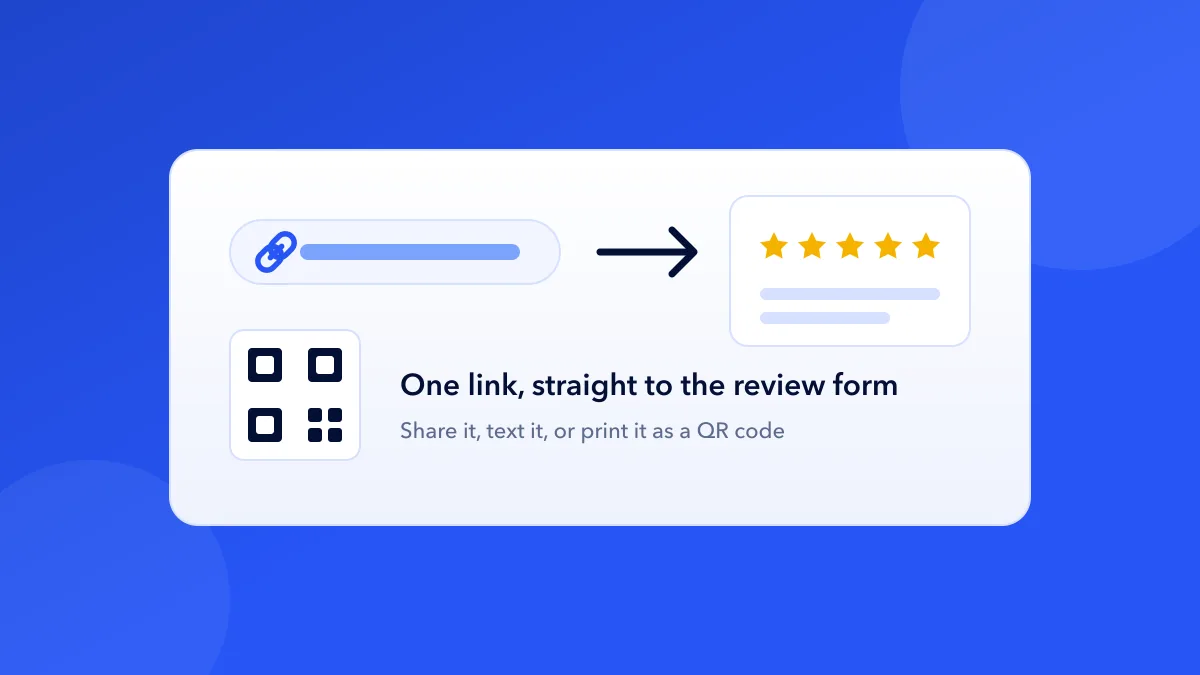
Active review collection means asking at the right moment (24–48 hours after the experience peak), making it frictionless (a QR code at checkout, a post-purchase email, a text after a service call), and asking often enough that your review velocity — new reviews per week — stays healthy.
One important note: don't gate reviews. Routing unhappy customers to a private form and only sending satisfied customers to Google violates Google's policies and, when customers notice, creates its own reputation problem. Ask everyone. Respond well to the ones who are unhappy. For practical scripts and automation approaches, how to ask for Google reviews covers this end to end.
Pillar 4: Amplify
Your best reviews are marketing assets sitting unused. Amplification means turning top reviews into social media content, embedding testimonials on key landing pages, using review language in your own ad copy (the words customers use to describe you are the words potential customers search for), and surfacing positive feedback in your sales process.
The amplification pillar is the least-implemented of the five, which is partly why it has the highest marginal return. Most competitors are not turning their reviews into content. The ones who do build a compounding asset — every good review generates more than the review itself.
Pillar 5: Analyse
Your reviews are the most honest feedback system your business has. Every theme that appears repeatedly — slow service, difficult parking, a specific staff member who keeps getting named, a product that consistently disappoints — is an operational signal, not just a PR problem.
Analysing review data means extracting keywords and topics that appear most often, tracking sentiment trends over time, and linking what reviewers say to what actually happens in the business. Customer sentiment analysis goes deeper on how to turn review text into structured operational insight.
Want to see where your reputation stands right now? Use the free reputation report card — it benchmarks your current rating, response rate, and review velocity against industry averages and shows you exactly where the gaps are.
Online vs. Offline Reputation Management
Reputation management is usually discussed as an online discipline. That framing misses the most important variable: the offline experience that creates the online review.
Online reputation management covers everything discussed above — the platforms, the responses, the collection systems, the AI signals. It's measurable, optimisable, and increasingly automated.
Offline reputation management is the product and service quality, the physical environment, the staff behaviour, the recovery when something goes wrong. It's harder to optimise because it involves people, not platforms.
The relationship between the two is one-directional: offline experience creates online reviews. No amount of review response strategy fixes a product or service problem. The best reputation management starts before anyone writes a review.
Reputation Management by Industry
The five pillars apply universally. How they're weighted and executed varies significantly by industry.
Hotels and hospitality
OTA platforms (Booking.com, Expedia, Agoda) carry weight that sits alongside Google in this category. A hotel with strong Google reviews and weak OTA ratings loses bookings to the algorithm before a human decision is ever made. Staff are named in reviews more often in hospitality than any other category — consistent positive mentions of specific team members are management information. For a deep dive, hotel reputation management with AI covers the operational and platform-specific details.
Restaurants and food service
Yelp carries more weight in this category than any other industry in the US. Google and TripAdvisor round out the critical three for most restaurants. The most common mistake is treating food complaints and service complaints identically — a complaint about a dish is a quality control issue that needs to go to the kitchen, while a complaint about service is a management issue. Restaurant reputation management tools covers multi-location management at scale.
Healthcare and medical practices
HIPAA places hard limits on what can be said in a response. You cannot confirm that someone is a patient, reference any treatment details, or include protected health information — even if the reviewer mentions it themselves. The correct response to a healthcare review is empathetic, general, and always invites the patient to contact the practice directly.
Retail and e-commerce
Product reviews (Amazon, Shopify) and brand reviews (Google, Trustpilot) operate differently and require different strategies. The single largest driver of retail negative reviews is the return and refund experience, not the product itself. A business that makes returns easy consistently outperforms one with a better product and a friction-heavy return process.
Professional services
Lower review volume means each review carries more individual weight. Building a simple post-matter review request into the client offboarding process is the single highest-return action available to most professional services businesses.
How to Build a Reputation Management Strategy: 7 Steps
Step 1: Audit where you stand
Claim every listing on every platform relevant to your industry. Check your current star ratings, review counts, response rates, and how recently your most recent reviews were posted. Use our free Reputation Score Calculator to benchmark against industry averages and see exactly where the gaps are.
Step 2: Set up monitoring
Decide which platforms you need to monitor and how you'll be alerted when new reviews come in. Email alerts from individual platforms are a starting point. A consolidated inbox across all platforms is the end state — it's the difference between managing 50 separate inboxes and managing one.
Step 3: Write your response playbook
Create three templates: positive review, neutral or mixed review, negative review. These aren't scripts — they're frameworks. Every response should include a detail specific to the actual review. The templates ensure you cover the essentials without forgetting anything under time pressure.
Step 4: Build your collection workflow
Choose your ask moment, your ask method (QR code, email, SMS), and your ask frequency. Make sure the link goes directly to your Google review form — every click you add loses you reviews. For templates and timing guidance, see how to ask for Google reviews.
Step 5: Assign ownership
Who responds to reviews? Who escalates a serious complaint? What's the SLA — how many hours before a negative review gets a response? Write this down. Review management falls apart when it's everyone's job and therefore no one's job.
Step 6: Close the operational loop
Schedule a monthly 30-minute review of what themes appeared in your feedback. Bring the output to an operations meeting. This is what separates businesses that use reputation management as a growth system from those that use it as damage control. Understanding voice of the customer methodology gives you a structured framework for this analysis.
Step 7: Track the right metrics
Average star rating by platform and location (trend over time matters more than snapshot), response rate (aim for 100%), average response time, review velocity (new reviews per week), and sentiment ratio (positive vs. negative themes in review text).
Reputation Management Tools and Software
At some point, manual reputation management stops scaling. The threshold differs by business: a single-location restaurant might manage fine with email alerts and 20 minutes a week. A 10-location hotel group managing five platforms cannot.
Reputation management software ranges from lightweight tools that aggregate reviews in one dashboard to full platforms that automate response drafting, review collection, and social amplification. Key features to evaluate: platform coverage, response automation, review collection tools, reporting depth, and multi-location support.
For alternatives to the major enterprise platforms, the Birdeye alternatives and Podium alternatives comparison pages cover how the options differ on price, features, and fit for different business sizes.
FeedbackRobot monitors 20+ review platforms, drafts AI responses in under 2 minutes, and collects new reviews via QR codes and post-purchase surveys — all from one inbox. Start your free trial — 25 AI actions, no credit card required.
Common Reputation Management Mistakes
Only responding to negative reviews. When you only engage with criticism, you signal to customers and search engines that you only show up when there's a problem.
Copy-paste responses. Customers notice. The reviewer who gets a form response to a specific, personal complaint almost always follows up with a worse one.
Arguing publicly. Even when the reviewer is factually wrong. People reading the exchange are assessing how your business behaves under pressure, not who's right.
Treating review management as a marketing function. When only the marketing team sees review data, the operational signals never reach the people who can act on them.
Ignoring new platforms. A business that set up monitoring on Google and Yelp in 2018 and hasn't revisited it may be missing a platform that now drives 30% of their customer decisions.
Not asking for reviews. The most expensive mistake because it's invisible. You'll never see the reviews you didn't get.
Ignoring AI-generated brand summaries. ChatGPT and Perplexity are now forming opinions about your business from your reviews. Most businesses have no idea what they're saying.
Knowing what reputation management is only takes you so far — the execution happens one response at a time. The guide to responding to negative reviews covers the full process: the right frame, the 5-step structure, and the phrases that consistently make responses worse even when the intent is good.
Reputation Management and Voice of the Customer
Reputation management and voice of the customer (VoC) programmes address the same underlying question: what do customers actually think? The difference is audience and timing.
VoC programmes capture feedback privately, at specific points in the journey, via structured surveys. Reputation management captures feedback publicly, asynchronously, in unstructured text that customers chose to write unprompted. Both are signals. Public reviews tend to capture emotional peaks; VoC surveys capture a broader, more representative sample. Businesses that run both and cross-reference the themes get the most complete picture.
See reputation management best practices for how to integrate both into a single feedback system.
Related reading: reputation management best practices · online reputation management tips · best reputation management software 2026
What's the difference between reputation management and PR?
PR manages your relationship with media and public narratives — press coverage, crisis communications, brand positioning. Reputation management manages your relationship with customers and the signals they leave — reviews, ratings, feedback. They overlap in a crisis but operate independently day to day.
How long does it take to improve a damaged reputation?
It depends on review volume. A business receiving 10 new reviews a week can meaningfully shift its average rating within 6–8 weeks of consistent collection and response. A business receiving 2 reviews a month may take 6–12 months. There's no shortcut — the work is generating new positive experiences and making sure those experiences become reviews.
Can you remove a negative review?
You can request removal if a review violates platform policies — spam, fake, disclosing personal information, or posted by a competitor. How to remove a Google review covers the process and realistic success rates. Outside of policy violations, removal is not reliably possible. The better path is response and dilution — a well-handled negative review surrounded by positive ones does far less damage than an unanswered one.
How much does reputation management cost?
Manual management costs staff time — estimate 30–90 minutes per week for a single-location business managing 2–3 platforms. Software ranges from free tiers with limited platform support to enterprise contracts. For most SMBs, the right range is $50–$300/month for a tool that consolidates monitoring, response, and collection across the platforms that matter.
Is reputation management worth it for small businesses?
The ROI case is straightforward: a 1-star improvement in your Yelp rating is associated with a 5–9% revenue increase (Harvard Business School). A business responding to 100% of its reviews earns an estimated 35% more revenue than one responding to none. The cost of not managing reputation is substantially higher than the cost of managing it.
What is the difference between reputation management and brand management?
Brand management shapes how a company wants to be perceived — through visual identity, messaging, and positioning. Reputation management responds to how a company is actually being perceived — through reviews, ratings, and public feedback. Brand management is proactive and strategic. Reputation management is both proactive and reactive.
Stop reading about it. Let your agent handle it.
25 free AI actions · no credit card required
Start Free