
Guide
Restaurant Review Sentiment Analysis (2026)
Free sentiment analysis for restaurant reviews — spot trending complaints, flag negative patterns, and auto-respond before they affect bookings.

Apr 20, 2026 · 14 min read
Free tool
Review Sentiment Analyzer
Paste your reviews or survey responses and get an instant sentiment breakdown with themes.
If you run a restaurant, you already have feedback. Too much of it, usually. A great Google review from lunch service. A sharp Yelp complaint about cold fries. A delivery app comment that says the food was good but the order showed up late. None of that is rare. What’s rare is having a clean way to turn all that text into action before the next shift starts.
That’s where sentiment analysis for restaurant reviews becomes useful. Not as a buzzword. As an operating habit. It helps you spot what guests are reacting to, separate food issues from service issues, and decide what needs a reply, a fix, a retrain, or a follow-up.
The issue usually isn’t lack of customer input. It’s overload. Owners and operators don’t need more dashboards full of noise. They need a system that helps them collect smarter, act faster, and grow stronger.
While manual analysis can uncover patterns, the sheer volume of customer feedback often presents a significant challenge for restaurants. For businesses looking to automate and scale this process, exploring dedicated AI tools can provide a more efficient and comprehensive solution. These platforms leverage advanced algorithms to process vast amounts of data, identify key trends, and streamline the entire feedback management lifecycle.
Discover how these AI customer feedback analysis tools can transform your operational efficiency and customer engagement.
Your Restaurant Reviews Are a Goldmine Here’s the Map
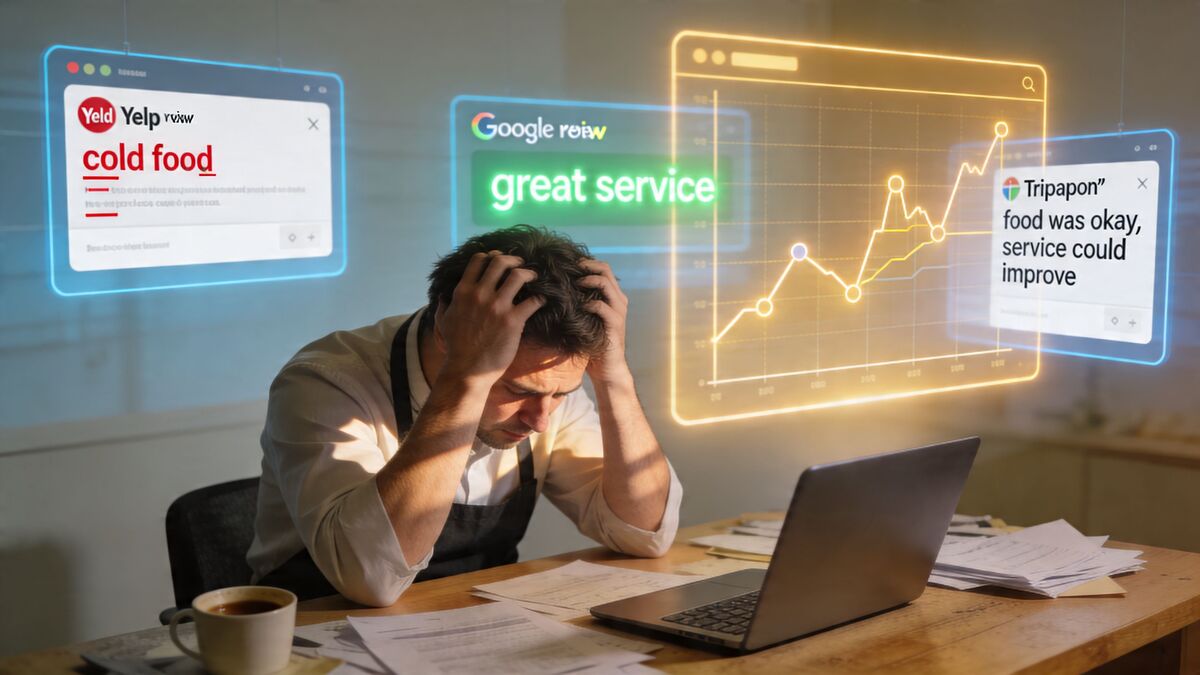
You can learn a lot from star ratings, but stars flatten the story. A three-star review might mean the burger was excellent and the host stand was disorganized. A five-star review might still include a warning about long waits on weekends. If you only track averages, you miss the reasons behind them.
That’s why text matters. A landmark study on restaurant reviews found that sentiment scores extracted from review text were better predictors of star ratings than the raw text itself, and it identified customer concern areas like food quality, service speed, and ambiance as direct drivers of ratings in restaurant settings (restaurant review sentiment research).
What owners usually miss
Staff often read reviews one by one. That works when volume is low. It breaks the moment you add multiple locations, multiple channels, or a busy weekend.
What gets missed is pattern recognition:
Repeated dish complaints: A single bad steak review is noise. Ten comments mentioning temperature or seasoning is a kitchen issue.
Shift-specific service dips: Late-night reviews often tell a different story than brunch.
Expectation gaps: Guests may love the food and still feel disappointed by wait times, music volume, or packaging.
Practical rule: Don’t read reviews only as reputation signals. Read them as operating data.
This is why teams that get serious about review management stop treating review sites as separate islands. They build one process for intake, tagging, review response, and follow-up. If you want a practical companion on that side of the job, this guide to restaurant review management is worth keeping open while you audit your current workflow.
Goldmine is the right word
Reviews contain the language your guests naturally use. That’s valuable for operations, but it also helps marketing, hiring, and retention. If guests keep praising “warm service” or “fast lunch specials,” that’s copy you can reuse. If they keep saying “great food, chaotic pickup,” that’s a workflow problem, not a branding problem.
And if you’re trying to build a stronger review profile in hospitality more broadly, this piece on earning 5-star reviews offers useful ideas about the experience details that shape public feedback.
First Stop Juggling Multiple Review Platforms
The first failure point in sentiment analysis for restaurant reviews is simple. The data is scattered.
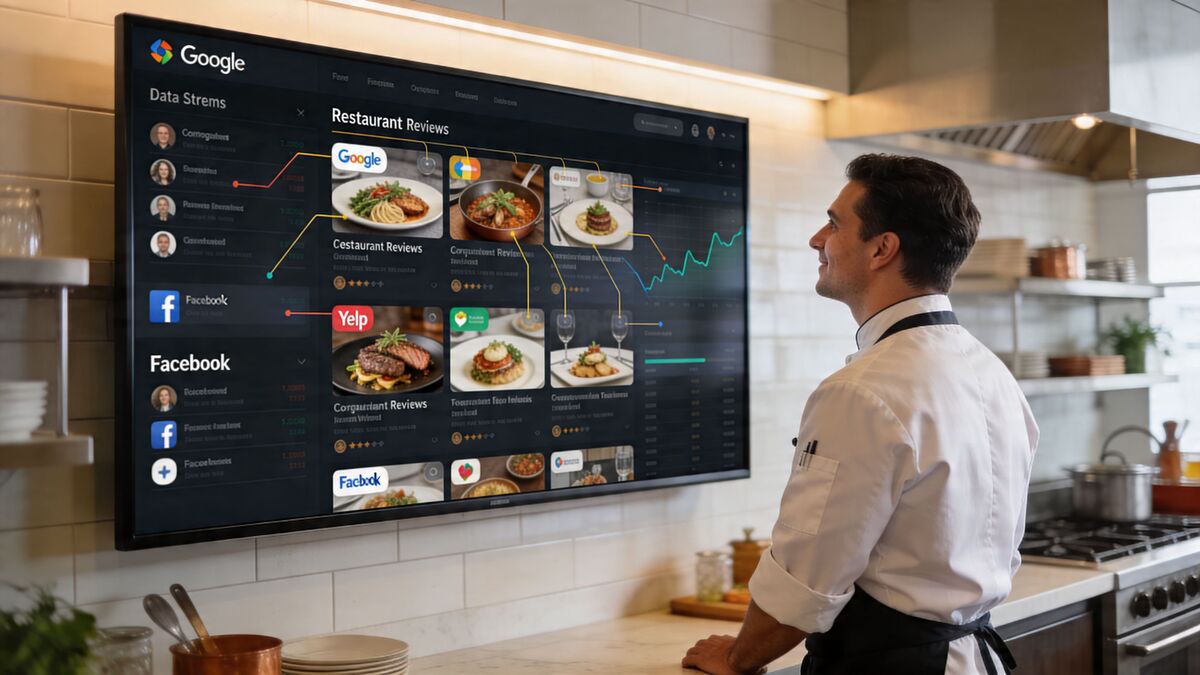
Google Reviews lives in one tab. Yelp in another. TripAdvisor matters if you’re attached to a hotel or depend on travelers. Direct survey comments sit in an inbox. Then there are delivery platforms, POS-linked feedback flows, and PMS-linked guest comments if you run a restaurant inside lodging and work with tools like Mews. If you’re in quick service or multi-unit casual dining, Toast often adds another stream of operational feedback.
One dashboard first, analysis second
Before you classify sentiment, summarize themes, or automate responses, you need one place where everything lands. That’s what Radar does. Radar is unified review intelligence. It pulls public reviews and private feedback into one view so your team can see trends across channels instead of checking each platform manually.
For busy operators, that matters for three reasons:
You stop missing urgent issues because no one checked the “other” platform.
You compare like with like across locations, shifts, and channels.
You reduce duplicate effort when managers answer the same underlying complaint in different systems.
Centralization also fixes context problems
A review on Google often sounds different from a private survey response. Public reviews are performative. Surveys are usually more blunt. Delivery app complaints skew toward packaging, timing, and handoff. Dine-in comments hit service flow, atmosphere, and menu clarity.
If those channels stay separate, managers end up making decisions from partial information. Centralizing them exposes patterns you can trust.
A good intake setup should normalize:
Source labels so the team knows where feedback came from
Location tags for multi-unit analysis
Time windows to spot spikes after menu changes, staffing changes, or promotions
Review cleaning to reduce spam, duplicates, and formatting mess
Multilingual feedback changes the stakes
If your restaurant serves tourists, operates in mixed-language neighborhoods, or runs across regions, language handling isn’t optional. A 2024 study noted that traditional models can misread polite, indirect criticism common in some cultures, which makes multilingual analysis important for restaurant groups working in diverse markets (multilingual restaurant sentiment study).
That matters in practice. “It was acceptable” may read neutral to a generic model. In context, it may be disappointment. “Interesting service style” might be a soft complaint, not a compliment.
Teams often think they have a review volume problem. They usually have a review consolidation problem first.
What this looks like on the ground
A sensible setup for a restaurant or hotel restaurant looks like this:
Google, Yelp, and TripAdvisor feed into one stream for reputation tracking.
Mews-linked guest feedback gets pulled in if reviews tie back to stay data, room type, or package context.
Toast-linked order or post-visit feedback gets grouped with operational data so service comments can be reviewed alongside order flow.
Direct survey comments sit beside public reviews, not in a silo.
Once that foundation is in place, sentiment analysis becomes useful instead of decorative.
How to Choose and Apply a Sentiment Model
Most restaurant teams have three options. They can do this manually, try to build something custom, or use a ready-made platform that already understands review workflows.
Manual review reading still has value, especially for owner intuition. But it doesn’t scale. A spreadsheet can log comments. It can’t reliably detect patterns across hundreds of mixed reviews, languages, and locations.
The three real choices
Here’s the clean way to compare your options.
Approach | Cost | Effort | Accuracy & Speed | Best For |
|---|---|---|---|---|
Manual review reading and spreadsheets | Low software cost, high labor cost | High | Slow, inconsistent, hard to scale | Single-location operators with low review volume |
Custom model built in-house or with contractors | High | Very high | Can be strong if maintained well, but requires ongoing tuning | Large brands with internal data and technical teams |
Off-the-shelf sentiment platform | Moderate | Low to moderate | Fast deployment, practical output for daily ops | Most restaurants, groups, and hospitality teams |
Accessible machine learning models for restaurant reviews can achieve around 77.67% accuracy, while more advanced deep learning models like BERT can reach 85-90% in classification tasks (restaurant review model examples). That sounds technical, but the operational takeaway is simple. Basic models can already help. Better models improve accuracy, especially when context and nuance matter.
Why generic sentiment isn’t enough
Restaurant reviews are rarely just positive or negative. They’re layered.
“Pasta was excellent but our table waited too long.”
“Friendly server, noisy room.”
“Fast delivery, missing side.”
Those are mixed reviews. If your model labels the whole comment as positive or negative, it throws away the part you need to fix. The practical goal is aspect-based sentiment. That means separating the sentiment tied to food, service, ambiance, price, pickup, or delivery.
A useful model doesn’t just tell you whether guests are happy. It tells you what they’re happy or unhappy about.
What owners should actually look for
When evaluating tools, ask these questions:
Does it break sentiment down by aspect?
You need food, service, wait time, ambiance, and value at minimum.Can it summarize without flattening detail?
Summaries should highlight themes, not hide root causes.Does it work across public and private feedback?
A model trained only on public review language will miss what customers say in surveys.Can managers use it without training?
If the output requires a data analyst, it won’t survive a busy Friday.
One practical option is FeedbackRobot’s AI Summaries. AI Summaries reads incoming comments, highlights recurring themes, and performs instant sentiment analysis so managers can see what’s going wrong without reading every review line by line. For owners comparing vendors, this overview of sentiment analysis tools is a useful starting point.
What works and what doesn’t
What works:
Short review summaries grouped by topic
Sentiment labels at the aspect level
Trend views by location, shift, or time period
Simple manager outputs like “service complaints rising” or “menu praise concentrated around two dishes”
What doesn’t:
A single overall sentiment score with no detail
Long AI summaries that read like a report nobody will finish
Models that don’t separate dine-in from delivery context
DIY systems no one updates after launch
Start with a narrow use case
The smartest rollout is small and operational.
Start by tracking:
Food quality
Service speed
Staff friendliness
Cleanliness or ambiance
Delivery or pickup accuracy
If the model can classify those reliably enough for your team to act, you already have something useful. You don’t need a lab. You need a tool that catches the same issues your guests keep naming and makes them visible before they become habits.
From Sentiment Scores to Restaurant KPIs
A sentiment score on its own doesn’t help a manager run better service. It becomes useful only when it connects to a KPI the team already cares about.
That’s where many operators get stuck. They can tell that reviews feel worse this month. They can’t tell whether that’s a staffing issue, a food consistency issue, a training issue, or a bad mix of all three.
Text usually tells you more than stars
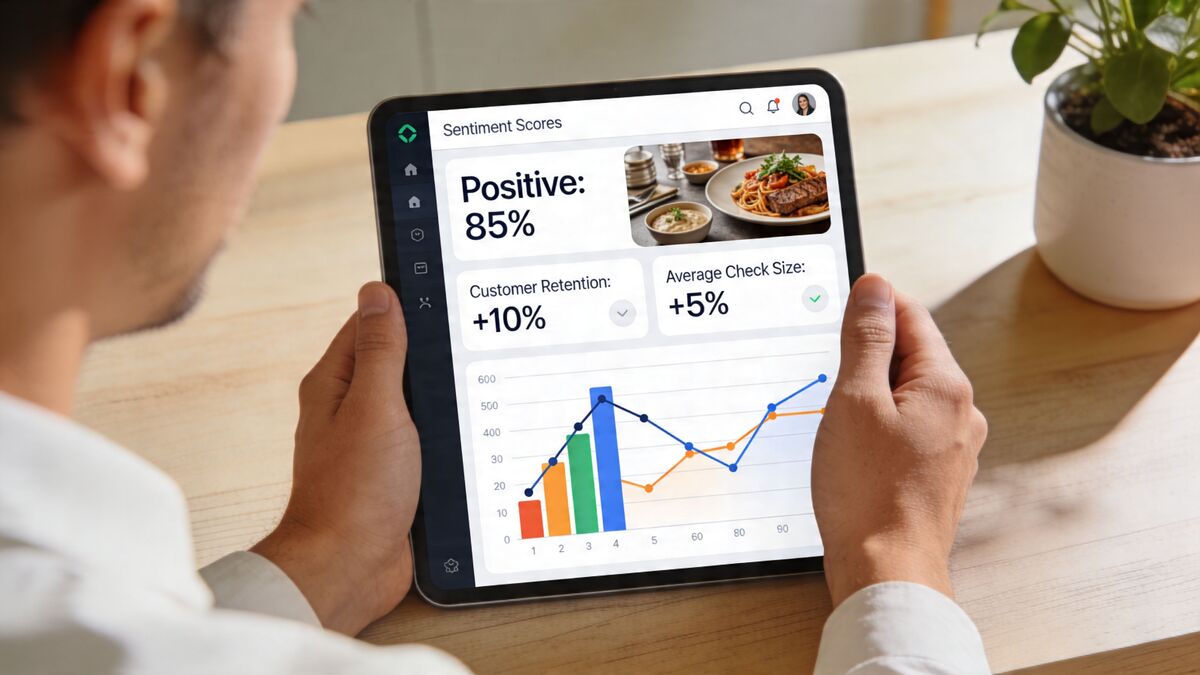
Research shows that sentiment in review comments explains substantially more variance in restaurant profitability, R² = 50%, than numerical ratings alone, R² = 20-30% (restaurant profitability and sentiment analysis research). That’s the business case in one line. Star ratings tell you the result. Review text tells you the driver.
Map sentiment to the KPIs you already track
This is the practical mapping I use most often:
KPI | Sentiment pattern to watch | Likely operational meaning |
|---|---|---|
Repeat visit intent | More neutral or mixed comments about service | Guests aren’t angry, but they aren’t attached |
Food consistency | Rising complaint volume around the same dish | Recipe drift, prep variance, expo breakdown |
Staff performance | Sentiment drop tied to friendliness, attentiveness, or speed | Coaching or scheduling issue |
Delivery quality | Comments about temperature, missing items, packaging | Handoff or fulfillment problem |
Revenue quality | Praise concentrated on a few items only | Menu dependence and uneven guest experience |
Neutral reviews deserve more attention than most teams give them
Owners jump on one-star reviews and celebrate five-star reviews. The bigger missed opportunity is the middle. Reviews that say “fine,” “okay,” or “nothing special” often point to preventable churn.
A guest who leaves a neutral comment often hasn’t written you off yet. They’re telling you the experience lacked a reason to return. That’s fixable if you catch the pattern early.
Neutral sentiment often signals hesitation. In restaurants, hesitation can become lost frequency before it becomes a public complaint.
Use sentiment in operating meetings, not just marketing reviews
The most effective rhythm is simple:
Weekly: Review top positive and negative themes by location.
After menu changes: Check whether food sentiment changes by item.
After staffing changes: Watch service tone, not just rating averages.
Monthly: Compare sentiment trends against repeat business, comps, or internal service scores.
When managers start discussing “service sentiment on Friday nights” instead of “reviews felt rough,” they make better decisions. The conversation gets specific. That’s when sentiment analysis for restaurant reviews stops being reporting and starts becoming control.
Automate Your Responses and Service Recovery
Once you know what guests are saying, the next question is speed. Most review programs fail because the team still handles everything manually after insight arrives.
That’s a mistake. Response quality matters, but response timing matters too. If a guest says the food was great but the service was inattentive, you shouldn’t wait days for someone to notice.

Build a response ladder
A practical response system has three lanes.
Low-risk positive feedback
These reviews need acknowledgment, not escalation.
Use a short thank-you. Mention the aspect they praised if possible. If the guest praised a dish, a server, or the room atmosphere, reflect that back in the response. Positive reviews can also trigger a gentle ask for another public review on a priority platform if that fits your workflow.
Mixed reviews
These are usually the most useful. The guest liked enough to stay engaged, but something got in the way.
Prompt to Survey helps by turning a simple prompt into a ready-to-send private survey, so you can ask for detail when a review is mixed, unclear, or too short to diagnose. Instead of guessing what “service was off” means, you can ask whether the issue was wait time, staff attitude, order accuracy, or table management.
Negative reviews
These should trigger action, not just a public apology.
The Resolutions Engine is the operational piece here. The Resolutions Engine automatically routes issues for service recovery, such as opening an internal task, drafting an empathetic reply, and triggering follow-up steps so managers can intervene before the guest is gone for good.
A 2024 study found that aspect-based sentiment analysis could predict restaurant survival with 89.50% accuracy, and that neutral sentiment around key areas like food and service could be stronger warning signs than outright negative reviews (restaurant survival and sentiment study). For operators, the lesson is clear. Don’t wait for loud complaints. Build workflows around early warning signals.
A simple automation playbook
Use rules like these:
If service sentiment turns negative, create a manager follow-up task.
If food quality is praised but service is criticized, route to floor leadership, not kitchen leadership.
If a review is mixed and vague, send a short private follow-up survey.
If a guest mentions a specific employee positively, tag it for recognition.
If delivery complaints cluster around missing items, notify the person responsible for packing and handoff.
This walkthrough helps show how a response workflow can look in practice:
Keep the human in the loop
Automation should speed up triage, not fake empathy. Auto-drafting a response is useful. Sending an unedited apology that ignores the actual complaint is not.
The best setup is usually:
AI detects the issue
The system drafts the first response
A manager approves or edits
Internal recovery actions happen automatically where appropriate
Fast service recovery beats polished delay.
If your brand also invests in visibility and reputation outside the review platforms themselves, it helps to coordinate feedback response with broader communications. For restaurants working on that side of the house, a specialist Food PR Agency can help align customer sentiment themes with public-facing messaging.
And if you’re tightening your service recovery process more broadly, this guide on customer service recovery gives a useful framework for escalation and follow-up.
Conclusion Your Restaurant's New Growth Engine
Restaurants don’t need more feedback. They need a better way to use the feedback they already get.
That’s the shift. When you centralize reviews, classify sentiment by topic, connect patterns to KPIs, and automate recovery steps, reviews stop being a reputation chore. They become an operating system for improvement. You stop reacting to isolated comments and start managing trends with intent.
The most important move is practical, not technical. Put all review sources in one place. Look for aspect-level themes. Treat neutral feedback as an early warning. Build response rules so your team doesn’t rely on memory and spare time.
For teams that want a cleaner loop, the combination matters:
Radar for unified review intelligence
AI Summaries for instant insights and sentiment analysis
Prompt to Survey for deeper context when reviews are mixed
Resolutions Engine for automated service recovery
That’s how you collect smarter, act faster, and grow stronger.
If you want to test this in your own operation, start with a small pilot. One location. One month. One set of review sources. Then compare what your team noticed before and after. The difference is usually obvious.
You can start a free trial with FeedbackRobot and see how quickly your reviews turn into action. And if you want to turn your best customer comments into on-site social proof, keep an eye on Spotlight: Feedback Wall, which is built to showcase positive reviews where future guests make decisions.
Common Questions About Restaurant Sentiment Analysis
Question | Answer |
|---|---|
Is sentiment analysis accurate enough for a restaurant? | It can be, if you use the right model for the job. Support Vector Machine models can achieve up to 94.56% accuracy in sentiment classification, but restaurant context is the hard part. Dish names, service jargon, and mixed feedback can confuse generic systems, which is why industry-tuned AI matters. |
Why not just look at star ratings? | Because stars compress the experience. A guest may rate four stars and still describe a serious service issue, or leave three stars while praising the food. Text shows what actually drove the score. |
Do I need a data team to use this? | No. Most restaurant teams don’t need to build models. They need a tool that groups feedback, tags sentiment by theme, and helps managers act quickly. |
What should I track first? | Start with food quality, service speed, friendliness, ambiance, and delivery or pickup issues. Those usually map fastest to operational fixes. |
What’s the biggest mistake owners make? | Treating every review as a one-off. The value comes from patterns. One complaint is anecdotal. Repeated complaints about the same issue deserve action. |
Can this help multi-location brands? | Yes, especially when feedback is centralized. It becomes much easier to compare locations, channels, and periods when all comments sit in one system. |
Are neutral reviews important? | Very. Neutral language often means the guest wasn’t angry, but also wasn’t impressed. That’s often the best chance to improve before they stop returning. |
Sentiment analysis for restaurant reviews works best when you keep expectations realistic. It won’t replace a good operator. It will make a good operator faster, more consistent, and less dependent on guesswork.
Start with FeedbackRobot if you want to turn scattered restaurant reviews into a usable workflow. A 14-day free trial lets you test review collection, sentiment analysis, issue routing, and follow-up without rebuilding your process first.
Why should restaurant operators prioritize text-based sentiment scores over traditional numerical star ratings?
Star ratings are lagging indicators that flatten the guest experience into a single, often misleading metric. Research indicates that sentiment extracted from review text explains roughly 50% of the variance in restaurant profitability, compared to just 20-30% for star ratings alone. By analyzing the language guests naturally use, operators can identify the specific drivers—such as food consistency or service speed—that dictate the final score, allowing for surgical operational improvements rather than guesswork based on a fluctuating average.
How does 'aspect-based' sentiment analysis resolve the issue of contradictory or mixed guest feedback?
Generic sentiment models often misclassify nuanced reviews, such as a guest praising the "excellent pasta" while criticizing a "long wait time." Aspect-based analysis deconstructs these layered comments by isolating and labeling sentiment for specific categories like food, ambiance, value, and service. This granularity ensures that kitchen successes are celebrated while front-of-house bottlenecks are identified, preventing critical operational data from being buried under a generalized "neutral" or "positive" label.
In a multi-unit environment, why is the centralization of disparate review channels like Google, Toast, and Mews considered a prerequisite for accurate analysis?
Data fragmentation is the primary failure point in reputation management; public reviews on Google tend to be performative, whereas private surveys via Toast or Mews are often more candid, and delivery-specific comments focus heavily on fulfillment logistics. Without a unified intelligence tool like Radar, managers make decisions based on partial, siloed information. Centralizing these streams into a single dashboard normalizes the data, allowing leadership to identify location-wide patterns and compare "like-with-like" performance across different shifts and service models.
What is the strategic value of monitoring 'neutral' sentiment, and how does it impact long-term guest retention?
Neutral feedback—often characterized by words like "fine" or "okay"—is frequently overlooked but serves as a vital early warning signal for guest churn. While one-star reviews represent an immediate crisis, neutral sentiment signals a lack of engagement or a missing "reason to return." Addressing these signs of hesitation before they escalate into public complaints allows operators to refine the experience and capture repeat business from guests who are currently indifferent but not yet lost to competitors.
How can a restaurant effectively bridge the gap between receiving a negative sentiment alert and executing a successful service recovery?
Successful recovery relies on a structured "response ladder" that moves beyond mere public apologies into automated internal workflows. Using tools like the Resolutions Engine, negative sentiment triggers immediate manager tasks and drafts empathetic, context-aware replies. Furthermore, for vague or mixed reviews, a "Prompt to Survey" function can be used to solicit specific details privately. This systematic approach ensures that the human-in-the-loop can intervene quickly and accurately, turning a potential loss into a documented resolution that prevents the issue from becoming a habit.
Put this on autopilot
Review Sentiment Analysis
A ready-made FeedbackRobot automation that runs this for you — deploys free in under 5 minutes.
Stop reading about it. Let your agent handle it.
25 free AI actions · no credit card required
Start Free