A Modern Guide to Restaurant Review Management for Busy Owners in 2026
Turn online chatter into revenue. Our guide to restaurant review management covers how to collect feedback, act fast on issues, and grow a loyal customer base.

Mar 31, 2026 · 18 min read
Free tool
Likert Scale Generator
Generate custom rating scales and survey questions tailored to your feedback needs.
You know that feeling when a new review notification pops up? That split-second mix of hope and dread. But what if every single review—good, bad, or in-between—became a clear instruction manual for making your restaurant stronger? That’s what restaurant review management is all about. It’s the system for listening, responding, and learning from what your customers are saying online to protect your reputation and actually grow your business.
Why Smart Review Management Is Your New Growth Engine
The deluge of customer feedback has shifted from a mere data stream to a strategic imperative that demands immediate, intelligent action. By 2026, the restaurant owner's challenge isn't just collecting reviews, but automating the synthesis and deployment of those insights across every operational touchpoint. The old model of reactive review management is now a clear liability; the market demands proactive, predictive engagement that human teams simply cannot sustain manually.
This isn't a fluffy marketing concept. It's a financial necessity. The goal is simple: collect smarter feedback, act faster on it, and build a stronger, more profitable restaurant.
Connecting Reviews to Your Bottom Line
It’s tempting to brush off online reviews as just noise, but the numbers tell a very different story—one that’s directly tied to your revenue. In the restaurant game, repeat customers are your lifeblood. They account for a massive 71% of sales at the average quick-service spot.
Even better? Those loyal regulars spend 67% more than first-time visitors. This is precisely why review management is so critical. A happy guest doesn't just leave a good tip; they come back again and again, bringing their friends. That's how you build a healthy bottom line.
This link between feedback and finance proves a simple truth: every review is a direct message from the market. Listening and acting on those messages is how you build a business that doesn't just survive, but thrives. It's about creating a system that works as hard as you do.
Every Touchpoint Shapes the Review
A customer's experience doesn't start when the food hits the table, and it certainly doesn't end when they pay the bill. Every single interaction—from the host's greeting to the cleanliness of the restrooms—shapes their final opinion.
For restaurants with a heavy focus on takeout and delivery, this extends even further. The way your food is packaged can make or break the entire at-home experience. Having crucial resources for the design of food packaging is a non-negotiable part of securing that five-star review before the food even leaves your kitchen.
A smart review management system helps you pinpoint and polish these moments. It gives you the intel you need to make smart decisions that fix operational hiccups, delight your diners, and turn one-time visitors into your most passionate promoters. This is how you stop reacting to feedback and start proactively building an experience that earns glowing reviews, night after night.
Build Your Feedback Command Center
Let's be honest. Your guest feedback is probably scattered all over the internet. You've got Google reviews, Yelp alerts, TripAdvisor notifications, DMs on Instagram, and buried comments on DoorDash. Trying to keep up manually is a recipe for burnout, and more importantly, it means you're missing the big picture.
Effective restaurant review management starts with a single, non-negotiable rule: get everything in one place.
This means building a central command center. Imagine ditching the dozen open tabs and having every review, rating, and comment flow into a single, unified dashboard. This isn’t just about making life easier; it's about seeing crucial patterns you’d otherwise miss entirely.
Consolidate All Your Feedback Channels
First things first, you need to corral all the places customers are talking about you online. Each one offers a unique piece of the puzzle, and to see the complete picture, you have to be listening everywhere.
This is where a dedicated review management platform becomes your best friend. Instead of juggling multiple logins, you connect all your accounts just once. From that point on, everything streams into a single, real-time feed of your brand’s reputation.
Here's a quick look at the essential feedback channels every restaurant needs to be watching. Each one has a different audience and purpose, making it critical to monitor them all.
Essential Feedback Channels to Monitor
Channel Type | Examples | Primary Focus | Action Priority |
|---|---|---|---|
Review Sites | Google, Yelp, TripAdvisor | Public reputation, new customer acquisition | High - Public responses required |
Social Media | Facebook Reviews, Instagram DMs, X (Twitter) Mentions | Real-time brand perception, direct engagement | High - Fast, conversational responses |
Delivery Apps | DoorDash, Uber Eats, Grubhub | Transaction-specific feedback, operational issues | Medium - Address operational trends |
Reservation Apps | OpenTable, Resy | Dining experience feedback from confirmed guests | Medium - Focus on in-house service |
Direct/Owned | Website contact forms, SMS feedback, QR code surveys | Private, solicited feedback, proactive issue resolution | High - Immediate, personal follow-up |
By pulling all these sources together, you finally get a bird's-eye view of what’s really going on. It’s the difference between reacting to individual fires and preventing them in the first place.
You can't manage what you don't measure, and you can't measure what you can't see. Consolidating your channels is the first step to truly seeing everything.
See Your Entire Reputation at a Glance
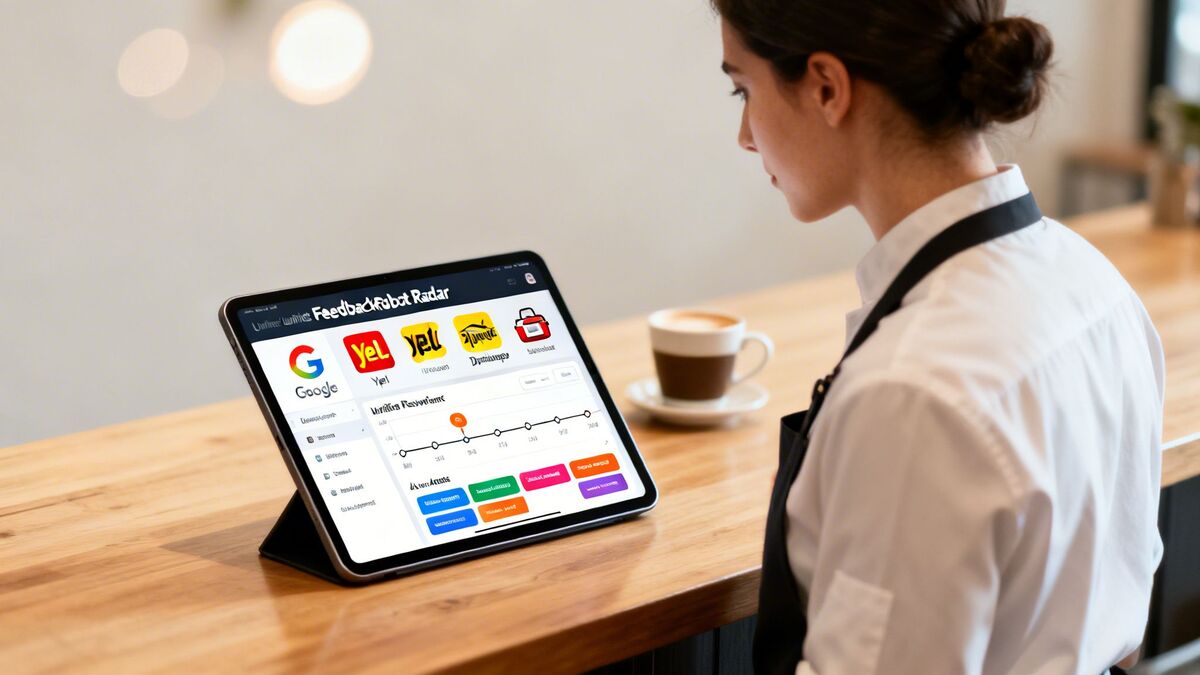
Once your channels are connected, you need a way to cut through the noise. This is exactly what a unified intelligence dashboard is for. Think of it as your 360-degree view of brand health, turning a flood of opinions into clear, actionable insights.
This is the power of FeedbackRobot's Radar. It’s your unified review intelligence hub. Radar lets you instantly see review volume, average ratings, and sentiment trends across every platform. You can spot if your Google rating is slipping while your DoorDash score is climbing, all without leaving the screen. This is what helps you make smarter decisions, faster.
Setting up your command center is more straightforward than you might think. You’ll connect your accounts—like your Google Business Profile and Facebook pages—and then set up smart alerts. These are your early-warning system.
You can create rules to notify a specific manager the moment a one-star review hits, when a VIP guest leaves feedback, or if a specific keyword like "cold food" or "long wait" appears.
This is the foundation for moving from reactive panic to proactive strategy. It ensures the right information gets to the right people instantly, giving you control of the narrative. To explore your options further, check out our guide on choosing the best restaurant feedback tool for your operation. This is how you start to collect smarter and prepare to act faster.
Go from Passive Collection to Proactive Insight
Waiting for reviews to trickle in on Google or Yelp is a passive game. It’s like letting strangers write your restaurant's story while you stand on the sidelines, hoping they get it right. It’s time to stop waiting and start asking.
Excellent restaurant review management means taking control of the narrative. You do this by proactively gathering high-quality, actionable feedback directly from your guests, before they post it publicly.
This isn’t about begging for a five-star rating. It's about getting the specific details—the "why" behind their score—that you need to make smart operational calls. Generic feedback won't help you fix a slow ticket time or spot which dish is a consistent hit. For that, you have to ask the right questions at the right moment.
Turn a Transaction into an Insight
The best time to ask for feedback is when the experience is still fresh. A simple, low-friction prompt right at the end of the meal is incredibly powerful. It’s your chance to intercept their experience before a complaint goes public or, just as important, to capture the details of a fantastic visit they might otherwise forget to share.
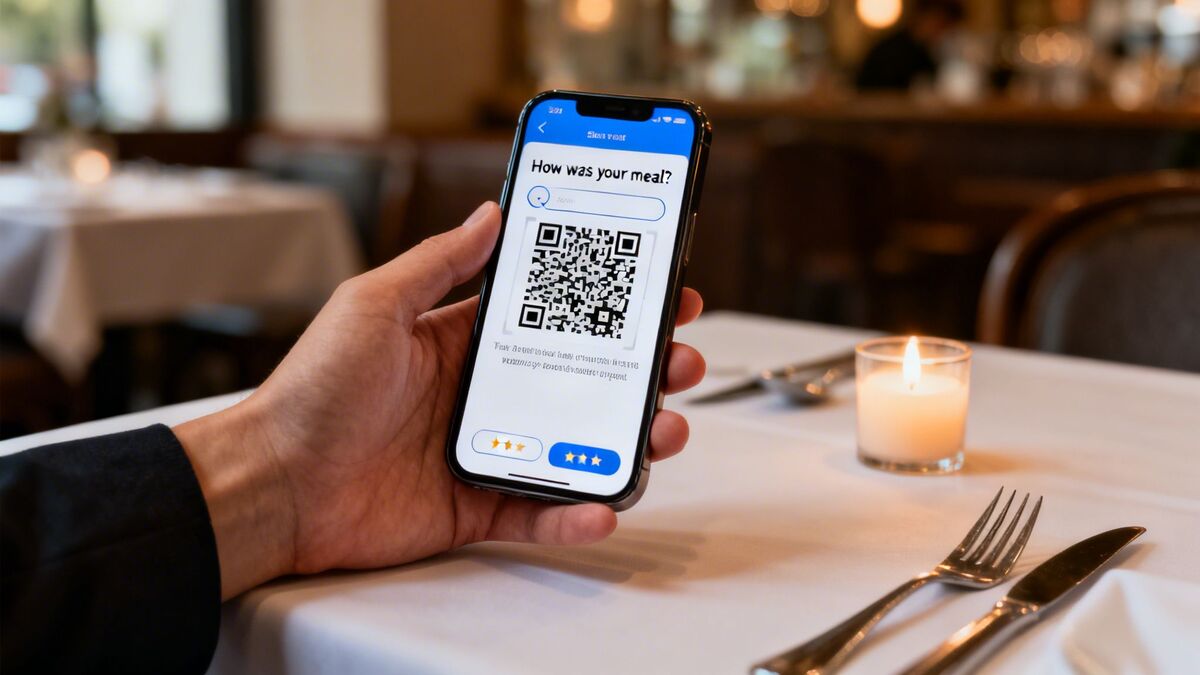
This is exactly why we built FeedbackRobot’s Prompt to Survey. This feature turns a simple customer interaction into a targeted, insightful feedback opportunity.
Instead of just asking, "How was everything?" as they head out the door, you can guide them to a quick, specific survey. This can be done effortlessly with:
QR codes placed on tables, menus, or bill presenters.
A simple link printed on receipts generated by your POS system.
Crucially, this method works seamlessly with the systems you already use. Powerful integrations with partners like Toast or Mews mean you can automate the entire process. When a guest pays their bill, a link to a tailored survey is automatically printed on their receipt or sent via text. No extra work for your staff.
Ask Questions That Drive Action
The real power of Prompt to Survey is its ability to go deeper than a star rating. A public review gives you a score; a private survey gives you a diagnosis. You can uncover specific details about food quality, service speed, ambiance, and cleanliness that a generic review platform would never provide.
Think about the difference between a three-star Google review that just says "It was okay" and a private survey response that tells you, "The risotto was amazing, but we waited 15 minutes for our drinks order to be taken." One is a vague complaint; the other is a direct, actionable coaching opportunity for your bar staff.
By directing customers to a private survey first, you give them a direct line to you. This simple act shows you care and gives you a chance to address issues before they become public complaints on TripAdvisor or Yelp.
This isn't about stopping bad reviews; it's about solving problems faster. When you collect smarter insights by asking pointed questions, you can act faster and with more precision.
From Vague Feedback to Specific Solutions
Using a direct survey lets you ask targeted questions that yield data you can actually use. You can get specific feedback on new menu items, a server's performance, or even the volume of the background music.
Consider these scenarios:
The Vague Public Review: "Service was slow."
The Actionable Survey Insight: "We loved our server, Maria, but it seemed like she was covering too many tables. Our appetizer arrived before our cocktails."
The Vague Public Review: "Food was a miss."
The Actionable Survey Insight: "The steak was cooked perfectly, but the side of roasted vegetables was undercooked and cold."
This level of detail is a goldmine. It allows you to move from guessing what went wrong to knowing exactly where to focus your training and operational fixes. This is how you transform restaurant review management from a reactive chore into a proactive growth strategy, strengthening your business one piece of feedback at a time.
Respond with Speed and Empathy Using AI
An unanswered negative review is like a digital billboard advertising poor customer service. But who has time to write a unique, thoughtful response to every comment that rolls in? When your team is already stretched thin, just keeping up can feel impossible.
This is where the right technology can be a game-changer for your restaurant review management. It’s not about replacing the human touch—it’s about giving your team the tools to deliver it, faster and more consistently than ever before.
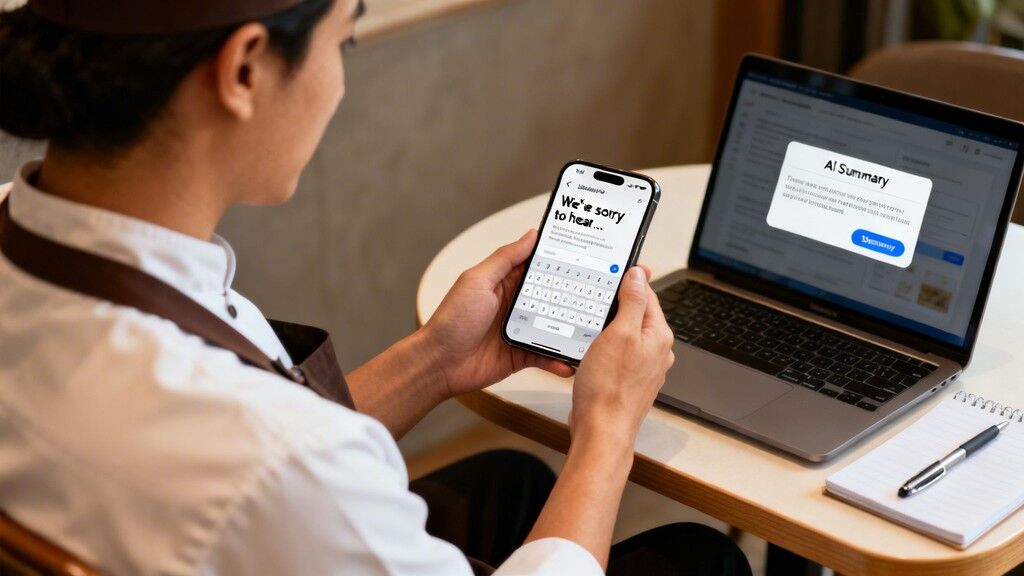
Let's be honest, labor challenges are a constant headache in our industry. Even with some recent stabilization, the average turnover for non-management staff is still a painful 35-40% annually. It’s a top concern for 44% of operators for a good reason. When you're short-staffed and costs are rising, any tool that saves your team time isn't a nice-to-have; it's essential.
Get to the Point with Instant Insights
Imagine a three-paragraph review hits Google. The guest loved the new decor, but their salmon was overcooked, and they thought the service was a bit slow. Before you can even think about replying, you have to dissect the entire comment to find the real issues.
That’s where FeedbackRobot’s AI Summaries come into play. Think of it as an intelligence briefing for every piece of feedback you receive, providing instant insights and sentiment analysis.
Here’s how it works:
It instantly spots the sentiment—positive, negative, or mixed—so you know where to focus first.
It gives you a short, sharp summary of long reviews, pulling out the main complaints so you don't have to dig for them.
It flags keywords and themes, helping you grasp the core of the feedback in seconds.
Instead of your manager spending five minutes decoding a review, they see a simple summary: "Guest loved the decor but found the salmon overcooked." Now they know exactly what to address. This is how you act faster and make sure nothing slips through the cracks.
Craft the Perfect Response in Seconds
Once you know the problem, you face the next challenge: writing a response that sounds professional, empathetic, and sincere. Getting the tone right is everything, but it’s also what takes up the most time. A canned, copy-paste reply can often feel worse than no reply at all.
Our platform tackles this by using AI to auto-draft on-brand replies. This isn't about sending robotic messages. It's about giving your team a solid, human-sounding starting point that they can quickly tweak and send.
This approach ensures every guest feels heard and acknowledged, without burning out your managers or hosts. It's about maintaining a caring, professional presence online, even when the restaurant is packed.
Let’s look at the difference this makes in practice.
Without AI: Your manager spends 10 minutes carefully composing a reply to that negative review. That's 10 minutes they aren't on the floor, talking to guests or helping staff.
With AI: The system suggests, "We're so sorry to hear the salmon wasn't cooked to your liking. This is not our standard, and we appreciate you bringing it to our attention." Your manager can add a personal touch and hit 'send' in under a minute.
This efficiency frees up your team to engage with more customers, turning what was once a dreaded chore into a powerful tool for building loyalty. You can learn more about how generative AI helps provide faster customer service in our detailed guide.
By giving your team tools that summarize feedback and suggest replies, you empower them to manage your online reputation without adding hours to their day. It’s a system that helps you respond with speed and genuine empathy, making every single guest feel valued.
Automate Service Recovery to Turn Critics into Fans
A complaint isn't just a problem—it's a gift. I know, I know. It doesn't feel like a gift when it lands in the middle of a chaotic dinner service. But that unhappy customer is giving you a golden opportunity to fix what's broken and show them you care.
The catch? This opportunity has a very short shelf life. Act fast, and you can turn a critic into one of your most loyal fans. Act too slow—or not at all—and you've lost them for good. This is where you stop manually putting out fires and start building a system that turns bad experiences into loyalty-building moments.
How an Automated Resolutions Engine Works
Imagine a one-star review pops up on Google during your Saturday night rush. The guest mentions a "cold steak" and a "long wait." In most restaurants, that review might sit unseen until Monday morning. By then, the damage is done.
This is precisely where FeedbackRobot’s Resolutions Engine becomes your secret weapon. It’s built for automated service recovery, making sure no unhappy guest ever slips through the cracks. It turns a manual, often chaotic process into a reliable machine for winning back customers.
Instead of waiting for a manager to spot the review, the Resolutions Engine uses simple rules you create. When it detects a specific type of feedback, it kicks off a workflow you've already designed. You set the rules once, and the system follows your plan perfectly every single time.
Let's look at how you could handle that "cold steak" review with an automated workflow:
Trigger: The system detects a new 1-star or 2-star review containing keywords like 'cold food' or 'cold steak'.
Notify: It immediately fires off an SMS alert to the on-duty kitchen manager and an email to the general manager. No delays.
Create Task: A task is instantly created in the team's shared inbox, assigned to the floor manager, prompting them to investigate.
Respond: An automated but empathetic apology is sent to the customer, acknowledging their specific issue and offering a unique discount code for a return visit.
This screenshot shows just how easy it is to build these "if-this-then-that" rules inside the Resolutions Engine.
You're visually connecting a trigger (like a bad rating) to a series of actions that solve the problem for you, without anyone having to lift a finger.
From Problem to Resolution in Minutes
The real magic here is the speed. A process that used to take hours—or even days—now happens in minutes. That guest who left the review gets a thoughtful apology and a compelling reason to give you another shot before they've even gone to bed.
A fast, effective resolution can increase customer retention by up to 82%. When you solve a problem on the spot, you're not just saving a customer; you're demonstrating a commitment to service that builds deep-seated loyalty.
This automated system is also a goldmine for operational insights. By tracking the kinds of resolutions you're sending, you can spot recurring problems. Seeing a lot of "cold food" complaints on weekends? That’s not just a string of bad luck; it’s a clear signal to check your pass times or kitchen line process.
The Resolutions Engine doesn't just fix individual complaints; it helps you diagnose and solve the root cause. You can learn more about the mechanics in our complete guide to feedback resolution automation.
This is how you master service recovery at scale. You stop hoping your team catches every fire and start building a system that guarantees you act faster, resolve smarter, and grow stronger from every piece of feedback you get.
Turn Positive Reviews into Powerful Marketing Assets
Those glowing reviews you get? They're pure marketing gold. Every five-star rating is a real customer telling the world that your restaurant delivers on its promise. So why let that praise just sit on Google or Yelp, doing more for their traffic than for your bottom line?
This is where you stop being passive and start getting strategic. A smart restaurant review management plan isn't just about putting out fires; it’s about fanning the flames of your best feedback. You'll learn to turn happy customer quotes into the most believable marketing you have.
Showcase Your Best Feedback Effortlessly
You worked hard for those five-star reviews, so let’s put them where it really counts: right in front of potential diners visiting your website. Manually copy-pasting testimonials onto a static page is a total time-sink. It gets outdated fast and, let's be honest, it looks a little staged.
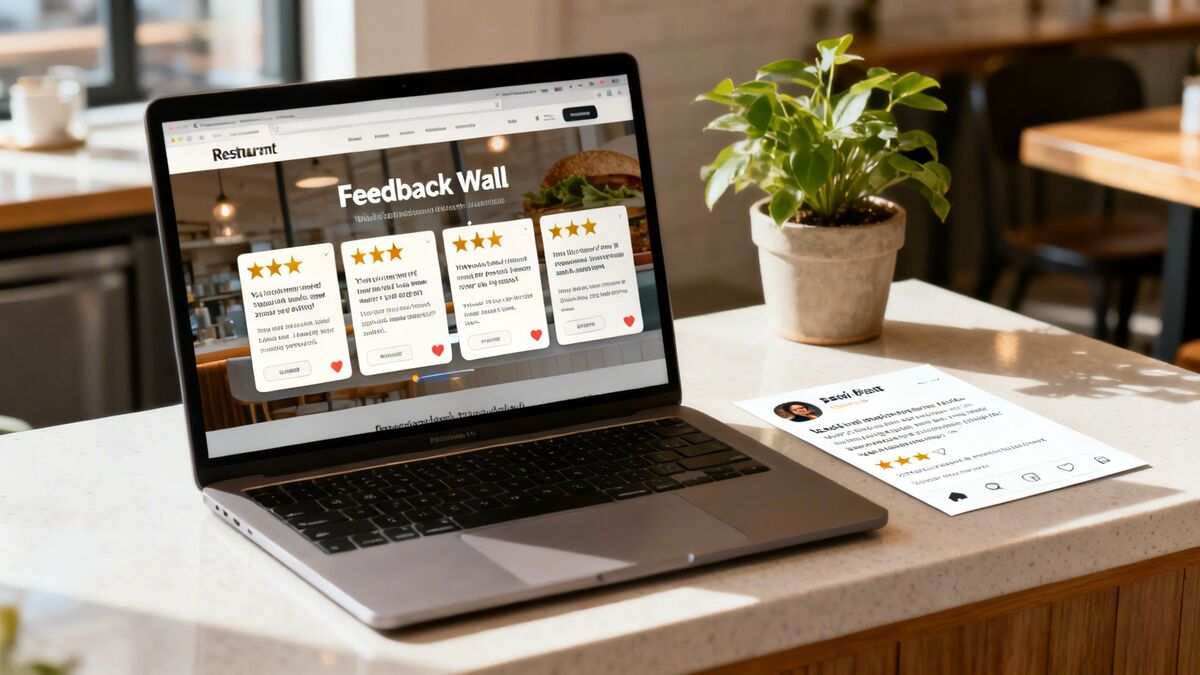
We saw this problem so often that we built a solution right into our platform. FeedbackRobot's Spotlight: Feedback Wall is a new feature that creates beautiful, live-streaming widgets of your best reviews, right on your website.
Think of it as your own automated feed of customer love. Here’s what makes it work so well:
Always Fresh: It automatically finds and displays your latest and greatest reviews from all over the web. No more manual updates.
Builds Instant Trust: The widget shows real, unfiltered praise from actual customers, which is far more credible than any marketing copy you could write.
Completely Brand-Aligned: You customize the look and feel to match your restaurant's style. You also get to filter which reviews appear, ensuring only the most impactful ones are front-and-center.
A Feedback Wall transforms your website from a simple menu into a living testament to your quality. It answers the question, "Is this place actually good?" before a visitor even has to wonder.
Turn a Great Review into Shareable Content
Beyond your website, your social media accounts are the perfect stage to show off your best feedback. A simple screenshot of a review is okay, but you can do so much better. A well-designed, branded graphic that tells a small story is far more compelling.
Next time you get a review that just perfectly nails your restaurant's vibe, don't just reply—amplify it. Pull out the best sentence or two and pop it into a branded template. You don't need a design team; free tools make it easy to create eye-catching visuals that make the customer's words shine.
Post it on your Instagram, your Facebook page, or wherever your customers hang out online. This doesn't just fill your content calendar; it turns your happiest guests into your most convincing marketers. This is how you grow stronger, one happy customer at a time.
Tired of posting boring screenshots of Google Reviews? Use our free Fine Dining Restaurant Review to Social Media Post Generator to create high-impact graphics for Instagram and LinkedIn.
A Quick Note on Permissions
When you're using reviews in your marketing, it’s always smart to be transparent. For public reviews on sites like Google or Yelp, quoting short excerpts is generally accepted practice.
However, if you want to feature a reviewer's full name or their profile picture, it's always a good idea to send a quick direct message and ask for permission. Nine times out of ten, happy customers are thrilled to be featured.
By turning praise into promotion, you close the loop on your entire restaurant review management system. You’ve collected the feedback, acted on the insights, and now you’re showcasing the positive results to fuel your growth. It’s a powerful cycle that builds on itself with every new happy guest.
See our food and beverage reputation guide for more restaurant-specific tools and strategies.
Your Restaurant Review Management Questions, Answered
Let's cut through the noise and tackle the questions we hear every day from restaurant owners. You're busy running a business, so let's get you some straight answers.
How Much Time Do I Really Need to Spend on This Every Day?
Honestly? Less time than you think. With the right setup, we're talking 15-20 minutes a day, tops.
It’s not about blocking out hours to scroll through Yelp. It’s about having a system that does the heavy lifting for you. A tool like FeedbackRobot uses AI Summaries to flag the reviews that actually need a personal touch, so you're not wasting time on fluff. The goal is consistency, not hours logged.
Do I Have to Respond to Every Single Review?
The short answer is yes, but you need a game plan. If you're slammed, prioritize. Always, always respond to negative reviews and any feedback with specific complaints. This shows you’re listening.
But don't ignore your fans! Thanking happy customers builds a loyal community. If you’re short on time, here's a smart way to triage your responses:
Tackle the Fires: Start with all 1- and 2-star reviews. These need immediate attention.
Address the Middle Ground: Move on to 3-star reviews, especially those with constructive feedback.
Appreciate the Fans: Finish by thanking your 4- and 5-star reviewers. This encourages more people to leave great feedback.
Tools that offer AI-generated replies make this process much faster, turning a chore into a quick daily habit.
What's the Best Way to Get More Good Reviews?
You have to make it ridiculously easy for happy diners to tell the world about you. The single best time to ask is right after they've had a great experience, not hours or days later.
A simple QR code on the table tent or receipt that links to a quick survey works wonders. We call this the Prompt to Survey method in FeedbackRobot, and it’s incredibly effective.
The real magic happens when you automate it. By integrating with your POS system, like Toast or Mews, a feedback request can be triggered the moment a check is closed. Just remember: never offer a discount or freebie in exchange for a review—it’s against the rules on most platforms. A simple, well-timed ask is all you need.
Ready to stop guessing and start growing? FeedbackRobot is the Feedback Operating System that turns your customer feedback from a daily chore into your most powerful growth tool.
Start your 14-day free trial today, or be the first to launch our new Spotlight: Feedback Wall and turn your best reviews into your best marketing.
Beyond general brand reputation, what is the specific financial justification for implementing a rigorous review management system in 2026?
In the current hospitality landscape, review management has shifted from a marketing luxury to a financial necessity. Data indicates that repeat customers drive a substantial 71% of sales at average quick-service establishments and typically spend 67% more than first-time diners. By systematically capturing and acting on feedback, you are not merely "managing comments"—you are directly protecting your highest-margin revenue stream. A structured system ensures that these high-value guests feel heard, preventing churn and securing the long-term lifetime value that stabilizes your bottom line.
How does the "Prompt to Survey" methodology differ from traditional public review collection in terms of operational utility?
While a public star rating provides a surface-level "score," FeedbackRobot’s Prompt to Survey offers a granular "diagnosis." Public reviews often lack the specific details required for management to take corrective action, frequently offering vague sentiments like "service was slow." Conversely, a private, well-timed survey—triggered via QR codes or POS integrations like Toast—uncovers precise friction points, such as a specific server’s table load or a temperature issue with a particular side dish. This allows you to intercept dissatisfaction privately and apply surgical operational fixes before a guest ever reaches for Yelp or TripAdvisor.
In a high-turnover environment where managers are stretched thin, how can a restaurant maintain a 100% response rate without compromising floor service?
The key lies in utilizing AI-driven intelligence to eliminate the "decoding" phase of review management. With the current industry turnover for non-management staff hovering between 35-40%, managers cannot afford to spend hours drafting replies. FeedbackRobot’s AI Summaries distill lengthy, multi-paragraph reviews into immediate intelligence briefings—identifying sentiment and core themes instantly. Combined with auto-drafted, on-brand responses, your leadership team can transition from spending ten minutes per review to under sixty seconds, ensuring every guest receives a professional, empathetic acknowledgement without the manager ever leaving the floor for long.
What is the mechanical process behind an automated "Resolutions Engine," and why is speed critical for service recovery?
Effective service recovery is time-sensitive; a fast resolution can increase customer retention by up to 82%. The Resolutions Engine operates on "if-this-then-that" logic to ensure no critic is ignored. For example, if a guest submits a 1-star rating mentioning "cold food," the system automatically triggers an SMS alert to the kitchen manager, assigns a follow-up task in the team inbox, and sends an immediate, empathetic apology with a recovery incentive. This automated workflow transforms a potential PR disaster into a structured loyalty-building event, occurring in minutes rather than days.
Why is a live-streaming "Feedback Wall" superior to traditional static testimonial pages on a restaurant’s website?
Static testimonials often appear staged and quickly become outdated, failing to build genuine trust with modern diners. Spotlight: Feedback Wall creates a live-streaming widget that pulls verified, high-impact reviews directly from across the web in real-time. This dynamic approach provides social proof that is both fresh and credible, answering the diner's core question of quality before they book. Because you can filter these streams to align with your brand standards, you transform your most glowing public praise into an automated, high-conversion marketing asset that requires zero manual maintenance.
Put this on autopilot
Review Management
A ready-made FeedbackRobot automation that runs this for you — deploys free in under 5 minutes.
Stop reading about it. Let your agent handle it.
25 free AI actions · no credit card required
Start Free