
How Generative AI for Customer Service Helps You Act Faster & Grow Stronger
Discover how generative ai customer service boosts efficiency, loyalty, and speed in 2026. Practical steps, real-world examples, and quick wins.

Mar 23, 2026 · 15 min read
Free tool
AI Negative Review Responder
Turn 1-star reviews into recovery opportunities with AI-crafted responses.
As a busy hospitality or service owner, what if you could have your sharpest, most empathetic agent working around the clock? Someone who never gets tired, understands exactly what your customers need, and solves problems instantly. That's what generative AI customer service brings to the table. This isn't about the clunky, old-school chatbots we've all grown to dislike. It's about actionable tech that understands context, writes human-like responses, and helps you collect smarter, act faster, and grow stronger.
What Is Generative AI in Customer Service, Really?

Think of it this way: old chatbots are like a basic microwave, while generative AI is like a skilled apprentice chef.
A microwave just follows simple commands—"heat for 60 seconds"—without knowing anything about the food. It can’t create, adapt, or learn from its mistakes. If you put a metal fork in, it just sparks and breaks.
But the apprentice chef understands ingredients (customer questions), techniques (your brand’s voice), and the goal (a happy customer). They can whip up a new dish from scratch (a personalized apology email) or tweak a recipe based on feedback (summarize themes from reviews). That’s the difference.
Beyond Simple Scripts
Traditional support bots are stuck with pre-written scripts. If a customer asks a question that isn't in the script, the bot hits a wall and the customer gets frustrated. Generative AI works on a completely different level.
It understands context and nuance. It can read a furious one-star review and instantly grasp the emotion behind the words.
It creates new, original content. It won't just spit out a canned reply. It can draft a unique, empathetic email that acknowledges a specific complaint and offers a real solution.
It learns and improves over time. The more customer interactions it handles, the better it gets at sounding like your best agent and solving problems efficiently.
The real magic happens when the AI is trained on your company’s specific data. This is where concepts like LLM fine-tuning come into play, teaching the model to communicate with your unique brand voice.
Traditional Support Vs Generative AI Support
The shift from old-school support to AI-powered service is a massive leap forward. Here’s a quick breakdown of how they compare.
Feature | Traditional Customer Service | Generative AI Customer Service |
|---|---|---|
Response Time | Slow; depends on agent availability. | Instant; 24/7 availability. |
Scalability | Limited; requires hiring more agents. | Highly scalable; handles thousands of queries at once. |
Consistency | Varies by agent and workload. | Perfectly consistent brand voice and quality. |
Personalization | Basic; uses customer's name. | Deep; uses interaction history and context. |
Cost | High; tied to salaries and overhead. | Low operational cost; reduces need for large teams. |
Data Analysis | Manual and slow; requires reports. | Real-time; spots trends and sentiment instantly. |
As you can see, generative AI doesn't just do the same work faster—it unlocks a completely new, more intelligent way of managing customer relationships.
The numbers back this up. The market for generative AI in customer service is expected to reach $15.12 billion by 2026. Klarna, for example, used an AI tool to cut its average issue resolution time from 11 minutes down to just 2 minutes. That's an 82% drop, and they did it while keeping customer satisfaction scores right on par with their human agents.
Tools like FeedbackRobot put this power right in your hands. It’s not just about answering questions faster; it’s about turning customer feedback into your biggest strength. By analyzing what customers are saying and helping you respond with both speed and real empathy, you can collect smarter, act faster, and grow stronger.
You can explore how this all comes together in our deep dive on generative AI for customer service.
Why Ignoring Generative AI Is No Longer an Option

The pressure on your service teams has never been greater. Customers want answers now, your best people are stretched thin, and your competitors are only getting faster. Sticking with manual, outdated methods is like trying to win a race on foot while everyone else is driving.
Ignoring generative AI is no longer a choice you can afford to make. It’s a direct risk to your business.
Think about all the repetitive work that drains your team’s day: manually sorting feedback, writing the same basic replies over and over, and trying to track complaint trends in a spreadsheet. Generative AI automates these tedious jobs. This isn't about replacing your people—it's about freeing them to handle the complex, high-value issues that actually need a human touch.
The business case is simple and rests on three pillars: radical efficiency, stronger customer loyalty, and a healthier bottom line. When you can answer a negative review in seconds, not hours, you stop churn in its tracks and can even turn an unhappy guest into a loyal fan.
From Hours of Reading to Instant Insights
Imagine trying to get a feel for customer sentiment by reading every single review from Google, TripAdvisor, and your social media pages. It’s an impossible job for a busy owner. You might spot a few obvious problems, but you’ll miss the subtle trends that could make or break your business.
This is where a Feedback Operating System delivers immediate value.
A powerful tool like FeedbackRobot's AI Summaries changes the game completely.
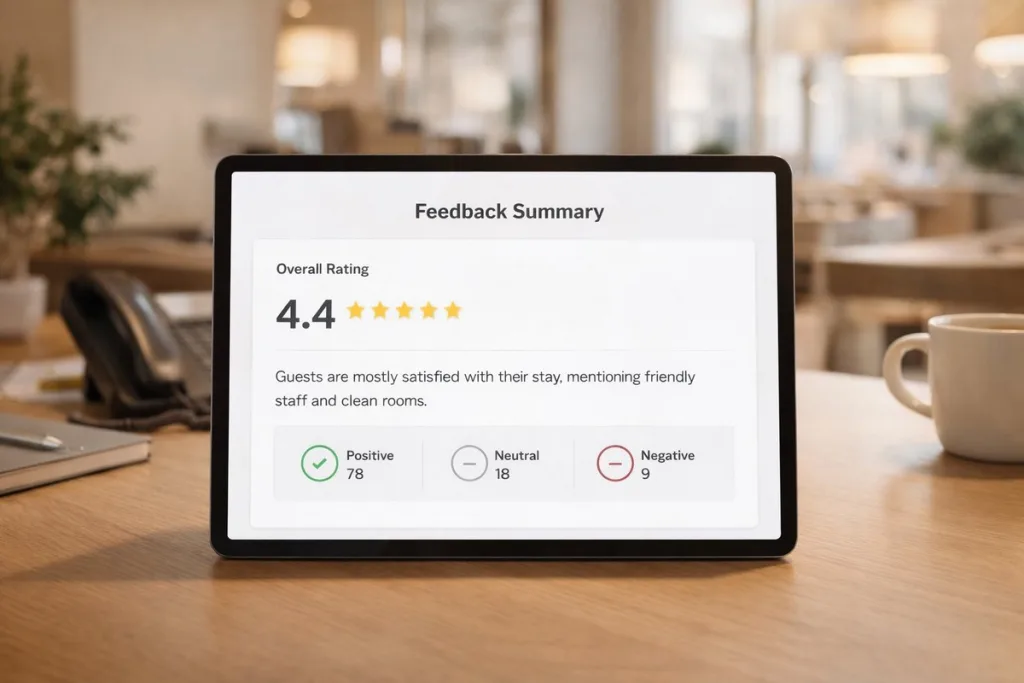
Instead of you manually sifting through hundreds of comments, AI Summaries reads everything for you. This feature performs instant insights & sentiment analysis, giving you a real-time pulse on your business health without you ever having to open a spreadsheet.
This means you can see, at a glance, what customers love, what they dislike, and where you need to take action right now. You’ll know if "slow service" was a trending topic last week or if praise for a new menu item is soaring. This is how you collect smarter and get ahead of problems before they escalate.
Supercharge Your Team and Your Profits
The impact of generative AI on team performance is staggering. Studies show that agents using AI tools can resolve 13.8% more inquiries per hour. In some cases, AI has slashed first response times from over 10 minutes to just a few seconds.
This is because AI now handles over 45% of all incoming queries in industries like retail and travel, taking a huge amount of pressure off human agents. You can find more data on how AI is boosting customer service productivity to see the full picture.
Ultimately, this newfound efficiency translates directly into profit. When your team can act faster on feedback, they resolve issues before they lead to lost customers and lost revenue. By using AI to automate responses and analyze trends, you're not just saving time—you're building a more resilient, profitable business.
This is the core of our mission at FeedbackRobot: to help you collect smarter, act faster, and grow stronger.
Seeing Generative AI at Work in Your Industry

It’s one thing to talk about generative AI in theory. It’s another to see exactly how it solves real problems for your business. Let's get past the buzzwords and look at what generative ai customer service really means for owners in hospitality, restaurants, and retail.
Imagine you're running a hotel. You know feedback is pouring in from Google, TripAdvisor, your PMS, and social media. Just trying to keep up feels like a full-time job. With a smart Feedback Operating System, you can stop hopping between a dozen different sites.
This is exactly what FeedbackRobot's Radar was built for.
Radar acts as your mission control, providing unified review intelligence. It pulls every piece of customer feedback from every important channel—public reviews, private surveys, social media—into a single, clean dashboard, spotting trends before they grow into bigger problems.
This isn’t just about collecting reviews; it’s about finding the signal in the noise so you can collect smarter. When the AI spots a pattern—like a few guests mentioning "slow check-in" or a "noisy air conditioner"—it can automatically alert the right manager. This lets you act faster to fix the root cause before it hurts your reputation.
For Hotels and Hospitality
In the hospitality world, guest experience is everything. A single bad review can sway dozens of potential bookings. Generative AI works as your first line of defense, protecting your reputation around the clock, especially with integrations to platforms like Mews.
Proactive Issue Detection: The system flags a sudden jump in reviews mentioning "room cleanliness" at one of your properties. It instantly notifies the general manager and housekeeping supervisor so they can handle it before the weekend rush.
Personalized Service Recovery: A guest leaves a 2-star review on Google about a billing error. The AI drafts an empathetic response that acknowledges the specific issue and prompts your front desk manager to follow up with a fix and a small goodwill gesture.
Operational Insights: By analyzing thousands of comments, the AI might find that guests who mention your "rooftop bar" in positive reviews have a 25% higher lifetime value. Now you know exactly where to focus your marketing dollars.
For Restaurants and Cafes
For restaurant owners, the pace is nonstop, and feedback comes from everywhere—a quick comment on Instagram, a detailed Yelp review, you name it. A generative AI tool for your customer service can be a game-changer, especially when it plugs into your POS system like Toast.
Let's say a diner posts on Facebook, "The food was great, but the service was incredibly slow tonight." An AI-powered system can instantly trigger an automated, yet personal, response. It might send a direct message with an apology, a link to a private survey for more details, and a 15% discount for their next visit. You can explore more real-world generative ai customer service examples in our full guide.
For Retail and E-commerce
In retail, the customer journey doesn’t stop at the checkout. The follow-up is where you earn loyalty and gather the feedback you need to improve. Generative AI helps you automate this entire process and make it feel personal, even at scale.
Instead of a generic "How did we do?" email, the AI can customize the follow-up based on the product. Someone who bought running shoes might get a quick survey about fit and comfort. Someone who bought a coffee maker might get asked about ease of use. This targeted approach gives you far better response rates and actionable feedback you can use to grow stronger.
Your Practical Blueprint for AI Implementation
The thought of "implementing AI" can sound overwhelming, but it doesn't have to be. For busy service and hospitality owners, it’s not about becoming a tech guru. It's about setting up simple, powerful "if-this-then-that" rules that put your feedback management on autopilot.
First, map out your most common service issues. What are the repetitive problems that eat up your team's time? For instance, a restaurant owner might create this rule:
"IF a customer review on any platform mentions 'cold food' or 'long wait,' THEN automatically alert the on-duty kitchen manager and the general manager via text message."
This simple automation closes the gap between feedback and action instantly. You no longer have to wait for a weekly report to find a problem that's been costing you customers all week.
Turning Feedback into Actionable Data
Once you’ve spotted a problem, the next move is to understand it. A single negative comment might just be an outlier, or it could be the first sign of a bigger issue. This is where you need to collect smarter without giving your team more work.
This is exactly what FeedbackRobot's Prompt to Survey feature was built for.
Let's say you get that "cold food" complaint. With a single click, Prompt to Survey turns that feedback into a targeted microsurvey. The system can automatically send the customer a message like, "We're so sorry to hear about your experience. Could you take 30 seconds to tell us more so we can fix this?"
This turns a vague complaint into structured, useful data. You're not just reacting; you're investigating and gathering the intel you need to stop the problem from happening again.
Automating Service Recovery to Act Faster
Gathering data is only half the battle. Closing the loop with the customer quickly and consistently is what builds real loyalty. This is where a Feedback Operating System becomes your most valuable player, helping you act faster and with perfect consistency.
Using a platform like FeedbackRobot, you can set up a complete service recovery workflow with the Resolutions Engine.
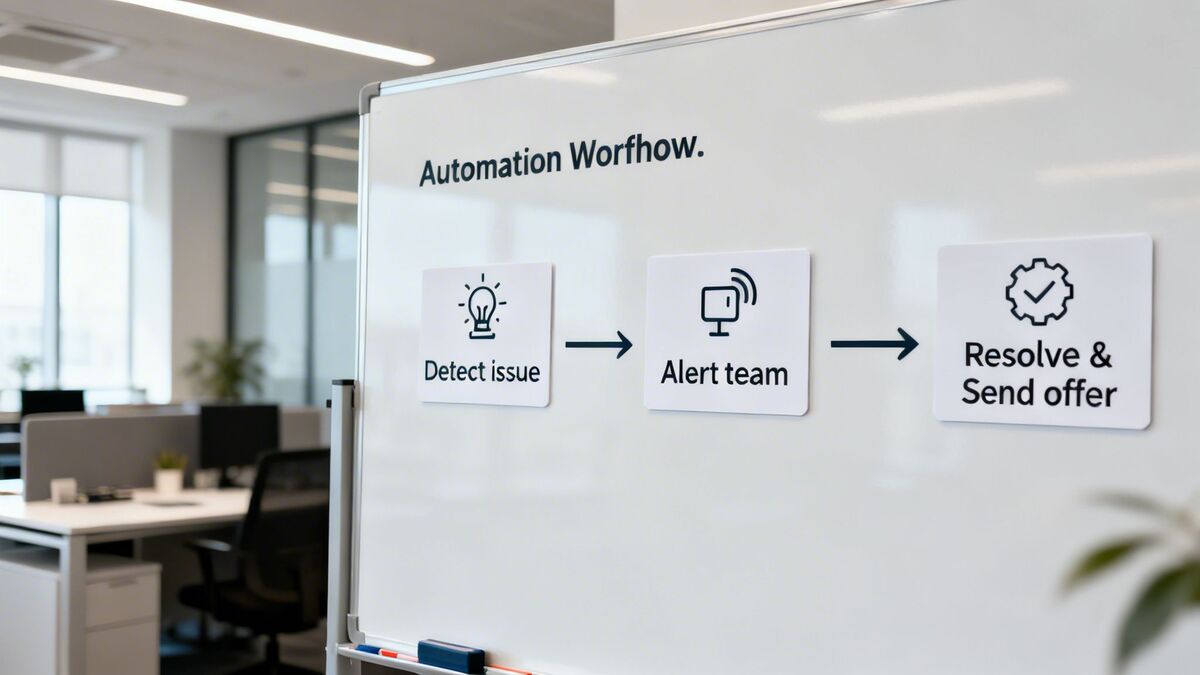
The Resolutions Engine is your tool for automated service recovery. It lets you define automatic responses and actions based on specific triggers you set. For a "cold food" review, the workflow could be:
Detect: The system flags the keyword.
Alert: It immediately pings the kitchen manager.
Resolve: It automatically drafts and sends an empathetic email to the customer, including a unique 15% off coupon for their next visit.
By setting up these rules, you ensure every unhappy customer gets a prompt, on-brand response, even if you’re not there. This turns a bad experience into an opportunity to win that customer back for good. It's a core part of an effective generative ai customer service strategy.
Integrating with Systems You Already Use
Real automation works best when it connects to the tools you use every day. A feedback system that stands alone just creates another silo. That's why seamless integration with your PMS or POS is non-negotiable.
FeedbackRobot is built to plug directly into leading hospitality platforms like Mews or restaurant POS systems like Toast. This creates a unified system where data flows freely. For example, a negative review can be automatically linked to a guest's profile in Mews, giving your front desk staff the full story for their next interaction.
Customer expectations for generative ai customer service are climbing. In fact, 75% of consumers who've used it think it will change how they interact with brands. At the same time, 79% of people still want the option to talk to a human, showing the need for a hybrid approach that blends AI's speed with a human touch.
As you build out your AI plan, it's helpful to see how it's being used in other parts of a business, like using an AI powered hiring platform to find new talent. This shows how AI can create efficiencies across your entire organization, not just in one department.
Measuring the ROI of AI-Powered Customer Service
So, how do you know if your investment in a Feedback Operating System is actually working? It’s not enough to just feel like things are running better. You need to prove it with hard numbers. This means tracking the Key Performance Indicators (KPIs) that truly show an impact on your business.
Your mission is to build an undeniable business case for generative ai customer service. The proof is always in the data. By tracking the right metrics, you can show the real-world effect AI has on your team's speed, your customers' happiness, and your bottom line.
Core Metrics to Track
To get started, focus on a few critical KPIs that tell the most important parts of the story. These numbers show how quickly you’re solving problems and how happy customers are with the answers they get.
First Response Time (FRT): This is how long a customer has to wait for that first reply. AI can slash this metric from hours down to seconds, which is a huge win for customer satisfaction. In one recent project, a public agency used AI to handle 2,700 inquiries in the first month—work that would have otherwise fallen on a person.
Customer Satisfaction (CSAT) Score: Are your customers actually happier? The best way to find out is with post-interaction surveys. If your CSAT score is climbing, it’s a solid sign that the AI-assisted responses are on the right track.
Ticket Escalation Rate: This tracks how often an issue has to be handed off to a manager. When this rate drops, it means your AI and frontline team are solving more problems on the first try, which saves everyone’s time.
To get the full picture, you have to master the different key performance metrics for customer service that truly drive success.
Turning Positive Feedback into New Business
One of the most powerful returns on investment—and one that’s often missed—is using AI to turn positive feedback into a marketing engine. Glowing reviews are your best sales tool, but only if new customers actually see them.
This is exactly where you can grow stronger with a tool designed to turn praise into profit.
The Spotlight: Feedback Wall from FeedbackRobot is your automated social proof engine. It automatically finds your best reviews from all over the web and displays them on a beautiful, branded wall you can embed right on your website.
Instead of great reviews getting lost in the noise, they become a living billboard for your brand that builds trust and brings in new bookings or sales. You directly connect the amazing service you’re providing to real business growth, closing the ROI loop for good. When you invest in a smarter feedback system, you're not just managing your reputation—you're actively building it.
Common Questions About AI in Customer Service
It's normal to have questions when you hear 'generative ai customer service'. You’re probably wondering about cost, complexity, and whether it will make your business sound like a robot.
As a hospitality or service owner, you need real answers, not just buzzwords. Let's tackle the most common concerns head-on so you know exactly what you’re getting into.
Will Generative AI Replace My Staff?
No, and it shouldn't. Think of generative AI as a power tool for your team, not a replacement. Its real job is to take on the draining, repetitive work that burns out your best employees—like writing the first draft of a reply to a common question or summarizing a week’s worth of online reviews.
This frees up your people to handle the things humans do best: solving tricky guest problems, building real relationships, and adding the personal touches that turn a good experience into a great one. A platform like FeedbackRobot is built to make your team’s job easier and more rewarding, not to replace them.
Is This Difficult to Set Up and Integrate?
The days of needing a dedicated IT team and a six-month timeline for new software are long gone. Modern AI platforms are designed for busy owners who need tools that just work. The setup is usually a simple, guided process that takes minutes, not months.
Most platforms offer no-code integrations that connect directly to the systems you already use, like hotel software such as Mews or a restaurant POS like Toast. The goal is a plug-and-play setup. You connect your feedback sources, and you can start seeing value almost immediately.
A recent public sector project successfully launched a generative AI chatbot in just over four months, handling 2,700 inquiries in its first month that would have otherwise required human intervention. This shows that rapid, effective implementation is achievable.
How Do I Keep Responses On-Brand and Authentic?
This is where a modern Feedback Operating System really shines. You train the AI on your brand’s specific voice by showing it examples of your best past responses. This ensures the tone always feels right, whether your brand is upbeat and casual or more formal and empathetic.
Better yet, a tool like FeedbackRobot is designed for a hybrid workflow that keeps you in the driver's seat. The AI generates a smart, contextual draft, but your team member gives it the final review. They can tweak a sentence, add a personal note, and then hit send.
This gives you the speed of AI with the critical final touch of human oversight, ensuring every interaction is 100% on-brand. It's how you collect smarter, act faster, and grow stronger without ever losing the genuine voice your customers know and trust.
Ultimately, data is only as powerful as the action you take with it. While spotting trends is vital, how you handle a frustrated guest in the heat of the moment is what truly defines your brand. To ensure no critique goes ignored, you can leverage our free AI Negative Review Responder to turn potential setbacks into displays of world-class service. It’s the fastest way to draft empathetic, brand-aligned replies that disarm tension and win back loyalty in seconds. By automating the 'damage control,' you free yourself to stay focused on the floor while your AI partner ensures your reputation remains spotless
Stop reading about it. Let your agent handle it.
25 free AI actions · no credit card required
Start Free
![7 Guest Retention Strategies [AI-Powered for 2026 Loyalty]](/images/legacy/WGelGexqyFsXWuP3AcaqrFJXjk.webp)