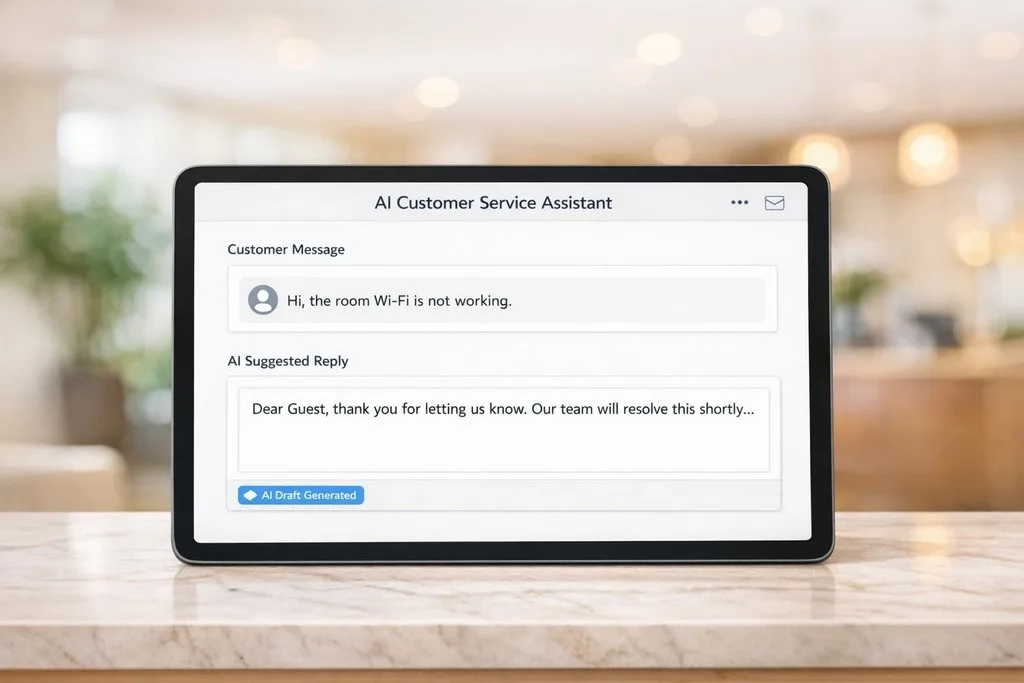
10 Generative AI Customer Service Examples (2026)
10 generative AI examples for customer service — chatbots, automated review responses, survey generation, sentiment analysis, and churn prediction.

Mar 10, 2026 · 20 min read
Free tool
AI Negative Review Responder
Turn 1-star reviews into recovery opportunities with AI-crafted responses.
You're busy running your hotel, restaurant, or service business, and every moment counts. You know exceptional service is the bedrock of your success, but keeping up with customer expectations is tougher than ever. What if you could respond faster, resolve issues before they escalate, and understand what customers really want, all while freeing up your team? That's the power of generative AI. This isn't just futuristic tech—it's a practical toolkit for today's service leaders.
In this guide, we break down 10 powerful generative AI customer service examples you can actually use. Forget the hype. We're focusing on real-world applications that help you collect smarter, act faster, and grow stronger. We'll show you how to turn feedback from a chore into your greatest asset, with actionable steps and a clear look at the business impact.
More importantly, we'll show you how these strategies work within a Feedback Operating System. You'll see how FeedbackRobot's tools make this easy. We'll connect each example to core features like Radar, our unified review intelligence dashboard; our Resolutions Engine, which provides automated service recovery; our AI Summaries for instant insights & sentiment analysis; and Prompt to Survey, which can turn a single idea into a targeted questionnaire. This is your blueprint for putting AI to work and gaining a serious competitive advantage. Let's get started.
1. AI-Powered Chatbots for Instant Customer Support
Generative AI chatbots are the new frontline of customer service, providing 24/7, real-time responses to customer inquiries across your website, apps, and messaging platforms. These aren't the rigid, script-based bots of the past. Today's AI chatbots use natural language understanding to interpret a customer's intent and generate human-like, contextually relevant answers on the spot. This immediate support drastically cuts wait times and resolves common issues on the first try.

This powerful application of generative AI customer service examples is seen in major brands like H&M, where chatbots manage order tracking and returns, and Marriott, which uses them for booking assistance. These bots handle high-volume, repetitive queries, freeing up your human team for more complex, high-touch interactions. For instance, leveraging sophisticated AI question answering technology allows chatbots to provide highly accurate and contextual responses, improving resolution times and customer satisfaction.
Strategic Application with FeedbackRobot
Integrating a chatbot with your Feedback Operating System creates a seamless loop of communication and action.
Initial Triage: The chatbot acts as your frontline, handling initial questions. It can acknowledge a customer's issue instantly, making them feel heard.
Feedback Collection: For FeedbackRobot users, a chatbot is the first point of data collection. After resolving a query, the bot can trigger our Prompt to Survey function by asking, "Was this helpful? Would you mind answering two quick questions about your experience?" to gather structured feedback directly in the chat.
Automated Routing: When an issue is too complex or requires a human touch, the chatbot automatically creates a ticket in the Resolutions Engine. This automated service recovery tool routes the issue to the correct team, ensuring a smooth handoff without the customer having to repeat themselves.
Response Refinement: By analyzing chatbot conversation transcripts and sentiment with AI Summaries, you can identify knowledge gaps. This insight allows you to refine your bot’s training data, making it smarter and more effective over time.
2. Sentiment Analysis and Emotion Detection in Customer Feedback
Generative AI excels at analyzing unstructured customer feedback from reviews, surveys, and social media to detect sentiment (positive, negative, neutral) and specific emotions like frustration or delight. This process transforms raw, qualitative text into structured, actionable intelligence. By automatically categorizing messages by their emotional tone and urgency, your team can instantly grasp what customers are thinking and feeling, allowing them to prioritize responses and spot emerging trends before they escalate.

This potent generative AI customer service example is in action across industries. Hilton analyzes guest feedback to pinpoint areas for improvement at specific hotel locations, while Chipotle monitors social media sentiment to quickly address any concerns. The core benefit is understanding not just what customers say, but the emotional context of how they say it. Deeper insights into customer sentiment analysis can guide more empathetic and effective service strategies, turning feedback into a direct line for operational improvement.
Strategic Application with FeedbackRobot
Integrating sentiment analysis within your Feedback Operating System allows you to act on customer emotion at scale.
Real-Time Monitoring: All incoming feedback is automatically scanned for sentiment. Our Radar dashboards provide unified review intelligence, visualizing these trends to show you at a glance if satisfaction is rising or falling at a specific location or across your entire brand.
Prioritized Action: FeedbackRobot's AI Summaries do more than just condense reviews; they deliver instant insights & sentiment analysis. This helps you immediately identify highly negative feedback that requires urgent attention.
Automated Empathetic Recovery: Configure the Resolutions Engine to create automated workflows based on sentiment. A review with strong negative sentiment can automatically trigger a high-priority ticket and assign it to a manager for personal follow-up, ensuring no upset customer is ignored.
Refined Service Training: Use sentiment trend data to inform staff training. If you see a rise in frustrated comments about check-in times, you have concrete data to address the issue with your front-desk team, helping you collect smarter and act faster.
3. Automated Response Generation and Reply Drafting
Generative AI can create contextually appropriate, personalized responses to customer feedback, significantly reducing the time your team spends drafting replies while maintaining a human voice. These systems learn from past successful interactions and your brand's specific tone guidelines to generate empathetic, on-brand replies. Agents can then review, edit if needed, and send these drafts with a single click, ensuring both speed and quality. This application of generative AI customer service examples helps maintain consistency across all communication channels.

This technology is already making a major impact. Starbucks, for instance, uses AI to draft replies to customer complaints about orders, while hotels generate apology and resolution offers for negative stay reviews. The goal isn't to replace the human element but to augment it. By handling the initial drafting, AI frees your team to focus on personalizing the message and managing the relationship. For proactive outreach or handling routine inquiries, leveraging advanced automated voice message systems can also significantly improve efficiency.
Strategic Application with FeedbackRobot
Integrating AI-powered reply drafting with your Feedback Operating System allows you to respond faster and smarter at scale.
Instant Drafts: When a new review arrives in Radar, FeedbackRobot's AI immediately generates a suggested reply based on the comment's sentiment and content. This eliminates the "blank page" problem for your team.
On-Brand Consistency: The AI is trained on your brand voice and successful past responses. This ensures every draft, whether for a 5-star review or a critical complaint, aligns with your communication standards and maintains a consistent, human tone.
Triggered Recovery: For negative feedback, the AI-generated response can be automatically coupled with an automated service recovery action in the Resolutions Engine. For example, the system can draft an apology and simultaneously create a task to send a discount voucher.
Smarter Responses: Our AI Summaries analyze incoming feedback to spot trends. These insights can be used to create pre-approved templates for common issues, which the AI then personalizes for each specific customer, making your response system more intelligent over time.
4. Intelligent Survey Generation and Question Optimization
Generative AI is changing how businesses gather feedback by automatically creating targeted survey questions based on your specific goals, recent customer interactions, and operational context. This moves you away from generic, one-size-fits-all questionnaires. The AI can optimize survey length, rephrase questions for clarity, and apply smart logic to maximize completion rates and the quality of responses, giving you more reliable data to act upon.
This is a key generative ai customer service example because it turns feedback collection from a manual chore into an intelligent, automated process. For instance, a hotel can generate a post-stay survey that specifically asks about the pool service because recent reviews mentioned it. Similarly, a restaurant can create a targeted survey about a new menu item to get immediate, focused feedback. These dynamic surveys feel more relevant to the customer, which drives higher engagement and provides more actionable insights.
Strategic Application with FeedbackRobot
Integrating AI survey creation with your Feedback Operating System connects the dots between what customers say and what you ask them next.
Context-Driven Creation: Instead of starting from scratch, use our Prompt to Survey feature to turn a simple goal into a well-structured survey. For example, a prompt like, "Create a 5-question survey for guests who used our spa services" instantly generates relevant questions based on industry best practices.
Targeted Deployment: After AI Summaries identifies a recurring theme in your reviews, like "slow check-in," you can automatically generate and send a specific survey to recent guests to dig deeper into that exact issue. This shows customers you are listening and actively seeking solutions.
Actionable Insights: The high-quality data gathered from these optimized surveys feeds directly into your Resolutions Engine. If a survey reveals a negative experience with a specific staff member, a ticket can be automatically created and assigned for management follow-up, ensuring automated service recovery.
Continuous Improvement: By analyzing survey completion rates and the sentiment of the responses, you can refine your survey prompts and question design. For more on creating effective surveys with AI, check out our guide on the AI survey generator.
5. Intelligent Ticket Routing and Priority Assignment
Generative AI is a powerful tool for bringing order to the chaos of customer support inboxes. It analyzes incoming customer feedback from all channels, automatically assigns priority levels based on urgency and sentiment, and routes tickets to the appropriate teams. This system learns from past resolutions and team member expertise, ensuring that critical issues get to the right person faster. This is one of the most effective generative AI customer service examples for cutting through the noise and accelerating resolution times.
This intelligent routing prevents critical issues from falling through the cracks. For example, Marriott automatically sends complaints about its loyalty program to retention specialists, while operational issues go to hotel management. A fashion retailer could route sizing questions to customer service representatives but send feedback about a torn seam directly to the quality assurance team. This ensures experts handle the problems they are best equipped to solve, improving both efficiency and the quality of the resolution.
Strategic Application with FeedbackRobot
Integrating intelligent routing with your Feedback Operating System centralizes and accelerates your response process.
Centralized Triage: All feedback, whether from email, surveys, or reviews, lands in Radar—your single source of truth. The AI then instantly analyzes the content, sentiment, and keywords to determine priority. An urgent complaint about food safety at a restaurant is flagged as high-priority, while a general inquiry is marked as low.
Automated Routing: The system uses predefined rules to send tickets to the correct team via the Resolutions Engine. For instance, a hotel can set a rule to route all feedback mentioning "dirty room" to the housekeeping manager's queue.
SLA Enforcement: For high-priority tickets, automated escalations can be triggered if they are not addressed within a specific timeframe (SLA). This ensures urgent matters never get lost or delayed.
Performance Auditing: You can use AI Summaries to analyze routing accuracy and resolution times by team. This helps identify bottlenecks or miscategorized tickets, allowing you to continually refine your AI model and routing rules for peak performance. This turns your support function from reactive to a proactively managed system.
6. Predictive Analytics for Customer Churn and Retention
Generative AI combined with predictive analytics offers a powerful method for identifying at-risk customers before they churn. By analyzing feedback patterns, interaction frequency, and behavioral signals, the system can forecast which customers are likely to leave. This proactive approach allows you to generate targeted retention strategies and personalized intervention recommendations, turning potential losses into loyalty opportunities.
This potent application of generative AI customer service examples is used by brands like Spotify, which analyzes listening habits and feedback to predict churn risk before subscription renewals. Similarly, retail chains can identify customers whose purchase frequency is declining alongside a drop in feedback sentiment. This early warning system enables companies to act decisively to retain valuable customers, a far more cost-effective strategy than acquiring new ones.
Strategic Application with FeedbackRobot
Integrating predictive analytics with your Feedback Operating System transforms reactive problem-solving into proactive retention.
Early Warning System: Use Radar to monitor shifts in feedback sentiment and frequency. A sudden drop in positive reviews or a decrease in survey responses from a loyal customer can be an early indicator of churn risk, triggering an alert for your team.
Targeted Intervention: When Radar flags an at-risk customer, the Resolutions Engine can automatically initiate a retention workflow. This might involve sending a personalized check-in email or creating a task for a manager to make a personal phone call.
Personalized Offers: The system can analyze the customer's history and feedback gathered through Prompt to Survey. Based on their preferences, it can generate a specific, personalized offer, such as a discount on their favorite product or a special service perk, to encourage them to stay.
Strategy Refinement: Track the success of different retention campaigns within FeedbackRobot. By using AI Summaries to analyze the feedback from customers who received an intervention, you can determine which strategies are most effective and refine your predictive models for even greater accuracy.
7. Personalized Recommendation Generation Based on Feedback
Generative AI analyzes customer feedback and purchase history to produce highly personalized product, service, or content recommendations. Instead of relying only on past purchases, this system identifies specific needs, preferences, and even complaints expressed in feedback to suggest relevant offerings that directly address those points. This approach turns passive feedback into active, intelligent upsell and cross-sell opportunities while genuinely improving the customer experience by demonstrating you listen.
This powerful application is one of the more advanced generative AI customer service examples, moving beyond simple problem-solving to proactive value creation. For instance, Amazon suggests complementary items based on product review feedback, not just purchase data. Similarly, a hotel can recommend dining packages based on a guest's positive feedback about a specific type of cuisine, or a clothing retailer can suggest a different brand with a better fit after a customer mentions sizing issues in a return comment.
Strategic Application with FeedbackRobot
Connecting recommendation logic to your Feedback Operating System turns customer voice into revenue.
Identify Opportunities: Use AI Summaries to analyze sentiment and pinpoint satisfied customers who are prime for upsell or cross-sell recommendations. You can also spot dissatisfied customers and recommend an alternative product or service that better meets their needs, turning a potential loss into a sale.
Gather Context: Deploy a Prompt to Survey after a purchase or interaction to ask targeted questions. For a restaurant, you could ask, "What was your favorite part of the meal?" If they mention the wine, you can recommend a similar bottle for their next visit or a wine-tasting event.
Trigger Smart Recommendations: Create rules within your Resolutions Engine to automatically send personalized recommendations. For example, if a customer's feedback sentiment is positive and they mention a specific feature, the system can trigger an email showcasing a premium service that expands on that feature.
Refine and Test: Monitor which recommendations are successful by tracking click-through rates and subsequent feedback. Use Radar to get a unified review intelligence view of how these personalized offers impact overall satisfaction scores and review ratings, allowing you to continuously refine your recommendation strategy for better results.
8. Real-Time Feedback Aggregation and Thematic Analysis
Generative AI automatically pulls together customer feedback from dozens of sources, including reviews, surveys, social media posts, and support tickets. It then identifies recurring themes, patterns, and emerging issues in real time. The system generates concise executive summaries and thematic insights, empowering your teams to make data-driven decisions swiftly and confidently. This is one of the most powerful generative AI customer service examples for transforming fragmented feedback into actionable business intelligence.
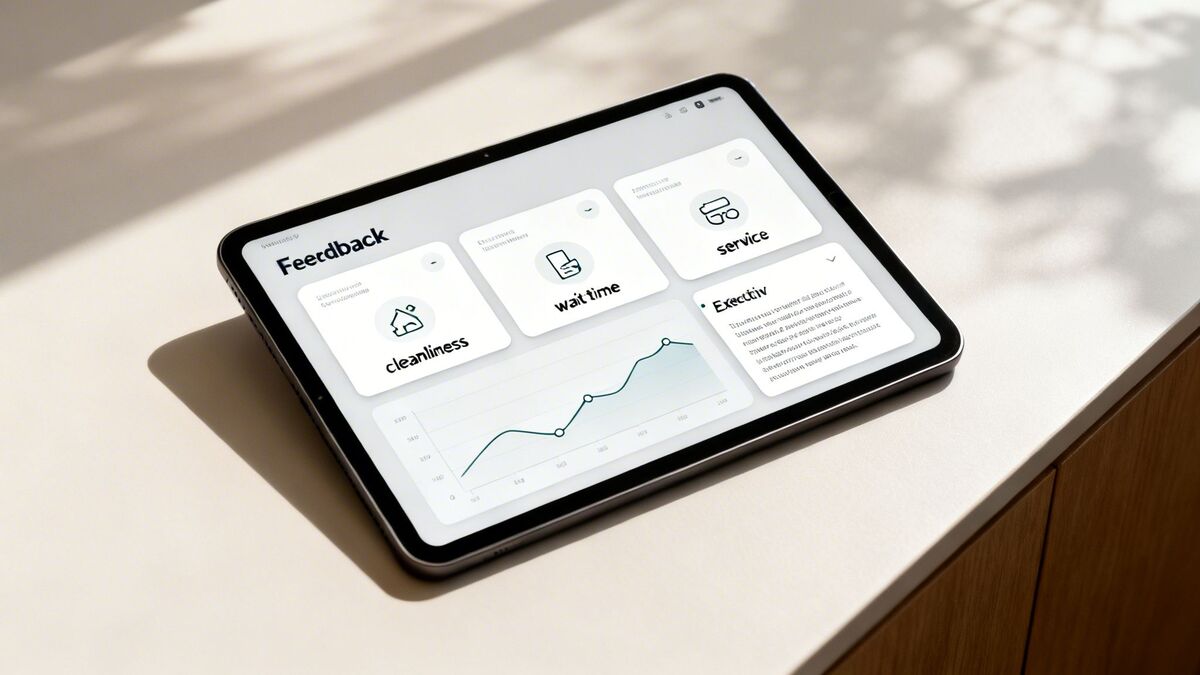
This application is crucial for multi-location businesses trying to spot trends. For instance, a hotel chain might use it to discover that multiple properties are reporting late check-in delays, or a restaurant group could uncover pricing concerns mentioned across different regions. It moves you from reacting to individual complaints to proactively addressing the root cause of systemic problems. Platforms like Brandwatch and Talkwalker have popularized this approach, and it’s a core function of the FeedbackRobot platform.
Strategic Application with FeedbackRobot
Aggregating feedback within your Feedback Operating System turns raw data into a strategic asset.
Unified Intelligence: Our Radar feature centralizes all your feedback streams into one dashboard, providing unified review intelligence. It automatically analyzes and visualizes key themes, showing you what matters most to customers across every channel.
Drill-Down Insights: AI Summaries process thousands of comments to provide instant insights & sentiment analysis. You can ask, "Summarize all feedback related to 'check-in process' this month" to get a clear picture without manual reading.
Proactive Problem Solving: Set up alerts within Radar to notify specific department heads when a negative theme, like "room cleanliness," spikes. This allows managers to address issues before they escalate.
Close the Loop: Once a theme is identified, you can use the Resolutions Engine to assign accountability and track the solution. This ensures that the insights you gather lead to real operational improvements that customers will notice.
9. Automated Knowledge Base Creation and Continuous Learning
Generative AI can automatically create, update, and maintain your internal and external knowledge bases. By analyzing support tickets, customer chat transcripts, and existing documentation, these systems identify common questions and generate clear, helpful articles. This creates a dynamic, self-improving resource where every customer interaction makes the knowledge base more accurate and valuable for the next user, significantly reducing redundant inquiries.
This is a powerful application among generative AI customer service examples, enabling businesses to scale their self-service support effortlessly. Software companies like Atlassian (Confluence) and Zendesk use this to auto-generate troubleshooting guides from support tickets. Similarly, a hotel can create a comprehensive guest information portal from common front-desk questions, while an e-commerce platform can build detailed product FAQs directly from customer feedback and reviews. The system constantly learns, ensuring content never becomes stale.
Strategic Application with FeedbackRobot
Integrating automated knowledge base tools with your Feedback Operating System turns raw customer data into a powerful self-service engine.
Content Gap Identification: Use AI Summaries to analyze customer conversations and survey responses. This instantly reveals recurring themes and unanswered questions, highlighting exactly what new articles your knowledge base needs.
Targeted Feedback Collection: Pinpoint which knowledge base articles are performing poorly or receiving negative ratings. Deploy a Prompt to Survey on those specific pages to ask users, "Was this article helpful? What information was missing?" to get precise improvement suggestions.
Proactive Issue Resolution: When a customer submits negative feedback related to a known issue, the Resolutions Engine can be automated to not only create a ticket but also send the customer a direct link to the relevant knowledge base article for an immediate solution while they wait for a human agent.
Continuous Improvement Loop: Feedback collected through your system feeds directly back into the generative AI model. This creates a closed loop where customer insights continuously refine and expand your knowledge base, improving first-contact resolution rates and reducing the burden on your support team.
10. Empathetic Issue Resolution and Apology Generation
Turning a negative customer experience into a positive one requires a swift, sincere, and empathetic response. Generative AI can be trained to analyze customer complaints, understand the emotion and specific details of the issue, and then generate personalized apologies that feel human and authentic. This goes beyond canned responses by crafting language that acknowledges the customer's frustration and offers a clear path to resolution, turning a complaint into a moment of loyalty-building.
This application is a key part of modern generative ai customer service examples, enabling brands to respond at scale without losing the personal touch. For instance, a hotel can use AI to instantly draft a response to a guest complaining about room cleanliness, acknowledging their specific feedback and suggesting a concrete make-good offer like a room change or service credit. Airlines can do the same for flight delays, generating apologies that reference the exact delay time and proactively offer compensation options, demonstrating genuine care.
Strategic Application with FeedbackRobot
Integrating empathetic response generation with your Feedback Operating System ensures that service recovery is not just fast, but also smart and effective.
Sentiment Analysis: When negative feedback arrives in your Radar dashboard, AI immediately provides instant insights & sentiment analysis. This flags urgent issues and provides context for the generated response.
Drafting Empathetic Replies: Using the complaint details, FeedbackRobot's AI can generate a draft apology. For example, if a diner's feedback mentions "cold steak," the AI will draft a reply like, "We are so sorry to hear your steak was not served at the proper temperature. That is not the standard we aim for, and we'd like to make it right."
Automated Resolution Offers: The system can suggest or automatically include pre-approved solutions from your Resolutions Engine. This automated service recovery could range from a 15% discount coupon for a restaurant to a specific compensation amount for a travel inconvenience, accelerating the recovery process. You can learn more about how this system works with feedback resolution automation.
Continuous Improvement: By analyzing which AI-generated apology templates and resolution offers lead to the highest rates of customer satisfaction and retention, you can continuously refine your service recovery strategy. This data-driven approach helps you understand what truly resonates with your customers when things go wrong.
10-Point Comparison: Generative AI Customer Service Examples
Solution | Implementation complexity | Resource requirements | Expected outcomes | Ideal use cases | Key advantages |
|---|---|---|---|---|---|
AI-Powered Chatbots for Instant Customer Support | Medium–High: channel integration and training required | Moderate compute, training data, ongoing maintenance, platform integrations | Instant responses, lower wait times, 24/7 coverage, reduced ops costs | High-volume inquiries, multi-channel support, initial feedback collection | Scales simultaneous conversations, reduces response time, routes complex issues |
Sentiment Analysis and Emotion Detection | Medium: model tuning and multilingual support needed | Labeled feedback data, monitoring, periodic model updates | Prioritized responses, trend detection, reduced manual review | Prioritizing urgent issues, satisfaction tracking, proactive outreach | Detects at-risk customers, automates emotional classification, enables empathy |
Automated Response Generation and Reply Drafting | Low–Medium: templates and brand voice training | Brand guidelines, sample replies, human review workflow | Faster drafting, consistent brand tone, reduced agent workload | Routine replies, multilingual drafting, scaling response teams | Saves agent time, ensures consistency, improves reply quality |
Intelligent Survey Generation and Question Optimization | Low–Medium: prompt design and validation | Business objectives input, A/B testing, human review | Higher completion rates, better-quality responses, faster survey creation | Post-interaction surveys, targeted research, product/service testing | Optimizes phrasing and length, increases engagement, tailors surveys to context |
Intelligent Ticket Routing and Priority Assignment | High: routing rules and team expertise configuration | Historical tickets, team profiles, SLA definitions, monitoring | Faster resolution, correct routing, balanced workloads | Complex support orgs, SLA-driven operations, high ticket volume | Ensures right-team assignment, prioritizes critical issues, reduces misrouting |
Predictive Analytics for Customer Churn and Retention | High: modeling and cross-system data integration | Historical behavior & feedback data, analytics expertise, privacy controls | Early churn detection, targeted retention, improved lifetime value | Subscriptions, high-value customers, retention-focused programs | Enables proactive interventions, focuses effort on high-value risks |
Personalized Recommendation Generation Based on Feedback | Medium–High: recommendation logic + feedback signals | Purchase/inventory data, feedback integration, testing framework | Increased AOV, better relevance, higher conversion rates | E‑commerce, hospitality upsells, product discovery | Turns feedback into personalized offers, real-time adaptation, revenue uplift |
Real-Time Feedback Aggregation and Thematic Analysis | Medium: ingestion, clustering, dashboards | Connectors for sources, compute for analysis, analyst validation | Identifies systemic issues, real-time alerts, executive summaries | Multi-channel monitoring, product QA, operational improvement | Centralizes insights, detects emerging trends, reduces manual analysis time |
Automated Knowledge Base Creation and Continuous Learning | Medium: content generation plus editorial workflow | Support transcripts, reviewers, integration with search/chatbots | More self-service, fewer tickets, faster agent onboarding | Support-heavy orgs, SaaS documentation, customer self-service | Builds institutional knowledge, improves self-service, continuously updates |
Empathetic Issue Resolution and Apology Generation | Medium: sentiment integration and tone controls | High-quality sentiment signals, human review, escalation policies | Higher complaint satisfaction, improved recovery and retention | Sensitive complaints, hospitality, healthcare, crisis responses | Produces empathetic, consistent apologies, speeds sensitive-case responses |
From Examples to Action: Activate Your AI-Powered Feedback Strategy Today
You've just seen 10 powerful generative AI customer service examples, moving from abstract ideas to concrete applications for your hospitality or service business. The common thread is a strategic shift from reactive problem-solving to proactive, intelligent operations. But knowing about these examples is one thing; putting them to work is what separates market leaders from the rest. The key is not just adopting AI, but integrating it into a cohesive system that turns feedback into your greatest asset.
Effective customer service in today's world depends on your ability to collect smarter, act faster, and grow stronger. This isn't just a catchy phrase; it's a strategic framework for success. Waiting for manual reports, guessing at customer sentiment, and letting negative reviews linger unanswered are no longer viable options for busy owners like you.
Turn Insights into Operational Excellence with FeedbackRobot
The real value of generative AI is unlocked when it becomes the engine of a complete Feedback Operating System. This is where the gap between understanding a concept and seeing real business impact is closed. Imagine a system where technology doesn't just add another task to your plate but removes several.
Go Beyond Simple Aggregation: Instead of just collecting reviews, you need to see the complete picture in one place. FeedbackRobot's Radar provides unified review intelligence, pulling data from every important channel (Google, TripAdvisor, Yelp) and integrating directly with systems like your Mews PMS or Toast POS. This connects feedback directly to specific stays, transactions, and locations, giving you context that is immediately actionable.
Ask the Right Questions, Effortlessly: The quality of your feedback depends on the quality of your questions. Instead of struggling with survey design, you can use our Prompt to Survey feature. Simply tell the AI your goal, such as, "Find out why our new seasonal menu isn't selling well," and it generates a focused, effective survey designed to get the answers you need. This is how you collect smarter.
Instantly Understand Your Data: Hours spent reading through hundreds of reviews can now be condensed into minutes. With AI Summaries, you get instant insights & sentiment analysis that tell you what customers are praising, what they're complaining about, and the emotional tone behind their words. This allows your team to skip the manual analysis and jump straight to problem-solving.
Automate Recovery and Resolution: A poor experience doesn't have to mean a lost customer. Our Resolutions Engine enables automated service recovery. When a negative review is detected, the system can draft a personal, empathetic apology, create a unique discount code for a future visit, and assign a task to the on-site manager for follow-up. This is how you act faster.
The journey from reviewing generative AI customer service examples to building a more resilient, customer-centric business is about choosing the right tools. It’s about creating a system where feedback isn't a chore, but an operational advantage that helps you improve daily, delight customers consistently, and ultimately, grow stronger.
Ready to stop managing feedback and start operating with it? Transform the examples you've read about into your daily operational reality.
How is Generative AI being used in hospitality customer service?
It’s used to draft empathetic, personalized responses to reviews and to summarize thousands of guest comments into actionable 'Executive Reports' for managers in seconds.
Can AI draft a response to a negative review?
Yes. It can analyze the sentiment of the complaint and suggest a professional, de-escalating response that a human then approves, saving 90% of the manual typing time.
What is an example of AI improving 'Service Speed'?
AI can instantly categorize incoming feedback (e.g., 'Maintenance Issue' vs. 'Staff Praise') and route it to the correct department immediately, bypassing manual sorting.
Is Generative AI 'Safe' to use with guest data?
Yes, if you use a secure platform. FeedbackRobot ensures that your business data and guest privacy are protected while providing you with the power of modern AI.
Can AI help me find 'Revenue Opportunities' in my feedback?
Yes. AI can identify 'Unmet Needs'—such as guests frequently asking for 'vegan options' or 'outdoor seating'—giving you a data-driven reason to expand your offerings.
Put this on autopilot
Sentiment Analysis for Feedback
A ready-made FeedbackRobot automation that runs this for you — deploys free in under 5 minutes.
Stop reading about it. Let your agent handle it.
25 free AI actions · no credit card required
Start Free