Best AI Customer Feedback Analysis Tools in 2026 (Ranked)
7 AI customer feedback analysis tools reviewed in depth and 10 compared on pricing, strengths and which team size each one actually fits.

Dec 12, 2025 · 18 min read
Free tool
Likert Scale Generator
Generate custom rating scales and survey questions tailored to your feedback needs.
Your team already has the feedback. It is scattered across Google reviews, Tripadvisor, survey tools, support platforms, and social channels, with no clear owner and no fast path to action. By the time someone spots a pattern, the complaint has already affected retention, ratings, or location performance.
Before comparing platforms, it helps to know exactly where your feedback currently stands. Use our free Reputation Score Calculator — it audits your review health, response rates, and recency in 30 seconds — then use this guide to find the AI tool that closes the specific gaps it finds.
That is why AI tools for customer feedback analysis matter in 2026. The market has moved past passive listening. Leaders now need systems that read messy, open-text feedback at scale, identify risk early, route issues automatically, and help teams fix the problem before it spreads.
The standard has changed. AI adoption in CX is no longer experimental. If your team still relies on spreadsheets, manual tagging, and delayed reporting, you are not merely slow. You are giving up preventable revenue and operating without a predictive layer.
If you want a sharper view of what modern platforms should deliver, start with this guide to AI-driven customer insights for CX teams.
If you need to improve collection before you upgrade analysis, this guide to sample types for customer feedback forms is a useful companion. If you are buying software, set a higher bar. Choose a platform that analyzes feedback and drives action.
What to look for in AI customer feedback analytics tools
The best ai customer feedback analysis tools do three jobs well.
First, they aggregate feedback from every channel that matters. Surveys alone are not enough. You need reviews, tickets, social comments, and location-level inputs in one place.
Second, they deliver strong AI sentiment analysis for customer reviews. Not just basic positive or negative labels, but themes, urgency, and signals your team can route immediately.
Third, they move from insight to execution. That means alerts, automated replies, workflows, and service recovery. A dashboard without action is just a nicer spreadsheet.
For hospitality, restaurants, clinics, and multi-location service brands, I would add one more filter. Avoid bloated software that takes months to deploy. Your team needs speed, clean workflows, and integrations that fit live operations.
If a tool only tells you what happened last week, it is already behind. The best platforms tell your team what needs attention now.
The 7 best tools for 2026
1. FeedbackRobot
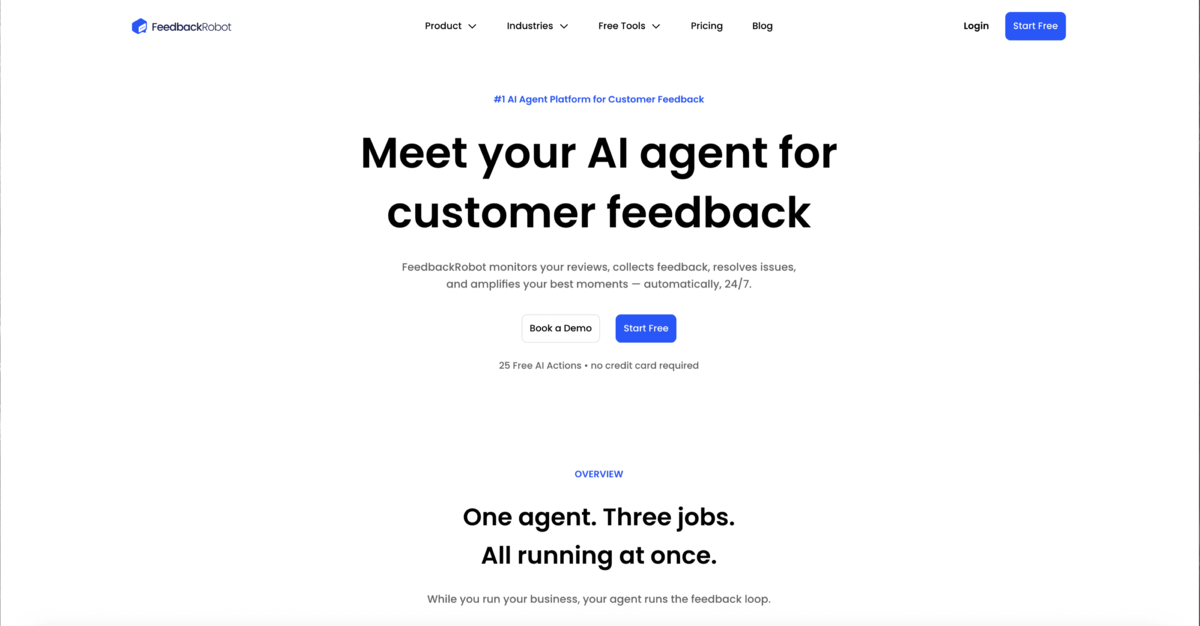
A regional operations lead gets 300 new reviews across 18 locations before lunch. Waiting for a weekly dashboard is useless. You need the tool to classify the feedback, trigger the right response, and flag risk before churn shows up in revenue.
FeedbackRobot stands out because it handles that full loop. It is built for teams that need feedback analysis tied directly to action, which is the standard that matters in 2026.
Why it stands out
The product is strongest where many feedback platforms fall short. It does not stop at tagging sentiment or grouping themes. It helps teams collect feedback faster, interpret it quickly, and launch follow-up actions without piling more work onto managers.
Prompt to Survey reduces setup time. A manager can generate a ready-to-send survey from a plain-language prompt instead of building one question by question. That matters for operators using systems like Mews or Toast, where speed to launch usually matters more than custom survey logic.
Radar gives teams one place to monitor reviews and feedback trends across channels. That cuts the tab switching and spreadsheet cleanup that slow down multi-location teams.
AI Summaries turn large volumes of comments into clear patterns. Managers can see what guests or customers like, where service is breaking down, and which locations need attention first.
The feature that gives FeedbackRobot a clear edge is Resolutions Engine. It connects analysis to service recovery through follow-ups, empathetic replies, and triggered workflows. That is the difference between a tool that reports a problem and one that helps fix it.
It also includes a generator for automated review responses and predictive reputation intelligence. That second piece matters more than the first. If your team wants to move from reacting to complaints toward spotting risk early, this is the capability to prioritize. For leaders building a stronger voice of customer program, that shift highlights where value appears.
For buyers who want more detail on how AI turns comments into decisions, FeedbackRobot’s guide to AI-driven customer insights is useful.
Best fit
FeedbackRobot fits operators who care about response speed, consistency, and accountability.
Best for hospitality and service brands: Hotels, restaurants, retail, healthcare, and professional services can collect feedback through QR codes, embeds, and review channels with little friction.
Best for multi-location teams: Shared inboxes, automations, custom domains, API access, and account support make it practical for both smaller groups and franchise networks.
Best for fast rollout: There is a free starter option, a 14-day free trial with no credit card, and paid plans starting at $99 per month.
The tradeoff is simple. High-volume teams need to check plan limits around actions and usage. Sensitive edge cases need human review, especially when a public response could escalate an issue.
If your priority is passive reporting, there are heavier platforms for that. If you want feedback analysis that leads directly to action, FeedbackRobot is one of the few tools in this list built for the job.
2. Qualtrics XM
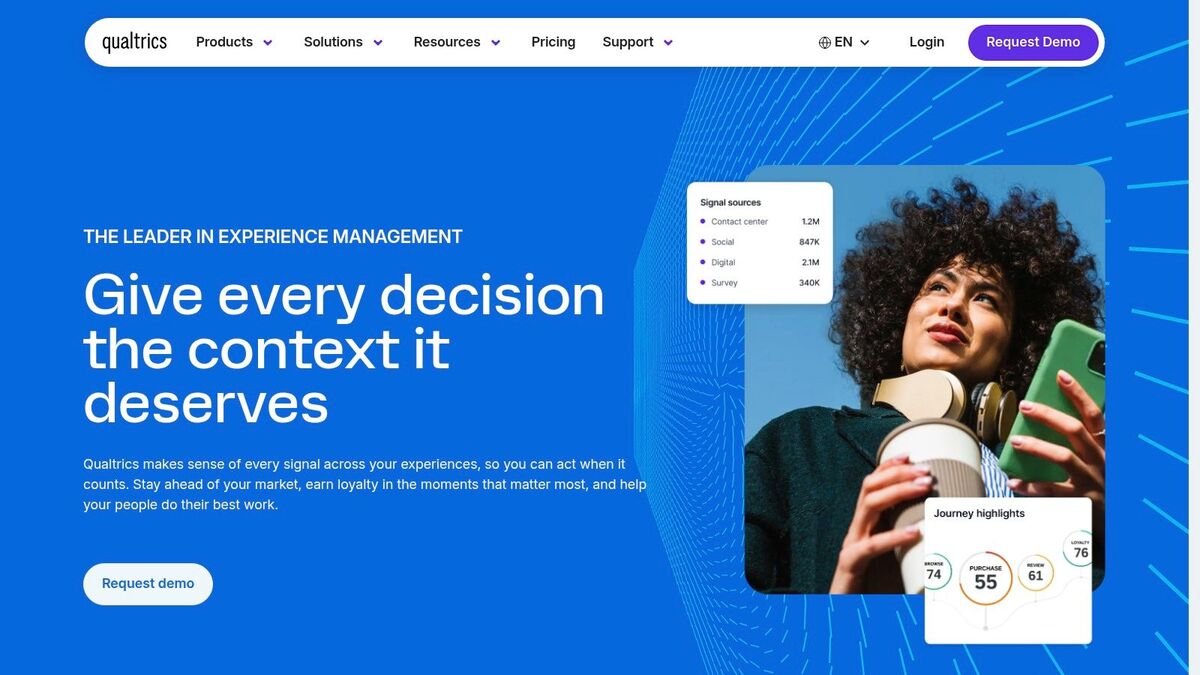
Your CX team already has the feedback. Surveys keep coming in, dashboards keep updating, and nobody wants another reporting tool. A key question for 2026 is whether the platform helps you turn signals into action fast enough to prevent churn, complaint volume, and service failures from piling up.
Qualtrics XM earns its place here because it gives large organizations structure. You get surveys, governance controls, reporting, and text analysis in one system. Text iQ can sort open-ended feedback into themes, sentiment patterns, and operational issues, which makes it useful for companies running a formal voice of customer program across multiple teams.
That said, Qualtrics feels like an enterprise command center first and an action engine second.
Where Qualtrics fits, and where it drags
Choose Qualtrics if your company values control, standardization, and internal process discipline more than speed. It works well for research-heavy organizations that need approvals, role-based access, and centralized oversight across regions or business units.
It is less compelling for lean CX teams.
Strong fit for mature enterprise programs: It handles survey operations, governance, and cross-functional reporting well.
Strong fit for teams with dedicated admins: Qualtrics rewards companies that can commit time to setup, taxonomy management, and ongoing system ownership.
Weak fit for operators who need fast action: If your priority is immediate service recovery, frontline automation, or AI-driven next steps, the platform can feel slow and admin-heavy.
This is the tradeoff. Qualtrics helps you organize feedback at scale, but many teams will still need to build the process that turns analysis into action. If your goal is to move from reactive reporting to prediction and response, check how much workflow automation you will need outside the core setup before you sign.
Visit Qualtrics XM.
3. Medallia Text Analytics
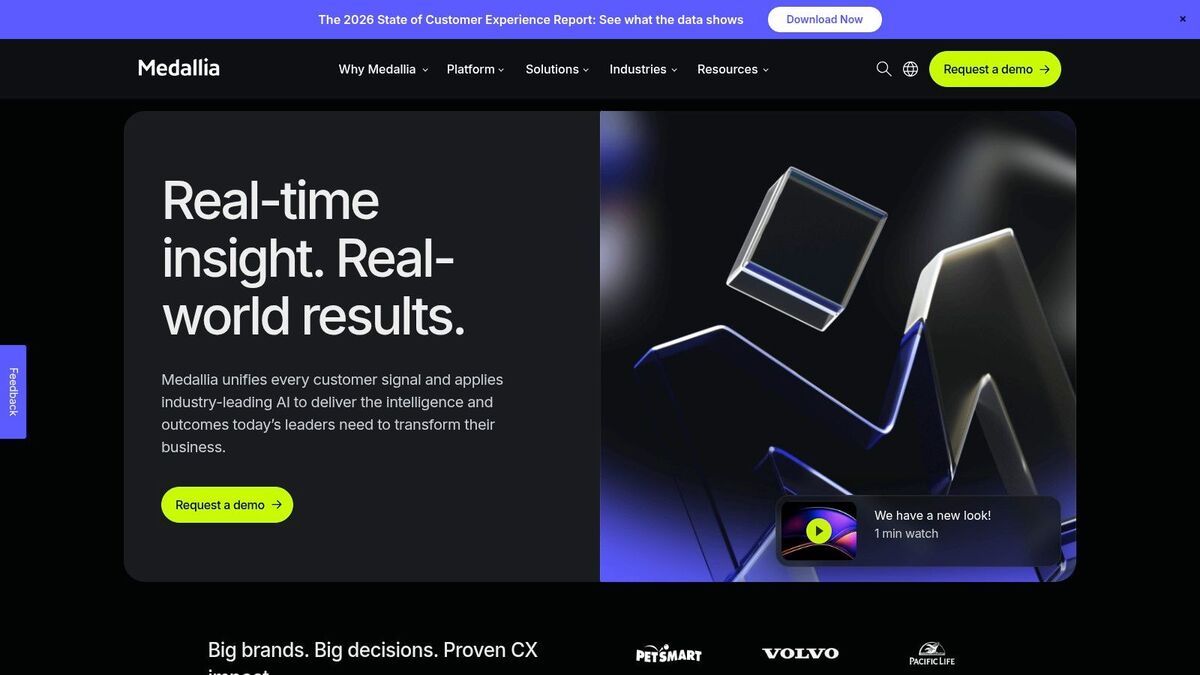
A regional team can get by with lighter tooling. A global brand with millions of comments, support transcripts, and location-level issues usually cannot. That is the buyer Medallia serves.
Medallia Text Analytics is designed for large CX operations that need one system to classify unstructured feedback across surveys, contact center interactions, reviews, and other customer channels. Its value is not just text analysis. It is the ability to connect analysis to case management, routing, governance, and executive reporting inside the same platform.
That matters in 2026. Passive dashboards are no longer enough. If your team wants to move from reading feedback to predicting risk and triggering action at scale, Medallia is closer to that standard than many reporting-first tools.
Where Medallia earns its keep
Medallia makes sense when feedback operations are already complex. Multiple business units, many customer touchpoints, strict permissions, and formal workflows all push the decision in its favor.
It is a strong choice for enterprise teams that need:
Centralized feedback intelligence: It pulls together text from multiple channels and applies structured categorization across a large operation.
Built-in operational follow-through: Teams can connect insights to alerts, workflows, and service recovery instead of stopping at sentiment review.
Governance across regions and teams: Medallia fits companies that need standard definitions, controlled access, and consistent reporting at scale.
The catch is straightforward. Medallia rewards organizations that have the budget, patience, and internal ownership to implement it properly.
Smaller teams feel that weight fast.
If you run a lean CX function and need visible time-to-value in weeks, Medallia will likely feel oversized. If you run an enterprise program and your bigger problem is coordinating action across fragmented teams, it can be a practical choice because it combines analysis with operating structure.
My recommendation is simple. Buy Medallia only if you need enterprise control and enterprise execution in the same system. If your priority is lightweight setup or fast experimentation, choose a tool with less implementation overhead.
Visit Medallia.
4. Chattermill
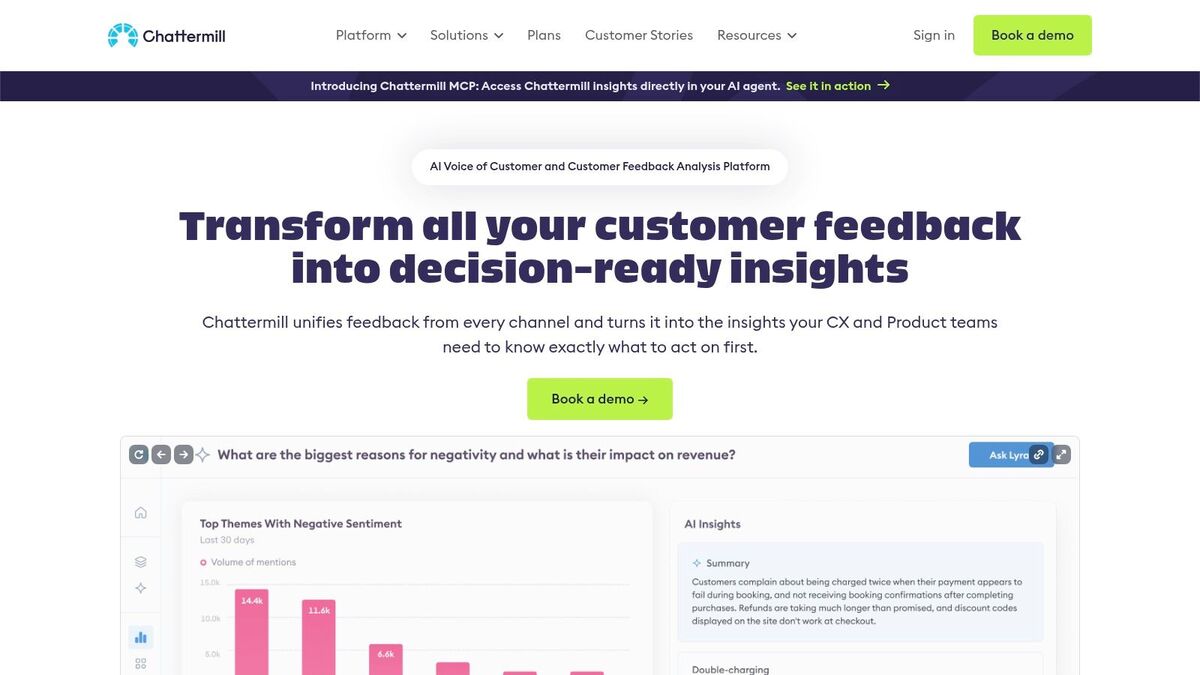
Chattermill has carved out a smart position for product and CX teams that want unified Voice of Customer analytics without buying a giant legacy suite.
It consolidates surveys, reviews, support signals, and other feedback into one analysis layer. Its product is especially useful when your leadership team wants to understand why metrics are moving, not just whether sentiment is positive or negative.
That makes it a strong option for SaaS, retail, and service brands with cross-functional product and CX collaboration.
What Chattermill does well
Chattermill is cleaner than many enterprise alternatives. It focuses on unified VOC analytics, historical trend analysis, and broad usability across teams.
Its orientation also aligns well with organizations building a formal voice of customer program, especially if product teams need direct access to recurring themes.
Where I stay cautious is execution beyond insight. Chattermill is good at analysis and visibility. It is less compelling if your main requirement is automated service recovery or direct operational action from the same platform.
Strong for insight sharing: Unlimited-user positioning is attractive for broad internal adoption.
Strong for product-led organizations: Teams can connect themes to roadmap and experience issues.
Less strong for frontline action: It is more analytics-centric than operations-centric.
Go with Chattermill if you need shared VOC intelligence across teams. Do not choose it over FeedbackRobot if your priority is to analyze and act in the same workflow.
Visit Chattermill.
5. Siena Insights
Siena Insights, formerly Idiomatic, is one of the more operationally focused tools in this group. It is designed to organize customer comments and tickets, surface anomalies, and help teams identify what to fix next.
That operational framing is a plus. Many feedback tools drown teams in themes without helping them decide what deserves action. Siena pushes harder toward root-cause detection.
Best for support-heavy environments
If your customer feedback mostly flows through support channels, Siena is worth serious consideration. Slack alerts, anomaly detection, and conversational querying can make it useful for support leaders who need fast visibility into issue spikes.
Its value is practical rather than flashy. You ask what changed. It shows the cluster. You assign the issue. The team moves.
The downside is simpler. It is not as widely recognized by buyers under its new brand, and pricing is not published publicly. That slows evaluation for managers who want easy budget comparison.
I would rank Siena above many generic text analytics tools for support operations. I would still put it behind FeedbackRobot for hospitality, multi-location service brands, and review-driven reputation workflows because Siena is less focused on public review response and service recovery automation.
Visit Siena Insights.
6. Thematic
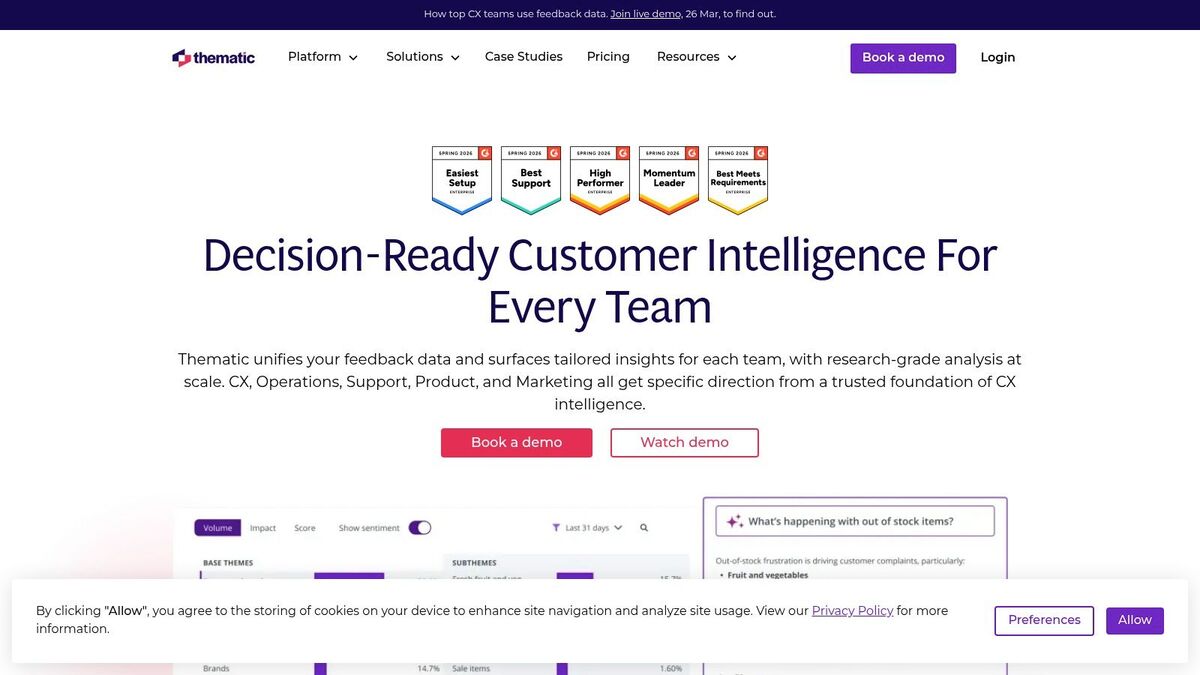
Thematic earns its place here because it makes text analytics easier to trust and easier to use. If your team is buried in survey comments, support notes, and open-text responses, it helps you identify themes, trace subthemes, and connect feedback patterns to business metrics without forcing you into a heavyweight enterprise stack.
That focus is useful.
A lot of CX platforms stop at collection and categorization. Thematic does the analysis well, but its value is highest for teams that mainly need clearer diagnosis, not full closed-loop automation. For 2026 buyers, that distinction matters. If your goal is to move from reactive reporting to prediction and action in one system, Thematic is narrower than the top end-to-end platforms in this guide.
Best for teams that need clear feedback intelligence
Mid-market product, research, and CX teams often like Thematic for a simple reason. People can understand what it is doing. The interface is cleaner than many enterprise suites, the outputs are easier to explain to stakeholders, and the platform is built around finding drivers behind scores instead of flooding teams with dashboards.
It is also easier to evaluate than vendors that hide basic commercial details until late in the sales process. In a crowded market, that matters. Busy managers need to compare cost, fit, and rollout effort quickly.
The tradeoff is scope. Thematic is strong at analyzing unstructured feedback. It is weaker if you want the same platform to trigger review responses, route issues automatically, or run service recovery workflows across locations and channels.
Choose Thematic if: you need fast, credible analysis of open-text feedback and want a cleaner alternative to sprawling enterprise software.
Avoid Thematic if: you want one platform to analyze feedback, decide the next action, and execute that action automatically.
Visit Thematic.
7. MonkeyLearn
MonkeyLearn appeals to teams that want configurable AI components instead of a complete CX operating layer.
You can build classifiers, extractors, and text workflows with APIs and no-code tools. That sounds attractive. For some teams, it is. But many buyers underestimate the effort required to make configurable tooling useful in production.
Flexible, but not turnkey
MonkeyLearn is best when you already know your taxonomy, your workflow, and your internal owner. If you need custom labels and a developer-friendly setup, it gives you room to build.
If you want a manager-friendly system that starts surfacing issues and drafting actions quickly, it is a weaker fit.
That is why I rank it lower for most service operators. Busy CX leaders do not need more flexibility. They need faster decisions.
There is also a wider risk issue in AI analysis that buyers should not ignore. Writer highlights a real underserved angle in this market, namely bias in multilingual and diverse feedback analysis. The piece notes concerns around cultural misinterpretation, lower performance in low-resource languages, and growing compliance pressure for customer-facing AI, which you can read in Writer’s overview of customer feedback analysis. If you are using a configurable model stack, that burden shifts even more onto your team.
Choose MonkeyLearn when custom model control matters more than turnkey CX execution.
Visit MonkeyLearn.
Top 10 AI Customer Feedback Analysis Tools Comparison
Product | Core features | Target audience | Unique selling points | User experience / Quality metrics | Pricing & value |
|---|---|---|---|---|---|
FeedbackRobot - Recommended | AI prompt-to-survey, sentiment & theme analysis, automated empathetic replies, shared team inbox, QR/embeds, Radar & Spotlight, automations, API | Hotels, restaurants, retail, healthcare, professional services; single locations to enterprise franchises | End-to-end AI workflow, fast onboarding, Spotlight for social proof, whitelabel & dedicated AM | Shortens response time, real-time summaries, centralized inbox, operational automations | Tiered: $99 / $249 / $599 mo (1k / 5k / 20k actions), free starter (25 actions), 14-day no-card trial, yearly ~15% off |
Qualtrics XM (Text iQ) | Text iQ topic modeling, sentiment, dashboards, integrated surveying & workflows | Large enterprises needing full XM stack (CX/EX/product) | Mature enterprise ecosystem, deep survey + text analytics, training & governance | Strong role-based reporting and drill-downs; can require admin enablement | Custom enterprise pricing; often expensive for small teams |
Medallia Text Analytics | Industry-tuned NLU, real-time anomaly detection, routing/alerts, compound topics | Large-scale CX programs, enterprise-grade deployments | Enterprise governance, strong integrations, recognized in analyst reports | Real-time alerts & anomaly detection; resource-heavy implementations | Contact sales; enterprise pricing |
Chattermill | Multi-source ingestion, AI theme & sentiment, anomaly detection, historical analysis | Product-led and CX teams seeking cross-source insights | Data-credits pricing with unlimited users, product analytics orientation | Fast insights for product teams; good for sharing at scale | Custom quotes; best value at higher volumes (≥5,000 items) |
Siena Insights (formerly Idiomatic) | Automated categorization, Slack anomaly alerts, conversational Q&A, cost-to-serve views | Support and ops teams focused on efficiency and root-cause | Conversational "chat with data", operational alerts, cost insights | Fast, actionable alerts tied to ops metrics | Pricing by demo/quote; contact sales |
Thematic | Automated theme discovery, hierarchical topics, impact analysis, HeatMap | CX & product teams, mid-market to enterprise | Explainable drivers of KPIs, clear entry pricing guidance | Self-serve insights, role-based views, KPI impact visibility | Published entry plans with annual comment caps; transparent pricing |
MonkeyLearn | Pretrained/custom classifiers & extractors, API, no-code builders, connectors | Teams needing configurable ML components and developer workflows | Highly configurable models, developer-friendly APIs & docs | Flexible and powerful but requires tuning and maintenance | Pricing not publicly listed in detail; verify with vendor |
SentiSum | Automatic ticket tagging, sentiment, native helpdesk integrations, routing/prioritization | Support teams using Zendesk, Intercom, Freshdesk, Gorgias | Native tag sync-back, fast time-to-value for support ops | Quick setup for support workflows, operational reporting | Contact sales; custom quotes |
Lumoa | AI topic modeling, generative summaries, "Ask Lumoa" Q&A, 60+ languages, APIs | Mid-market teams and pilot projects needing transparent pricing | Published pricing with free tier, unlimited users on paid plans | No-card free trial, generative summaries, self-serve Q&A | Published tiers incl free lifetime tier; entry plan response caps |
Wonderflow | Large-scale review ingestion, high-resolution sentiment, competitor benchmarking, dashboards | Consumer brands and product/marketing teams at scale | Strong review intelligence, competitor benchmarking, product insights | Valuable for product roadmapping and message optimization | Enterprise sales process; pricing by quote |
How to choose: your evaluation checklist
Picking the right AI partner is a big decision. This checklist will help you ask the right questions and focus on the features that directly impact your team's ability to act on feedback and improve the customer experience.
Feature or Capability | Why It Matters for Your Business | Key Questions to Ask Vendors |
|---|---|---|
Industry-Specific Focus | A tool built for hospitality or retail understands your unique challenges, like managing multiple locations or handling real-time guest issues. | Is your platform designed specifically for businesses like mine (e.g., restaurants, hotels, services)? |
Intuitive User Interface (UI) | Your team is busy. If the software is confusing, they won't use it. Simplicity leads to adoption. | Can my front-line staff learn to use the core features in under an hour? Can we get a live demo? |
Core System Integrations | Connecting to your POS, PMS, or CRM automates data flow and creates a single source of truth for customer interactions. | Do you offer direct, pre-built integrations with my key systems (e.g., Toast, Mews, Shopify)? |
Automated Ticketing & Routing | This ensures negative feedback never falls through the cracks. It turns a complaint into a trackable task for the right manager. | Can your system automatically create and assign a service ticket based on a negative review or survey response? |
Sentiment & Theme Analysis | Going beyond star ratings, AI can tell you why customers are happy or upset by identifying themes like "slow service" or "clean rooms." | Does your AI identify both the sentiment (positive/negative) and the specific topics mentioned in open-ended feedback? |
Multi-Location Management | If you have more than one location, you need to easily compare performance, spot trends, and manage feedback for each site. | How does your dashboard support multi-unit operators? Can I filter reports and alerts by location? |
Scalable Pricing & Features | The tool should grow with you. You don't want to be forced into a massive platform change after opening a few new locations. | What do your pricing tiers look like? How does the cost change as I add more locations or users? |
Why predictive reputation intelligence is the future
A guest leaves a two-star review at 8:12 a.m. By 10:00, the same complaint shows up in support tickets, survey comments, and social posts. If your team only responds after the review is public, you are already behind.
Predictive reputation intelligence changes the job. Instead of waiting for visible damage, it spots patterns early. You see which locations are slipping, which service issues are repeating, and which sentiment trends are about to become a reputation problem.
That shift matters because 2026 buyers should expect more than dashboards. A feedback tool should analyze signals, prioritize risk, trigger follow-up, and help teams resolve the issue before more customers pile on. Collection alone is a commodity. Analysis without action is a reporting layer.
A fundamental divide in this category is simple. Basic tools summarize what happened. Better tools explain why it happened. The tools worth buying in 2026 help your team prevent the next complaint, assign the fix, and measure whether the intervention worked.
This matters most in high-volume service environments where small failures spread fast and public feedback shapes revenue. Hotels, restaurants, clinics, and multi-location brands do not need another passive listening system. They need early warnings, automatic routing, and closed-loop recovery tied to frontline execution.
FeedbackRobot fits that direction because it connects analysis to operational response. That model is where the category is heading.
If your software cannot identify risk early, route it to the right team, and support recovery before sentiment drops further, replace it. That is the standard now.
Final Thoughts
A regional operator finds out about a service failure after ratings drop, refund requests rise, and location managers start arguing over what happened. That is how many teams run customer feedback. It is too slow for 2026.
Choose software based on what your team has to do next.
Qualtrics and Medallia suit companies that need enterprise controls, research depth, and formal governance. Chattermill and Thematic fit teams that care more about product and VoC analysis than frontline execution. Siena makes sense if support operations is the center of the problem. MonkeyLearn is still a valid option for teams that want flexible AI building blocks and have time to configure them.
For multi-location service brands, the standard is higher. The tool has to collect feedback, explain the issue, route the work, and support recovery without forcing managers into another reporting queue.
FeedbackRobot matches that operating model. Prompt to Survey helps teams collect more private feedback before frustration turns public. Radar pulls public and private signals into one view. AI Summaries cut review-reading time. The Resolutions Engine turns findings into assigned follow-up instead of leaving them in a dashboard.
The category is shifting toward systems that analyze and act in one workflow. Buyers want sentiment analysis, review response support, reputation monitoring, and issue resolution connected in the same product. Splitting that work across separate tools creates delays, weak ownership, and missed recoveries.
This constitutes a significant buying test.
If a platform cannot surface risk early, send it to the right team, and show whether the fix worked, remove it from the shortlist. Slow setup, heavy admin, and passive reporting are legacy traits. They drain attention and postpone action.
For operators in hospitality, restaurants, clinics, retail, and other high-volume service environments, FeedbackRobot is a strong fit because it ties feedback analysis to operational response. If your goal is to move from reacting to predicting, start there.
Pro-Tip: Turn Your Analysis into Social Proof Once your AI tools have helped you identify and resolve your best customer experiences, don't let those positive reviews sit idle. Use our free Review to Social Media Post generator tool to instantly transform your best Google and Tripadvisor reviews into high-impact graphics for Instagram, LinkedIn, and Facebook.
What makes an AI feedback tool different from a survey platform?
A survey platform collects data; an AI analysis tool *decodes* it. It finds hidden themes and emotional trends that standard charts and graphs miss.
How does AI handle qualitative vs. quantitative data?
Quantitative (scores) is easy. The real power is in qualitative data (text). AI reads the 'vibe' of the comments, turning messy sentences into structured, actionable insights.
Can AI analysis identify 'Feature Requests' or 'Service Gaps'?
Yes. Our AI can cluster mentions of specific items (like 'outdoor seating' or 'vegan options') to show you exactly what your market is asking for.
Do these tools integrate with Google Business Profile?
The best tools, like FeedbackRobot, pull your Google, Yelp, and Facebook reviews into one place automatically. This ensures you have a 360-degree view of your brand without logging into five different sites.
Are these tools affordable for single-location businesses?
Yes. Modern feedback platforms are built on a SaaS model, meaning you only pay for what you need. For a small business, the ROI comes from saved time and improved ratings.
Is AI feedback analysis secure?
The best tools use enterprise-grade encryption and anonymize personal data, ensuring your business intelligence is gathered safely and ethically.
Does the AI improve over time?
Yes. Through machine learning, the tool gets better at understanding your specific business context and industry jargon the more data it processes.
Put this on autopilot
Feedback Analysis
A ready-made FeedbackRobot automation that runs this for you — deploys free in under 5 minutes.
Stop reading about it. Let your agent handle it.
25 free AI actions · no credit card required
Start Free