Automated Review Request Emails: Setup Guide (2026)
Automated review request emails sent after every purchase, stay, or booking. Setup guide with copy-paste templates for Google, Yelp, and TripAdvisor.

Mar 28, 2026 · 17 min read
Free tool
Likert Scale Generator
Generate custom rating scales and survey questions tailored to your feedback needs.
Think that “thank you” email you send after a purchase is just a courtesy? Think again.
Specifically, we're talking about automated review request emails - the ones that ask guests to leave a Google, TripAdvisor, or Yelp review while their experience is still fresh.
For you, a busy hotel, restaurant, or service owner, that single, automated message is a hidden revenue engine waiting to be turned on. This isn't just another task to check off your list; it’s a core growth strategy that helps you collect smarter, act faster, and grow stronger.
Your Hidden Revenue Engine: Automated Post-Purchase Feedback

The moment a guest checks out or a diner pays their bill is a golden opportunity. Their experience is fresh, and their willingness to share an opinion is at its absolute peak. Tapping into this moment does more than just give you data—it makes your customers feel heard.
And when customers feel heard, they come back.
Why These Emails Drive So Much Growth
The numbers behind automated feedback emails are staggering. While they make up a tiny 2% of all emails sent, they are responsible for a massive 37% of all email-generated sales.
The performance gap between automated and manual campaigns is huge. Just look at the data.
Automated vs. Manual Email Campaign Performance
Metric | Automated Emails | Manual Campaigns |
|---|---|---|
Revenue Per Send | 16x Higher | Baseline |
Conversion Rate | 2,361% Better | Baseline |
This level of performance isn't an accident. It happens for a few specific reasons:
Perfect Timing: The email arrives right when the customer expects to hear from you. It feels like a natural part of the service, not a random marketing blast.
Builds Trust: Simply asking for an opinion shows you care about their experience beyond the transaction. This one act makes customers 40% more likely to make a second purchase.
While timing and trust are crucial for post-purchase feedback, an effective strategy extends beyond just a single email. True growth comes from implementing comprehensive automation workflows that manage the entire feedback lifecycle, ensuring no valuable insight is missed and every customer interaction contributes to your brand's reputation. Discover how to build these powerful systems by exploring customer feedback automation workflows.
Catches the "Glow": That post-purchase feeling is real. Customers are often still feeling good about their experience, and your email gives them a perfect outlet to share that positivity.
This one move—automating your feedback requests—turns a one-time transaction into an ongoing relationship. It's how you start a cycle to collect smarter, act faster, and build a stronger business.
From Raw Feedback to Actionable Intelligence
But the real power isn't just in asking for feedback; it's what you do with the answers. A flood of comments is useless if you don't have a system to make sense of it all.
This is where your Feedback Operating System comes into play. It’s the engine that transforms raw opinions into clear, actionable intelligence. For example, our AI Summaries feature can instantly digest hundreds of responses to pinpoint recurring themes and analyze sentiment, highlighting things like a slow check-in process or a rave-worthy new menu item.
By connecting this system to your daily operations, you close the loop between hearing from a customer and actually making an improvement. Every response from your automated feedback surveys becomes a chance to either fix a problem or double down on what you’re already doing right. This is how a simple email becomes a powerful engine for non-stop growth.
Building Your Feedback Operating System
Before a single automated email goes out, you need to build the foundation. This isn't just about ticking off tasks; it's about creating a central nervous system for all your customer intelligence. Think of it as your Feedback Operating System—a single hub where every piece of customer feedback, from every channel, lives.
For a busy hospitality or service owner, this isn’t just software. It’s a machine that helps you collect smarter, act faster, and grow stronger.
Your customers are talking about you everywhere—on Google, Yelp, TripAdvisor, and social media. Trying to keep up manually is like trying to catch rain in a thimble. You need one unified view.
This is where a dedicated tool becomes essential. FeedbackRobot’s Radar feature, for instance, was built to solve exactly this problem. Radar is your unified review intelligence dashboard that pulls in feedback from every major platform into one real-time stream. Instead of juggling a dozen logins, you get one consolidated view of what people are saying, letting you spot trends instantly.
Why Integration Is Non-Negotiable
A Feedback Operating System only works if it’s plugged into your daily operations. The most crucial connection is with your core business software, whether that's your Property Management System (PMS) or Point of Sale (POS).
For a hotel, that means integrating with a system like Mews. When a guest checks out, that action should automatically trigger your feedback request. For a restaurant, a finalized bill in Toast should do the same. This direct integration is the engine of your automation.
It ensures perfect timing: Emails are sent based on real-world events, not manual batch-and-blast campaigns.
It guarantees relevance: The request is tied directly to a recent, specific experience.
It removes human error: No one has to remember to press "send."
Without that link, your "automated" system is still fundamentally manual, relying on someone exporting and uploading lists. True automation happens when your systems talk to each other, freeing up your team to focus on the guest experience, not admin work.
From Idea To Insight In Minutes
Let's be honest—one of the biggest hurdles for busy owners is just finding the time to create a good survey. You know you need the feedback, but carving out hours to write questions, design a layout, and set up the logic feels impossible. A true Feedback Operating System removes that friction.
Imagine having an idea for a quick survey about your new menu and being able to launch it in minutes, not days. That's the goal.
This is exactly why we built Prompt to Survey into FeedbackRobot. Prompt to Survey lets you type a simple instruction—like "Create a 3-question survey about the brunch experience"—and our AI instantly generates a polished, ready-to-send survey. It turns the tedious process of survey creation into a simple conversation, so you can act on an idea while it's still fresh.
To truly build a complete system, you need to manage your public reputation, too. This is where tools like dedicated Google review software come in. By combining your internal survey tool with external review management, you create a complete, 360-degree view of customer sentiment. That holistic approach is what a modern Feedback Operating System is all about.
Crafting Feedback Emails That Get Opened and Answered
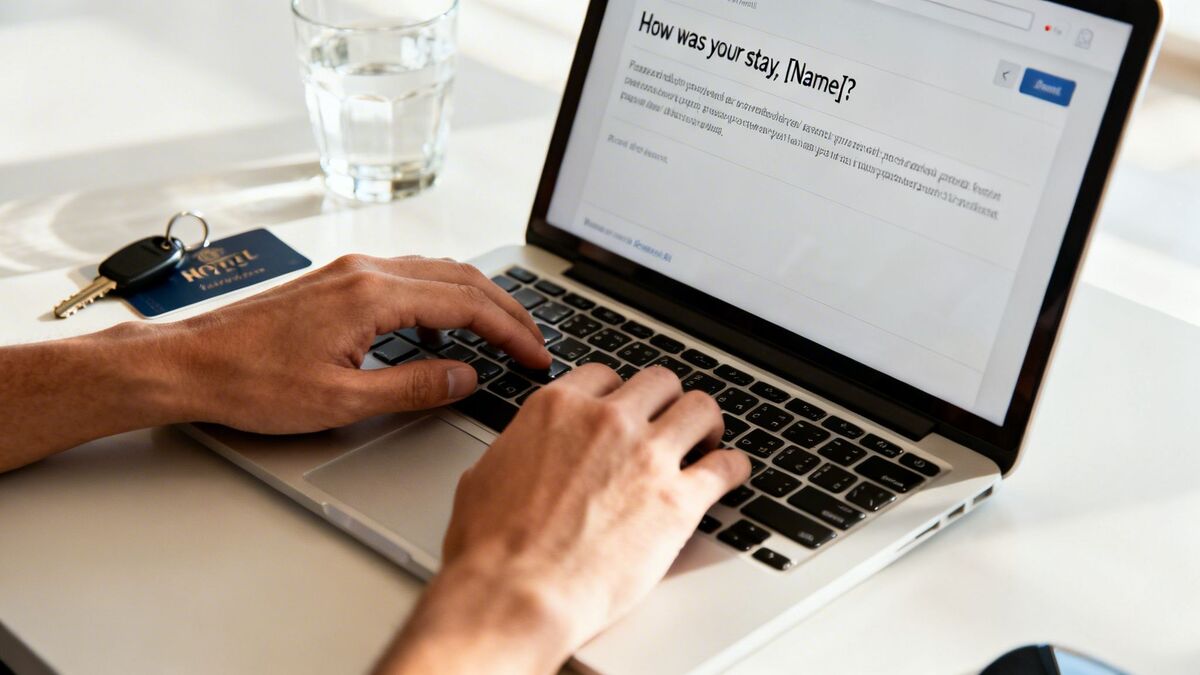
An automated feedback email is useless if it never gets opened. With inboxes overflowing, your message has to prove it’s worth a customer's time, and fast. It’s not about just blasting out a survey; it’s about starting a real conversation.
The first hurdle is always the subject line. This is your only shot to make an impression. Forget generic lines like "Your Feedback is Important"—they're a one-way ticket to the trash folder.
Instead, your subject line needs to be clear, personal, and signal that there's value inside. A few simple tweaks here can make all the difference.
Subject Lines That Cut Through the Noise
Think from your guest's perspective. They just had an experience with you, so anchor your request to that specific moment.
For a hotel guest: "How was your stay with us at The Grandview, [Guest Name]?"
For a restaurant diner: "A quick question about your dinner with us last night."
To create urgency: "Share your thoughts & get 10% off your next visit."
See how direct and personal these feel? They reference the actual event and sometimes offer a clear incentive. This simple shift turns a corporate-sounding request into a genuine follow-up.
Personalization Beyond the First Name
The real power move is going beyond just a first name. True personalization taps into data from your operational systems to make the email hyper-relevant to a customer’s specific experience. This is where integrating your feedback platform with systems like Mews or Toast becomes a game-changer.
Let's say a guest stayed in a particular room or a diner ordered a signature dish. Your automated email should absolutely reflect that.
The best feedback requests feel less like a generic survey and more like a real conversation. They show you paid attention to the details, which makes customers far more willing to share details of their own.
For instance, a hotel could ask, "Did the ocean view from your King Suite meet your expectations?" That’s infinitely more engaging than a bland "How was your room?" It shows you know exactly who they are and what they paid for.
Likewise, a restaurant using a Toast integration could ask, "We saw you tried our new seasonal risotto. We'd love to know what you thought!" This level of detail makes customers feel seen and valued, not just like another order number.
Asking Questions That Lead to Action
Once they've opened the email, the questions you ask will dictate the quality of the feedback you get back. Steer clear of vague, open-ended questions like "How was everything?" They only lead to vague, useless answers like "It was fine."
Your goal is to get smart feedback you can actually use. That means you need to ask smarter questions.
Closed-ended questions for easy data: Use star ratings or simple "Yes/No" choices for key metrics like cleanliness, staff friendliness, or food temperature. This gives you quantifiable data you can track over time.
Specific open-ended questions for rich insights: Follow up a rating question with a targeted prompt. Instead of asking "Any other comments?" try, "What is one thing we could have done to make your check-in experience perfect?"
This approach guides the customer toward giving you the precise, actionable information you need. For a deeper dive into survey design, check out our guide on how to email a survey that gets real results. It’s a strategy that turns a simple email into a powerful tool for improving operations, training your team, or perfecting your menu.
Perfecting Your Automation Timing and Triggers
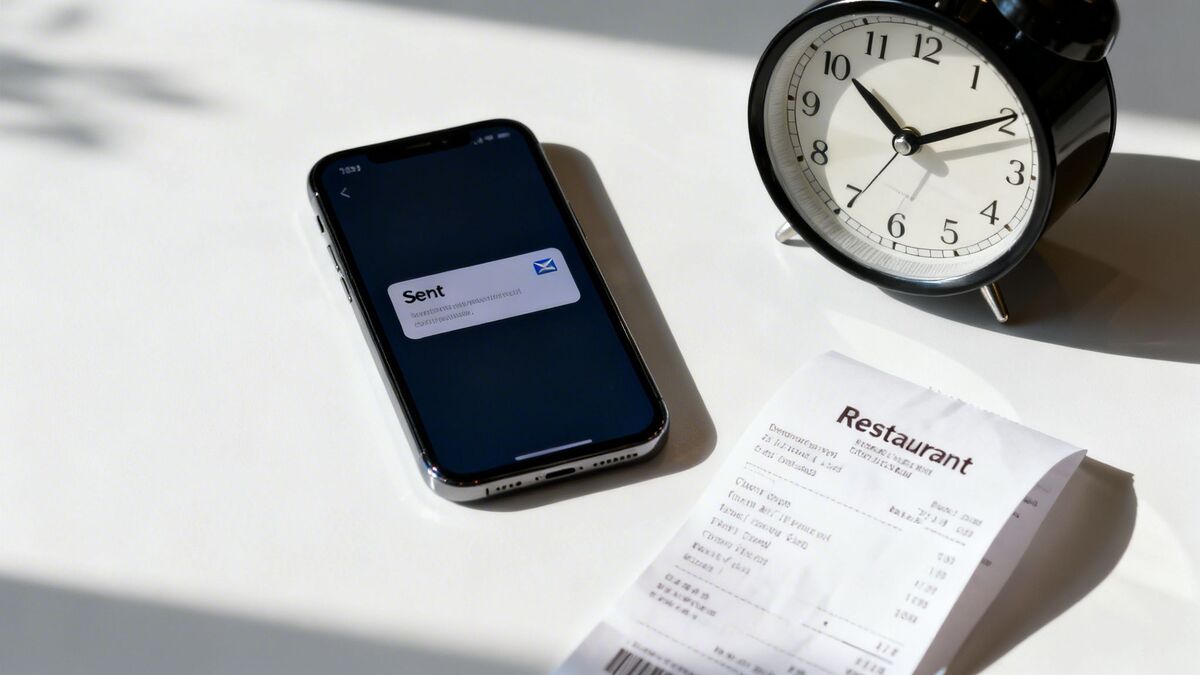
You can write the world's best feedback email, but if it shows up at the wrong time, it's just noise. Send it too soon, and your customer hasn't had a chance to form an opinion. Send it too late, and their experience is already a fuzzy memory.
Timing is everything. Getting your request in front of a customer while the experience is still fresh is the single biggest factor in getting a thoughtful response. It turns your email from an interruption into a welcome follow-up.
Finding the Golden Window
So, what's the perfect time to ask? It’s completely different for every type of business. You wouldn't ask a diner for feedback a week after their meal, just like you wouldn't survey a hotel guest before they’ve even packed their bags.
We see it over and over again in the data: the moments immediately following the experience are when engagement is highest. Emails sent within the first 24 hours after a transaction can see open rates as high as 68%. This is your golden window. To learn more about how timing impacts customer retention, check out this excellent post-purchase email guide.
A perfectly timed feedback email feels like part of the service. It shows you care about their opinion at the exact moment they’re most willing to share it. This small detail is often what separates a deleted email from a detailed, valuable response.
For a hotel guest, the trigger is checkout. The best window is usually 2-4 hours after they've left. By then, they've settled their bill, are on their way home, and have a quiet moment to reflect on their stay.
For a restaurant, the window is much tighter. The trigger is when the check is closed in your Toast POS. You'll want to send the feedback request within 30-60 minutes after they leave, while the food, service, and atmosphere are still crystal clear in their mind.
Getting this timing right is crucial, and it varies more than you might think.
Optimal Email Timing by Industry
Here’s a quick breakdown of the ideal send windows we've seen work best across different service industries.
Industry | Optimal Send Window | Primary Goal |
|---|---|---|
Hotels & Hospitality | 2–4 hours post-checkout | Capture detailed stay feedback |
Restaurants & Cafes | 30–60 minutes post-payment | Get fresh opinions on food & service |
Spas & Salons | 1–2 hours post-appointment | Assess service quality & satisfaction |
Healthcare & Clinics | 24 hours post-visit | Check on patient experience & follow-up |
Events & Venues | 24–48 hours post-event | Gather feedback on the overall experience |
These aren't just guesses; they're starting points backed by data on when customers are most likely to open, click, and respond.
Setting Up Your Triggers
This kind of precision isn't possible by hand. It requires automation that’s powered by direct integrations with the tools you already use. A modern Feedback Operating System connects right into your core software—like your Property Management System (PMS) or Point of Sale (POS)—to create triggers based on real-world events.
Your systems do all the heavy lifting. Mastering this kind of email automation is what takes your feedback strategy from good to great.
Here’s what that looks like in practice:
For a hotel using Mews: When a guest's status changes to "Checked Out" in Mews, your feedback system can automatically send the survey after a preset delay, like 3 hours.
For a restaurant using Toast: As soon as an order is paid and closed in Toast, it triggers the feedback email to be sent after your chosen delay, say 45 minutes.
These triggers are the backbone of a strategy to collect smarter. They ensure every single feedback request goes out at the moment of peak relevance, completely removing manual work and guesswork. You set the rules once, and the system executes perfectly, every time. It’s not just about being efficient—it's about making sure you never miss a chance to capture crucial insights while they're still fresh.
Turning Customer Feedback Into Action and Growth
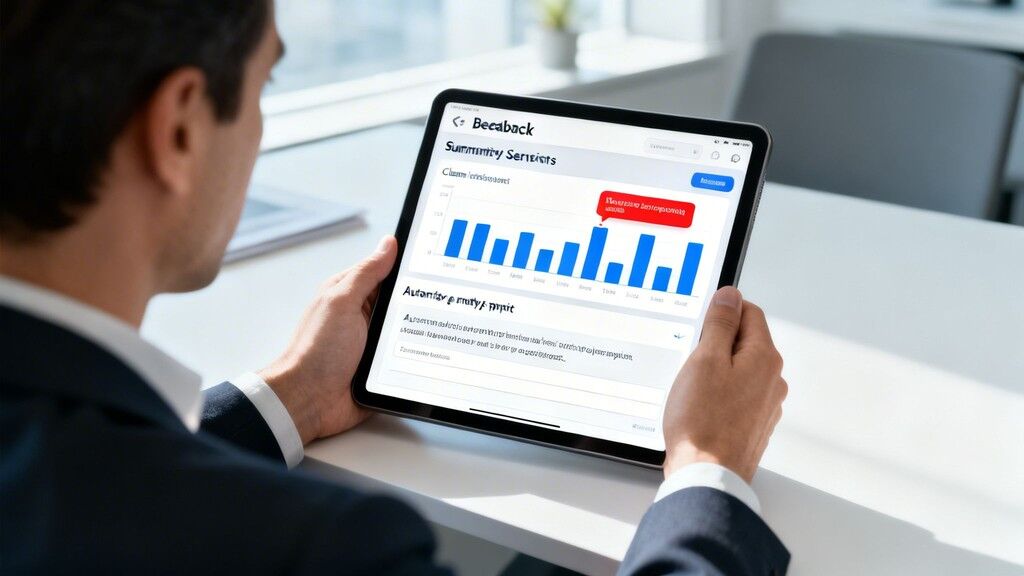
Collecting feedback is just the first step. The real growth happens when you turn those raw comments and scores into real-world improvements. A flood of survey responses is just noise until you have a system to translate it into action.
As a busy owner, you don't have time to manually sift through hundreds of comments, trying to connect the dots. This is where automation stops being a buzzword and becomes your most valuable employee, letting you act faster on feedback without drowning in it.
Find the Signal in the Noise with AI
Imagine trying to read every single comment from every customer, every day. It's not scalable. You need a way to get straight to the point.
This is exactly what our AI Summaries feature does inside FeedbackRobot. This tool instantly analyzes all your feedback for insights and sentiment, so you get the big picture without reading every word.
Spot recurring issues: Is "slow check-in" mentioned a lot? Are customers consistently praising a specific product? The AI bubbles these themes right to the top.
Understand sentiment at a glance: The system automatically tags feedback as positive, negative, or neutral, so you get an instant read on the overall mood.
Track changes over time: See if sentiment around a key topic, like "room cleanliness," is getting better or worse after you’ve made changes.
This isn’t about replacing your judgment; it’s about sharpening it. The AI pinpoints exactly where you need to focus, saving you hours and making sure critical insights never slip through the cracks.
Automate Service Recovery and Close the Loop
Responding to negative feedback is one of the most powerful ways to build loyalty, but it has to be fast. A complaint left unanswered for days just makes a bad situation worse. A swift, empathetic response, however, can turn a disappointed customer into your biggest fan.
This is where automation becomes your service recovery superpower.
Closing the loop on negative feedback in real-time is no longer a 'nice-to-have'—it's a critical part of the modern customer experience. When you resolve an issue quickly, you're not just fixing a problem; you're building a reputation for incredible customer care.
We built the Resolutions Engine for this very reason. It’s a powerful automation tool that identifies negative feedback and instantly kicks off an automated service recovery workflow that you define. You set the rules once, and the system executes them perfectly, 24/7.
For example, if a survey response contains negative keywords like "unclean" or scores below 2 stars:
The Resolutions Engine can instantly send an empathetic apology email to the customer.
At the same time, it can trigger a notification with all the details to your on-site manager.
You can even have it automatically include a discount code for a future visit, turning a bad experience into a reason to come back.
This automated process ensures every unhappy customer gets a response and their issue gets addressed. You close the loop before they even think about posting a negative review online. For a deeper dive into making sense of customer comments, our guide to analyzing survey data has more practical tips.
Showcase Your Wins to Build Social Proof
Finally, all that positive feedback is a marketing goldmine. The glowing comments from your automated post-purchase feedback emails shouldn't just sit in a spreadsheet. They are powerful social proof that can convince new customers to choose you.
Turn your best feedback into your best marketing. With FeedbackRobot's Spotlight: Feedback Wall, you can automatically showcase your favorite reviews right on your website. It’s a simple but powerful way to build trust and let your happy customers do the selling for you. This completes the cycle: you collect feedback, act on it, and then use the positive results to attract even more business.
Start Collecting Smarter Feedback Today
You've got the playbook. Now it’s time to stop letting valuable customer insights slip through the cracks and start putting this plan into motion.
The difference between a good feedback strategy and a great one comes down to action. You can't just collect data; you need a system to act on it, fast.
Operationalize Your Feedback
Turning theory into real-world results requires a tool built for busy operators. This is where FeedbackRobot comes in. We designed it to operationalize this entire process, turning simple interactions into your most powerful engine for loyalty and growth.
Your Feedback Operating System is what connects the dots between collecting insights and taking meaningful action. It makes sure every piece of feedback—from every channel—is actually seen, understood, and handled, driving real improvements.
Our platform plugs directly into systems like Mews or Toast, firing off perfectly timed feedback requests without you lifting a finger.
Once that feedback starts rolling in, the real magic begins. You can:
Unify every review and survey response in one place with Radar to finally see the big picture.
Instantly grasp themes and customer sentiment using our AI Summaries.
Automate service recovery and turn bad experiences around with our Resolutions Engine.
The best time to start was yesterday. The next best time is right now. See for yourself how simple it is to turn customer feedback into your biggest advantage.
Ready to see how it works? Check out our brand new Spotlight: Feedback Wall to see how our clients are showcasing their success. Or, even better, kick off your 14-day free trial today and start collecting smarter feedback by tomorrow.
Expert FAQ
We get a lot of questions from hospitality and service owners about setting up automated feedback. Here are the answers to the ones that come up most often.
How Do I Avoid Annoying My Customers?
The key isn't volume, it's relevance. A generic marketing blast is annoying. A feedback email sent right after a guest checks out of your hotel via Mews or pays their bill on Toast isn't. It’s expected.
Because the email is triggered by a specific action they just took, the message feels personal and timely.
The best way to respect your customers' time is to use smart frequency caps. For example, you can set a simple rule that stops the system from sending a new request to a guest who gave you feedback in the last 30 days. This way, you're communicating smartly, not just loudly.
What Is the Single Most Important Metric to Track?
Open and click-through rates tell you part of the story, but the metric that actually matters is what we call the Actionable Insight Rate. This is the percentage of feedback that leads directly to a tangible business improvement or a successful service recovery.
It’s all about outcomes, not just engagement.
Inside FeedbackRobot, you can track this in two specific ways:
The Resolutions Engine shows how many negative experiences were automatically flagged and resolved. This turns a complaint into proof of incredible customer care, all without you lifting a finger.
AI Summaries instantly scan all your feedback for recurring themes. This gives you a high-level view of what's working and what isn't, so you can pinpoint operational issues and fix them fast.
This focus on action is how you stop just collecting data and start growing from it.
Your goal isn't just to hear from customers; it's to learn from them. Tracking actionable insights ensures your feedback program directly contributes to operational excellence and business growth.
Can I Automate This with My Specific POS or PMS?
Absolutely. Modern feedback platforms are built to integrate with the tools you already use. Connecting to systems like Toast, Mews, or your own CRM isn't just a nice-to-have; it's what makes this whole strategy work.
This is the engine that powers true automation.
When your systems are connected, a guest checking out or a customer paying a bill automatically triggers the right feedback email at the perfect time. This direct link between your operations and your feedback program gets rid of all the manual work, cuts out human error, and puts your entire feedback strategy on autopilot.
Ready to turn customer feedback into your biggest growth driver? FeedbackRobot makes it simple to collect smarter, act faster, and grow stronger.
Start your Free 14-Day Trial now and launch your first automated feedback campaign tomorrow.
Beyond simple automation, how does a direct integration with a PMS like Mews or a POS like Toast fundamentally alter the guest's perception of the feedback request?
Integration ensures hyper-relevance by anchoring the request to a specific, recent event—such as a specific room stay or a particular dish ordered. When a guest receives a query about the "ocean view from their King Suite" rather than a generic "how was your stay," the interaction shifts from a cold marketing touchpoint to a professional follow-up. This precision demonstrates operational excellence and makes the customer 40% more likely to return because they feel seen as an individual rather than a transaction number.
For a high-volume operator, how do AI-driven summaries bridge the gap between raw data collection and actual operational changes?
Raw data is often a "thimble in a rainstorm" for busy owners; AI Summaries act as a filter that distills hundreds of disparate comments into high-level sentiment trends and recurring themes. Instead of manually auditing every response, you can instantly identify if a "slow check-in process" is a systemic failure or a one-off incident. This allows management to allocate resources toward specific friction points—like staff training or menu adjustments—based on quantified evidence rather than anecdotal guesswork.
How can an automated "Resolutions Engine" effectively mitigate the risk of negative public reviews on platforms like TripAdvisor or Yelp?
The key is closing the feedback loop before the customer resorts to public forums. By setting triggers for low star ratings or negative keywords like "unclean," the system initiates an immediate, empathetic service recovery workflow. An automated apology or a corrective offer sent within the "golden window" of the experience can neutralize frustration in real-time. This proactive approach captures the issue internally, giving the manager a chance to resolve the grievance before it impacts the brand's public reputation.
Why does the "Golden Window" for feedback response vary so significantly between a restaurant and a healthcare clinic?
The decay of experiential memory dictates the timing: a restaurant guest’s sensory experience—taste, service, and atmosphere—is most vivid 30–60 minutes post-payment, whereas a healthcare patient may need 24 hours to process their visit and assess the clarity of follow-up instructions. Respecting these industry-specific cadences ensures the request feels like a natural extension of the service cycle. Sending a request too early can be intrusive, while sending it too late results in "fuzzy" data that lacks the detail necessary for meaningful operational pivots.
What is the tactical advantage of using "Prompt to Survey" AI for short-term operational experiments, such as testing a new seasonal menu?
Traditional survey design often creates a bottleneck that prevents owners from gathering data on time-sensitive initiatives. The "Prompt to Survey" feature removes this friction by generating professional, logic-based questionnaires from simple natural language instructions in minutes. This agility allows you to move from an operational idea to live data collection immediately, ensuring you can "double down" on successful pilots or pivot away from unpopular offerings before they negatively impact your bottom line.
Put this on autopilot
Review Request Email
A ready-made FeedbackRobot automation that runs this for you — deploys free in under 5 minutes.
Stop reading about it. Let your agent handle it.
25 free AI actions · no credit card required
Start Free