
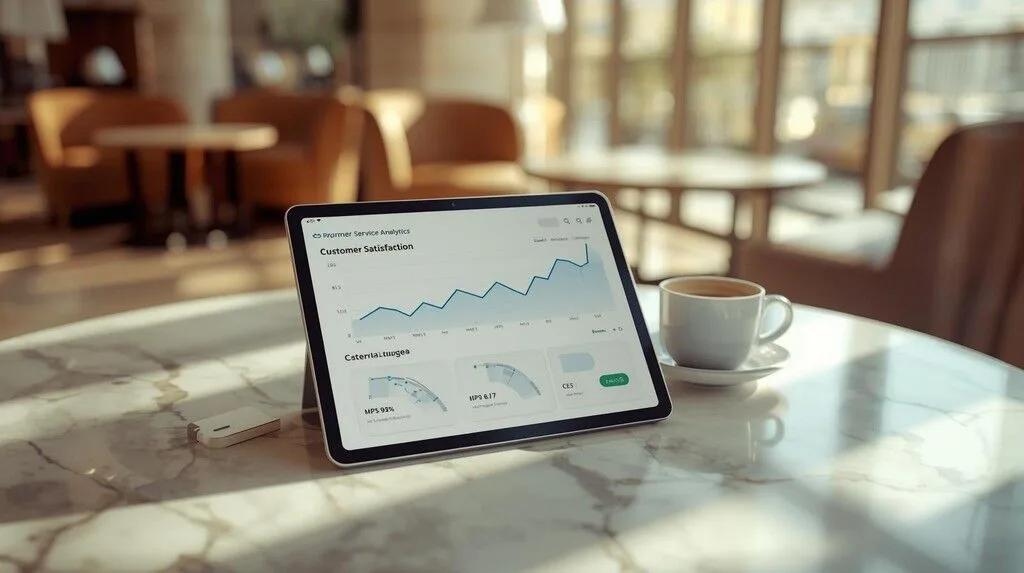
Guide
How Do You Measure Customer Service? A Guide for Busy Hospitality Owners
Learn how do you measure customer service with practical KPIs and actionable strategies. See real examples for hospitality businesses to boost guest loyalty.

Feb 19, 2026 · 12 min read
Free tool
AI Survey Generator
Describe what you want to learn and get a ready-to-send survey in seconds.
Measuring customer service isn't just about tracking vanity metrics like Customer Satisfaction (CSAT) or Net Promoter Score (NPS). For a busy hospitality owner like you, it’s about building a system that moves you beyond guesswork. It’s about using real feedback and hard data to understand what your guests truly feel, spot operational hang-ups before they become bad reviews, and prove your team's impact on the bottom line. It's how you collect smarter, act faster, and grow stronger.
Move Beyond Gut Feelings in Customer Service

As a leader in hospitality, you know incredible service is your single most valuable asset. But can you actually prove it?
Relying on intuition or the occasional glowing comment isn't a strategy for growth; it’s a gamble. The hard truth is, without a systematic way to measure your service, you're flying blind. You can't tell the difference between a one-off bad day and a recurring flaw that's quietly bleeding you business.
This is exactly why a modern measurement framework is non-negotiable. It's the critical difference between reacting to problems—usually after a scathing review goes public—and proactively managing the entire guest experience from start to finish. For a deeper dive into the mechanics, this guide on Measuring the Customer Experience is a great starting point.
Building a System to Listen and Grow
A structured approach brings much-needed clarity. It lets you connect the dots between your team's performance, guest happiness, and your profitability. Experts call this the service-profit chain, which shows a direct, powerful link between a supported, happy team and a loyal, profitable customer base. Your job is to build a system that fuels this cycle.
When you adopt this mindset, you can suddenly:
Pinpoint Strengths and Weaknesses: Know exactly which parts of the guest journey are creating "wow" moments and which are causing friction.
Motivate Your Team: Use real data to recognize your top performers and offer targeted coaching where it's actually needed.
Justify Investments: Finally prove the ROI of that new training program or technology upgrade you’ve been wanting.
The core idea is simple but powerful: what gets measured gets managed. When you truly listen to the Voice of the Customer, you gain the insights to make smarter decisions, act faster, and build a more resilient business.
This guide will walk you through building that exact system. We'll break down the essential metrics every hospitality business must track and show you how to turn raw feedback into your most powerful tool for growth. It’s all about creating a continuous loop where every guest interaction becomes a lesson to help you get better.
Choosing the KPIs That Actually Matter
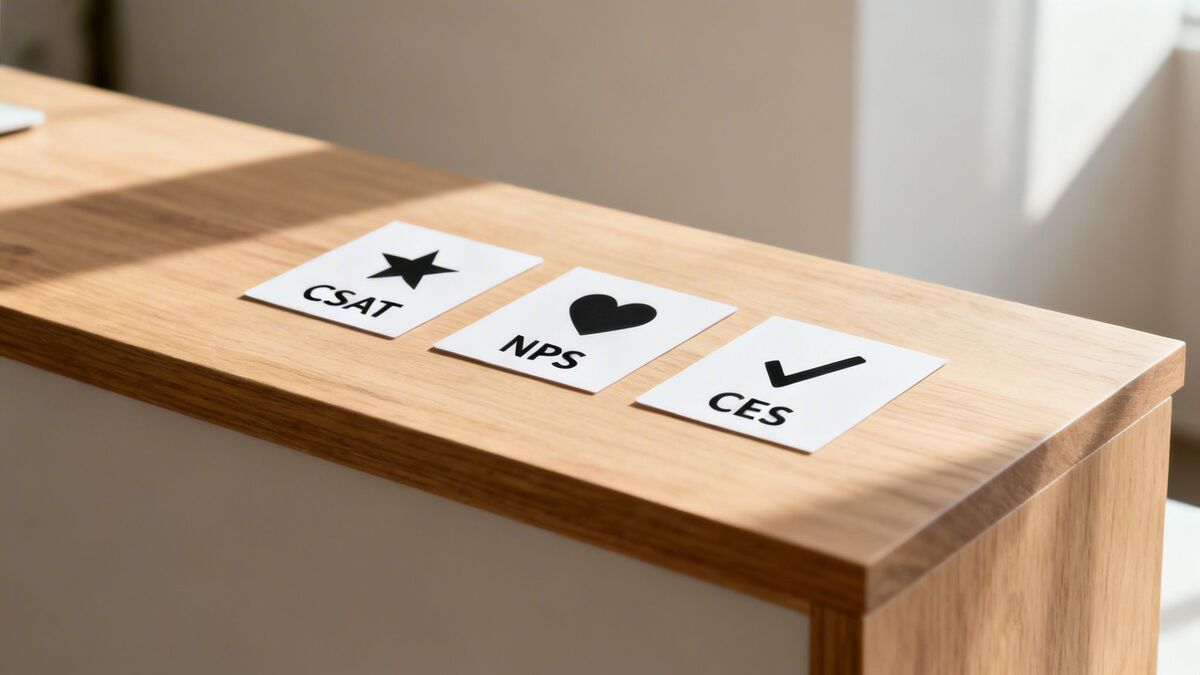
To really measure customer service, you have to look past the surface-level numbers and dig into the Key Performance Indicators (KPIs) that tell you what’s actually happening with your guests.
What works for a bustling cafe with quick transactions won’t work for a luxury hotel trying to build lifelong relationships. Picking the right mix of metrics is the first real step toward building a smarter feedback system that gives you answers, not just data.
There are three foundational KPIs every service business owner should know inside and out. Each one gives you a different angle on your performance, creating a much clearer picture when you put them all together.
The Big Three Customer Experience Metrics
Customer Satisfaction Score (CSAT): This is your in-the-moment pulse check. CSAT asks a simple question like, "How satisfied were you with your stay today?" measured on a 1-5 scale. It’s perfect for measuring satisfaction with a specific interaction, like checking in at a hotel, finishing a meal at a restaurant, or closing a support ticket.
Net Promoter Score (NPS): This one is all about long-term loyalty. It asks how likely a customer is to recommend your business to others on a 0-10 scale. A boutique hotel would obsess over NPS because it predicts repeat bookings and word-of-mouth referrals—the lifeblood of their business. If you're curious, we have a helpful guide on what is a good Net Promoter Score.
Customer Effort Score (CES): This metric asks, "How easy was it to resolve your issue?" It’s a game-changer for spotting friction in your customer journey. A great CES score means your processes are smooth and intuitive, which is a massive driver of satisfaction and repeat business.
Of these, the Customer Satisfaction Score (CSAT) has become the cornerstone for measuring service effectiveness across the globe. Recent data shows that 76% of organizations actively track CSAT as their main performance indicator, with the industry benchmark hovering around 85%.
Pro Tip: Choosing the right metric depends on what you want to learn. Use CSAT for specific touchpoints, CES to find and remove friction, and NPS to gauge overall brand loyalty and predict future growth.
Beyond Scores: Operational Metrics That Drive Success
While sentiment scores are vital, they don't tell the whole story. You also need to watch the operational metrics that directly impact your team's ability to deliver outstanding service. These numbers show you how efficient—or inefficient—your internal processes really are.
For a high-volume restaurant, speed is everything. A single delayed order or complaint can snowball during a busy service. This makes response and resolution times critical KPIs to watch.
Here are two operational metrics you absolutely must track:
First Response Time (FRT): How long does it take for your team to first acknowledge a customer's question or complaint? A fast FRT shows guests you’re attentive and value their time, even if a full solution takes a bit longer.
Average Resolution Time (ART): This tracks the total time it takes to completely solve a customer's issue from start to finish. A low ART means your team is empowered and efficient, capable of fixing problems before they escalate into negative online reviews.
How to Collect Feedback Without Annoying Your Guests
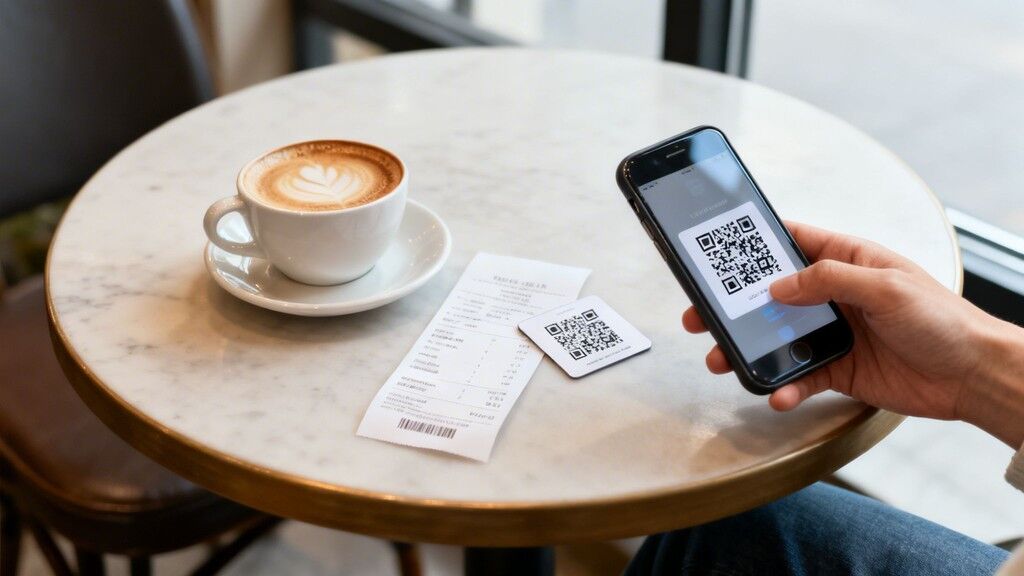
Knowing what to measure is half the battle. The other half? Getting your guests to actually give you honest feedback.
The secret is making it completely effortless for them. Forget long, annoying surveys—the real goal is to capture insights at the perfect moment, without ever getting in the way of their experience.
This means you have to meet your customers where they are. For a hotel, that might be a simple, one-question SMS survey sent right after check-out. For a busy restaurant, a well-placed QR code on the receipt lets diners share their thoughts in seconds while the memory is still fresh.
Crafting Surveys People Actually Answer
Let’s be honest: nobody has time for twenty questions. The key to a good survey is brevity. To get high response rates, you need a tool that can translate your business questions into concise, effective surveys people don't mind answering.
This is where technology can be a real game-changer. For example, with FeedbackRobot’s Prompt to Survey, you simply type a goal like "check-in experience" or "meal quality," and it instantly generates an optimized, ready-to-send survey. This AI-driven feature saves you critical time and ensures you’re asking the right questions in the right way, every single time, so you can get back to running your business.
To learn more, check out our guide on the best practices for survey design.
To effectively gather customer insights without creating friction, you might explore specialized customer feedback platforms and InTouch solutions. These platforms often centralize feedback collection, making it easier to manage a multi-channel strategy.
Unifying Your Feedback Channels
Your guests are already talking about you on public platforms like Google, Yelp, and TripAdvisor. If you ignore these channels, you're missing a massive piece of the puzzle. Monitoring these sites is crucial, but logging into each one individually is a huge time-sink for any busy owner.
The most effective way to measure customer service is to bring all this data into one central place. This creates a single source of truth for your entire operation. You need a system that can pull in everything:
Direct Surveys: Feedback you actively request from guests.
Online Reviews: Public comments from major review sites.
Social Media Mentions: What people are saying about you online.
This unified view helps you spot trends you’d otherwise miss—like a recurring complaint about Wi-Fi speed that shows up in both your direct surveys and your Google reviews. This holistic approach is fundamental to collecting smarter so you can act faster on the insights that truly matter.
Turning Guest Feedback Into Actionable Intelligence
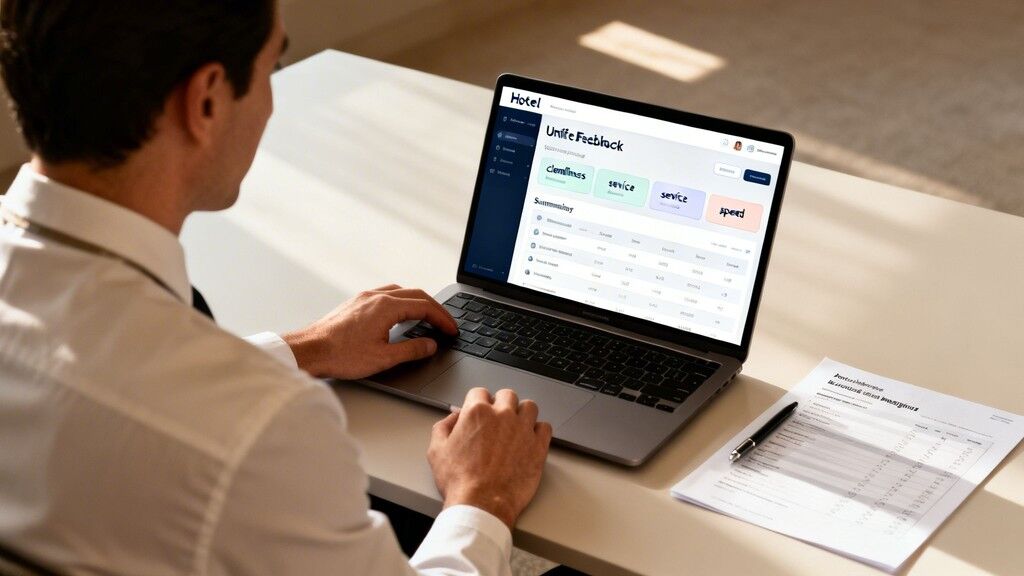
Collecting feedback is just gathering raw materials. The real magic happens when you turn that data into a clear roadmap for improvement—without getting lost in spreadsheets for hours on end.
The goal isn't just to look at data; it's to build a real-time pulse on your business. You need a way to instantly see your key metrics and understand the story they’re telling. This is where a unified dashboard becomes your most powerful tool.
Instead of jumping between Google reviews, survey results, and social media comments, you need one central command center. This is precisely why we built FeedbackRobot’s Radar. It’s a unified review intelligence dashboard that pulls every piece of guest feedback from every channel into a single, easy-to-understand view. You can see your NPS, CSAT, and review ratings at a glance, helping you spot trends before they become problems.
Uncovering the "Why" with AI
Quantitative scores tell you what is happening, but all those written comments tell you why. The problem is, digging through hundreds of reviews to find recurring themes is a massive time drain that no busy owner can afford.
This is where you can truly collect smarter and act faster. Modern tools now use artificial intelligence to do the heavy lifting. For instance, FeedbackRobot's AI Summaries provide instant insights and sentiment analysis from all your text-based feedback. The system automatically detects if comments are positive, negative, or neutral and identifies common themes.
Imagine seeing at a glance that "slow service" was mentioned 15 times last week, or that guests consistently praise a specific staff member by name. This technology pinpoints the root causes and highlights opportunities, saving you countless hours of manual work.
You’re not just reading comments anymore; you’re being handed a prioritized to-do list generated directly from your guests' own words. It transforms a mountain of feedback into a clear path forward.
Personalization is no longer a luxury—it's an expectation. Research shows that 76% of customers now expect personalized service interactions. To deliver this, you have to understand your guests on a deeper level, and that requires using customer data effectively. You can find out more about how personalization drives loyalty in the latest customer service reports.
Ultimately, a smart analysis system connects the dots between a guest's comment and an operational fix. It's the engine that turns "collecting smarter" into "acting faster," ensuring every piece of feedback helps you grow stronger.
Closing the Loop to Drive Real Improvement
Collecting customer feedback is only half the battle. If all that data just sits in a dashboard, you're missing the entire point. The real magic happens when you operationalize your feedback—creating a system where every comment and score sparks a genuine, tangible improvement.
This process is what we call "closing the loop." It’s where you transform raw insights into concrete actions and build a culture of constant improvement. Feedback isn’t just reviewed; it’s resolved.
More than anything, it’s your chance to turn a bad experience into an unforgettable moment of recovery. A swift, empathetic response can stop a minor issue from snowballing into a brutal online review. It can even turn an unhappy customer into one of your most passionate advocates.
Automating Service Recovery to Act Faster
When a guest has a poor experience, the clock is ticking. Every minute you wait, their frustration grows, and so does the likelihood they’ll share that negative story with the world. You have to act before they even think about posting that angry review.
This is where a smart system becomes your best friend. For instance, FeedbackRobot’s Resolutions Engine is an automated service recovery tool designed for exactly this moment. It instantly spots negative feedback based on keywords or low scores.
Once a problem is flagged, the engine can immediately:
Trigger an alert to the right manager or team member.
Draft an empathetic, personalized reply to the guest automatically.
Send a follow-up action, like a discount voucher for their next visit.
This proactive approach shrinks your response time from days to minutes. It proves to your guests that you’re listening and that you care, which is the absolute cornerstone of building loyalty.
Closing the loop effectively means every piece of feedback gets a response, and every problem gets a resolution. It’s the engine that powers the entire service-profit chain, directly connecting your actions to customer loyalty and, ultimately, your bottom line.
Using Feedback to Motivate and Grow
While fixing problems is mission-critical, don't forget to celebrate your wins. Positive feedback is a goldmine for both team morale and your marketing efforts. When you get glowing comments, make sure you share them far and wide.
Recognizing employees who get mentioned by name reinforces the exact behaviors you want to see from everyone. It creates a positive cycle where great service is acknowledged and rewarded, encouraging the whole team to step up their game.
You can also use this positive feedback as powerful social proof. Tools like the Spotlight: Feedback Wall from FeedbackRobot let you showcase your best reviews right on your website. This not only builds trust with potential customers but also gives your team a huge sense of pride in the amazing service they provide.
Ultimately, a closed-loop system ensures no feedback ever goes to waste. Every comment—good or bad—becomes a tool to help you collect smarter, act faster, and grow stronger.
Frequently Asked Questions About Measuring Customer Service
Even with a solid framework, questions always come up when you start measuring customer service in the real world. Let's tackle some of the most common ones I hear from hospitality and service owners who are building a smarter feedback system.
What Is the Best Metric for a New Restaurant or Hotel?
For any new hospitality business, the Customer Satisfaction Score (CSAT) is the best place to start. It’s direct, simple to set up, and gives you immediate feedback on specific moments in the guest experience.
Just ask, "How satisfied were you with your experience today?" on a simple 1-5 scale. This kind of transaction-level data is gold in the early days. It helps you quickly spot and fix operational friction—like a slow check-in process or a confusing menu item—before it becomes a reputation-damaging pattern.
How Often Should I Ask Guests for Feedback?
The right timing depends entirely on your service cycle. For transactional businesses like restaurants, cafes, or hotels, the sweet spot is within 24 hours of the visit or check-out. The experience is still fresh, which means you’ll get more accurate and detailed responses.
The big goal here is to avoid survey fatigue. You can use a platform that connects to your POS or PMS, like Toast or Mews, to trigger feedback requests automatically. Think sending a quick text after a payment is processed. This makes your request timely and relevant, not just another random email.
The key is to make giving feedback a natural part of the guest journey, not an interruption. A well-timed, brief request shows you value their opinion without being intrusive.
How Can I Prove the ROI of Better Customer Service?
Proving the return on investment (ROI) from your service efforts comes down to connecting your feedback metrics directly to business outcomes. You have to show how happier guests translate into a healthier bottom line.
Start by tracking your KPIs—like NPS, CSAT, or average review ratings—alongside your key financial data. For example, you can correlate a 10% increase in your Net Promoter Score over a quarter with a measurable drop in customer churn or a rise in repeat bookings. A powerful platform makes this easy by putting all your data in one place, revealing trends that clearly show how investing in service directly impacts revenue.
Ready to stop guessing and start measuring what truly matters? FeedbackRobot gives you the tools to collect smarter feedback, act faster on insights, and grow your business with a system built for busy owners like you. See how our Radar dashboards and AI Summaries can transform your guest feedback into your biggest asset.
What are the most important KPIs for measuring hospitality service?
Focus on 'Response Time' (how fast you fix issues), 'Review Velocity' (how many new reviews you get), and 'Sentiment Score' (how guests feel about the interaction).
Is 'First-Visit Satisfaction' different from 'Regular Satisfaction'?
Yes. First-timers focus on the 'Wow Factor,' while regulars value consistency. Measuring both allows you to optimize your 'Welcome' process and your 'Retention' strategy simultaneously.
How can a busy owner measure service without being on the floor?
Use automated 'Pulse Surveys' triggered by your POS. This gives you a data-driven view of every shift, allowing you to see which managers are performing even when you aren't there.
What role does 'Service Recovery' play in measurement?
You should track how many 'Negative' ratings are turned into 'Positive' outcomes. This 'Recovery Rate' is the ultimate measure of your team’s ability to handle conflict and build loyalty.
Should I use 'Mystery Shoppers' or real guest feedback?
Real guest feedback is 100x more valuable. Mystery shoppers are snapshots; guest feedback is a continuous stream of authentic data from the people who actually pay your bills.
Stop reading about it. Let your agent handle it.
25 free AI actions · no credit card required
Start Free