
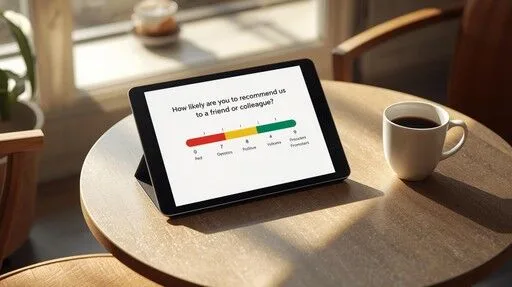
Guide
What Is a Good Net Promoter Score and How to Improve It
Find out what is a good Net Promoter Score for your industry. Explore NPS benchmarks and learn practical strategies to turn customer feedback into real growth.

Feb 18, 2026 · 18 min read
Free tool
AI Survey Generator
Describe what you want to learn and get a ready-to-send survey in seconds.
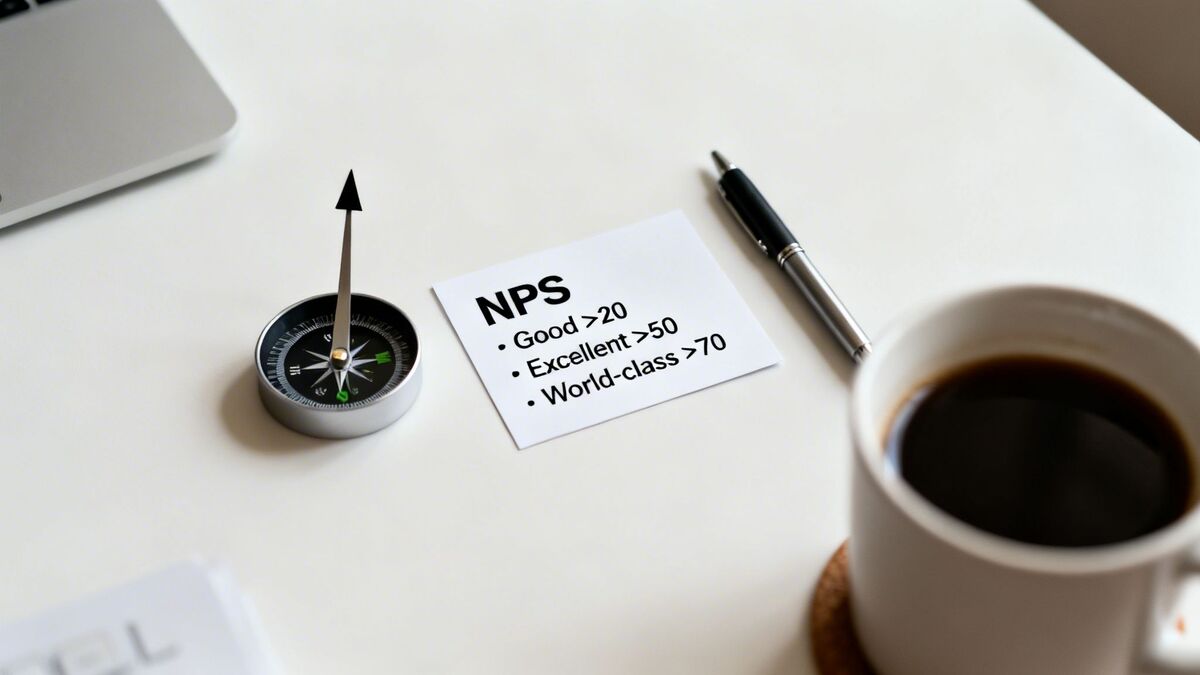
Let's get right to it: what’s a good Net Promoter Score, really? For a busy hospitality or service owner, any score above 20 is solid. If you’re hitting 50 or more, you're doing great. And anything over 70? That’s world-class.
But don't think of your NPS as a final grade. It's your business's compass. It tells you exactly where you stand with customers and, more importantly, which direction you need to head next. The goal is simple: collect smarter, act faster, and grow stronger.
Your Quick Guide to a Good Net Promoter Score
For a busy hotel or restaurant owner, your Net Promoter Score is more than just another number to track. It’s one of the clearest health indicators for your entire customer experience. It all boils down to one simple but powerful question: "How likely are your customers to recommend your business to others?"
This single metric cuts through the noise. It gives you a straightforward measure of customer loyalty and helps you understand the story your service is telling. The goal isn't just to chase a high score; it's to collect smarter feedback so you can act faster on what truly matters and build a stronger business.
Understanding the NPS Scale
NPS operates on a scale from -100 (everyone is a Detractor) to +100 (everyone is a Promoter). Any score above 0 is a great first milestone. It means you officially have more happy customers than unhappy ones. But just being in positive territory isn't enough to drive real, sustainable growth.
So, where should you aim? A score above 50 is widely considered excellent in most industries, while hitting 70 or higher puts you in world-class territory. In fact, an analysis of over 150,000 organizations found the global average NPS is around 32, with the top 25% of companies scoring 72 or higher. You can see a full breakdown of NPS benchmarks across different sectors to learn more.
To make things even simpler, here's a quick reference table to help you figure out what your score means at a glance.
NPS Score Performance Tiers at a Glance
This table breaks down the different levels of NPS scores, from needing improvement to world-class, to help businesses quickly interpret their own score.
NPS Score Range | Performance Level | What It Means for Your Business |
|---|---|---|
Below 0 | Needs Improvement | You have more unhappy customers than happy ones, indicating significant risks to your reputation and repeat business. |
0 - 20 | Good | You have a decent foundation of customer loyalty but still have many neutral or unhappy customers to win over. |
21 - 50 | Great | Your business has a strong base of loyal customers who are likely to recommend you. Focus on converting passives. |
51 - 70 | Excellent | You are a leader in customer experience, with a very high ratio of promoters who can drive organic growth. |
Above 70 | World-Class | Your customer experience is exceptional and sets the standard in your industry, creating passionate brand advocates. |
Ultimately, this table helps you move beyond just seeing a number and start understanding the story behind it. A "Good" score is your starting line, while "World-Class" is the goal you should always be striving for.
How the Net Promoter Score Is Calculated
Calculating your Net Promoter Score is refreshingly simple. It all boils down to the responses from one core question: “On a scale of 0 to 10, how likely are you to recommend our business to a friend or colleague?”
Based on their answer, every single person who responds gets sorted into one of three groups. Getting to know these groups is the key to unlocking what your final score actually means.
Segmenting Your Customer Responses
First, you’ll want to tally up your responses and categorize them. This simple step helps you see beyond a single number and start understanding the different mindsets driving customer behavior.
Here’s how the breakdown works:
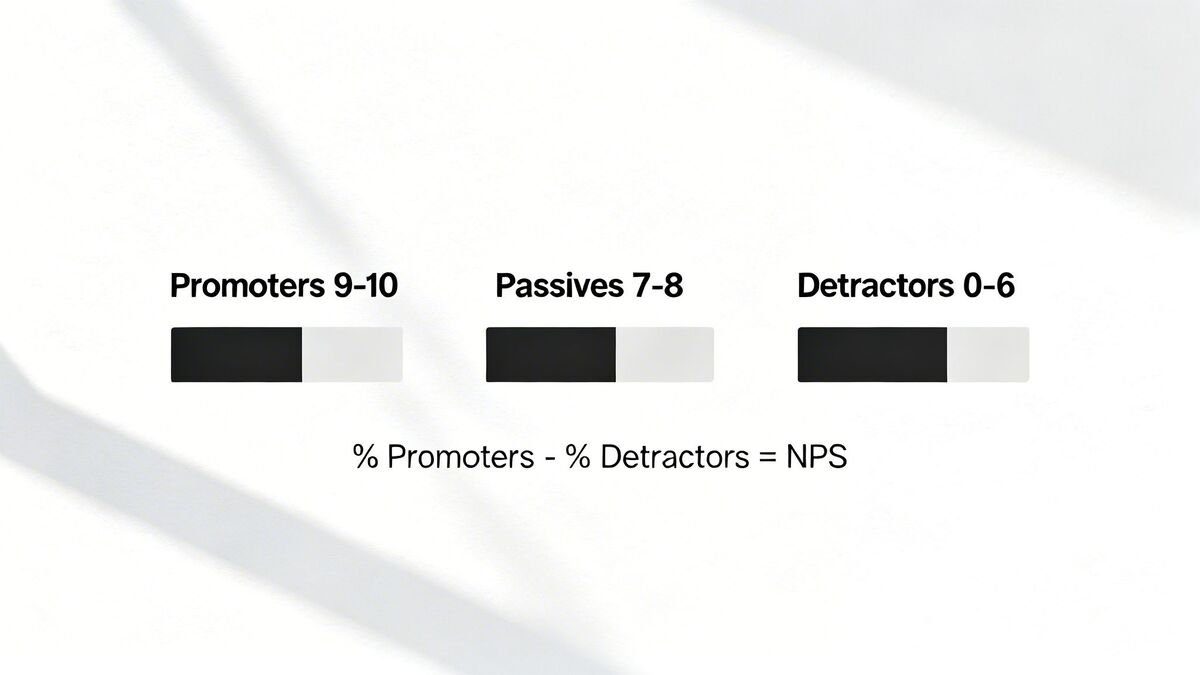
Promoters (Score 9–10): These are your loyal enthusiasts. They’re the customers who will keep coming back for more, spend more over time, and happily refer new business your way.
Passives (Score 7–8): Think of these customers as satisfied for now, but not truly loyal. They’re vulnerable to offers from competitors and won’t go out of their way to promote your brand.
Detractors (Score 0–6): These are your unhappy customers. They are at a high risk of churning and can damage your reputation with negative word-of-mouth.
Notice how broad the Detractor category is? A score of 6 is intentionally grouped with a 0. That’s the simple brilliance of the NPS system—it recognizes that even mild dissatisfaction is often enough to stop a customer from ever coming back.
The Simple NPS Formula
Once you have your three groups sorted, the calculation itself is straightforward. The magic of the NPS formula is that it completely ignores the "Passives," giving you a high-contrast, unfiltered picture of customer loyalty.
Your final NPS score is calculated with one simple formula: (% of Promoters) – (% of Detractors) = NPS
Let's walk through a real-world example. Imagine a busy hotel sends out 100 guest surveys and gets these results:
70 guests responded with a 9 or 10 (70% Promoters).
20 guests responded with a 7 or 8 (20% Passives).
10 guests responded with a 0 to 6 (10% Detractors).
Now, you just apply the formula: 70% (Promoters) - 10% (Detractors) = 60. Your hotel's NPS is 60, which is a fantastic score.
This process shines a bright light on your biggest fans and your biggest critics, showing you exactly where to focus your energy. But manually creating, sending, and tracking all those surveys is a huge time sink.
This is where the FeedbackRobot Feedback Operating System simplifies everything. Our Prompt to Survey feature lets you create ready-to-send NPS surveys in seconds, connecting directly to the tools you already use, like Toast or Mews. It automates the entire collection process, so you can gather smarter feedback without lifting a finger.
What Is a Good Net Promoter Score in Hospitality and Service?
So, what’s a “good” Net Promoter Score? It’s a tricky question because context is everything. A score that’s excellent in the tech world might be just average for a five-star hotel. Your industry, business model, and what customers expect all set the stage for what a meaningful score actually looks like.
This is especially true for owners in hospitality and other service industries. You’re in the business of experiences, where loyalty is earned through countless small interactions. Simply chasing a generic "good" score won't give you the competitive edge you need to really stand out.
From Vague Goals to Clear Benchmarks
The first step to setting realistic yet ambitious goals is to understand your industry’s benchmark. It helps you measure your performance not in a vacuum, but against the direct competitors vying for the same customers.
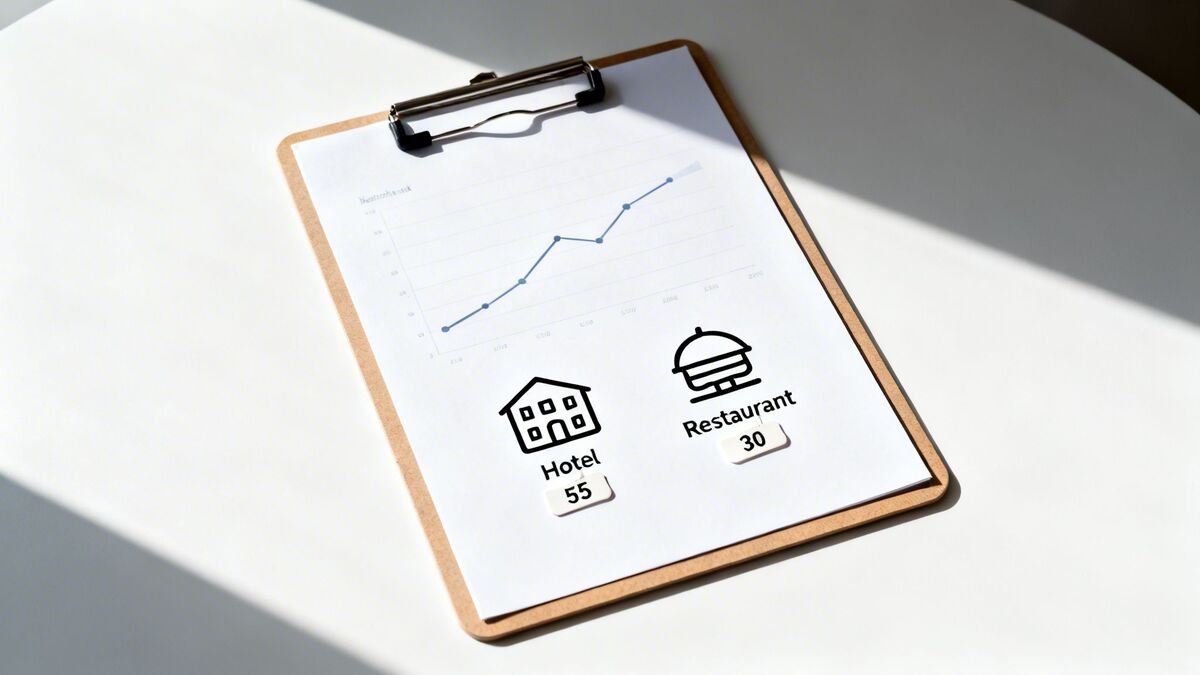
For instance, the hotel industry often has higher average NPS scores thanks to the personal nature of the service and the opportunity to create memorable stays. Restaurants, on the other hand, can have a much wider range of scores, influenced by everything from food quality to the speed of service during a busy lunch rush.
Looking at the data, the median NPS across all industries is 42, but that number hides some big differences. The Manufacturing sector leads with a median of 65, while the Software industry lags behind at just 30.
For businesses like yours, a more focused view is what matters. Here’s a quick breakdown of what good, excellent, and world-class scores look like in key service industries.
NPS Benchmarks by Industry (2026)
NPS ranges vary significantly by industry — what counts as "good" in financial services would be exceptional in telecoms. Use the table below to benchmark against your specific sector, not the global average.
Industry | Good NPS | Excellent NPS | World-Class NPS | Typical average |
|---|---|---|---|---|
Hospitality & Hotels | 40–55 | 56–70 | 70+ | ~47 |
Restaurants | 30–45 | 46–60 | 60+ | ~38 |
Retail | 35–50 | 51–65 | 65+ | ~44 |
E-commerce | 35–50 | 51–65 | 65+ | ~45 |
Healthcare | 30–45 | 46–60 | 60+ | ~38 |
Professional Services | 45–60 | 61–75 | 75+ | ~52 |
SaaS / Software | 30–45 | 46–60 | 60+ | ~41 |
Financial Services | 20–35 | 36–50 | 50+ | ~34 |
Telecommunications | 15–25 | 26–40 | 40+ | ~24 |
Source: Satmetrix, Bain & Company, and Qualtrics industry benchmarks (2023–2026). Ranges reflect B2C operations; B2B benchmarks in the same sector typically run 5–10 points higher due to deeper customer relationships and higher switching costs.
A few things the table makes clear: SaaS companies with an NPS of 40 are performing well — the same score in hospitality would be a sign of trouble. And telecoms businesses with any score above 25 are outperforming most of their sector, despite that looking low in absolute terms. Always benchmark against your industry, not a generic global average.
NPS Benchmarks by Company Size
Company size affects what's achievable. Smaller businesses often have higher NPS scores because customers interact with the founder or a small team directly — there's less service variability. As companies scale, NPS tends to decline before process improvements bring it back up.
Company Size | Typical NPS range | Key driver |
|---|---|---|
SMB (<50 employees) | 45–70 | Personal relationships, consistent service, founder involvement |
Mid-market (50–500) | 35–55 | Process consistency matters more — score often dips during growth phases |
Enterprise (500+) | 25–45 | Volume and variability increase; recovery programs become critical |
If your score is below the range for your size, the priority is operational consistency — reducing the gap between your best and worst customer interactions. If you're at the top, the lever is amplification: turning existing Promoters into referral sources. Use the free Reputation Score Calculator to see how your NPS fits into your broader reputation picture.
Why Your Internal Score Is Only Half the Story
Tracking your own NPS is vital, but it doesn't give you the full picture. Your customers are also sharing their unfiltered opinions on Google, TripAdvisor, Yelp, and social media. A great NPS score doesn't mean much if your public reviews are telling a completely different story.
You need a system that brings all your feedback streams together. Without that unified view, you’re trying to solve a puzzle with missing pieces. You might see a high NPS but miss a growing trend of negative comments about slow service on a popular review site.
A holistic view of customer feedback—combining internal surveys with public reviews—is the only way to get an accurate, real-time pulse on your brand's health and competitive standing.
This is where the Feedback Operating System comes in. Our Radar feature gives you unified review intelligence by pulling feedback from all your public and private channels into one dashboard. It doesn't just track your NPS; it analyzes sentiment from all the platforms that matter to you.
Imagine seeing your NPS score right alongside sentiment trends from Google reviews, all on one clean dashboard. This allows you to instantly see how you truly stack up against the competition and pinpoint exactly where you need to act to improve your overall customer experience management strategy. By combining internal metrics with external perception, you finally get the full context needed to make decisions that drive real growth.
Why Your NPS Score Fluctuates and What It Means
Seeing your Net Promoter Score jump around from month to month can be unsettling. One quarter you’re at a solid 55, the next you’ve dipped to 48. Before you hit the panic button, remember this: a single NPS score is just a snapshot in time. The real story is told by the trend over several months.
NPS volatility is completely normal, especially if you’re in the service or hospitality world. For a hotel, seasonality can cause big swings—a summer packed with happy vacationers will naturally score higher than a slower off-season. For a restaurant, a simple menu change or a new front-of-house manager can temporarily move the needle.
The key is to view these fluctuations not as a pass/fail grade, but as an early warning system.
Interpreting the Ups and Downs
Think of a declining score as a quiet alarm bell. It’s a chance to investigate and fix small issues before they snowball into negative online reviews and lost customers. On the flip side, a consistently rising score is clear proof that your new training program or updated service model is hitting the mark.
The goal is to avoid overreacting to small, one-off dips while acting decisively when you spot a significant or sustained trend. This is how you transform a raw number into real intelligence that helps you steer the business with confidence.
Your NPS trend is a direct reflection of your customers’ evolving perception. A downward trend isn't a failure—it's a crucial signal telling you it's time to listen closer and act faster.
This dynamic nature of customer loyalty is visible across entire markets. Broader economic shifts and changing consumer expectations can impact scores across the board. For example, Forrester's analysis revealed that Net Promoter Scores dropped in eight industries in the U.S. market between 2022 and 2023. This shows that even top-performing businesses aren't immune to external pressures, making consistent monitoring even more critical. You can learn more about these NPS benchmark findings from Forrester.
Turning Volatility into Action
So, how do you know which fluctuations actually matter? Consistent, intelligent data collection is the answer. When you gather feedback continuously, you create a clear baseline that makes significant changes stand out. This is where a dedicated system becomes essential for turning numbers into a narrative. For a deeper dive, check out our guide on analyzing survey data.
This is precisely why we built AI Summaries into the Feedback Operating System. Instead of manually sifting through hundreds of comments to find out why your score dipped, our AI does the heavy lifting for you.
Instant Insights & Sentiment Analysis: It analyzes all your open-ended feedback in real-time, telling you what customers are saying and how they feel about it.
Theme Detection: It automatically identifies and groups recurring themes like "slow check-in," "cold food," or "friendly staff."
With AI Summaries, you can instantly connect a drop in your NPS to a specific, actionable problem. It closes the gap between knowing your score and understanding the "why" behind it, allowing you to act faster and fix the issues that truly matter to your customers.
How to Turn Customer Feedback into Business Growth
Your Net Promoter Score is the starting point, not the finish line. It’s a powerful number, but its real value comes from what you do next. For busy owners in hospitality and services, this means having a simple, effective game plan for each customer group—Detractors, Passives, and Promoters.
This isn’t about just collecting data; it’s about turning feedback into real growth. Each group needs a different approach, and acting fast is what protects your reputation, reveals hidden opportunities, and gets your happiest customers talking. This is our entire philosophy: collect smarter, act faster, and grow stronger.
Your Three-Step Action Plan for NPS Segments
A good NPS score is the direct result of a system. When you tailor your follow-up for each segment, you start turning survey responses into measurable business results. Let's break down the playbook.
Recover Your Detractors (Scores 0–6)
This is your top priority. Detractors are unhappy, likely to churn, and might share their bad experience online. A quick, empathetic response can flip the script, turning a negative moment into a showcase of great customer service. The goal is simple: solve their problem and earn back their trust.Engage Your Passives (Scores 7–8)
Passives are your biggest untapped opportunity. They’re not unhappy, but they aren’t loyal either, which makes them easy targets for your competitors. Following up with a simple question like, "What could we have done to make your experience a 10?" can uncover the small frictions you need to fix to create more Promoters.Activate Your Promoters (Scores 9–10)
Your Promoters are your marketing army-in-waiting. They already love what you do, so your job is to make it easy for them to spread the word. A quick thank you, followed by a request to leave a Google review or share on social media, can kickstart a powerful stream of social proof that brings in new customers.
Every piece of feedback is a gift. A Detractor’s complaint is a road map for improvement, a Passive’s comment is an opportunity for innovation, and a Promoter’s praise is your best marketing material.
From Manual Work to Automated Growth
Trying to follow this playbook manually is a huge challenge. Imagine reading every survey comment, figuring out the root cause, and then writing a personal follow-up for every Detractor—all while running a busy hotel or restaurant. It just doesn’t scale.
This is where a feedback operating system becomes your greatest ally. Instead of getting buried in data, you can automate the entire process. This lets you act on every single piece of feedback with speed and precision. For example, to convert feedback into growth, you could enhance the booking experience with a tool like a campsite site map creator, which allows guests to see and select their preferred spot, solving a potential issue before it even happens.
Pinpoint Problems Instantly with AI Summaries
The first step to acting faster is understanding the "why" behind your score. This is where the open-ended comments in your surveys are pure gold. But who has time to read them all?
This is exactly what our AI Summaries feature was built for. It’s a powerful engine that provides instant insights & sentiment analysis from all your open-ended feedback.
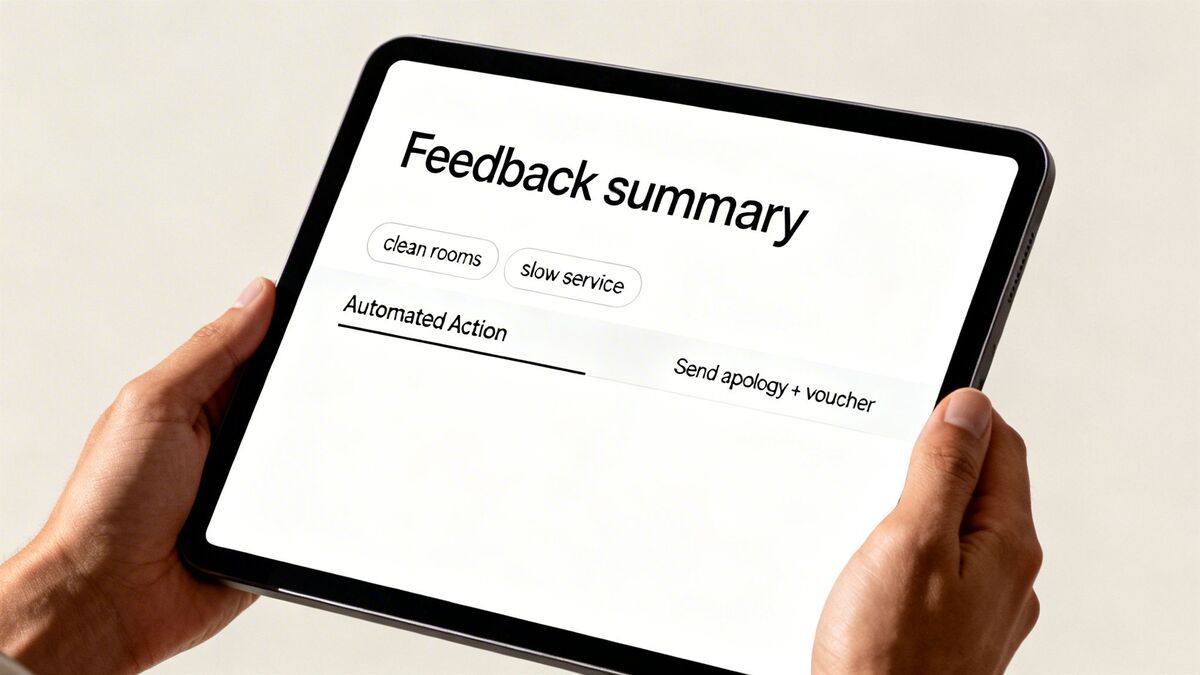
It spots recurring themes, like "slow service," "clean rooms," or "friendly staff."
It organizes these themes so you can see what’s driving your score at a glance.
It saves you hours of manual work, delivering the insights you need in seconds.
With this tool, you stop guessing and start knowing. You can immediately connect a dip in your NPS to a specific, fixable issue, empowering you to solve the root cause.
Turn Detractors into Fans with the Resolutions Engine
Once you know the problem, you have to fix it—fast. A delayed response to a Detractor all but guarantees they won't come back.
Our Resolutions Engine is designed for automated service recovery, closing the loop on negative feedback instantly. You can set up rules that trigger specific actions based on an NPS score.
Picture this: a hotel guest completes a survey, gives a score of 3, and mentions a long wait at check-in.
Without FeedbackRobot: The negative feedback sits in a spreadsheet, unseen for days. The guest leaves frustrated and probably posts a bad review online.
With FeedbackRobot: The Resolutions Engine instantly kicks off an automated workflow. The guest immediately gets a personalized apology email with a voucher for a free drink on their next stay.
This automated response turns a moment of frustration into a powerful opportunity to show you care. You not only solve the problem but also prove to the customer they’ve been heard, dramatically increasing the odds of winning them back—all without any manual work from you or your team.
Activating Your Promoters to Drive New Business
Your happiest customers are your most powerful—and most overlooked—marketing asset. You’ve already done the hard work to earn their loyalty. Now it's time to mobilize them.
Think of it this way: for every Detractor who might leave a bad review, you have an equally passionate Promoter ready to share a great story. Your job is just to make it incredibly easy for them to do it. This isn’t about launching a massive marketing campaign; it's about simple, well-timed requests that turn your biggest fans into your best advocates.
From Silent Fans to Vocal Champions
The plan is simple: thank your Promoters for their glowing feedback, then give them a clear, one-click way to share that experience publicly. This simple step transforms their private praise into powerful social proof.
Here are a few proven ways to activate your Promoters:
Ask for Online Reviews: The moment a customer gives you a 9 or 10, send a quick, personal thank you with a direct link to leave a review on Google, TripAdvisor, or whatever platform matters most to your business.
Encourage Social Sharing: Invite them to share a photo or memory from their visit on social media. User-generated content feels genuine and builds trust in a way that slick, paid advertising just can't.
Build a Referral Program: Offer a small thank you—like a discount on their next purchase or a free coffee—for referring a friend. It formalizes word-of-mouth and gives your Promoters an extra nudge to spread the word.
The most credible advertising comes straight from the people who have experienced your service firsthand. Activating your Promoters isn't just a marketing tactic; it's about letting your happiest customers tell your story for you.
Showcase Your Best Feedback Automatically
To make this even easier, FeedbackRobot is launching Spotlight: Feedback Wall. This brand-new feature is designed to help you effortlessly turn your best customer feedback into compelling marketing content.
Instead of hunting down testimonials and manually adding them to your site, Spotlight: Feedback Wall automatically showcases your top survey responses and reviews. It creates a dynamic, visually appealing wall of praise that serves as instant social proof for anyone checking you out. This turns positive feedback from a private metric into a public asset that builds trust and attracts new customers.
You can learn more about how to create a powerful display of customer praise by checking out our guide on building an effective testimonial landing page.
By systemizing how you engage Promoters, you create a self-sustaining growth loop. Happy customers bring in new customers, who then have their own great experiences and become Promoters themselves. It's the most authentic and cost-effective way to build a thriving business.
Your Top Questions About Net Promoter Score
As a busy owner, you don't have time for fluff. You need direct answers. Here are the most common questions we hear about NPS, with practical advice to help you turn feedback into fuel for growth.
How Often Should I Measure My NPS?
For businesses where the experience is immediate—like restaurants or hotels—measuring NPS after each transaction gives you a real-time pulse on service quality. For others, a quarterly check-in can work just fine.
The most important thing is consistency. A steady stream of data helps you track trends accurately and spot issues before they blow up. This is where automation is a lifesaver. FeedbackRobot’s integrations with systems like Mews or Toast let you continuously collect feedback without any manual work, so you always have fresh, actionable data.
How Many Responses Do I Need for a Reliable Score?
While there's no single magic number, aiming for 50-100 responses per measurement period (like a month) usually provides a reliable signal.
But don't get too hung up on that. A continuous flow of feedback is far more valuable than one big, infrequent survey. A platform that helps you gather a steady trickle of daily responses makes your trend data more accurate and lets you act faster, even if your daily sample size is small.
The goal isn't just to get a single, statistically perfect score. It's to build a system that constantly listens, learns, and adapts based on a steady flow of customer feedback.
Can I Have a Good NPS and Still Have Problems?
Absolutely. A high NPS is a fantastic sign of loyalty among your current customers, but it doesn't tell you if you're struggling to attract new ones or if a specific part of your service is quietly failing.
This is why digging into the "why" behind every score is so critical. You might have an overall score of 55, but if your AI Summaries reveal that Detractors consistently mention "slow check-in," you’ve just uncovered a hidden problem that could be costing you business. AI Summaries are a core part of our Feedback Operating System that provide instant insights & sentiment analysis from your written feedback, uncovering operational issues that a single score would completely miss.
Ready to stop guessing and start growing? The FeedbackRobot Feedback Operating System gives you the tools to collect smarter, act faster, and grow stronger.
What is considered a 'Good' NPS in the hospitality industry?
While it varies by niche, an NPS above 50 is generally considered excellent for restaurants and hotels. However, the most important metric is your *improvement* over your own baseline, not just the raw number.
How do I calculate my Net Promoter Score (NPS)?
Subtract the percentage of 'Detractors' (score 0-6) from the percentage of 'Promoters' (score 9-10). Passives (7-8) are excluded from the calculation but are key targets for conversion.
Why is my NPS fluctuating month to month?
Hospitality NPS often follows 'Service Cycles' or seasonal staff changes. Tracking your score alongside your 'Sentiment Radar' helps you identify if a dip is related to a specific shift or a new menu item.
Can I use NPS to identify my most loyal customers?
Yes. Your Promoters are your 'Brand Ambassadors.' You should identify these individuals and offer them exclusive previews or referral rewards to turn their loyalty into growth.
What is the best way to improve a low NPS score?
Close the loop with your Detractors. Reaching out to a guest who gave a low score to resolve their issue is the fastest way to turn a critic into a promoter and raise your overall average.
Stop reading about it. Let your agent handle it.
25 free AI actions · no credit card required
Start Free