A Guide to Customer Experience Management for Hospitality Leaders
Master customer experience management in hospitality. Learn strategies to gather feedback, use smart tools, and build lasting customer loyalty.

Feb 16, 2026 · 16 min read
Free tool
Likert Scale Generator
Generate custom rating scales and survey questions tailored to your feedback needs.
Customer Experience Management (CEM) isn't just about fixing problems—it's about designing an experience so good that problems rarely happen in the first place. For busy hospitality and service owners, this is your key to sustainable growth.
Think of it as the intentional design behind every single touchpoint a customer has with your business. From their first Google search to the final "thank you," CEM is the proactive orchestration of that entire journey. In a world of endless choices, the experience you provide has become your most powerful competitive advantage. Every article from FeedbackRobot reinforces our core value: collect smarter, act faster, and grow stronger.
Moving Beyond Customer Service
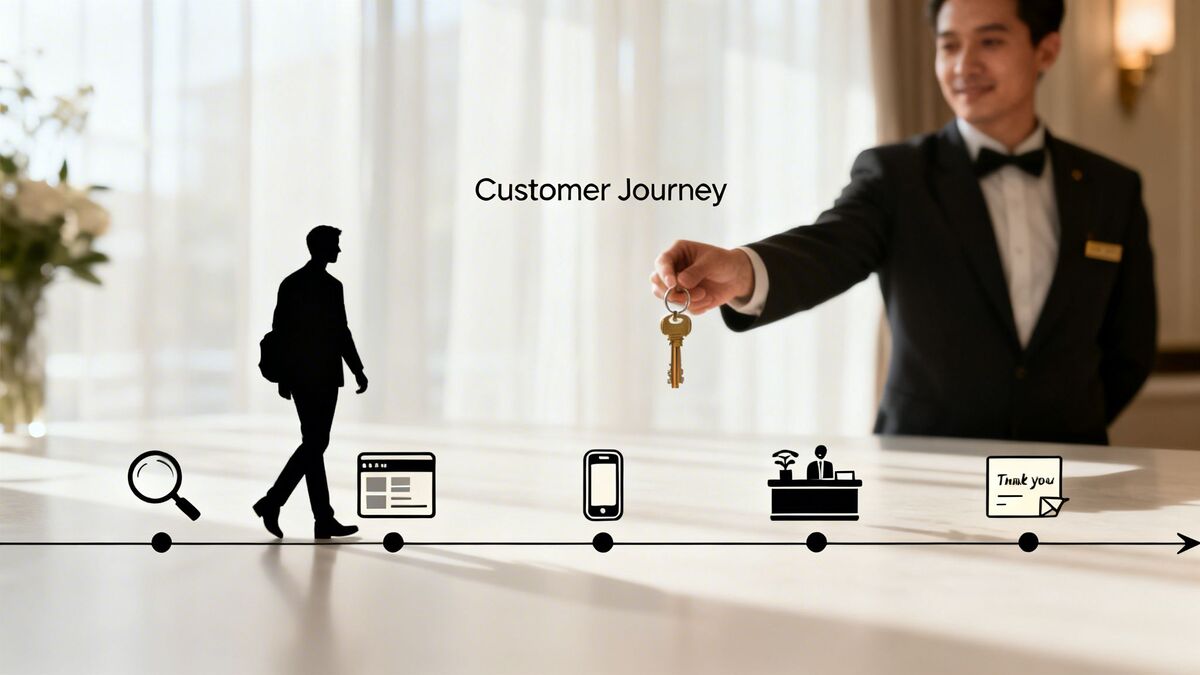
As a busy hospitality or service owner, you're already an expert in customer service. You know how to handle issues as they come up. But customer experience management is a strategic shift from that reactive mindset.
Here’s an analogy: Customer service is the skilled crew that expertly patches a leak in a boat. Customer experience management is the naval architect who designs the boat to be leak-proof from the start.
This proactive approach means you’re not just solving problems; you're preventing them by deeply understanding the customer journey. You anticipate needs, smooth out friction points, and engineer memorable moments that build genuine loyalty. This is how you stop competing on price and start winning on the quality of the experience you deliver.
Customer experience management is the difference between fixing a cold meal when a guest complains and ensuring your kitchen-to-table process is so efficient that the meal is never cold in the first place.
This fundamental shift is what drives sustainable growth. It’s all about building a system that helps you consistently collect smarter feedback, act faster on insights, and grow stronger as a brand customers love and can't stop recommending.
The Strategic Difference
Getting the distinction between these two concepts is the first step toward building a truly customer-centric operation. While both are critical, their focus and impact are worlds apart. Traditional service is often seen as a cost center, while strategic experience management is a powerful growth engine.
For a deeper dive, our friends at Toki wrote a great resource that breaks down the essentials of What Is Customer Experience Management. The key takeaway is to see every touchpoint not as an isolated transaction, but as a chance to reinforce your brand’s promise.
Customer Service vs Customer Experience Management
To really bring it home, let's look at a quick comparison. This table highlights the shift from reactive problem-solving to proactive journey orchestration.
Aspect | Traditional Customer Service (Reactive) | Customer Experience Management (Proactive) |
|---|---|---|
Focus | Resolving individual problems as they occur. | Designing the entire end-to-end customer journey. |
Timing | Post-interaction, often after a negative event. | Pre-, during-, and post-interaction; a continuous loop. |
Goal | Problem resolution and damage control. | Building loyalty and increasing customer lifetime value. |
Ownership | Primarily the responsibility of a specific department. | A company-wide mindset owned by every employee. |
This table makes it clear: by embracing CEM, you move from just putting out fires to building a fire-resistant business.
You start listening to the collective voice of the customer to make smarter, more informed operational changes. In the sections that follow, we’ll show you exactly how to build a CEM program that wins.
The Three Pillars of a Winning CEM Strategy
If you want to build a customer experience program that actually grows your business, you have to move beyond just random acts of good service. A truly winning strategy is built on a simple but powerful framework: Listen, Understand, and Act.
Think of these as the foundation, walls, and roof of a business that customers can't wait to come back to.
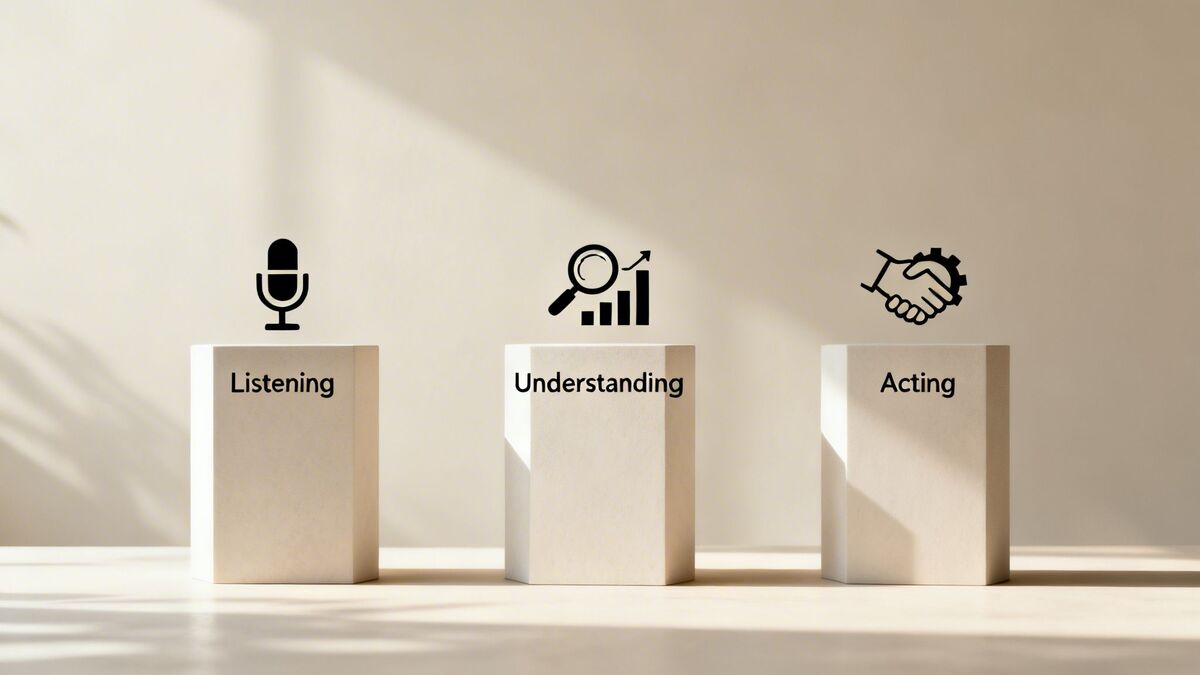
This three-part approach creates a cycle of constant improvement. It’s the engine that lets you collect smarter feedback, act faster on what you learn, and ultimately, grow stronger as a company.
Let’s break down what each pillar really means for you.
Pillar One: Listen Everywhere Your Customers Speak
The first pillar, Listening, is all about opening up channels to hear the customer's voice at every important touchpoint. Your customers are already talking about you, but that feedback is scattered everywhere—Google reviews, social media DMs, booking sites, and direct emails.
A solid CEM strategy doesn't just wait for feedback to show up; it actively goes out and gets it. This means doing more than sending out one big survey a year. It’s about putting simple QR codes on tables for instant feedback, keeping an eye on social media mentions, and automatically asking for reviews after someone checks out or uses your service.
The goal here is to gather a steady stream of raw, unfiltered data that shows you what the customer experience is really like. This is your ground truth—the essential material for everything that comes next.
Pillar Two: Understand the Story in the Data
Listening gets you the raw data. The second pillar, Understanding, is where you turn all that noisy, scattered feedback into clear, actionable insights. For a busy manager or owner, this is usually the hardest part. Who has the time to read hundreds of reviews every week and connect all the dots?
This is exactly where a Feedback Operating System becomes your most valuable player. It does the heavy lifting for you, turning mountains of text and ratings into a simple, coherent story.
With the right tools, you stop guessing what your customers want and start knowing. You can spot a recurring issue with front-desk wait times or a dip in food quality long before it blows up into a major problem.
Our platform gives you two powerful features built for this exact job:
Radar provides unified review intelligence, pulling all your reviews from every platform into a single, clean dashboard. No more logging into five different sites just to see what people are saying. It’s your command center for customer sentiment.
AI Summaries deliver instant insights & sentiment analysis. Instead of reading every single comment, our AI instantly spots key themes, flags positive and negative trends, and tells you what matters most. You get the big picture in minutes, not hours.
Pillar Three: Act with Speed and Empathy
The final pillar is Acting. All the listening and understanding in the world is pointless if you don't close the loop. This stage is all about responding to feedback in a way that not only fixes problems but also makes your customer relationships stronger and drives real operational improvements.
Acting quickly and personally shows customers you’re actually paying attention. When someone leaves a great review, a fast "thank you" can turn a happy customer into a vocal advocate. Even more importantly, when an experience goes wrong, a swift and empathetic response can turn an unhappy detractor into a loyal fan. That’s service recovery in action.
A critical part of any strong CEM strategy is building trust. Exploring essential symbols of trustworthiness can help lay this groundwork. Responding effectively proves your business is reliable. When you consistently listen, understand, and act, you create a positive feedback loop that builds an unshakeable reputation and fuels lasting growth.
How to Measure Customer Experience Success
You can't improve what you don't measure. A solid customer experience program isn't built on feelings or guesswork—it’s about turning your goals into real numbers that show a clear return on your effort. As a busy owner, you need to know exactly which dials to watch to see if your work is actually paying off.
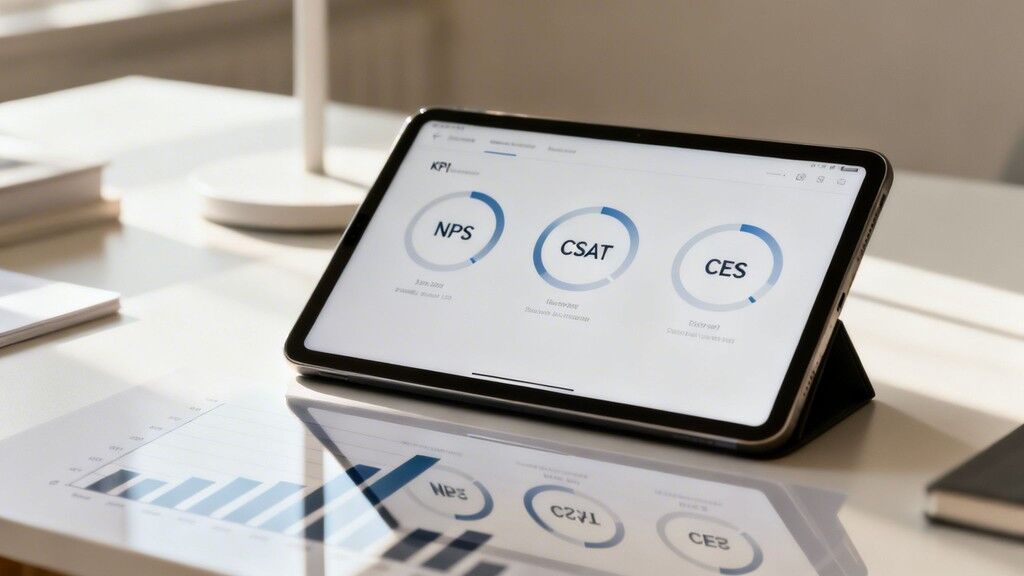
This is where key performance indicators (KPIs) come in. Think of them as the vital signs for your customer relationships. They tell you what’s healthy, what’s hurting, and where to focus your attention. Let's break down the essential metrics that every hospitality and service business should be tracking.
The Big Three Experience Metrics
While there are dozens of metrics you could track, three stand out for giving you a complete picture of your customer experience. They're like different lenses for viewing the same scene: loyalty, satisfaction, and effort.
Net Promoter Score (NPS): This one’s all about long-term loyalty. It asks the ultimate question: "On a scale of 0-10, how likely are you to recommend our business to a friend or colleague?" It’s the clearest measure of brand advocacy you can get.
Customer Satisfaction (CSAT): This score measures short-term happiness with a specific interaction, like checking in, finishing a meal, or a call with your support team. It gives you immediate, in-the-moment feedback on a single touchpoint.
Customer Effort Score (CES): This metric tells you how easy it was for a customer to get something done. Was booking a table a hassle? Was it a pain to get an issue resolved? Lower effort almost always leads to higher loyalty.
These three work together beautifully. NPS tells you if they’ll come back, CSAT tells you how their last interaction went, and CES reveals if you made it easy for them. For a deeper dive, check out our guide on how to measure customer experience.
Key Customer Experience KPIs at a Glance
To make it crystal clear, here’s a simple breakdown of each metric, what it measures, and when you should use it.
Metric | What It Measures | Best Use Case |
|---|---|---|
NPS | Customer Loyalty & Advocacy | To gauge overall brand health and predict future growth. |
CSAT | Transactional Satisfaction | To measure the quality of a specific touchpoint (e.g., front desk, checkout). |
CES | Ease of Experience | To identify and remove friction from processes like booking or support. |
Connecting Metrics to Your Bottom Line
Tracking these scores is just the first step. The real magic happens when you connect them to business outcomes.
Here’s a number that should get your attention: a 5% increase in customer retention can boost profitability by 25% to 95%. This is where your customer experience efforts hit the bottom line, hard.
A high NPS score directly correlates with a higher Customer Lifetime Value (CLV). On the flip side, low CSAT scores after a specific interaction are an early warning sign for churn. Ignoring this data is like throwing money away. Poor CX costs businesses a staggering $3.7 trillion annually, with top frustrations being having to repeat information and not being able to use a preferred channel.
The brands that win are the ones that use technology to create a balanced, human-centric approach that just makes things easy for the customer. Systematically measuring these key metrics lets you move from reacting to problems to proactively designing an experience that builds loyalty, cuts churn, and grows a stronger, more profitable business.
Putting Your Customer Feedback into Action
Having the right metrics is like having a clear map, but a map is useless if you don't actually start driving. The real power behind customer experience management comes from turning all that data into decisive, loyalty-building action.
This is where a Feedback Operating System becomes the engine for your business, creating a powerful loop: collect, analyze, and act.
This cycle is how you move from just knowing your NPS score to actively improving it. It’s the practical, day-to-day process that helps you collect smarter, act faster, and grow stronger. Let's walk through how this loop works and how specific tools can make it almost effortless.
Systematically Collecting Feedback at Key Moments
First things first, you need a steady stream of high-quality feedback. Relying on the occasional fiery or glowing review that pops up on Google isn’t a strategy—it’s a lottery. You need to systematically ask for input at the moments that truly matter.
This is where a feature like Prompt to Survey becomes so important. Its function is to effortlessly convert any customer interaction into a feedback opportunity.
Imagine a guest checks out of your hotel via your Mews PMS, or a customer pays their bill using your Toast POS. Prompt to Survey can automatically send them a simple, branded survey just a few minutes later, asking about their experience while it’s still fresh in their mind. This automated, targeted approach ensures you’re not just hearing from the loudest voices, but from a representative slice of your entire customer base.
Analyzing and Understanding at a Glance
Once the feedback starts flowing in, you need a way to make sense of it without getting buried in spreadsheets for hours. This is the "analyze" stage, and frankly, it’s where most businesses get stuck. The sheer volume of comments can be overwhelming.
This is why our Feedback Operating System is built with two core intelligence features:
Radar serves as your unified review intelligence command center. It pulls all your reviews from Google, Yelp, TripAdvisor, and more into one clean dashboard. This gives you a single source of truth for your brand's reputation, saving you from logging into a dozen different platforms.
AI Summaries provide instant insights and sentiment analysis. Instead of reading every single comment, our AI does it for you. It instantly identifies recurring themes—like "slow service on Saturdays" or "amazing front desk staff"—and shows you the sentiment behind them.
You don't need to be a data scientist to understand your customers. You just need tools that translate raw feedback into a clear, actionable to-do list.
This combination of Radar and AI Summaries cuts right through the noise. It pinpoints exactly where you’re winning and where you have opportunities to improve, turning a flood of data into a handful of clear priorities. The customer experience management landscape is shifting quickly as businesses adopt specialized tools like these. In fact, 85% of organizations now want shared responsibility for CX, proving it's becoming a core value engine focused on clear ROI. You can discover more about the evolution of CXM and how technology is shaping it.
Acting to Build Unshakeable Loyalty
The final and most critical stage is to "act." This is where you close the loop and turn a potentially negative experience into a reason for a customer to come back again and again. Quick, empathetic responses build trust, but manually tracking every single issue is impossible when you're busy running a business.
This is where automated service recovery becomes your secret weapon. Our Resolutions Engine is designed for exactly this. Its function is to transform a bad experience into a memorable recovery with automated workflows.
Imagine this scenario:
A customer leaves a 2-star review mentioning a cold meal.
The Resolutions Engine automatically detects the negative sentiment and keywords.
It instantly triggers a workflow: an alert is sent to the on-duty restaurant manager, a personalized apology email is sent to the customer, and a digital coupon for a free appetizer on their next visit is issued.
This entire process happens in minutes, without anyone lifting a finger. You’ve just turned a detractor into a potential advocate by showing you listen and care. This is customer experience management in action—a system that empowers you to act with speed and empathy at scale.
Turning Positive Reviews into a Marketing Engine
Positive feedback is more than just a pat on the back; it's your most authentic marketing asset. After all the hard work you put into creating a great customer experience, you need to make sure those wins are working for you. They’re what attract new customers and build your brand’s reputation.
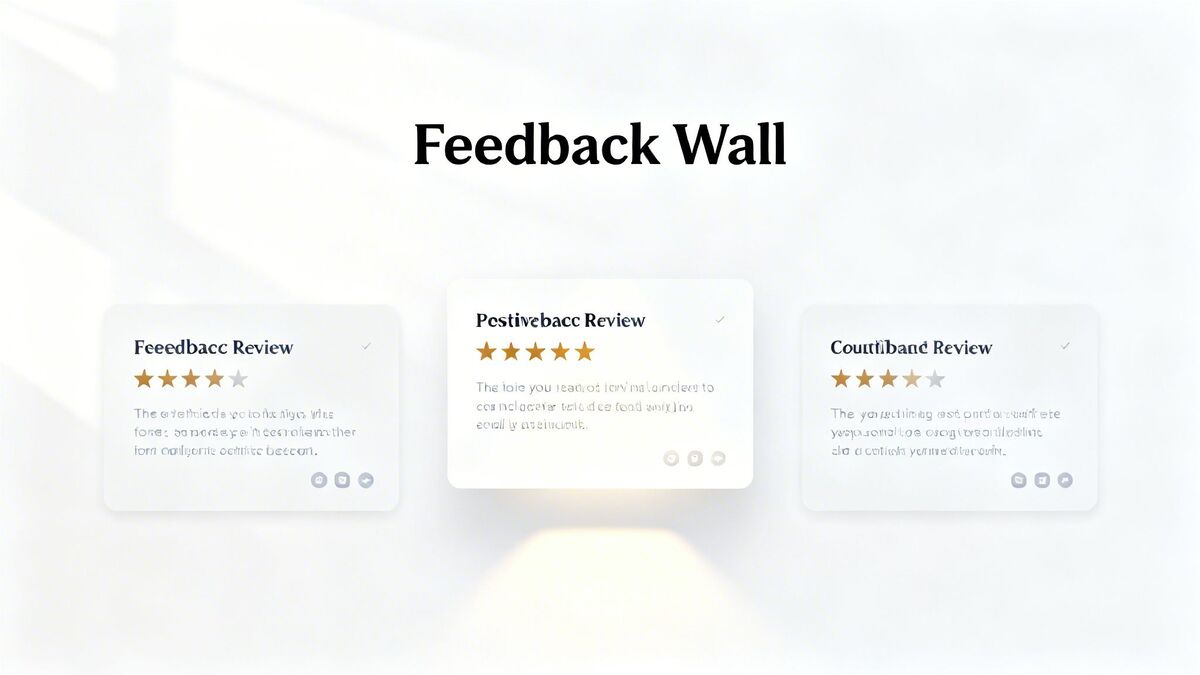
Think of a glowing review as a trusted recommendation from one friend to another. It builds instant credibility in a way traditional advertising just can't. This is the final, crucial step in your strategy: amplifying your wins to grow stronger.
Showcase Your Success with a Feedback Wall
Manually collecting your best reviews, getting permission, and then posting them on your website is a huge time-sink. This is where you need a smart tool that turns happy customer voices into compelling social proof without any extra effort.
We built Spotlight: Feedback Wall for exactly this reason. Its function is to automatically curate and showcase your best reviews directly on your website.
Imagine a potential guest browsing your hotel’s site and seeing a live, dynamic feed of recent 5-star reviews from real customers. That immediate, authentic praise often makes the difference between them booking with you or clicking away to a competitor.
This tool transforms your website from a simple brochure into a vibrant testament to your quality. It’s a low-effort, high-impact way to let your happiest customers do the selling for you.
The investment in customer experience management is surging for a reason. The global CEM market is projected to hit USD 47.72 billion by 2033, growing at a blistering 15.2% compound annual rate. This is happening because businesses now realize that a standout customer experience is the real competitive advantage, and they're pouring money into tools that help them deliver. You can learn more about these market insights and see how top performers are pulling ahead.
Turning Praise into Powerful Marketing Content
Your feedback wall is just the beginning. The positive reviews you collect are a goldmine of marketing content you can use across all your channels. Don't let them just sit on review sites—put them to work.
Here are a few simple ways to leverage great reviews:
Social Media Content: Turn a powerful quote from a review into a visually appealing graphic for Instagram or Facebook. Tagging the location can add even more context and appeal.
Email Campaigns: Include a "What Our Guests Are Saying" section in your newsletters to reinforce trust and encourage repeat business.
Staff Training and Motivation: Share outstanding reviews internally to recognize great work. It shows your team the direct impact their efforts have on customer happiness.
By integrating customer praise into your marketing, you create a self-sustaining cycle. A great experience leads to a great review, which in turn attracts a new customer who then has their own great experience. This is how you connect top-notch customer experience management directly to measurable business growth. To get started, check out our guide on how to share reviews on social media for some practical tips.
It’s Time to Transform Your Customer Experience
Throughout this guide, we've walked through how modern customer experience management isn't a one-off task—it's a complete system designed to help you collect smarter, act faster, and grow stronger. In today’s market, just guessing what customers think is a recipe for being left behind. You need a dedicated Feedback Operating System to shift from reactive problem-solving to proactive, experience-led growth.
FeedbackRobot gives you the specific tools to make this happen. Instead of just hoping for feedback, Prompt to Survey automatically asks customers for their thoughts right after key moments, like checking out with Mews or paying with Toast. You’ll build a constant, reliable stream of in-the-moment insights.
Stop guessing what your customers want and start knowing. A Feedback Operating System is your engine for turning raw feedback into your biggest competitive advantage and a source of sustainable growth.
But collecting data is only half the battle. Our system is built to help you understand and act on it instantly. Radar gives you unified review intelligence, pulling every review from across the web into one simple dashboard. Meanwhile, AI Summaries deliver instant insights & sentiment analysis, so you can spot trends in minutes, not hours.
And when a problem does pop up? The Resolutions Engine provides automated service recovery, turning a potentially negative experience into a genuine moment of loyalty.
It’s time to see the impact for yourself. Stop guessing and start knowing what really drives your business forward.
Ready to see how it all works? Start your free 14-day trial of FeedbackRobot today and discover how easy it is to listen, understand, and act. Or, be the first to amplify your success with the launch of our new Spotlight: Feedback Wall to turn your best reviews into your most powerful marketing.
Your Top Questions About CEM Answered
Here are a few of the most common questions we hear from service and hospitality pros thinking about a real customer experience strategy.
How Is CEM Different From Just Good Customer Service?
It's a great question, and the difference is crucial. Think of it like this: customer service is reactive. It’s the skilled firefighter who expertly puts out a blaze when something goes wrong. It’s essential, but it’s a response to a problem that already happened.
Customer Experience Management (CEM), on the other hand, is proactive. It’s the architect who designs the entire building to be fire-resistant from day one. CEM looks at the whole journey—from how easily a guest books online to the lobby's ambiance, every staff interaction, and the follow-up email they get after leaving. It's about designing an experience so seamless and positive that fires rarely even start.
Can a Small Business Really Do This?
Absolutely. In fact, small businesses often have a secret weapon here: you're closer to your customers and can move much faster than a huge corporation. You don't need a massive team; you just need a smart system to do the heavy lifting for you.
CEM can start with something as simple as putting a QR code on a receipt that asks for quick feedback. A Feedback Operating System automates the listening and analysis, letting you spot trends and act personally without hiring more staff. For a small business, a sharp CEM strategy is one of the most powerful ways to stand out.
What’s the Best First Step to Get Started?
The single most important first step is to start listening systematically. Stop relying on random online reviews or just the loudest person in the room.
Choose one critical moment in your customer’s journey—right after check-out, post-appointment, or when an order is completed—and make that your consistent feedback point. This focused approach is the key to getting started without getting overwhelmed.
Use a simple tool like Prompt to Survey, which is built to effortlessly turn any customer interaction into a feedback opportunity. This gets a steady flow of data pouring into a central dashboard like Radar, where you can spot your first actionable patterns. Start small, be consistent, and build your program from there.
Ready to stop guessing what your customers truly think? FeedbackRobot gives you the tools to collect smarter feedback, act on it faster, and build a stronger business.
How does customer experience management (CXM) differ for hospitality leaders?
For hospitality, CXM isn't just about the product; it's about the entire 'service ecosystem.' It involves managing every touchpoint—from digital booking to the physical environment—to ensure a cohesive brand promise is kept.
What is the ROI of investing in a formal CXM strategy?
The ROI is seen in increased RevPAR (Revenue Per Available Room) and higher table turnover. By managing the experience professionally, you reduce friction, which leads to higher spending and better reviews.
Can CXM help reduce staff turnover in restaurants and hotels?
Absolutely. A well-managed guest experience reduces 'Staff Stress.' When processes are smooth and guests are happy, employee morale improves, leading to a more stable and professional workforce.
How do I use technology to manage the guest experience at scale?
Use a 'Command Center' like FeedbackRobot to unify all guest signals. This allows you to monitor sentiment across multiple locations and departments from one central dashboard without losing the personal touch.
What is the first step in building a CXM framework?
Map your 'Ideal Guest Journey.' Once you define what a perfect visit looks like, you can use feedback data to identify where the actual experience is falling short and make targeted adjustments.
Stop reading about it. Let your agent handle it.
25 free AI actions · no credit card required
Start Free