Best Customer Review Management Platforms for Retail (2026)
The best customer review management platforms for retail in 2026 — what actually matters for store count, review volume, and budget, plus a 90-day implementation playbook for retail teams.

Apr 25, 2026 · 10 min read
Free tool
Business Reputation Calculator
Get an instant score of your online reputation across all major review platforms.
Most retail brands are currently overpaying for legacy review software that still requires hours of manual human effort to manage. In 2026, the competitive differentiator isn't just collecting feedback—it's the autonomous speed and precision with which you resolve it. While generic lists provide names, they don't provide a fit. This guide ranks the best customer review management platforms for retail by what actually determines fit — your store count, review volume, and budget — and closes with a 90-day implementation playbook. (Want a quick read on where your reputation stands first? Our free Reputation Score Calculator takes 60 seconds.)
The common wisdom of "customer reviews are critical" has become an insufficient baseline. In 2026, the real differentiator isn't just acknowledging feedback, but the Resolution Velocity with which a brand can interpret, respond, and act on every customer interaction. The liability now isn't merely ignoring reviews, but failing to transform them into automated reputation assets—a shift we call the move from Manual Management to Autonomous Resolution.
This definitive guide will dismantle the outdated "dashboard" mindset and provide a blueprint for scaling retail review management without scaling headcount. Whether you operate a national grocery chain, a high-end department store, or a hybrid e-commerce brand, mastering your reputation is the only way to protect your market share.
Chapter 1: The Manual Bottleneck and the Hidden Costs of "Management"
The retail landscape has evolved past simply "having" a customer review platform. What was once considered adequate—collecting reviews in a centralized inbox and responding when convenient—is now a significant drag on both top-line growth and operational efficiency. For a multi-location retailer with 50, 100, or 500 stores, the "Manual Bottleneck" is the primary cause of brand erosion.
Consider the mathematical reality of manual review management. If a store manager spends an average of just 12 minutes reading, investigating, and drafting a thoughtful response to a single review, a brand with 100 locations receiving 15 reviews per store per week is losing over 1,200 hours of productivity every single month. You are paying your highest-leverage local leaders—the people who should be coaching staff and driving sales—to act as part-time copywriters. Autonomous Resolution recovers that time immediately.
The true cost of human-led retail review management goes far beyond payroll. It creates systemic vulnerabilities in your customer experience (CX) architecture:
The Devastating Response Gap: Negative sentiment festers in the hours (or days) it takes a human to "find the time" to reply. When a customer leaves a 1-star review about a messy fitting room in Chicago, their frustration peaks while waiting for an acknowledgment. Autonomous agents close this gap, engaging the customer in under 120 seconds.
Data Silos vs. Actionable Intelligence: Legacy platforms act as "data graveyards." You might know your aggregate Net Promoter Score (NPS) dropped by two points, but you don't know why. Autonomous Resolution surfaces store-level, hyper-specific service gaps—like a faulty POS terminal at register three—directly to regional managers in real-time.
Algorithmic Decay on Search: Search engines like Google, and AI-driven platforms like Perplexity and ChatGPT, now prioritize "Interaction Velocity." They don't just look at how many 5-star reviews you have; they measure how fast and how comprehensively you resolve the 1-star reviews. Slow response times actively punish your local SEO rankings, pushing your stores down the Google Map Pack.
Chapter 2: The New Standard: Real-Time Feedback Solutions for Retail
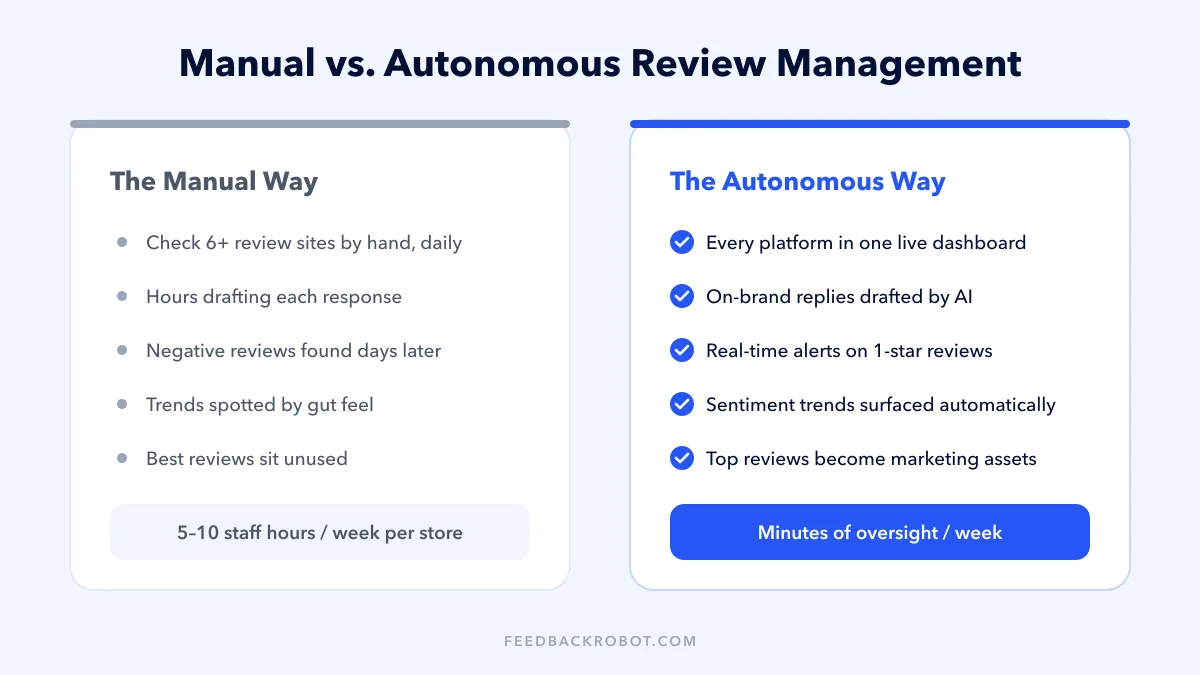
We have officially entered the era of the Autonomous Feedback Hub. When evaluating the best real-time customer feedback platforms for retail chains, executives must look past basic aggregation. The new standard requires "RepOps" (Reputation Operations)—the integration of customer feedback directly into the operational heartbeat of the store.
RepOps requires tearing down the wall between the marketing team (who monitors the reviews) and the operations team (who actually fixes the problems in the store). The best review software for stores acts as an invisible bridge between these two departments.
For instance, consider the unique needs of a regional supermarket. The best in-store customer feedback system for grocers must operate instantaneously. If a shopper encounters expired dairy products, they will likely leave a review or fill out a survey while walking to their car. If that feedback sits in a dashboard until Monday morning, the damage is done. A top instant feedback system for retail businesses will instantly catch that localized complaint, trigger an automated apology acknowledging the specific aisle, and send an immediate Slack or Teams alert to the shift manager to pull the inventory.
This shift from passive observation to active, automated resolution is what separates legacy software dinosaurs from the modern Category Kings. It is no longer enough to document the customer's anger; the platform must proactively defuse it.
Chapter 3: Synchronized Radar: Catching Sentiment Before It Escapes
To scale your brand's reputation without endlessly increasing your CX headcount, your infrastructure must possess a "Synchronized Radar." A mastery-level platform must provide a sub-30-second sync across the entire digital ecosystem: Google Business Profiles, Meta, Yelp, TripAdvisor, and niche industry-specific aggregators. But digital listening is only half the battle.
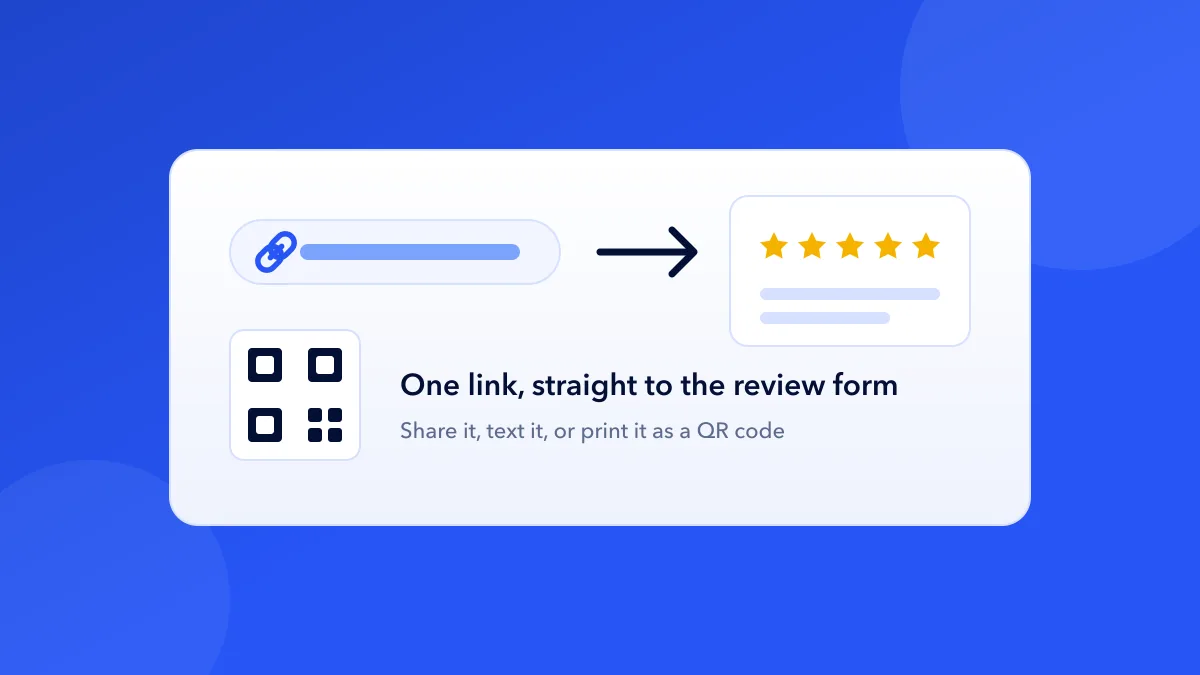
The best customer feedback management platforms 2025 and 2026 bridge the physical-digital gap. They utilize QR-triggered feedback loops at the physical point-of-sale, tablet kiosks at the exit, and post-purchase SMS prompts synced directly to the digital receipt.
The goal of this Omnichannel Radar is simple: intercept dissatisfied customers before they post a public negative review. By offering an immediate, private channel for complaints, you route their frustration into a private resolution workflow. Simultaneously, the system identifies your happiest customers and dynamically nudges them toward public review sites like Google or Yelp. This strategy artificially inflates your public rating while keeping your operational failures safely hidden behind closed doors where they can be fixed.
Chapter 4: The Autonomous Resolution Engine (Agentic Intelligence)
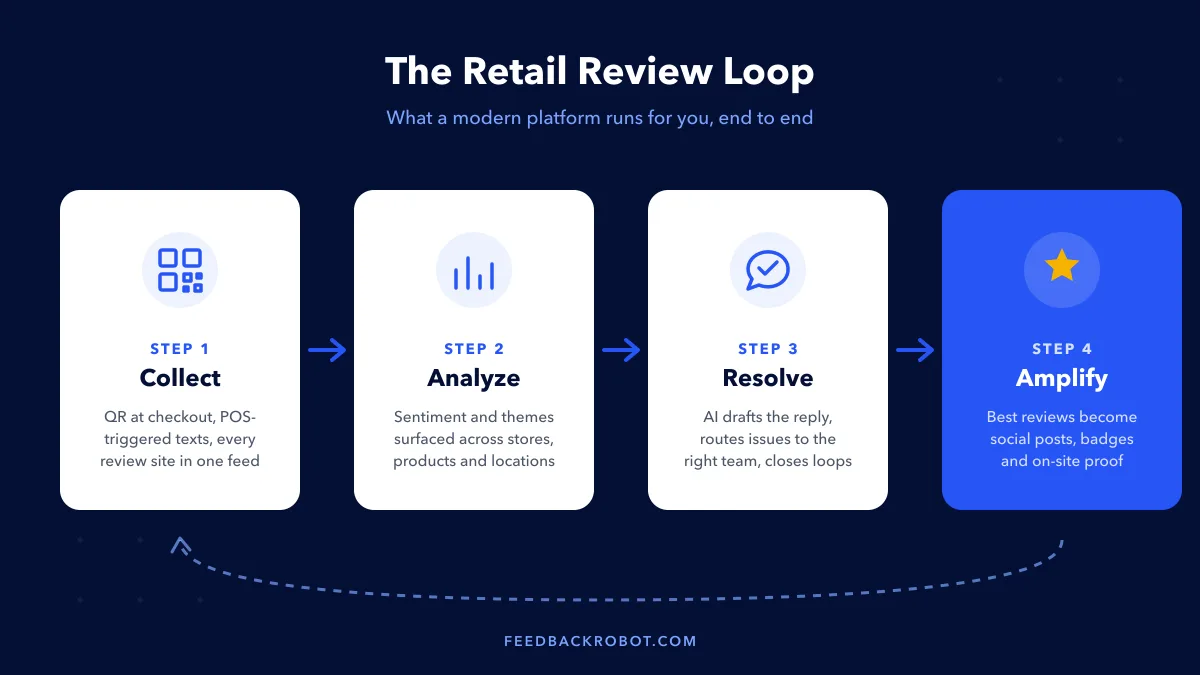
This is the critical transition from "Templates" to "Agentic Intelligence." Legacy platforms rely on static macros—pre-written responses that say "We are sorry for your experience, please call us." In 2026, modern consumers can spot a macro from a mile away, and it only enrages them further.
Platforms like FeedbackRobot do not rely on macros. They utilize an Autonomous Resolution Engine powered by advanced Large Language Models (LLMs) that execute true service recovery.
Here is what an Autonomous Resolution Engine does differently:
High-Fidelity Specificity: The AI agent reads the unstructured text of a review and distinguishes between a "slow checkout line" and a "rude cashier." It drafts distinct, context-aware responses that make the customer feel truly heard, rather than processed.
Unwavering Brand Voice: Human managers are prone to varying moods and inconsistent writing skills. One store manager might offer a highly empathetic apology, while another might leave a defensive reply. Autonomous agents learn your specific corporate tone guidelines and maintain a 100% consistent, brand-aligned persona across the entire retail fleet.
Executing the Recovery: It doesn't just issue a generic apology. The agent can be skilled to offer professional resolutions—such as securely issuing a dynamic discount code or processing a refund based on the severity of the sentiment and the customer's lifetime value.
Human-in-the-Loop Oversight: True mastery is about leverage, not losing control. The platform provides a "Review & Approve" workflow. This allows a single CX manager at corporate headquarters to oversee, tweak, and approve the AI-drafted reputation responses of 500 individual stores in under 15 minutes a day.
Chapter 5: The CRM Integration Imperative
A review is completely useless if it lacks context. If a customer leaves a 2-star review saying "My order was wrong," a standalone review platform has no idea who that customer is, what they ordered, or how much they spend annually. This is why "review management" CRM integration has become the non-negotiable feature for enterprise retail.
When your customer review platform is deeply tied to Salesforce, HubSpot, or a retail-specific CRM, the AI agent becomes infinitely more powerful.
Imagine a VIP customer—someone who spends $5,000 a year at your brand—leaves a 3-star review about a delayed shipment. Because the review platform is integrated with your CRM, it recognizes the email address or phone number attached to the feedback. The AI instantly flags this as a "High-Risk VIP Churn Event." It bypasses the standard queue, drafts a highly personalized response referencing their loyalty ("Sarah, we know you've been shopping with us since 2022..."), and immediately alerts a senior customer success manager to step in.
Conversely, if a first-time buyer leaves a minor complaint, the system can autonomously handle the apology and offer a 10% coupon to incentivize a second visit, without ever bothering a human agent. Automation is only as powerful as the customer context it can access, making CRM integration the bedrock of Retail Reputation Mastery.
Chapter 6: Navigating the 2026 Vendor Landscape
The market is no longer a monolith. Retailers must choose between software that simply tracks their problems and AI agents that actively solve them. Depending on your business model, you must evaluate which category best fits your operational reality.
The Enterprise Legacy Dashboards These are the top enterprise feedback platforms for chain stores and franchises that dominated the 2010s. They are essentially "Oversight Tools." They provide excellent, dense data visualization and reporting suites for the C-suite, but they do absolutely nothing to alleviate the workload of the store manager on the ground. They are passive cost centers. If you want a pretty pie chart for a board meeting, buy legacy. If you want to actually fix your reputation, look elsewhere.
E-commerce Focused Toolsets If you are looking for the best customer feedback systems for online retailers, this category is tailored specifically for pure-play digital brands. These platforms integrate beautifully with Shopify, BigCommerce, and WooCommerce. They are highly optimized for "Review-for-Discount" strategies and injecting rich snippets into digital product pages. However, they almost universally lack the sophisticated local SEO architecture and multi-location Google Maps integrations required for physical brick-and-mortar retail dominance.
Department Store & Big Box Solutions The best customer feedback platform for department stores must handle extreme scale and complex departmental routing. If a customer reviews the shoe department, that feedback should not go to the cosmetics manager. These platforms excel at complex routing rules and hierarchical reporting, ensuring that the right department head sees the right feedback instantly.
Autonomous Reputation Agents (The Category Kings) This category represents the future, and it is the space FeedbackRobot has defined. These systems are built from the ground up on an agentic AI model. By securely connecting specialized "Skills" to your existing POS or CRM, they autonomously pull in reviews, draft highly specific responses, and manage the entire marketing loop. For retailers looking to achieve true mastery without exploding their payroll, this is the only scalable path.
Chapter 7: Spotlight Automation and Reputation Marketing
Do not let your best reviews die in a private database. Autonomous Resolution platforms do not just mitigate the negative; they weaponize the positive.
Mastery-level platforms identify top-tier 5-star reviews—specifically those that mention key revenue drivers like "friendly staff," "clean store," or "great selection." The system automatically strips any personally identifiable information (PII) and converts the text into beautifully designed, brand-compliant social graphics.
These assets are then automatically pushed to local store Facebook, X, and Instagram pages. This transforms your customer feedback from a static metric into a self-powering, hyper-local marketing machine. When local consumers are searching for a place to shop, they don't just see a star rating; they see a continuous feed of authentic, localized praise natively integrated into their social feeds. This is how you drive organic, high-intent foot traffic.
Chapter 8: The 90-Day Implementation Playbook for Retail Executives
To dominate your local market and transition your brand from manual oversight to Autonomous Resolution, you must move systematically. You cannot flip a switch and expect 500 stores to instantly adapt. Here is the definitive 90-day playbook for retail mastery:
Days 1-30: Audit, Consolidate, and Establish the Radar Cancel the legacy software that simply emails you when you get a bad review. Consolidate your locations into a single Autonomous Hub. Connect your Google Business Profiles, Yelp, and Meta accounts to establish your baseline Radar. Turn on the AI response engine in "Draft Only" mode. This allows the LLM to learn your specific brand voice and tone guidelines while your human CX team manually approves every response, ensuring quality control during the onboarding phase.
Days 31-60: Standardize Your Link-Logic (The Tech Stack Integration) Once the AI has mastered your brand voice, it is time to integrate your tech stack. Ensure your review platform is securely synced with your POS and CRM. Set up conditional routing rules. For example: If sentiment is negative, mentions "shipping," and the customer's lifetime value is over $500, auto-route the ticket to the VIP logistics team. If a review mentions "expired," immediately ping the local store manager via SMS.
Days 61-90: Activate the Spotlight and Full Autonomy Now that your resolution time is under 2 minutes and your operational leaks are plugged, turn on Spotlight Automation. Begin turning every 5-star review into a localized social media asset immediately. Finally, transition your most common, low-risk review responses (like 5-star ratings with no text) to full AI autonomy, freeing your human team to focus exclusively on complex service recovery events.
Conclusion: The Era of Manual Management is Officially Over
In 2026, the retail brands that thrive are those that view feedback not as a nuisance to be managed, but as a high-velocity currency to be leveraged. Investing in the best customer review management platforms for retail is no longer a software decision; it is a fundamental choice between manual labor and autonomous leverage.
Legacy software creates work for your team; an Autonomous Reputation Agent handles it. The move to Autonomous Resolution ensures that every customer is heard, every store operation is optimized, and your brand remains the definitive, unshakeable choice in a hyper-competitive market. Stop managing your reputation—start resolving it.
Read the full retail reputation management guide for a deeper look at industry-specific tools and workflows.
How can brick-and-mortar retailers effectively bridge the gap between physical in-store transactions and digital reputation management in 2026?
The most successful retailers utilize an omnichannel ecosystem that captures feedback at the moment of peak engagement. This involves deploying physical touchpoints such as QR codes at checkout counters or tablet kiosks, paired with automated triggers from Point of Sale (POS) systems that send SMS or email prompts immediately following a purchase. By integrating these in-store mechanisms with a unified dashboard, businesses can ensure that offline experiences are accurately and instantly reflected in their online presence.
How does modern AI-driven response automation maintain a brand’s unique voice without appearing clinical or repetitive to the customer?
Sophisticated platforms like FeedbackRobot leverage advanced contextual AI that moves beyond basic templates to analyze the specific sentiment and nuances of each individual review. These systems are trained to mirror a brand's established tone and style, drafting personalized replies that address the specific points raised by the consumer. By incorporating a "human-in-the-loop" oversight model, staff can quickly review and approve these AI-generated drafts, ensuring the efficiency of 24/7 automation is balanced with the authenticity of human empathy.
What specific features should a retail-focused review platform provide to assist in high-level product development and merchandising decisions?
Beyond simple star ratings, the platform must offer deep sentiment analysis and granular reporting that extracts actionable insights from customer language. Retailers should look for tools that identify recurring themes—such as specific product quality concerns, shipping delays, or sizing issues—across thousands of reviews. This feedback loop serves as a direct window into consumer preferences, allowing merchandising teams to make data-driven decisions that align product offerings with actual market demand.
Why is the seamless integration of review management software with existing CRM and e-commerce stacks considered a "strategic imperative" for modern retail?
Linking these systems allows for a holistic view of the customer journey, transforming a review from an isolated comment into a valuable data point within a customer profile. When a review platform connects to a CRM or e-commerce engine (like Shopify or Magento), it enables targeted review solicitation based on specific purchase history and automates the creation of support tickets for negative feedback. This connectivity ensures that professional resolutions are handled swiftly by the correct department, minimizing churn and maximizing lifetime value.
How can retailers transition from a reactive stance on reviews to using them as a proactive engine for marketing and social proof?
Retailers should treat high-tier testimonials as "marketing gold" by utilizing amplification tools that turn positive sentiment into visual assets. Modern platforms can automatically generate shareable social media graphics from top reviews and embed dynamic widgets or trust badges directly onto product pages and checkout flows. This proactive approach ensures that the "lifeblood" of customer feedback is leveraged across all marketing channels to influence prospective buyers and drive higher conversion rates.
Put this on autopilot
Review Management
A ready-made FeedbackRobot automation that runs this for you — deploys free in under 5 minutes.
Stop reading about it. Let your agent handle it.
25 free AI actions · no credit card required
Start Free