

Guide
6 Feedback Collection Channels Compared (2026)
Email gets 25% response rate. SMS gets 45%. Compare 6 feedback collection channels by response rate, cost, and setup time — and see which fits your business.

Apr 12, 2026 · 14 min read
Free tool
AI Survey Generator
Describe what you want to learn and get a ready-to-send survey in seconds.
A guest tells your front desk the room was noisy. Another leaves a kind note in an email reply. A third says nothing to staff, then posts a rough Google review after checkout. Your restaurant gets quick thumbs-up comments at the table, but the one angry diner sends a direct Instagram message your team sees the next morning.
That’s how feedback usually looks in practice. Not neat. Not centralized. Not easy to act on.
Most owners don’t have a feedback problem. They have an orchestration problem. The issue isn’t that customers aren’t talking. It’s that feedback is scattered across inboxes, review sites, SMS threads, POS receipts, QR codes, and whatever your manager remembers from yesterday’s shift.
If you run a hotel, restaurant, clinic, or service business, a list of feedback collection channels isn’t enough. You need to know which channel belongs to which moment, what kind of question fits that channel, and who acts when a response signals risk. Otherwise you collect data and still miss the save.
Customer feedback isn't just scattered; it's a weapon pointed at your brand if you can't orchestrate it. In 2026, relying on manual checks across dozens of channels is a retention death sentence, not a strategy. FeedbackRobot cuts through this chaos by giving every business a 24/7 AI agent dedicated to turning scattered opinions into a unified voice that boosts reputation and retention.
Your Customers Are Talking, But Are You Listening?
A hotel owner once described her weekly routine like this: check Google reviews on Monday, skim email replies on Tuesday, ask the front desk if anyone complained on Wednesday, and hope nothing ugly showed up on social before Friday.
That’s common. It’s also expensive.
When feedback lives in separate places, your team reacts late. The bartender hears one complaint about slow service. The manager sees two more in a private survey. A guest posts the fourth complaint publicly. Nobody connects the pattern until the weekend is over and the damage is already visible.
Fragmented feedback creates blind spots
The biggest mistake isn’t choosing the wrong channel. It’s treating each channel like a separate program.
A few examples:
Email without on-site capture: You only hear from guests after they leave, when recovery is harder.
QR codes without follow-up: You collect comments at the table but no one closes the loop.
Reviews without internal routing: Public complaints pile up because staff don’t know who owns the response.
SMS without conversation design: You ask for feedback, but the thread turns into a live service issue your team isn’t prepared to handle.
If you’re using text as part of your process, it helps to understand the mechanics of SMS 2 Way Communication before you deploy it broadly. SMS can be excellent for quick feedback and recovery, but only when someone owns the replies and escalation path.
Practical rule: If a customer can answer through a channel, your business needs a defined response path for that channel.
The true cost is missed service recovery
A bad experience isn’t always fatal. An ignored bad experience is.
Owners often focus on collecting more responses. The better goal is catching friction early enough to fix it. That means you need channels for private feedback before public reviews, and you need one system that shows the full picture fast enough for a manager to act during the shift, not after month-end reporting.
Why An Omnichannel Approach Is Non-Negotiable
Relying on one feedback source gives you a partial story. Email surveys tend to catch one type of customer. Public reviews catch another. In-person prompts reveal issues that would never show up in a formal questionnaire.
If you only listen in one place, you’ll optimize for the people who answer there and miss everyone else.
One channel cannot cover the whole journey
A hotel guest may book online, ask a question by SMS, complain at the desk, and leave a review on Google. A restaurant guest may scan a table QR code, pay through the POS, and later mention the experience on Instagram.
Those are not separate customer experiences. They’re one experience expressed through multiple channels.
An omnichannel approach matters because different channels capture different truths:
Channel | What it captures well | What it misses |
|---|---|---|
Reflective, relationship-level feedback | In-the-moment issues | |
SMS | Fast transactional reactions | Detailed nuance |
Web embeds | Friction during a digital task | Offline experience |
QR codes | On-site context | Guests who ignore signage |
Public reviews | Unfiltered reputation signals | Recoverable issues that should have stayed private |
Retention is tied to channel coverage
This is not just a CX preference. A 2024 KPMG healthcare study found that companies actively tracking multi-channel feedback achieved 18% lower annual churn rates according to Zigpoll’s summary of the study.
You don’t need to run a healthcare business to understand the operational lesson. When a company captures feedback across more than one touchpoint, it spots friction earlier and acts on a broader set of signals. In hospitality and food service, that usually means fewer unresolved complaints, better recovery, and a clearer view of what’s hurting repeat business.
Omnichannel does not mean channel overload
Many owners hear “omnichannel” and think more tools, more dashboards, more noise. That’s the wrong model.
You don’t need every possible channel. You need the right mix for your journey:
Pre-visit or post-stay relationship feedback
In-the-moment service feedback
Passive collection from public review sites
A system for routing negative sentiment to the right person
More channels without coordination create chaos. Coordinated channels create visibility.
That distinction matters. The return doesn’t come from asking everywhere. It comes from matching the channel to the moment, then tying every signal back to one operational workflow.
Digital Channels Email SMS and Web Embeds
Digital feedback collection channels do the heavy lifting for most service businesses. They’re fast to launch, easy to automate, and flexible enough to fit both guest journeys and staff workflows.
The catch is that owners often use them interchangeably. They shouldn’t.
Email works best for relationship feedback
Email is the right channel when you want a guest or customer to reflect on the full experience. Post-stay hotel surveys, recurring diner sentiment, membership feedback, and account-level service reviews fit here.
Email achieves a typical response rate of 25-35% for relationship-based surveys in B2B contexts, according to CustomerGauge’s breakdown of feedback channels. It also notes that channel-survey alignment matters for data quality.
That point matters more than the raw percentage. If you ask a deep relationship question in a channel designed for speed, you usually get shallow answers.
Use email when you need:
Context: space for open-text comments
Branding control: better design and longer-form framing
Post-visit reflection: after checkout, after a completed service, after onboarding
If you’re refining your follow-up process, this guide on how to email a survey is useful for structuring the ask without creating unnecessary friction.
SMS is strong for immediate, transactional moments
SMS gets attention quickly. That’s why it’s effective right after a transaction, service interaction, or support event.
The same CustomerGauge analysis notes that SMS can reach 25-50% response rates, but it’s better suited to transactional feedback than relationship measurement. That aligns with what operators see on the ground. A quick “How was check-in?” or “How was your order pickup?” fits text. A broad “How do you feel about our brand?” usually doesn’t.
SMS is a good fit when you need to know:
Did something just go wrong
Does a manager need to step in now
Should this guest be contacted before they post publicly
What doesn’t work is turning SMS into a long survey. Customers don’t want homework in a text thread.
Web embeds catch friction while it happens
Web embeds are useful when the customer is already on your site or app and you want to catch digital experience issues close to the moment.
They work well for:
booking flow friction on a hotel site
checkout confusion for e-commerce
support article feedback
account portal issues for clinics or agencies
Their main strength is timing. Their main weakness is context. You’ll often capture a symptom, not the full relationship.
If the guest is still inside the task, ask a transactional question. If the experience is complete, ask a relationship question.
Quick comparison for operators
Channel | Best use | Main risk |
|---|---|---|
Post-stay or post-service relationship surveys | Too slow for urgent recovery | |
SMS | Immediate transactional feedback | Poor fit for long-form questions |
Web embeds | Digital journey friction | Skews toward active site users only |
If you run one of these channels well, you’ll get useful data. If you run all three with clear job definitions, you’ll get a much cleaner operating picture.
On-Site Channels QR Codes Kiosks and POS
On-site feedback collection channels are where you catch problems before the customer leaves. For hospitality and food service, that matters more than almost anything else.
A guest who tells you privately that the room wasn’t clean gives you a chance to recover. A diner who flags a problem before dessert gives you a chance to fix the table. Once they leave, your options narrow.
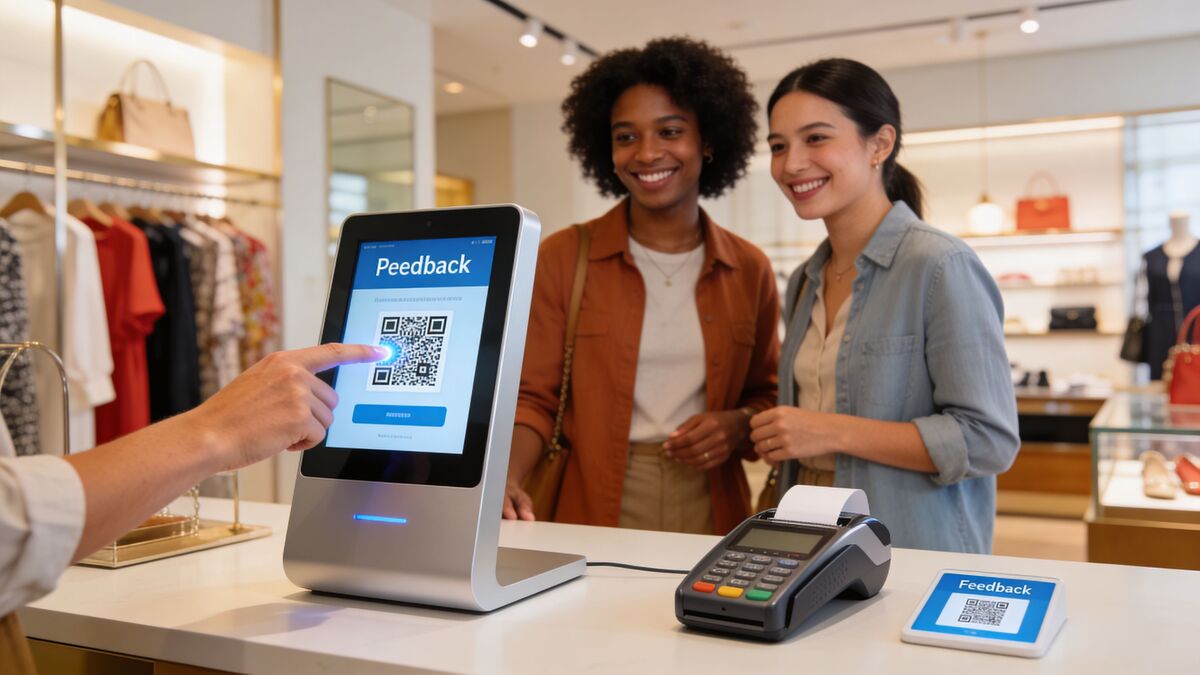
QR codes are low-friction and flexible
QR codes work because they meet the customer where the experience is happening. On a table tent, reception desk sign, room card sleeve, or takeaway bag, they give customers a fast path to respond without needing staff involvement.
They’re especially useful for:
table-side service checks
room cleanliness feedback
spa or clinic visit comments
event venue touchpoints
The best QR deployments stay short. Ask one focused question first, then branch if needed. If you’re building this flow, this practical piece on a QR code survey covers the setup logic well.
QR codes fail when businesses hide them, overdesign the survey, or never monitor incoming responses.
Kiosks work when visibility matters
Kiosks are blunt instruments, but they can be effective in high-traffic settings. Hotel lobbies, retail exits, food halls, and clinic waiting areas are common fits.
They help when you want:
a visible prompt that signals “we care about feedback”
fast pulse checks from many visitors
a simple score or sentiment read at exit
They are less useful for detailed comments unless the interaction is designed well. Most guests won’t stand at a kiosk to write paragraphs.
POS prompts are ideal for transaction-close timing
POS-triggered feedback is underrated. If you run Toast or another modern POS, the moment after payment is often the cleanest transactional checkpoint you have.
Use POS-linked prompts for questions like:
Was service speed acceptable?
Was your order accurate?
Would you come back?
This is not the place for a broad annual-style satisfaction survey. It is the place for a short prompt tied to a completed transaction.
Ask on-site questions that staff can still act on. If the answer arrives too late to fix anything, you’ve wasted the best part of on-site collection.
Which on-site channel fits which job
QR codes: best when you want flexibility and can place prompts at multiple physical touchpoints.
Kiosks: useful when you need a visible capture point and high walk-by exposure.
POS prompts: strongest for immediate transaction feedback tied to a specific visit.
Most operators don’t need all three on day one. They need the one that matches their service model and a process for who gets alerted when a response signals a save is needed.
Public Channels Social Media and Review Platforms
Public feedback is where customers say what they didn’t say directly to you. That makes it uncomfortable, but also useful.
Reviews and social mentions often contain the most candid version of the experience. They also shape buying decisions before a new guest ever contacts you.
Public feedback is unsolicited intelligence
Private surveys tell you what respondents choose to share in your process. Public channels show what people say when they’re on their own turf.
That’s why review monitoring matters. Not just for star ratings or damage control, but for pattern detection.
Between 2017 and 2019, England’s NHS Digital patient feedback web service collected 51,845 reviews, showing the scale and analytical value of large free-text feedback sets in public digital channels, as documented in the JMIR study on the NHS feedback corpus.
The operational lesson is straightforward. Free-text feedback at scale becomes useful when you can group recurring themes and route them to the right team. Without that, it’s just a pile of comments.
What to watch on review sites and social
For hotels and restaurants, the practical list usually includes:
Google reviews: broad reputation and local search impact
Tripadvisor or Yelp: travel and dining intent
Instagram and Facebook mentions: public complaints and praise in informal language
Review platforms like Trustpilot: for some service brands, review platforms like Trustpilot add another stream of reputation data that should be monitored alongside survey responses
Don’t treat public feedback like a separate universe
Owners often split public feedback from survey feedback. Marketing owns reviews. Operations owns service issues. That separation causes delays and duplicated effort.
A complaint about wait time means the same thing whether it lands in a QR form, a Google review, or an Instagram comment. The source changes. The root issue doesn’t.
Public channels tell you what customers are willing to say where everyone else can see it. That makes them reputation data and operations data at the same time.
Unify Everything with an AI Feedback Operating System
At some point, adding channels stops helping. If your team can’t make sense of what’s coming in, more collection just creates more backlog.
That’s why an effective solution isn’t another survey link. It’s an operating layer that takes feedback from every channel, organizes it, interprets it, and triggers action.

What the system needs to do
In practice, an AI feedback operating system should handle four jobs well:
Ingest feedback from different channels
Turn messy comments into usable themes
Surface urgent issues fast
Trigger recovery before the complaint spreads. Many operators move beyond standalone survey tools and use a platform like FeedbackRobot to centralize surveys, reviews, and response workflows.
A useful benchmark here is that thematic analysis combined with sentiment analysis can uncover pain points from feedback arriving through emails, chatbots, and websites simultaneously, reducing manual analysis time from hours to minutes, based on InMoment’s discussion of real-time feedback processing.
If you want a deeper look at that workflow, this overview of a feedback analysis tool for small business is worth reading.
The core operating system features
Radar gives you unified review intelligence. Instead of checking Google, survey exports, and message threads separately, you get one place to see what guests are saying across channels and locations. For a hotel group or multi-site restaurant brand, that means less hunting and faster pattern recognition.
Prompt to Survey turns simple prompts into live feedback requests across the customer journey. That matters because channel choice should follow the moment. Post-stay email, post-payment SMS, and table-side QR code prompts should all feel intentional, not improvised.
To see the product context in motion, watch this short walkthrough.
AI Summaries provide instant insights and sentiment analysis. That’s not just a convenience feature. It’s how a busy operator gets from “lots of comments” to “three recurring issues need action today.” If ten reviews mention breakfast delays in different wording, the system should cluster that theme without a manager reading every line manually.
Resolutions Engine handles automated service recovery. This is the piece most businesses are missing. If a guest gives negative private feedback, the system can trigger an empathetic follow-up, route the case to a manager, or start a recovery workflow before the complaint turns into a public review. That’s how collection becomes operational.
Why orchestration matters more than channel count
A strong feedback program doesn’t win because it uses email, SMS, QR, kiosks, and reviews all at once. It wins because those channels feed one brain.
Without orchestration, you get scattered alerts. With orchestration, you get:
One view of sentiment across touchpoints
Faster triage of urgent issues
Less manual reading and tagging
Cleaner handoff from insight to action
That’s the difference between collecting feedback and running on it.
QR codes are one of the highest-response in-person feedback channels. FeedbackRobot's QR code integration generates print-ready survey codes and routes happy respondents to Google or Yelp — turning feedback into public reviews automatically.
Your Action Plan for Smarter Feedback Collection
If you’re busy, don’t start by adding every feedback collection channel you can think of. Start by mapping the moments where a customer can tell you something useful and your team can still do something with it.
Build from the journey, not the tool list
For a hotel, that might look like this:
Booking stage: web embed for reservation friction
Pre-arrival or post-check-in: SMS for immediate operational issues
Mid-stay: QR code in-room or on-property for recoverable service issues
Post-stay: email for broader relationship feedback
After departure: review monitoring for reputation management
For a restaurant:
During service: QR code on table or receipt
At payment: POS-triggered pulse check through Toast
After visit: SMS or email based on the guest relationship
Always on: Google and social monitoring
Keep the questions channel-specific
Don’t ask the same question everywhere.
Use short, actionable prompts in fast channels. Use open-text reflection in slower channels. If you serve multilingual or diverse customer bases, this gets even more important.
A documented market gap is how AI tools handle non-English feedback. According to Alchemer’s discussion of omnichannel feedback challenges, response rates can drop 15-20% for non-native surveys, and standard sentiment analysis often struggles with messy open-text feedback from diverse sources.
That has direct implications for hotels, restaurants, and clinics in mixed-language markets.
If your surveys are only easy to answer in English, your data will overrepresent English-comfortable customers and understate other groups’ problems.
Prioritize the first three moves
If you want a clean rollout, do this in order:
Fix one private recovery channel first Start with SMS, email, or QR code where unhappy customers can respond before they go public.
Add one public listening stream Make sure Google reviews and social mentions are visible to someone who can act.
Connect collection to resolution Don’t launch another survey until you know who responds, who escalates, and what happens when sentiment turns negative.
If you already use systems like Mews in hotels or Toast in restaurants, tie channel triggers to those operational events so feedback requests go out at the right moment rather than on a random schedule.
The businesses that do this well follow a simple operating principle. Collect smarter, act faster, grow stronger.
Ready to stop chasing feedback and start using it to build a stronger business? Before you launch your next survey, do you know exactly how Google and your customers perceive your business today?
Use our free Reputation Score Calculator to get an instant audit of your star rating, review volume, and response speed. See your "Reputation Report Card" in 30 seconds and uncover the hidden gaps in your local SEO. Once you know your score, you can start using FeedbackRobot to collect smarter, act faster, and grow stronger.
Many businesses collect a significant volume of data but still suffer from service "blind spots." Why does having multiple feedback channels often lead to operational failure rather than clarity?
The failure typically stems from an "orchestration problem" where channels are treated as isolated silos rather than a unified ecosystem. When feedback is scattered across SMS, email, and POS systems without a centralized routing path, critical patterns—such as a recurring service delay—go unnoticed until public reputation damage is already visible. Effective management requires matching the specific channel to the guest's journey stage and ensuring every signal feeds into a single operational workflow for immediate triage.
When designing a feedback strategy, how should an operator determine whether to deploy an SMS prompt or a traditional email survey for a specific touchpoint?
Selection depends on whether you seek "transactional" or "relationship" insights. SMS is optimized for high-velocity, immediate reactions, such as verifying room cleanliness or order accuracy while the guest is still on-site. Conversely, email is the superior medium for post-visit reflection, providing the necessary space for long-form, relationship-level feedback. Deploying a complex survey via SMS often results in "homework fatigue" for the customer, while using email for urgent service checks is typically too slow to allow for a successful "save" or recovery.
What is the tactical advantage of utilizing on-site channels like QR codes or POS prompts compared to waiting for a post-stay review?
On-site channels prioritize active service recovery while the customer is still within your sphere of influence. A QR code on a table tent or a prompt at the POS terminal allows an unhappy diner or patient to flag friction privately and instantly. This creates a critical intervention window, enabling a manager to resolve the issue before the guest leaves and subsequently posts a negative public review. Once a guest departs the property, your options for meaningful intervention and sentiment reversal narrow significantly.
How does an AI-driven "Feedback Operating System" fundamentally change the way a manager handles the daily influx of guest comments?
Instead of requiring a manager to manually skim hundreds of disparate comments across various platforms, an AI layer performs thematic and sentiment analysis to cluster recurring issues into actionable insights. It automates the heavy lifting by identifying urgent negative sentiment and triggering immediate alerts or recovery workflows. This shifts the staff’s responsibility from manual data processing to active resolution, reducing the time between identifying a complaint and executing a fix from days to mere minutes.
For businesses operating in diverse or international markets, what are the primary risks of relying on a single, English-centric feedback channel?
Relying on a single language or channel often alienates non-native speakers, leading to a documented 15-20% drop in response rates among those demographics. This creates skewed data that overrepresents one segment of your clientele while ignoring systemic issues faced by others. A sophisticated omnichannel approach must account for diverse linguistic needs and handle messy, open-text feedback, ensuring the final operating picture reflects the entire customer base rather than just the most vocal, English-comfortable segment.
Stop reading about it. Let your agent handle it.
25 free AI actions · no credit card required
Start Free