
Guide
Qualitative Research Questionnaire: 7 Free Templates & Sample Questions
What a qualitative questionnaire is, how to design one, and 7 free copy-paste templates — including a full sample with consent script.

Apr 5, 2026 · 22 min read
Free tool
Likert Scale Generator
Generate custom rating scales and survey questions tailored to your feedback needs.
Star ratings and quantitative metrics tell you what people think — a qualitative research questionnaire tells you why. Whether you are a student building a research instrument, a UX researcher planning a study, or a service-business owner trying to understand your customers, the format is the same: open-ended questions that invite stories, feelings, and detailed descriptions instead of numbers. That narrative data is where the ‘aha’ moments and hidden friction points live — the ones that make or break loyalty.
This is where a well-crafted qualitative research questionnaire becomes your secret weapon. But who has time to become a market research expert? You're busy running your business, managing staff, and serving guests.
This guide is your shortcut. Forget guesswork and theory. We're providing a curated collection of industry-tested, ready-to-use sample qualitative research questionnaire templates designed for busy hospitality, retail, and healthcare owners. You'll get actionable question sets you can copy and paste today, complete with consent scripts, adaptation notes for your specific business, and tips for analysis.
What Is a Qualitative Questionnaire?
A qualitative questionnaire is a set of open-ended questions designed to capture experiences, motivations, and opinions in the respondent’s own words, rather than as numeric ratings. Instead of asking “How satisfied were you, on a scale of 1–5?”, it asks “What stood out about your visit?” — producing narrative data that is analyzed for themes and meaning rather than averages.
Structurally, a qualitative questionnaire sits between a structured survey and a full interview. It is usually self-administered (email, web form, or paper), which makes it far cheaper to run at scale than interviews, while still collecting the depth that closed-ended surveys miss. Researchers use qualitative questionnaires for exploratory studies, needs assessments, and experience research; service businesses use the same instrument to understand why customers stay, leave, or recommend. The trade-off is analysis effort: open-ended responses must be read and coded for themes — a step that AI text analysis has made dramatically faster than the manual coding of a decade ago.
Qualitative vs. Quantitative Questionnaires
The two formats answer different questions, and most serious research programs use both. Here is how they differ in practice:
| Qualitative questionnaire | Quantitative questionnaire |
|---|---|---|
Question type | Open-ended prompts (“Describe…”, “Why…”) | Closed items — Likert scales, star ratings, multiple choice (see these likert scale examples, or build your own with the free question generator) |
Data produced | Narrative text: stories, descriptions, verbatims | Numbers: scores, percentages, distributions |
Analysis method | Thematic coding, sentiment analysis, AI summarization | Statistical analysis, benchmarks, trend charts |
When to use | Exploring the why, new problem spaces, smaller samples | Measuring the how much, tracking KPIs, large samples |
Between qualitative research cycles, pulse surveys are the standard way to track quantitative signals on a weekly or monthly basis. Our pulse survey questions template covers 50 questions across engagement, satisfaction, and operational health.
Sample Qualitative Research Questionnaire (Copy-Paste)
Before the seven specialized templates, here is one complete, generic instrument you can copy, adapt, and send today. It follows the standard structure of a qualitative research questionnaire: a short consent script, three screening questions, eight open-ended questions sequenced broad-to-specific, and a closing statement.
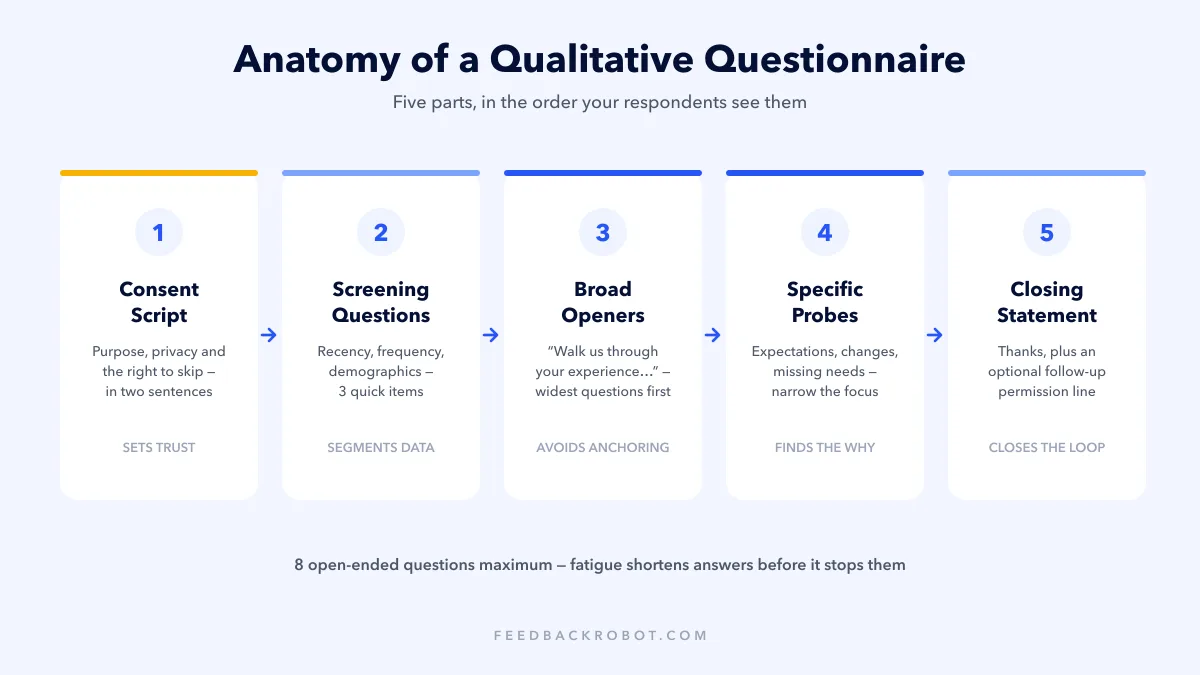
Customer Experience Research Questionnaire — [Business Name]
Consent script: Thank you for taking part in this research. Your responses will be used only to improve our products and services, will be stored securely, and will never be linked to your name in any report — you may skip any question or stop at any time.
Screening questions:
When did you most recently visit or use us? (Within the last week / month / 6 months / longer)
Roughly how often do you visit or use us? (This was my first time / Occasionally / Monthly / Weekly or more)
Which age group are you in? (18–24 / 25–34 / 35–44 / 45–54 / 55+ / Prefer not to say)
Open-ended questions:
Walk us through your most recent experience with us, from start to finish. What do you remember most clearly?
What originally led you to choose us over the alternatives you considered?
Describe a moment during the experience when you felt especially pleased — or especially frustrated. What happened?
How did the experience compare with what you expected beforehand?
If you could change one thing about the experience, what would it be — and why does that matter to you?
What words would you use to describe us to a friend who has never visited?
Was there anything you needed or hoped for that you didn’t find or didn’t receive?
Is there anything we haven’t asked about that you think we should know?
Closing statement: That’s everything — thank you for your time and honesty. If you’re happy for us to follow up on anything you’ve shared, please leave your email below (optional).
To adapt it: swap the experience wording for your context (“your stay”, “your appointment”, “your order”), keep the broad-to-specific sequence intact, and resist adding more than eight open questions — fatigue shortens answers long before respondents quit outright.
How to Design a Qualitative Research Questionnaire
Whether you use the sample above or build from scratch, the design process is the same five steps:
Define the research question. Write one sentence naming the decision this data should inform — “Why do first-time guests not return?” beats “learn about the guest experience.” Every question you write must serve that sentence, or it gets cut.
Choose open question formats. Favor “describe”, “walk me through”, and “what happened when” framings over anything answerable with yes/no. Avoid leading constructions (“How great was…”) and double-barreled questions that ask two things at once.
Sequence broad → specific. Open with the widest experience question, then narrow to specific touchpoints, and end with the catch-all “anything we haven’t asked?”. Early narrow questions anchor respondents and contaminate everything that follows.
Pilot with 3–5 respondents. Send the draft to a handful of real customers or colleagues and read the answers for misreadings, thin responses, and questions everyone skips. One pilot round catches most design flaws at almost no cost.
Plan the analysis approach before sending. Decide up front how responses will be coded — a theme list, a spreadsheet, or AI-assisted summarization — and who will read them. Questionnaires designed without an analysis plan produce data nobody ever uses.
More importantly, you'll learn how to deploy these questions and instantly turn open-ended feedback into action. We’ll show you how tools like FeedbackRobot's AI Summaries can analyze thousands of text responses in seconds, giving you instant insights & sentiment analysis without manual work. This is how you collect smarter, act faster, and grow stronger. Let’s stop guessing and start asking the right questions.
Traditional questionnaires are valuable, managing and deriving actionable insights from the sheer volume of feedback can be overwhelming. You can streamline this process and gain deeper understanding by integrating your feedback collection with advanced tools. Explore how a comprehensive online feedback form strategy can automate analysis and response, ensuring no customer voice goes unheard and that your reputation is managed proactively.
While the seven templates below cover the most common industry scenarios, the most insightful qualitative data comes from questions tailored to your specific operational blind spots. Instead of manually editing a generic list, try our free AI survey generators — describe the specific ‘why’ you are trying to uncover, whether it’s why guests are choosing a competitor or why a specific service feels ‘off’, and get a custom, open-ended questionnaire designed to draw out deep, narrative answers.
1. Open-Ended Experience Questionnaire
The Open-Ended Experience Questionnaire is a foundational tool for qualitative research. It moves beyond simple yes/no answers or star ratings by using broad, unrestricted questions. This approach encourages customers to provide detailed narratives about their experiences, capturing their thoughts and feelings in their own words. Unlike structured surveys with predefined options, this method uncovers the "why" behind customer behavior, revealing nuanced insights you might not have anticipated.

This type of sample qualitative research questionnaire is incredibly versatile, making it ideal for various service-based industries. It helps you collect smarter feedback by getting straight to the core of the customer's perspective. When designing your Open-Ended Experience Questionnaire, understanding the nuances of question length and depth is crucial, such as the distinction between short answer vs. paragraph questions.
Industry-Specific Question Examples
Hospitality: "Describe the most memorable part of your stay with us. What made it stand out?"
Restaurants: "If you were to describe your dining experience to a friend, what would you say?"
Retail/E-commerce: "Tell us about your recent shopping journey. What did you enjoy, and what could have been smoother?"
Healthcare: "Thinking about your recent visit, what is one thing we could have done to make you feel more comfortable or supported?"
Strategic Breakdown & Actionable Takeaways
This questionnaire format is designed to produce rich, narrative data. The real power comes from how you deploy it and what you do with the responses.
Core Strategy: The goal is to capture authentic voice-of-customer data at the point of interaction. This provides immediate, contextual feedback that is far more valuable than a generic survey sent days later.
Tactical Implementation:
Lead with Impact: Always place your most important question first. Attention spans are short, so capture the most critical feedback immediately.
Keep it Conversational: Phrase questions naturally. Instead of "Evaluate our service," ask "How was your experience with our team today?" This encourages more genuine and detailed responses.
Deploy at the Point of Experience: Use QR codes on receipts, table tents, or in-room materials. FeedbackRobot's Prompt to Survey feature lets you instantly turn an idea into a live survey. For example, you can automatically trigger these questionnaires after a specific interaction, like a completed appointment or a checkout via your POS system (e.g., Toast or Mews integrations).
Balance Depth and Brevity: Set a character limit (500-1000 characters is a good starting point) to encourage focused, yet detailed, answers. You want a story, not a novel. You can discover more strategies in our guide to designing effective open-ended surveys.
Once responses start flowing in, FeedbackRobot’s AI Summaries instantly analyze the text for themes and sentiment. This turns pages of qualitative feedback into actionable instant insights & sentiment analysis, showing you whether the "memorable part" of a hotel stay was the friendly staff or the uncomfortable bed, allowing your team to act faster.
2. Critical Incident Technique (CIT) Questionnaire
The Critical Incident Technique (CIT) is a structured qualitative method that zeroes in on specific events that have a significant impact, either positive or negative, on a customer's experience. Instead of asking for general feelings, this questionnaire prompts respondents to recall and describe a single, memorable incident in detail. This approach provides a microscope for examining key service moments, revealing the precise actions and circumstances that create loyal advocates or drive customers away.

This sample qualitative research questionnaire is especially powerful for understanding service failures and successes through detailed case descriptions. By focusing on a "critical incident," you get past vague feedback and learn exactly which touchpoints matter most. It allows you to collect highly specific stories that can be used for staff training, process improvement, and targeted service recovery.
Industry-Specific Question Examples
Hotels: "Think about your recent stay. Can you describe one specific interaction or event that stood out to you, for either a good or bad reason?"
Restaurants: "Tell us about a particular moment from your meal that significantly affected your overall experience."
Retail: "Describe a specific time a staff member helped you (or failed to help you) find what you were looking for."
Healthcare: "Please recall one specific moment during your appointment that made you feel either particularly heard or dismissed."
Strategic Breakdown & Actionable Takeaways
This questionnaire is designed to collect focused, high-impact stories that reveal the moments that define your brand. The key is guiding the customer to recall a specific event and its consequences.
Core Strategy: The goal is to isolate and analyze the make-or-break moments in the customer journey. These incidents are rich data points that show exactly what behaviors and processes to replicate or eliminate.
Tactical Implementation:
Start with a Neutral Prompt: Begin with a broad, neutral question like, "Tell us about a recent experience that stood out to you." This avoids leading the respondent and allows them to choose the incident they feel is most important.
Use Probing Follow-up Questions: Guide the narrative with follow-ups. A conversational interface is perfect for asking, "What exactly happened?" "How did that make you feel?" and "In your opinion, what would have made it a better experience?"
Trigger Feedback at High-Stakes Moments: Deploy this questionnaire immediately following a critical interaction. FeedbackRobot's Prompt to Survey feature can instantly turn an idea into a live survey after a guest checks out via your Mews PMS or a patient completes a high-value consultation.
Analyze Incidents for Root Causes: Don't just collect stories; analyze them. When a negative incident is reported, FeedbackRobot's Resolutions Engine provides automated service recovery. It can automatically open a service recovery ticket and assign it to the right manager, ensuring that a critical failure is addressed before it becomes a public complaint.
By categorizing incidents by touchpoint (e.g., "check-in," "bedside manner," "checkout"), you can use the feedback to build a clear picture of operational strengths and weaknesses. Our AI Summaries feature helps by automatically tagging themes like "staff attitude" or "wait time," turning individual stories into measurable performance indicators.
3. Phenomenological Interview Template
The Phenomenological Interview Template is a deeply exploratory qualitative approach designed to understand how customers experience and make meaning from their interactions with your business. It goes beyond asking "what happened" to uncover "what it was like." This method focuses on the lived experience, personal significance, and emotions tied to an event, revealing the deep-seated drivers of loyalty and emotional connection. Its goal is to understand the very essence of an experience from the customer's unique perspective.

Popularized by philosophers like Edmund Husserl and applied in modern research by academics such as Max van Manen, this sample qualitative research questionnaire helps you explore concepts that are often hard to articulate. It's not for every customer, but for those highly engaged individuals willing to share a deeper story, the insights are invaluable. This approach turns feedback into a window to the customer’s soul, showing you what truly matters to them on an emotional level.
Industry-Specific Question Examples
Hospitality: "Describe what the feeling of 'home away from home' was like for you during your stay."
Restaurants: "Beyond the food itself, can you tell me about the moments that made you feel truly comfortable and at ease during your meal?"
Healthcare: "Walk me through your visit. What did it feel like to put your trust in our care team?"
Luxury Retail: "Think about your purchase. Describe the journey of emotions you felt, from first seeing the item to making it your own."
Strategic Breakdown & Actionable Takeaways
This questionnaire is a precision tool for unearthing profound emotional insights that standard surveys cannot reach. Its value lies in capturing the subjective reality of your most thoughtful customers.
Core Strategy: The objective is to move past transactional feedback and understand the core emotional and psychological experience your brand creates. These rich narratives provide the raw material for building a stronger brand story and a more empathetic customer journey.
Tactical Implementation:
Start Broad, Then Go Deep: Begin with a wide-open prompt like, "Describe what this experience felt like to you." Use gentle follow-ups such as, "Can you tell me more about that feeling?" to encourage elaboration without leading the respondent.
Target the Right Audience: This isn't a mass survey. Implement it as an optional, longer-form questionnaire for your most engaged or loyal customers. A small number of rich responses is more valuable than many superficial ones.
Automate the Invitation: Use FeedbackRobot's Prompt to Survey to instantly turn an idea into a live survey. You can trigger an invitation for this deeper feedback after a specific positive milestone, like a customer's fifth visit or a 5-star rating on a shorter survey. This targets customers who are already primed to share.
Convert Insights into Assets: The powerful, emotional language captured here is perfect for marketing. With permission, these responses can become compelling testimonials, case studies, or the foundation of your brand's narrative.
Once you collect these stories, FeedbackRobot's AI Summaries are essential for making sense of the deep, unstructured text. The AI instantly identifies recurring emotional language, abstract concepts like "trust" or "comfort," and the specific moments that created them. This analysis helps you pinpoint exactly what actions and environmental factors create powerful, positive experiences, allowing you to train your team and refine your service with unparalleled precision.
4. Service Quality Expectation-Gap Questionnaire
The Service Quality Expectation-Gap Questionnaire is a powerful diagnostic tool that measures the difference between what customers expect and what they actually experience. Rooted in the principles of the SERVQUAL model, this method helps you pinpoint specific breakdowns in service delivery. By asking comparative questions, it reveals critical gaps where your marketing promises don't align with operational reality.
This type of sample qualitative research questionnaire is especially useful for identifying specific service design flaws and misaligned marketing messages. It gives you a clear map of where reality falls short of perception, allowing you to make targeted improvements. As you build your questionnaire, you'll need a clear structure to prevent bias. Our guide on how to create a questionnaire provides a framework for designing effective, well-ordered questions.
Industry-Specific Question Examples
Hotels: "Before your stay, what did you expect from our 24-hour room service? Please describe what you actually experienced when you tried to use it."
Restaurants: "Based on our menu's description, what did you expect from our 'farm-to-table' salad? Did the ingredients and taste meet that expectation?"
Retail/E-commerce: "Thinking about our 'easy returns' policy, what was your expectation for the process? Tell us about what happened when you initiated your return."
Healthcare: "We aim to keep wait times under 15 minutes. What was your expectation for your appointment wait time today, and how long did you actually wait?"
Strategic Breakdown & Actionable Takeaways
This questionnaire is built to expose mismatches between promises and performance. The insights gained are direct and highly actionable, pointing to specific areas needing attention.
Core Strategy: The objective is to systematically identify and quantify the biggest "expectation gaps" across the customer journey. This data directly informs both operational training and marketing messaging to ensure they are perfectly aligned.
Tactical Implementation:
Sequence is Key: Always ask about expectations before asking about the actual experience. This prevents the reality of the experience from coloring their memory of the initial expectation.
Focus on SERVQUAL Dimensions: Frame questions around reliability (delivering on promises), assurance (staff knowledge and courtesy), tangibles (physical facilities), empathy (individualized attention), and responsiveness (willingness to help).
Deploy with Context: Use a structured questionnaire builder to guide customers through the two-part questions. Trigger this survey via Prompt to Survey after a specific touchpoint where expectations are high, like after a spa treatment or a premium-priced dinner.
Use Specific Scenarios: Avoid generalities. Instead of "Did we meet expectations?", ask, "You expected [specific situation, e.g., a quiet room away from the elevator]—what actually happened?"
After collecting responses, FeedbackRobot's AI Summaries feature can instantly categorize and analyze the expectation gaps. The system provides instant insights & sentiment analysis, highlighting the most frequent and severe discrepancies, such as guests consistently expecting 24-hour room service when it's only available until 11 PM. This allows your team to either adjust marketing materials or change operational hours to close the gap and improve satisfaction.
5. Customer Journey Stage-Specific Questionnaire
A Customer Journey Stage-Specific Questionnaire is a segmented qualitative approach that moves beyond a one-size-fits-all survey. Instead of asking generic questions, this method tailors questions to specific stages of the customer journey, from initial awareness and consideration to the purchase, experience, and post-interaction advocacy. This captures precise, contextual insights at each touchpoint when the experience is still fresh and top-of-mind for the customer.
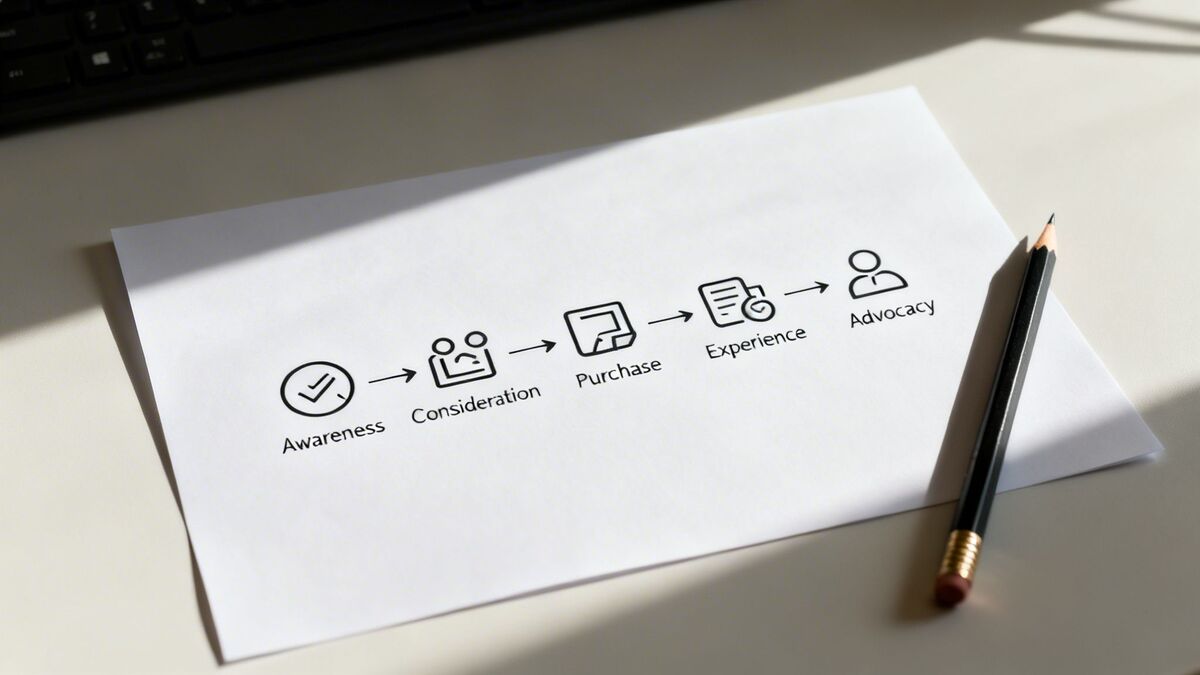
This sample qualitative research questionnaire is critical for businesses with multi-step service interactions. By dissecting the journey, you can pinpoint exactly where you are excelling and where friction is causing satisfaction to drop. Mapping your complete customer journey is the essential first step before designing questionnaires, as it provides the blueprint for your feedback strategy.
Industry-Specific Question Examples
Hotels (Mid-Stay): "How is your stay so far? Is there anything our team can do right now to make it more comfortable?"
Restaurants (Reservation Stage): "Was our online booking process straightforward? What information were you looking for before making your reservation?"
Retail/E-commerce (Post-Purchase): "Now that you've received your order, how did the product meet the expectations set on our website? Please describe any differences."
Healthcare (Discharge Stage): "As you prepare to leave, what are your biggest questions or concerns about your recovery at home?"
Strategic Breakdown & Actionable Takeaways
This questionnaire type is built to generate hyper-relevant feedback by catching customers at the right moment. The strategy hinges on automation and precision targeting.
Core Strategy: Deploy short, targeted questionnaires at critical journey milestones to gather immediate, in-context feedback. This allows you to identify and fix issues at specific touchpoints before they damage the overall customer experience.
Tactical Implementation:
Map the Journey: Before writing a single question, chart out every touchpoint a customer has with your business, from discovery to referral.
Use Automated Triggers: The key to this method is timing. FeedbackRobot's Prompt to Survey feature lets you instantly turn an idea into a live survey and integrates with systems like Toast for restaurants or Mews for hotels. It can automatically send a "mid-stay" survey 24 hours after check-in or a "post-purchase" survey two days after an order is delivered, ensuring maximum relevance.
Keep it Focused: For each stage, ask only 2-3 focused questions. At the check-in stage, ask about the welcome experience, not the room cleanliness. This respects the customer's time and improves response quality.
Route Feedback to the Right Teams: Use automation to send stage-specific feedback directly to the relevant department. Arrival experience feedback should go to the front desk manager, while post-purchase feedback goes to the e-commerce or product team.
By collecting data this way, you can build a journey-stage dashboard. FeedbackRobot's AI Summaries will then analyze responses from each stage, instantly identifying themes and sentiments. This helps you see if satisfaction drops off after the "purchase" stage or if the "care experience" is consistently outperforming the "scheduling" phase, allowing you to act with precision.
6. Netnographic / Social Listening Qualitative Template
The Netnographic / Social Listening Template is a modern qualitative research approach that shifts from asking direct questions to analyzing existing online conversations. It extracts customer feedback from natural settings like Google reviews, social media comments, forums, and community discussions. This method reveals authentic customer language, priorities, and sentiment without the influence of a formal survey, providing a powerful, unfiltered view of your brand perception.
This type of sample qualitative research questionnaire isn't one you send out; it's a framework for organizing the feedback you’re already receiving across the web. Instead of prompting for answers, you are listening to what is already being said. This is perfect for any service business looking to understand the real-world impact of their operations, from the specific words customers use to describe their experience to the unexpected issues that drive negative reviews.
Industry-Specific Question Examples
Instead of asking questions, a netnographic approach defines "questions" as themes to investigate within public data:
Hospitality: "What are the most common complaints and praises in our Google reviews regarding 'cleanliness' or 'staff friendliness'?"
Restaurants: "How do customers on Instagram and TripAdvisor describe our 'ambiance' and 'food presentation'? What specific words do they use?"
Retail/E-commerce: "What patterns are emerging in Twitter mentions and Reddit threads about our 'product quality' or 'shipping times'?"
Healthcare: "What emotional language do patients use on Trustpilot and forums when discussing their 'wait times' or 'communication' with our staff?"
Strategic Breakdown & Actionable Takeaways
This framework turns the entire internet into your focus group. The strategy is to systematically capture and analyze this organic feedback to spot trends, understand customer priorities, and respond to issues before they escalate.
Core Strategy: The goal is to monitor, aggregate, and analyze unsolicited, organic feedback from across the web to gain an unfiltered understanding of customer sentiment and emerging trends.
Tactical Implementation:
Centralize Your Listening: Use a unified dashboard to pull in feedback from all platforms. FeedbackRobot's Radar feature acts as your command center, providing unified review intelligence by aggregating reviews from Google, TripAdvisor, social media, and more into a single, manageable feed.
Establish Keyword Alerts: Don't just read reviews; monitor them for specific themes. Set up alerts for keywords relevant to your operations, like "food quality," "room cleanliness," or "front desk," to track sentiment around key service areas.
Analyze Sentiment at Scale: Manually reading every comment is impossible. Use tools that automatically analyze the tone and emotion behind the text. FeedbackRobot’s AI Summaries process this data instantly, providing instant insights & sentiment analysis to identify whether mentions of your "new menu" are positive or negative and flagging urgent issues. You can learn more about how this works in our guide to automatic sentiment analysis for reviews.
Validate and Probe: Combine your social listening insights with prompted surveys. If Radar shows a spike in negative comments about "wait times," use the Prompt to Survey feature to send a targeted, open-ended question to recent customers asking about their check-in experience. This validates the trend and gathers deeper context for solving the problem.
7. Focus Group Discussion Guide Template
A Focus Group Discussion Guide is not a questionnaire given to one person, but a structured script for facilitating a dynamic group conversation. This qualitative method brings together a small, targeted group of customers (usually 6-12) to explore specific topics in depth. The real value emerges from the interaction between participants, as they build on, challenge, and refine each other's ideas, revealing community norms and shared perspectives that one-on-one interviews might miss.
This sample qualitative research questionnaire format is perfect for concept testing, brand perception studies, and exploring complex customer motivations. The guide ensures the conversation stays on track while remaining flexible enough to pursue unexpected insights. It allows businesses to hear how ideas land not just with an individual, but within a social context that mirrors real-world word-of-mouth.
Industry-Specific Question Examples
Hospitality: (To frequent travelers) "Let's talk about loyalty programs. What makes a program truly valuable to you beyond just points? What are some frustrating experiences you've had?"
Restaurants: (To a group with mixed dietary needs) "When you look at a new menu, what are the first things you search for? How can we make our menu more welcoming for everyone in your party?"
Retail/E-commerce: (Showing a new digital prototype) "Walk us through what you see here. What is your first impression? Where would you naturally click first, and why?"
Healthcare: (To patients who recently used telehealth services) "Describe your experience booking a virtual appointment. What were the biggest hurdles, and what felt surprisingly easy?"
Strategic Breakdown & Actionable Takeaways
This guide is your roadmap for turning a simple chat into a powerful intelligence-gathering session. The success of a focus group depends entirely on the quality of the guide and the skill of the facilitator.
Core Strategy: The objective is to use group dynamics to validate concepts and uncover shared beliefs. The guide should be designed to move from broad, rapport-building questions to specific, probing inquiries without leading the participants.
Tactical Implementation:
Recruit with Precision: Your insights are only as good as your participants. Recruit a diverse but relevant mix of customers representing key segments. Avoid grouping dominant personalities with more reserved individuals.
Structure for Flow: Design your guide with a clear beginning, middle, and end. Start with easy, ice-breaker questions, move to the core topics, introduce any concepts for testing, and finish with a summary and thank you.
Prioritize Open Questions: Always ask broad, open-ended questions first to get unfiltered opinions. For example, ask "What do you think of this concept?" before asking "Do you like the color blue used in this concept?"
Record and Analyze: With consent, always audio or video record the session. After the focus groups are complete, you can transcribe the discussions and upload the text into a tool like FeedbackRobot. Our AI Summaries will then process hours of conversation to instantly identify key themes, points of consensus, and areas of disagreement across all your groups. This allows you to spot patterns much faster than manual coding alone.
Comparison of 7 Qualitative Questionnaire Templates
Method | Implementation complexity | Resource requirements | Expected outcomes | Ideal use cases | Key advantages |
|---|---|---|---|---|---|
Open-Ended Experience Questionnaire | Low — simple 3–5 day setup | Low–moderate — survey builder, analysts for coding | Rich narrative responses and emotional cues | Hospitality, restaurants, healthcare general feedback | Reveals unexpected insights and authentic language |
Critical Incident Technique (CIT) Questionnaire | Moderate — structured incident prompts | Moderate — skilled probing and qualitative analysis | Actionable incident narratives showing root causes | Service failure analysis, staff training, professional services | Identifies root causes and service recovery opportunities |
Phenomenological Interview Template | High — in-depth design and interviewer skill | High — long interviews, expert analysts, time investment | Deep emotional insights, loyalty drivers, unmet needs | Luxury hospitality, premium healthcare, high-touch services | Uncovers deep meanings and non-obvious competitive advantages |
Service Quality Expectation-Gap Questionnaire | Moderate — SERVQUAL mapping and design (~1 week) | Moderate — structure... |
How does the Critical Incident Technique (CIT) provide more actionable data than a standard open-ended experience survey?
While general open-ended questions capture broad sentiment, CIT focuses exclusively on a singular, high-impact event that defines the customer’s journey. This specificity moves beyond vague feedback—such as "the service was slow"—to identify the exact "make-or-break" moment, such as a specific handoff between clinical departments or a late-night check-in delay. By isolating these incidents, hospitality and healthcare managers can use FeedbackRobot’s Resolutions Engine to automate service recovery and pinpoint root causes for staff training, rather than guessing based on generalized complaints.
Why should luxury hospitality or premium healthcare providers prioritize the Phenomenological Interview Template over transactional metrics?
Luxury and high-touch services thrive on emotional resonance and the "lived experience," which traditional quantitative metrics cannot quantify. The phenomenological approach uncovers the deep-seated psychological drivers of loyalty, such as the feeling of being "truly heard" or achieving a "home away from home" atmosphere. Utilizing AI Summaries to analyze these rich, unstructured narratives allows administrators to identify recurring emotional themes and abstract concepts like trust, enabling them to refine their brand narrative and service delivery based on how guests actually derive meaning from their stay or treatment.
In the Service Quality Expectation-Gap Questionnaire, why is the sequence of questions vital to the integrity of the data?
Priming is a significant risk in qualitative research; if a respondent recounts their actual experience first, it often colors their memory of what they originally expected. To maintain a clean diagnostic of your "expectation gaps," you must capture the customer's pre-service anticipations—shaped by your marketing and brand promises—before asking about the reality. This order reveals exactly where operational delivery is failing to meet the standards set by your sales team, allowing for precise adjustments to either your service capacity or your promotional messaging.
How can operators implement Journey Stage-Specific Questionnaires without contributing to guest survey fatigue?
The solution lies in hyper-relevance and precision timing rather than survey length. Instead of a comprehensive post-departure questionnaire, FeedbackRobot’s Prompt to Survey feature allows for "point-of-experience" deployment. By asking only two or three focused questions at critical milestones—such as the reservation process or a mid-stay check-in—you gather data while the experience is fresh and the guest is still engaged. This segmented approach ensures each department receives feedback relevant to their specific role, facilitating faster operational pivots without overwhelming the customer.
What is the primary advantage of incorporating a Netnographic framework alongside direct feedback collection?
Direct surveys, while valuable, are inherently prompted and can sometimes be influenced by social desirability bias. Netnography, or social listening, captures the "unfiltered" organic voice of the customer as it exists in natural settings like Google Reviews, TripAdvisor, or niche forums. Integrating these insights through FeedbackRobot’s Radar dashboard allows you to cross-reference your internal survey data with spontaneous public sentiment. This dual-lens approach helps identify emerging trends or niche service failures that guests might not feel compelled to mention in a formal survey but are vocal about within their own social communities.
What is the difference between a qualitative and a quantitative questionnaire?
A qualitative questionnaire uses open-ended questions to collect experiences and opinions in the respondent's own words, producing narrative text that is analyzed for themes. A quantitative questionnaire uses closed items — rating scales, multiple choice, rankings — to produce numbers you can score and benchmark. Qualitative instruments explain the “why” behind a metric; quantitative instruments measure the “how much.” Most mature feedback programs run both, using open-ended follow-ups to explain movements in their scored surveys.
How many questions should a qualitative questionnaire have?
Six to ten open-ended questions is the practical ceiling for a self-administered qualitative questionnaire. Because every question demands a written answer, fatigue sets in far faster than with rating scales — and tired respondents don't quit, they just write one-line answers, which quietly erodes data quality. If you need more coverage, split the instrument across two shorter waves, or reserve the extra depth for interviews with your most engaged respondents.
Stop reading about it. Let your agent handle it.
25 free AI actions · no credit card required
Start Free