How to Create a Questionnaire (AI-Powered): 2026 Templates
How to design a questionnaire that gets answers — question types, order, length and wording, with free templates and real-world examples.

Nov 14, 2025 · 15 min read
Free tool
Likert Scale Generator
Generate custom rating scales and survey questions tailored to your feedback needs.
As a busy hospitality owner, you don't have time for guesswork. You need answers that drive action. Before you write a single question, remember this simple rule: goal first, questions second, distribution third. Get that order right, and you're already halfway to collecting smarter feedback that actually moves the needle for your business. (Need ready-made questions to start from? This basic survey questions sample has 50+ organized by category.)
Running exploratory research? Our qualitative research questionnaire templates include a complete copy-paste sample instrument.
Your Blueprint for a High-Impact Questionnaire
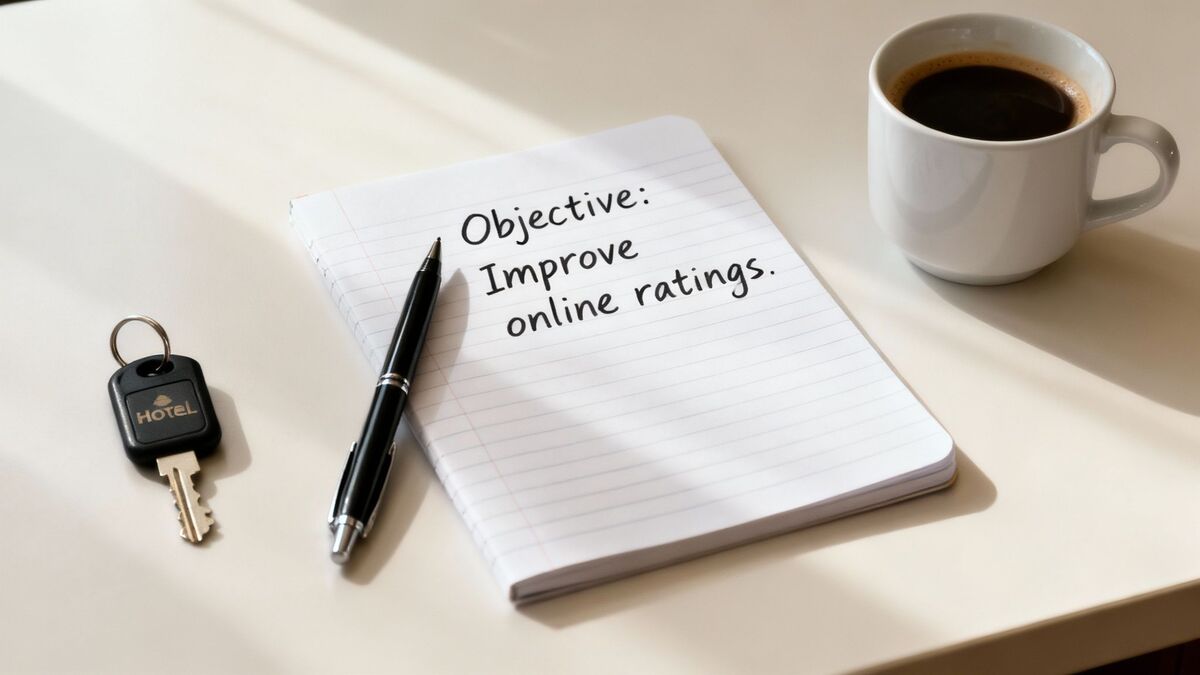
It all starts with a single, focused goal. A vague objective like "improve the guest experience" is a recipe for vague, unusable answers. You have to zero in on a specific, measurable action you want to take based on the feedback you collect.
This is the foundation. It’s what separates a questionnaire that helps you grow stronger from one that just creates a spreadsheet of noise.
So, what problem are you trying to solve right now?
Are you trying to pinpoint service gaps at your hotel's front desk during peak check-in?
Do you need to understand why lunch sales are down 15% month-over-month?
Are you looking to measure post-stay satisfaction to boost online reviews?
Each of these goals demands a different set of questions and a completely different audience. Knowing who you're asking is just as critical as what you're asking. Is your ideal respondent a first-time diner, a business traveler who stays with you quarterly, or a family on vacation? A loyal regular will have wildly different insights than a guest who just discovered your property.
Aligning Goals with Your Audience
The secret to getting powerful feedback is asking the right people the right questions. It’s about precision.
Matching your questionnaire's objective with the right customer group is the first step toward getting valuable feedback. This table shows practical examples for hospitality businesses.
Business Goal | Target Audience | Key Question to Ask |
|---|---|---|
Increase online reviews | Guests within 24 hours of checkout | "Based on your recent stay, how likely are you to leave us a review on Google or TripAdvisor?" |
Improve breakfast menu | Guests who had breakfast in the last 48 hours | "What's one thing we could add to our breakfast buffet to make it even better?" |
Refine front desk service | Business travelers who checked in during peak hours (4-6 PM) | "On a scale of 1-10, how efficient was your check-in process?" |
Boost spa bookings | Guests who have stayed before but never used the spa | "What's the main reason you haven't visited our spa during your past stays?" |
As you can see, this alignment ensures every piece of data you collect is relevant and actionable. It’s the difference between collecting noise and collecting intelligence.
A boutique hotel trying to bump its online rating should target recent guests within 24 hours of checkout. Their experience is fresh, and their feedback will directly relate to the details that influence public reviews. A restaurant refining its new seasonal menu should survey diners who actually ordered one of the new dishes. It's common sense, but it's amazing how often it's overlooked.
Don't waste time and resources asking everyone everything. By defining one powerful objective and targeting the precise audience that can answer it, you set the stage to collect smarter feedback.
Expert Tip: For more inspiration, explore various customer feedback survey templates to see how different goals require different approaches. This foundational step guarantees your efforts will lead to tangible improvements.
Writing Questions That Get You Real Answers

This is where the magic happens. The questions you ask are the engine of your entire feedback system. Get them wrong, and you're just collecting junk data that leads to bad decisions.
But get them right? You turn a simple form into a powerful listening tool that helps you act faster.
Your job is to make it dead simple for customers to give you honest, specific feedback. That means you can't just throw a bunch of open-ended essay questions at them, nor can you rely solely on simple yes/no answers. You need a strategic mix.
Finding the Right Question Types
Think of different question types as tools in a toolbox—each one is built for a specific job. You wouldn't use a hammer to turn a screw.
Multiple-Choice: These are your workhorses for quick, quantitative data. Perfect for straightforward questions like, "What brought you in today?" with clear options like "Lunch," "Coffee Meeting," or "To-Go Order."
Likert Scales: This is how you gauge satisfaction or sentiment. A simple 1-to-5 or 1-to-10 scale asking guests to rate the "speed of service" or "cleanliness of our facility" gives you a clean, measurable score you can track over time.
Open-Ended: Here's where you find the gold. This is where the rich, detailed stories live. A question like, "What’s one thing we could have done to make your experience perfect?" gives customers the space to tell you what's really on their mind.
Striking the right balance here is everything. Research on questionnaire design shows that surveys leaning heavily on closed-ended questions (like multiple-choice or scales) see 65% to 80% higher completion rates. Overloading a survey with open-ended questions can tank your completion rate by up to 25% because it just feels like too much work.
A great questionnaire doesn't just ask questions; it starts a conversation. The trick is to guide that conversation toward actionable insights without putting words in your customer's mouth.
How to Write Clear, Unbiased Questions
Once you’ve picked your question types, the wording is critical. Vague or leading questions are the fastest way to get useless, skewed feedback. Your language needs to be simple, direct, and completely neutral.
Watch out for these common traps that can poison your data:
Leading Questions: Don't ask, "How amazing was our new seasonal cocktail?" It assumes a positive experience from the start. Instead, ask, "How would you rate our new seasonal cocktail?" This one actually allows for honesty.
Double-Barreled Questions: Never ask two things at once. A question like, "Was our staff friendly and efficient?" is a classic mistake. What if they were friendly but slow? You'll never know. Split it into two separate questions for clarity.
Jargon and Insider Lingo: Use the language your customers use. Ditch internal terms like "turn-down service efficiency" and just ask, "How satisfied were you with our evening housekeeping service?"
Crafting great questions is part art, part science. If you want to go deeper, our guide on generating AI survey questions offers more advanced tips and examples. This is how you stop guessing and start understanding the 'why' behind what your customers do.
Designing a Seamless and Engaging Survey Experience
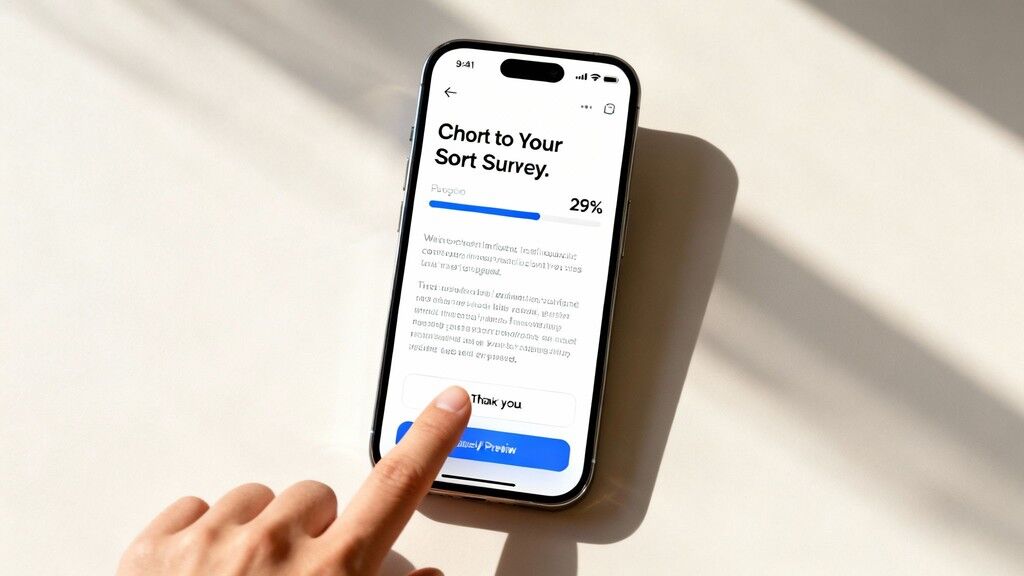
A great questionnaire is more than just a list of questions; it's an experience. If it’s clunky, long, or confusing, your busy customers will abandon it in a heartbeat, and you'll lose out on crucial feedback. The real goal is to design a survey that feels effortless and respectful of their time.
This isn't just about making things look nice—it's a strategic move to boost completion rates. Decades of research have shown that shorter, well-structured questionnaires produce better results. Studies going back to the 1980s and 1990s found that surveys with fewer than 20 questions saw response rates as high as 60%, while those with over 50 questions often struggled to break 30%. The design itself directly influences whether a customer finishes or just gives up.
If you want to dive deeper into how survey design impacts data quality, this global sentiment survey research is a great resource.
Building a Logical and Engaging Flow
Think of your survey's flow like a good conversation. You don't jump straight into the deepest, most complex topics. Instead, you build rapport and guide the discussion naturally.
Start with easy, engaging questions. A simple multiple-choice or a star-rating question at the beginning is low-effort and gets the respondent invested. Save the more detailed, open-ended questions for the middle, once they've already committed a minute or two.
From there, group related questions into logical sections.
Arrival Experience: Questions about check-in, valet, and front desk staff.
Room Comfort: Questions about cleanliness, amenities, and bed quality.
Dining Experience: Questions about food quality, service speed, and menu variety.
This approach reduces cognitive load, making the survey feel organized and less intimidating. It lets the customer focus on one part of their experience at a time, which almost always leads to more thoughtful and accurate answers.
A well-designed questionnaire feels like a brief, guided chat, not an interrogation. Respecting your customer's time is the single best way to improve the quality and quantity of the feedback you receive.
Setting Expectations and Showing Gratitude
Never underestimate the power of a strong introduction and a sincere thank-you. Your intro should be brief and compelling, explaining why you're asking for their time and what you'll do with the feedback. A simple line like, "Help us make your next stay even better with two minutes of your time," can make all the difference.
Managing expectations is just as important. Always include a progress bar so customers can see how close they are to the end. This small visual cue has been proven to reduce survey abandonment rates significantly.
Finally, end with a genuine thank-you message. It’s a small thing, but it closes the loop and makes your customers feel heard and valued, reinforcing their relationship with your brand. By designing a seamless experience, you're not just collecting data—you're strengthening loyalty.
How to Create a Questionnaire in Seconds with AI
As a busy owner, you don't have time to become a survey design expert. This is where modern tools completely change the game. Instead of blocking out hours to brainstorm questions, research best practices, and build a survey from the ground up, you can now use technology to do the heavy lifting for you.
This isn't about replacing your judgment; it's about augmenting your expertise. Think of it as having an on-demand feedback strategist on your team. The goal is to get from identifying a problem to collecting actionable feedback in a matter of minutes, not days.
Introducing Prompt to Survey
This is where you can truly accelerate your feedback loop. With FeedbackRobot’s Prompt to Survey feature, creating a professional, industry-specific questionnaire is as simple as writing a single sentence. It’s an AI tool designed specifically around the nuances of the hospitality and service industries.
You don't need to know the difference between a Likert scale and a multiple-choice question. You just need to know what you want to achieve.
Simply type a clear objective into the prompt, like:
"Create a short survey for hotel guests after they check out to find out what we can do to get more 5-star reviews."
"I need a questionnaire for my restaurant to understand why our new brunch service is getting mixed feedback."
"Generate a survey to ask customers about their experience with our new online ordering system."
In seconds, the AI generates a complete, ready-to-send questionnaire. It already knows the right question types to use, the most effective logical flow, and the kind of language that will actually connect with your guests.
The screenshot below shows just how simple the Prompt to Survey interface is—you type your goal, and the AI builds the rest.
This gives you a powerful, professionally crafted starting point that you can quickly review and tweak if needed.
This instant creation process lets you be incredibly responsive. Notice a few complaints about wait times during the lunch rush? You can have a targeted survey ready to go on your tables' QR codes before the dinner service even begins.
From Hours of Work to a Single Click
Automating the creation process is the first step toward helping you collect smarter and act faster. By removing the friction of building a questionnaire from scratch, you free up your time to focus on what really matters—analyzing the feedback and making improvements that strengthen your business.
This speed is a massive advantage. You're no longer waiting weeks to gather data on a problem that is affecting your business today. For a deeper look at how this technology works, you can explore more about top-tier AI survey generator tools and see how they stack up.
By using a feature like Prompt to Survey, you close the gap between problem and solution, ensuring no opportunity for improvement slips through the cracks.
Getting Your Questionnaire in Front of Customers
Even the most thoughtfully designed questionnaire is just a document until it reaches your customers. Getting your survey in front of the right people at the right moment is the final—and most critical—step. Your distribution strategy is what turns potential feedback into actual, usable data.
For a busy restaurant or hotel, this means meeting customers where they are. Don't make them hunt for a feedback link. Instead, you need to weave the request smoothly into their experience. Think about the natural touchpoints you already have.
Choosing the Right Channels for Hospitality
The goal here is to make giving feedback as easy as possible. In the service world, a few key channels consistently deliver the best results because they require almost no effort from the guest.
QR Codes: This is your frontline tool. Put them right on tables, receipts, or room key cards. A simple call-to-action like, "Got two minutes? Tell us how we did," invites immediate, in-the-moment feedback while the experience is still fresh.
Email & SMS Follow-ups: This is where smart automation really shines. By integrating with your POS system like Toast or your PMS like Mews, you can trigger a survey to be sent automatically after a specific event—think a paid bill or a hotel checkout.
Wi-Fi Landing Pages: When a guest logs into your complimentary Wi-Fi, you have a captive audience. Present them with a quick, one-question survey before they start browsing. It's a low-effort way to capture a high volume of general sentiment.
Timing is everything. A post-stay survey sent 24 hours after checkout will get far better responses and more accurate details than one sent a week later when the memory has faded.
You've worked hard to create a thoughtful questionnaire; now, make it incredibly easy for your customers to answer it. The fewer clicks and steps required, the more responses you'll get.
Nudging Your Response Rates Higher
Getting your survey out there is only half the battle; you still have to convince people to complete it. The average response rate for online questionnaires hovers between 20% and 30%, so every small optimization counts. That benchmark means for every 100 people you ask, you can realistically expect about 20 to 30 to follow through. If you want to dive deeper, you can discover more insights about survey response rates and what drives them.
A compelling email subject line like, "A quick question about your dinner at [Your Restaurant Name]" is far more effective than a generic one. For QR codes, ensure the landing page is clean, simple, and mobile-friendly. Every extra second a page takes to load is another chance for a customer to give up.
By focusing on these distribution details, you make sure your effort in creating the questionnaire pays off with a steady stream of valuable, representative feedback.
Turning Feedback into Action and Growth
Creating and distributing a great questionnaire is just the start. The real challenge—and where the biggest opportunities hide—is what you do with the answers. Anyone can collect data. Turning that information into real, measurable growth is what separates the top operators from everyone else.
This is where a true Feedback Operating System comes in, moving you from just gathering responses to taking smart, automated action.
The old way of doing things meant spending hours buried in a messy spreadsheet, squinting at comments and trying to connect the dots. As a busy owner, that's time you just don't have. Modern feedback platforms are built to do the heavy lifting for you.
From Raw Data to Instant Insights
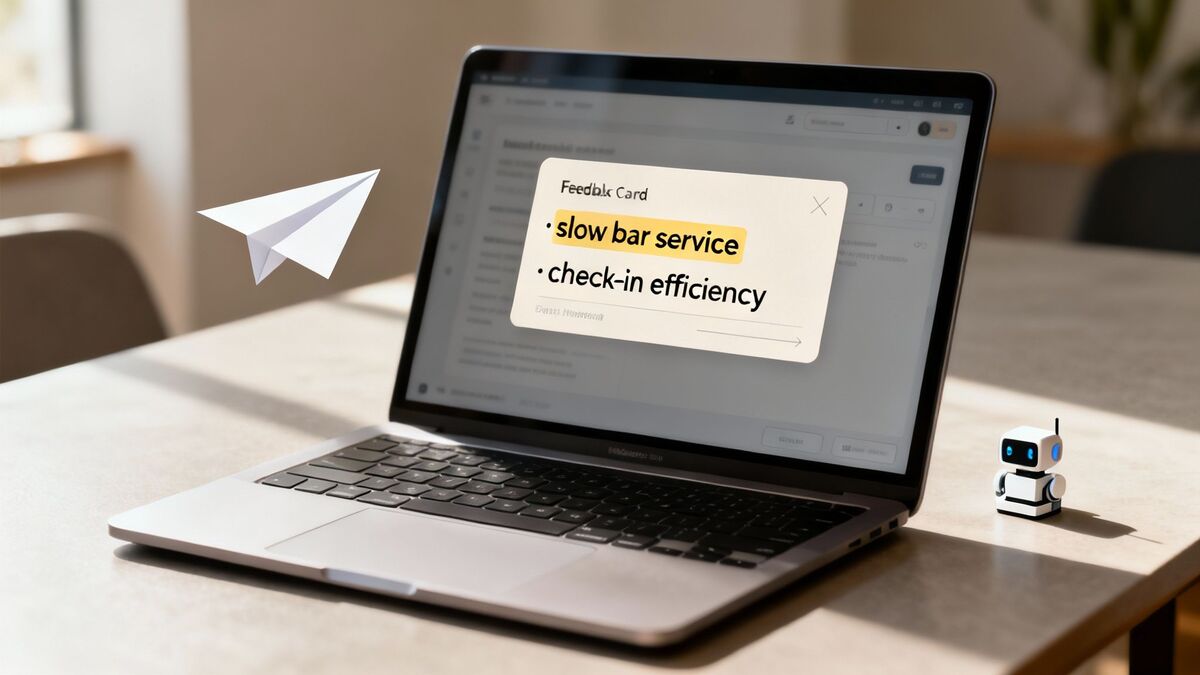
First things first, you need to make sense of it all. As soon as responses land in FeedbackRobot, our AI Summaries get to work. This feature provides instant insights and sentiment analysis by scanning thousands of open-ended comments to pull out key themes and trends. No more manual sifting.
Within minutes, you can see that "slow bar service on weekends" and "check-in efficiency" are your two most mentioned issues, both with a heavily negative sentiment. That’s the power of instant insight. It gives you a clear, data-backed starting point for where to focus your energy.
But feedback isn't just coming from your surveys. It’s on Google, TripAdvisor, and social media. That’s why we built Radar.
Radar acts as your unified review intelligence hub, pulling all your feedback—from internal surveys to public online reviews—into one central dashboard. This gives you a complete, 360-degree view of your guest experience, allowing you to spot trends you’d otherwise miss and make decisions with total confidence.
Closing the Loop with Automated Action
Insight without action is a wasted opportunity. Knowing about a problem is one thing, but fixing it before it costs you a customer is what really moves the needle. This is where you can flip a negative experience into a chance to build incredible loyalty.
For any negative feedback that comes in, our Resolutions Engine triggers automated service recovery workflows. Imagine a guest completes your survey and reports their meal was cold. You don’t have to do a thing.
The system can automatically:
Create a ticket for your management team.
Send a personalized apology email from the manager.
Include a 15% discount on their next visit to win them back.
This closed-loop system ensures you’re not just passively listening but actively responding and resolving issues in real-time. It’s how you act faster to fix problems, recover at-risk customers, and grow stronger with every single piece of feedback you receive.
Got Questions About Building a Questionnaire? We've Got Answers.
As a hospitality or service owner, you’re juggling a dozen things at once. When it comes to figuring out how to create a questionnaire that actually works, a few questions pop up over and over again. Let's get you the straightforward answers you need.
How Long Should My Questionnaire Be?
Keep it short enough to complete in 3-5 minutes. That’s the magic window. For most businesses, this translates to about 5-10 well-crafted questions.
You're asking for a customer's time—their most valuable asset. A short, focused questionnaire will always beat a long, rambling one. You'll get higher completion rates and better data, simply because people won't give up halfway through.
What Is the Biggest Mistake to Avoid?
The single biggest mistake? Asking leading or biased questions. It’s an easy trap to fall into when you're passionate about your business, but it completely poisons your data.
For example, never ask, "How amazing was our friendly staff?" This kind of wording pressures the customer to agree with you. A much better, more neutral question is, "How would you rate the service you received from our staff?" This simple tweak opens the door for honesty, giving you feedback you can actually use to improve.
Key Takeaway: You're not fishing for compliments; you're hunting for the truth. Neutral wording is the only way to collect unbiased feedback that helps your business get stronger.
Should I Offer an Incentive?
Incentives can be a double-edged sword. On one hand, offering a small reward can definitely boost your response rates. On the other, it might attract people who just want the freebie, not those who want to provide genuine feedback.
If you decide to offer one, keep it small and relevant to your business. A 10% discount on a future visit or an entry into a gift card drawing usually does the trick. The best approach? Test it. See if an incentive gives you a meaningful bump in responses without watering down the quality of the insights.
Ready to skip the manual work and get straight to the insights? FeedbackRobot helps you collect smarter feedback without the hassle. Use our Prompt to Survey feature to generate expert questionnaires in seconds and start turning customer opinions into action.
What is the first step in creating a high-growth questionnaire?
Define your 'Goal.' Are you trying to reduce churn, improve a specific product, or get more reviews? A questionnaire without a clear goal just wastes your customer's time.
How do I avoid 'Leading Questions'?
Don't ask 'How great was our service?' Ask 'How would you rate our service today?' Neutral phrasing ensures you get honest data, not just the answers you want to hear.
What is the 'Optimal' number of questions?
Between 3 and 5. For every question after the 5th, your 'completion rate' drops by 15-20%. If you need more data, use 'Conditional Logic' to only show extra questions when necessary.
Should I put the most important question first or last?
First. You want to capture your core metric (like NPS or overall satisfaction) immediately, in case the user drops off halfway through.
Can I create a questionnaire for social media?
Yes. Short 'Pulse' questionnaires are highly effective on Instagram Stories or Facebook. They drive engagement while providing a quick snapshot of your audience's current mood.
Stop reading about it. Let your agent handle it.
25 free AI actions · no credit card required
Start Free