![How to Measure Customer Satisfaction Without Surveys [10 Methods]](/images/legacy/HZ9HoLgQGt0VJJpCMqdS6vtTcAE.webp)
How to Measure Customer Satisfaction Without Surveys
Measure customer satisfaction without surveys in 2026. Discover 10 proven methods, AI insights, practical templates & examples.

Feb 27, 2026 · 16 min read
Free tool
AI Negative Review Responder
Turn 1-star reviews into recovery opportunities with AI-crafted responses.
In hospitality and service, you don't have time for guesswork. Customer satisfaction isn't just a 'nice-to-have'—it's the engine that drives repeat business, stellar online reviews, and a brand that lasts. But how do you move from hoping guests are happy to knowing they are? The key is to stop just collecting feedback and start operating on it.
This guide details 10 powerful measure customer satisfaction methods, designed for busy owners who need to collect smarter, act faster, and grow stronger. We'll cover the essential metrics like CSAT and NPS, but also dive into actionable strategies from AI-powered sentiment analysis to customer journey mapping. You'll learn how to transform raw feedback from any source—whether it's a Toast receipt, a Mews checkout survey, or a Google review—into your most valuable business asset.
We'll break down the what and the how for each method, giving you the metrics, pros, and cons you need to make smart decisions. More importantly, you'll see how a modern Feedback Operating System automates this entire process. With tools like FeedbackRobot, you can finally turn guest opinions into operational excellence and measurable growth. Let's get started.
1. Net Promoter Score (NPS)
Net Promoter Score (NPS) is one of the most direct methods to measure customer satisfaction and, more importantly, loyalty. It boils down to a single question: “On a scale of 0-10, how likely are you to recommend our business to a friend or colleague?” Based on their response, customers fall into three groups.
Promoters (9-10): Your brand champions. They drive referrals and repeat business.
Passives (7-8): They're satisfied but not loyal, making them easy targets for competitors.
Detractors (0-6): Unhappy customers who can hurt your reputation with negative word-of-mouth.
The score is calculated by subtracting the percentage of Detractors from the percentage of Promoters, giving you a number between -100 and +100.
Why NPS is a Go-To Metric
The power of NPS is its simplicity and ability to predict growth. A hotel can use it to gauge loyalty per property, while a restaurant can see how a new menu impacts guest sentiment. The real value isn't just the score, but the "why" you get from a follow-up, open-ended question. That's where you find your most actionable insights.
How to Implement NPS Effectively
Trigger the NPS question after a key interaction, like a hotel checkout or after a service is completed. Segment your results by location, service, or customer type to uncover specific strengths and weaknesses in your operation.
FeedbackRobot Action Plan: Don't just collect scores; act on them. The Resolutions Engine is your automated service recovery tool. When a Detractor score comes in, it automatically creates a case and alerts your team, turning a bad experience into a chance to win back a customer. For Promoters, it can trigger a request for an online review, boosting your reputation on autopilot. This is how you collect smarter and act faster.
2. Customer Satisfaction Score (CSAT)
The Customer Satisfaction Score (CSAT) is a direct, in-the-moment metric for a specific interaction. It gets straight to the point: “How satisfied were you with your [experience/purchase/service] today?” Customers usually respond on a scale of 1-5, where 1 is "very unsatisfied" and 5 is "very satisfied."
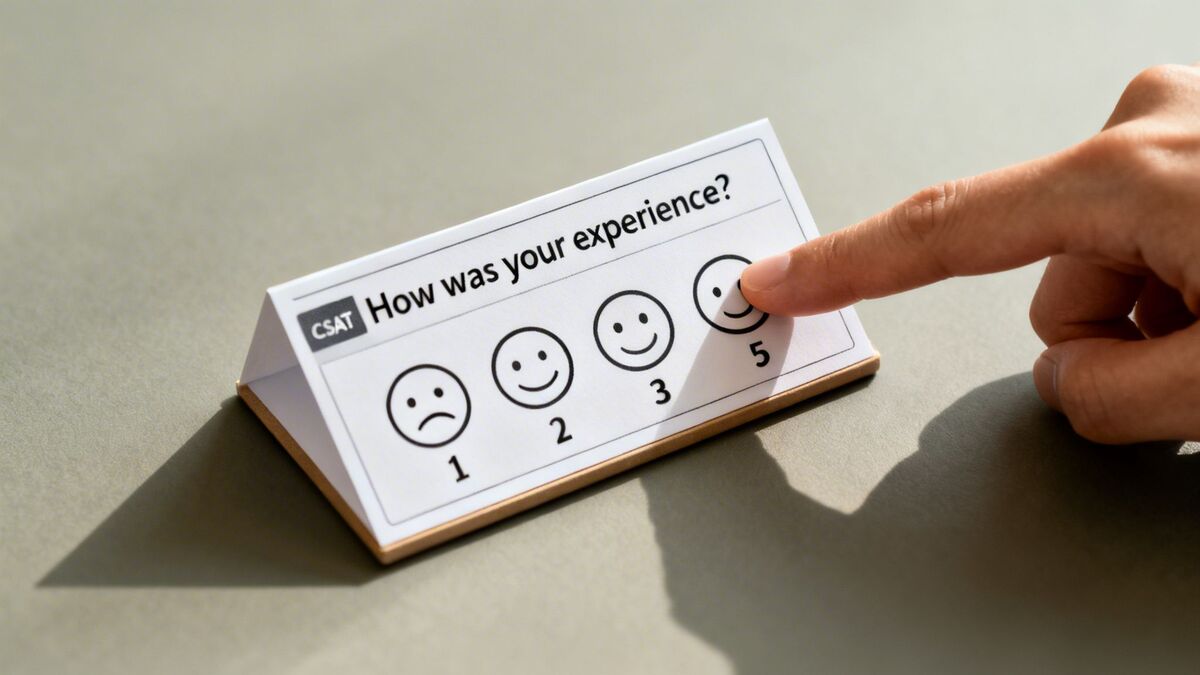
Your score is the percentage of "satisfied" customers (those who rated 4 or 5). It gives you a real-time snapshot of performance at a critical touchpoint, answering the question: "Did we deliver right now?" This transactional focus makes it one of the most popular measure customer satisfaction methods for busy service businesses.
Why CSAT is a Transactional Powerhouse
CSAT's strength is its immediacy and specificity. A restaurant can put it on a tabletop device to gauge satisfaction with a meal, while a front desk manager can use it to track check-in experiences. Unlike broader loyalty metrics, CSAT tells you how a specific staff member, location, or process performed today.
How to Implement CSAT Effectively
Deploy the CSAT question immediately after the interaction—via SMS after a guest checks out or on a digital receipt from your Toast POS. Keep the survey short to maximize completion rates. Analyzing the results by staff member, time of day, or location will reveal powerful operational patterns and training opportunities.
FeedbackRobot Action Plan: Never let a poor CSAT score become a bad online review. With our Resolutions Engine, you can set a rule to automatically open a case and notify a manager when any score below 4 is received. This immediate action shows you're listening and allows for swift service recovery, protecting your reputation and turning a negative into a positive.
3. Customer Effort Score (CES)
Customer Effort Score (CES) measures how easy it was for a customer to get something done. It operates on a simple premise: loyalty is driven by reducing friction. The survey typically asks customers to agree or disagree with a statement like, "The company made it easy for me to handle my issue," on a 1-7 scale.
Unlike metrics that measure general satisfaction, CES pinpoints the frustrating parts of your customer journey.
Low Effort (6-7): Smooth, seamless experiences that build loyalty.
High Effort (1-3): Frustrating experiences that lead to customer churn.
The goal is to eliminate high-effort interactions, as making things easy is a more powerful driver of loyalty than simply trying to "delight" customers.
Why CES is a Go-To Metric
CES is a powerful predictor of future behavior. A high-effort experience, like a complicated online booking system for your hotel or a confusing checkout process at your cafe, is a direct signal of potential customer loss. By measuring and reducing effort, you directly impact retention.
How to Implement CES Effectively
Deploy CES surveys immediately after a specific task is complete. For example, after a customer uses your online ordering system or completes a support chat. The key is to measure the effort for a specific journey, not the overall brand experience. This allows you to map customer pain points with precision and fix the processes that cause the most frustration.
FeedbackRobot Action Plan: Use CES feedback to streamline your operations. Our AI Summaries feature provides instant insights and sentiment analysis from all your open-ended comments. It can analyze feedback tied to CES scores to identify recurring themes like "confusing website" or "long wait times," so you can pinpoint the exact cause of customer effort and fix it fast.
4. Online Reviews and Ratings
Online reviews are your digital word-of-mouth. They are the public, unfiltered truth about your customer experience on platforms like Google, TripAdvisor, and Yelp. This method involves monitoring and analyzing this constant stream of feedback, which directly influences new customers and serves as your social proof.
Unlike surveys you send, online reviews are a passive but continuous source of insight. They reveal what customers really think.
Positive Reviews (4-5 stars): Act as powerful marketing, building trust and driving business.
Negative Reviews (1-2 stars): Present an urgent risk but also a clear opportunity for service recovery.
Your aggregate star rating is often the first thing a potential customer sees in search results, making it one of your most important metrics.
Why Online Reviews are a Critical Metric
The power of online reviews comes from their authenticity and high visibility. A high rating on a booking platform directly correlates with hotel occupancy rates. For restaurants, positive reviews on Google and Yelp drive foot traffic. This feedback is a constant, real-world measure of your performance.
How to Implement Review Monitoring Effectively
First, actively encourage recent, happy customers to leave a review. Second, respond to all reviews—positive and negative—promptly. This shows you're engaged and value customer feedback. Use the insights to identify recurring issues that need to be addressed through training or operational changes.
FeedbackRobot Action Plan: Managing reviews across dozens of sites is a huge time sink. Our Radar feature is your unified review intelligence hub. It pulls all your reviews from Google, TripAdvisor, and more into a single dashboard. Combined with AI Summaries, you get instant insights into sentiment and trends without reading every word. This lets you spot problems and celebrate wins across all locations, turning chaotic public feedback into a clear, actionable strategy.
5. Sentiment Analysis (AI-Powered)
A huge amount of customer feedback is unstructured text: online reviews, social media comments, and open-ended survey answers. Sentiment analysis uses AI to automatically detect the emotional tone behind this text, classifying it as positive, negative, or neutral. This is one of the most efficient measure customer satisfaction methods for making sense of massive amounts of qualitative feedback.
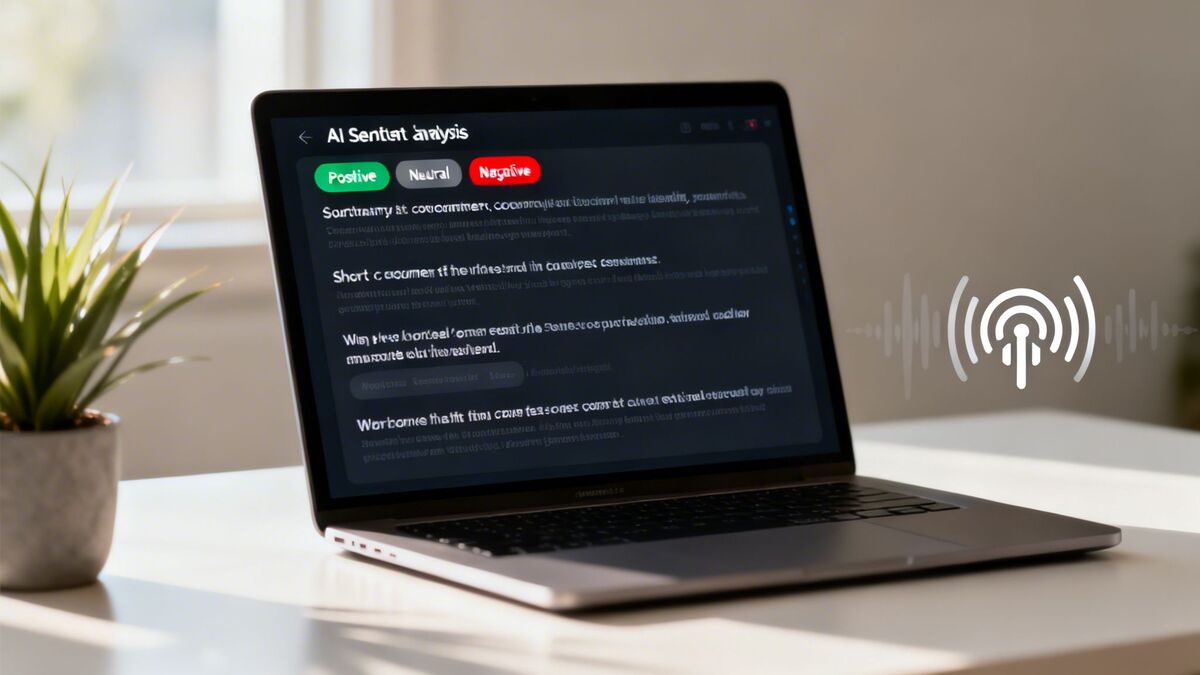
This technology tells you how customers feel, not just what they're saying.
Positive: "The check-in was seamless and the staff was incredibly welcoming!"
Negative: "The room was noisy, and the Wi-Fi connection kept dropping."
Neutral: "The hotel is located downtown."
The real power comes when this technology is integrated directly into your feedback platform, giving you instant insights without the manual work.
Why Sentiment Analysis is a Modern Necessity
The key benefit is analyzing feedback at scale and in real-time. A multi-location restaurant group can instantly analyze thousands of reviews to pinpoint unpopular menu items or recurring service issues at a specific branch—a task that's impossible to do manually every day. For businesses looking to harness advanced AI insights, working with an AI Native Agency can offer a competitive edge.
How to Implement Sentiment Analysis Effectively
To make it actionable, use sentiment trends to guide your focus. Track sentiment over time to measure the impact of changes you make, like a new training program or menu update. A sudden spike in negative sentiment about "cleanliness" at a hotel should trigger an immediate operational review.
FeedbackRobot Action Plan: Our AI Summaries feature provides instant insights and sentiment analysis. It doesn't just categorize feedback; it automatically identifies the key topics and emotional drivers from all your reviews and surveys. You can see at a glance if "service" is trending positive while "price" is trending negative, allowing you to focus your attention where it matters most and make data-driven decisions.
6. Feedback Surveys and Questionnaires
While single-question metrics give you a quick pulse check, detailed feedback surveys are your diagnostic tool. This method involves creating custom, multi-question surveys to collect deep feedback on specific aspects of the customer experience, like service quality, product value, or facility cleanliness. It's one of the most flexible and in-depth measure customer satisfaction methods available.
Unlike NPS or CSAT, detailed surveys let you dissect the entire experience.
Restaurants: Can ask about food quality, service speed, and ambiance.
Hotels: Can deploy post-stay questionnaires covering cleanliness, front desk service, and amenities.
The goal is to get a rich, multi-dimensional view of your performance, identifying not just if a customer is happy, but why and where you're succeeding or failing.
Why Surveys Provide Deeper Insights
A well-designed survey gives you granularity. A hotel might learn that while guests love the rooms (9/10), the check-in process is a major pain point (4/10). This level of detail is impossible to get from a single loyalty question. It allows you to pinpoint specific areas for training and operational improvements.
How to Implement Surveys Effectively
Keep surveys focused and short (5-10 essential questions) to boost completion rates. Deploy them immediately after the experience, like via email after a purchase. Use a mix of rating scales for quantitative data and open-ended questions for qualitative context.
FeedbackRobot Action Plan: Build powerful, intelligent surveys right inside our platform. Use our Prompt to Survey feature to automatically invite customers to a detailed survey after they leave a short public review. Then, our AI Summaries will instantly analyze all the open-ended responses, identifying key themes and sentiment without any manual work. This gives you the depth of a full survey with the speed of AI.
7. Customer Journey Mapping and Touchpoint Analysis
Instead of focusing on one interaction, customer journey mapping visualizes the entire customer experience from start to finish. This method identifies every touchpoint a customer has with your business—from discovery to post-purchase support. Touchpoint analysis then evaluates satisfaction at each step, pinpointing your "moments of truth" and areas of friction.
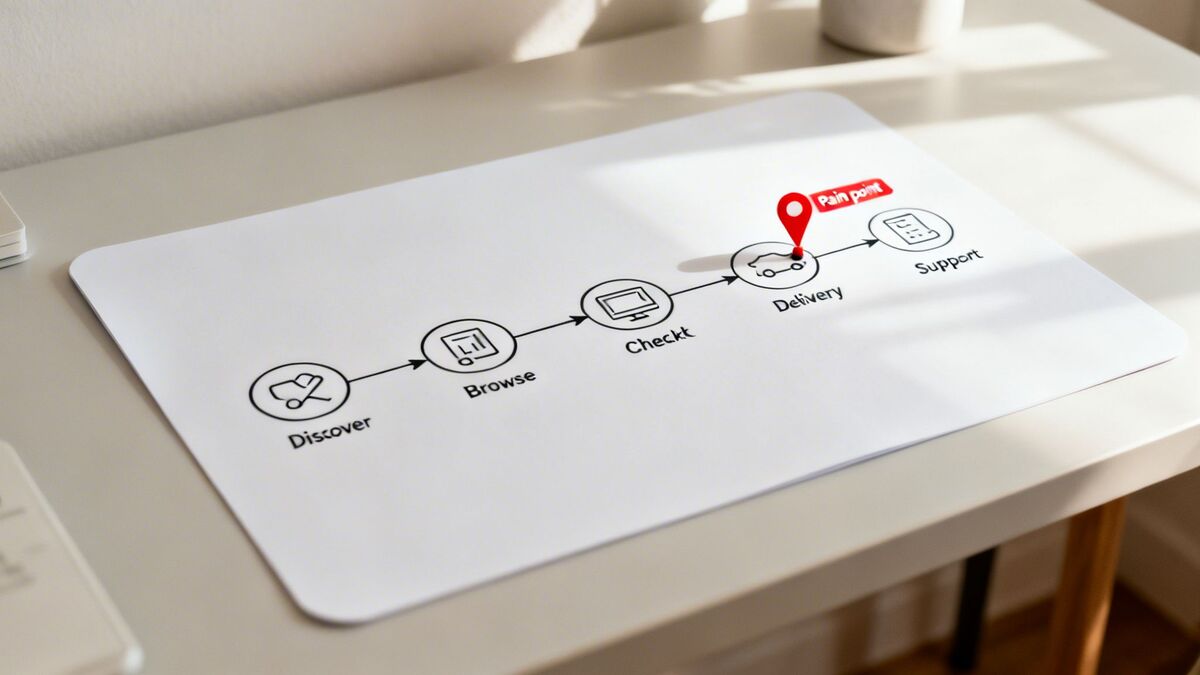
This method helps you see your business through your customers' eyes at key stages:
Awareness: How they first discover your brand.
Consideration: Their research and comparison phase.
Purchase/Booking: The transaction itself.
Service/Experience: The core delivery of your service.
Support & Loyalty: Post-purchase interactions and repeat business.
Why Journey Mapping Provides a Complete Picture
The value here is the holistic view. A hotel can map the entire guest journey from the online booking process to check-in, room quality, and post-stay feedback. This ensures you're not just improving one metric but enhancing the entire end-to-end experience.
How to Implement Journey Mapping Effectively
Start by outlining the key stages, then gather customer feedback at each critical touchpoint to validate your map. Segment journeys for different customer types, like first-time guests versus loyal members. This map becomes your strategic guide for where to deploy other methods, like CSAT or NPS surveys.
FeedbackRobot Action Plan: Use your customer journey map to inform your feedback strategy. Our Prompt to Survey feature lets you trigger targeted micro-surveys at the specific touchpoints you've identified as critical. By collecting feedback at the moment of truth—like right after check-in or after a meal is served—you get the most accurate and actionable data to improve each stage of the journey.
8. Focus Groups and In-Depth Interviews
When quantitative data tells you what is happening, qualitative methods like focus groups and in-depth interviews tell you why. These direct conversations are essential for gathering rich, detailed feedback that numbers alone can't capture. Focus groups bring together a small group of customers for a moderated discussion, while in-depth interviews are one-on-one conversations.
Both methods uncover the nuances and emotional drivers behind satisfaction ratings.
Focus Groups: Ideal for exploring new concepts, like a restaurant testing new menu items.
In-Depth Interviews (IDIs): Perfect for understanding complex decisions, like why a guest chooses your hotel over a competitor.
Why Direct Conversation is a Go-To Method
The power of these methods lies in their depth. A hotel can learn the subtle factors that build loyalty beyond just a clean room. The authentic stories and direct quotes provide a layer of human understanding that surveys can't match.
How to Implement This Method Effectively
Recruit participants who represent your key customer segments. Use a structured guide to cover important topics but allow the conversation to flow naturally. Recording and transcribing sessions is critical for detailed analysis.
FeedbackRobot Action Plan: Qualitative insights are gold, but analyzing them is time-consuming. Use the AI Summaries in your Feedback Operating System to process your interview transcripts. Our AI can identify recurring themes, sentiment, and key takeaways from all your qualitative data, saving you hours of manual work and helping you pinpoint high-impact areas for improvement.
9. Social Listening and Community Monitoring
Not all feedback comes from a direct question. Social Listening is a powerful way to measure customer satisfaction by tuning into the organic conversations people are having about your brand across social media, forums, and review sites. It captures raw, unfiltered sentiment from platforms like Twitter, Instagram, and Reddit.
This method involves monitoring keywords, brand mentions, hashtags, and even competitor names to understand public perception in real-time.
Positive Mentions: Customers tagging your hotel in their vacation photos.
Negative Mentions: A traveler tweeting about a poor service experience.
The goal is to listen to the context, sentiment, and trends within these public conversations.
Why Social Listening Reveals the Full Picture
The value of social listening is its authenticity. Customers share their honest thoughts when they aren't talking directly to you. This provides a continuous stream of feedback that reflects the genuine customer experience, often identifying issues before they escalate.
How to Implement Social Listening Effectively
Set up alerts for your brand name and key products. Monitor competitor mentions to benchmark public sentiment. Responding quickly and empathetically to public complaints can turn a negative situation around, while engaging with positive mentions strengthens loyalty.
FeedbackRobot Action Plan: Don't let valuable social feedback get lost in the noise. Our Radar feature unifies social media mentions with reviews from all other channels into a single, intelligent dashboard. AI Summaries then analyze this unstructured data to instantly identify sentiment and emerging trends, so you can spot a recurring complaint without manually reading every post. This is how you tap into the voice of the customer, wherever they're speaking.
10. Transactional Email and SMS Feedback
This method embeds satisfaction requests directly into operational messages your customers already expect, like order confirmations or appointment reminders. Instead of sending a separate survey, you capture in-the-moment feedback on high-engagement communications, making it one of the most efficient ways to measure customer satisfaction.
This approach meets customers where they are. Key examples include:
Restaurants: Placing a QR code or link on a digital receipt to rate the dining experience.
Hotels: Embedding a simple satisfaction question within the final checkout confirmation.
Retail: Adding a one-click rating to a "Your order has shipped!" email.
By integrating the feedback request into a necessary communication, you respect the customer's time and dramatically increase response rates.
Why Transactional Feedback is So Effective
Its primary strength is context and timing. You're asking for feedback about a specific transaction right after it happens, when the experience is fresh. This immediacy yields more accurate and relevant data.
How to Implement Transactional Feedback
Make the feedback request as frictionless as possible—a single click, star, or emoji rating is best. Place it after the main transactional information so it doesn't disrupt the message's primary purpose.
FeedbackRobot Action Plan: Use our Prompt to Survey feature to automatically embed these micro-surveys into your transactional emails or SMS. When a response comes in, our Resolutions Engine can instantly trigger a follow-up. A low rating can create a support ticket, while a high rating can trigger an automated request for a public review. This turns your routine communications into powerful feedback channels.
10-Method Customer Satisfaction Comparison
Method | Implementation complexity | Resource requirements | Expected outcomes | Ideal use cases | Key advantages |
|---|---|---|---|---|---|
Net Promoter Score (NPS) | Low — single-question deployment | Minimal (survey tool, segmentation) | High-level loyalty/benchmark trends | Periodic loyalty tracking, benchmarking | Simple, benchmarkable, correlates with growth |
Customer Satisfaction Score (CSAT) | Low — short post-interaction surveys | Minimal to moderate (timed triggers) | Immediate satisfaction of specific touchpoints | Post-purchase, service completion, support follow-up | Timely, actionable, high response rates |
Customer Effort Score (CES) | Low–Medium — targeted to journeys | Moderate (journey triggers, analysis) | Identifies friction; predicts retention | Onboarding, support resolution, checkout flows | Pinpoints operational friction, reduces churn |
Online Reviews and Ratings | Low–Medium — multi-platform management | Ongoing (moderation, monitoring resources) | Public reputation impact; purchase influence | Hospitality, retail, e-commerce, local businesses | Authentic social proof, SEO and discovery benefits |
Sentiment Analysis (AI-Powered) | Medium — integration and model tuning | Moderate–High (tools, training data, analysts) | Scalable theme/emotion detection; early alerts | Large volumes of unstructured feedback (reviews, social) | Fast, scalable, surfaces hidden patterns |
Feedback Surveys & Questionnaires | Medium — design and logic required | Moderate (design, sampling, analysis) | Detailed, structured insights across topics | Research studies, segmented feedback, feature evaluation | Highly customizable, comparable metrics |
Customer Journey Mapping & Touchpoint Analysis | High — cross-functional mapping effort | High (workshops, research, stakeholder input) | Holistic CX view; prioritized improvement areas | Strategic CX redesigns, omnichannel optimization | Identifies high-impact fixes; aligns teams |
Focus Groups & In-Depth Interviews | Medium–High — recruitment and moderation | High (facilitators, incentives, analysis) | Rich qualitative context and motivations | New product testing, exploring “why” behind behavior | Deep, nuanced insights; uncovers root causes |
Social Listening & Community Monitoring | Medium — tool setup and rule tuning | Moderate (listening tools, analysts) | Real-time organic sentiment and trend detection | Brand reputation, crisis detection, competitor monitoring | Captures unsolicited voice of customer; early signals |
Transactional Email & SMS Feedback | Low — embed in existing communications | Minimal–Moderate (integration with systems) | High engagement at relevant moments; quick fixes | Order confirmations, shipping, receipts, appointments | Contextual, high response rates, easy to automate |
From Data to Action: Your Feedback Operating System
You now have a complete toolkit of methods to measure customer satisfaction. But for busy owners, the real challenge isn't a lack of data; it's the overwhelming, fragmented nature of it all. An NPS score from an email, a review on Google, and a CSAT survey from your Toast POS all paint a picture, but they live in different systems. This is where insights get lost and opportunities are missed.
The goal is not just to collect feedback but to build a responsive system around it.
Beyond Collection: How a Feedback Operating System Works
You need a centralized system that connects every piece of feedback, analyzes it for intelligence, and empowers your team to respond fast. This is a Feedback Operating System: a unified platform that helps you collect smarter, act faster, and grow stronger.
Think of it as the central nervous system for your guest experience. Here’s how FeedbackRobot creates this system for your business:
Unify Your Intelligence: Our Radar is your unified review intelligence command center, pulling in reviews from Google, TripAdvisor, and more into a single dashboard alongside your direct survey feedback. No more jumping between tabs.
Automate Your Collection: Our Prompt to Survey feature integrates with systems you already use, like Toast or Mews, to intelligently ask for feedback at the right time.
Get Instant Insights: Our AI Summaries provide instant insights and sentiment analysis, doing the heavy lifting by analyzing all incoming feedback to identify key themes so you know exactly what to focus on.
Automate Service Recovery: The Resolutions Engine is your automated service recovery tool. It creates and assigns tickets for negative feedback, ensuring every issue is tracked, managed, and resolved quickly, turning detractors into loyal fans.
The Final Word: From Measurement to Movement
Mastering the methods to measure customer satisfaction is critical, but the real value comes from what you do with that information. By implementing a systematic approach, you stop reacting to isolated complaints and start proactively managing your entire customer experience. You build a business that not only listens but also learns, adapts, and improves. This is how you turn customer satisfaction from a metric into the engine that drives your growth.
And if you decide a survey does belong in your toolkit after all, start with a purpose-built client satisfaction survey — 25 questions and a copy-paste template — rather than a generic form.
Ready to stop chasing feedback and start putting it to work? FeedbackRobot gives you the complete operating system to manage your customer experience from one place.
What is the 'Actionable' way to measure guest satisfaction?
Don't just collect scores; collect 'Intent.' Ask questions like 'Would you return?' or 'What is the #1 thing we could change?' These drive growth, while raw scores just track status.
How does the 'Transactional' method differ from 'Relational'?
Transactional surveys happen right after a visit (e.g., SMS). Relational surveys happen periodically (e.g., every quarter) to measure the long-term health of the brand bond.
Can I measure satisfaction without using any surveys?
Yes, by monitoring 'Review Trends.' Tracking the velocity and sentiment of your public reviews on Google and Yelp provides a passive but highly accurate measure of satisfaction.
What is 'Sentiment Drift' and why should I track it?
Sentiment Drift measures how your guest's emotional tone changes over time. Tracking this allows you to catch 'Service Fatigue' in your team before it leads to a drop in sales.
Should I use 'Real-Time' alerts for measurement?
Yes. Measuring satisfaction is useless if you don't act. 'Alert-Driven Measurement' ensures that any dip in satisfaction is addressed by a manager within minutes.
Stop reading about it. Let your agent handle it.
25 free AI actions · no credit card required
Start Free