The Owner's Playbook: How to Collect Feedback From Customers That Actually Drives Growth
Discover how to collect feedback from customers and turn insights into growth with practical, hospitality-focused strategies.

Jan 21, 2026 · 16 min read
Free tool
Likert Scale Generator
Generate custom rating scales and survey questions tailored to your feedback needs.
If you're only hearing from your customers when a bad review pops up on Google, you're playing defense. In the hospitality and service game, running your business on assumptions is a recipe for disaster. That old-school comment card in a dusty box? It’s not giving you the intelligence you need to win.
Quick win before you read on: our free customer feedback form builder gives you a print-ready, industry-tailored form in under a minute.
Waiting for public complaints means you're stuck in a reactive loop—doing damage control instead of proactively building a five-star reputation. It's time to get ahead of the conversation.
Stop Guessing, Start Asking: Build Your Feedback Operating System
The real power move is shifting from a passive, "suggestion box" mindset to an active, in-the-moment feedback system. It’s about creating a process that doesn't just collect data but makes it immediately actionable. This is how you turn customer feedback from an operational headache into your most powerful engine for growth.
This is where a Feedback Operating System comes in. It’s a unified platform designed to help you collect smarter, act faster, and grow stronger.
Why Proactive Feedback is a Non-Negotiable
When you actively ask for an opinion, you're doing more than just sniffing out problems. You're sending a clear message: "We value your experience." That simple act builds incredible trust and goodwill.
In fact, a 2023 Microsoft study found that 77% of customers view brands more favorably if they proactively ask for and accept feedback. This really drives home how vital a smart feedback process is for shaping how people see your brand.
A modern feedback strategy boils down to three core actions:
Collect Smarter: Ditch generic comments. Use targeted, timely prompts to get high-quality insights when the experience is still fresh.
Act Faster: Use automation and real-time alerts to jump on issues before they escalate into public complaints.
Grow Stronger: Turn what you learn from customers into real operational improvements, stronger loyalty, and incredible social proof.
The goal isn't just to listen; it's to create a continuous conversation. Every piece of feedback—good or bad—is a chance to refine your service, save a customer relationship, or recognize a team member for a job well done.
When you're ready to stop guessing, exploring some powerful feedback form examples is a great place to start — and our step-by-step guide to creating an online feedback form shows how to build and deploy one free. In the next sections, we'll walk through how to map your customer journey, pick the right channels, and use the right tools to turn raw feedback into measurable business growth.
Map the Customer Journey to Find Your Feedback Hotspots
If you want to know how to really collect feedback from customers, you need to stop thinking in one-off interactions. Start seeing the entire experience through their eyes.
Asking for feedback at the wrong time—like days after a hotel stay or during a chaotic dinner rush—is a guaranteed way to get ignored. Even worse, you'll get low-quality, half-hearted responses. The secret is to find your "moments of truth."
These are the critical touchpoints where a customer’s experience is either won or lost. For a hotel, it’s not just checkout. It's the first impression at the front desk, the moment they walk into their room, or right after a room service delivery. For a restaurant, it's after they finish their main course or when they pay the bill with your Toast POS system.
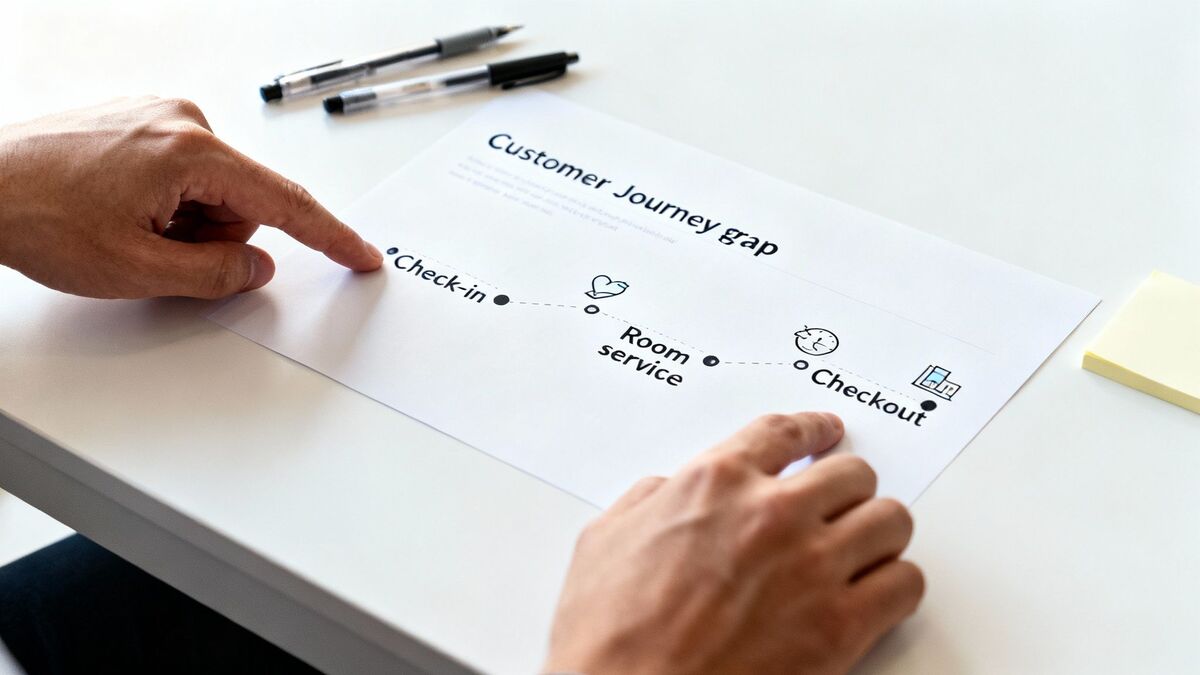
Pinpoint Your Moments of Truth
Mapping this out doesn't need to be some massive, complicated project. Just list every single interaction a customer has with you, from booking all the way to post-visit. Think chronologically and get specific.
Here are a few high-impact moments that work wonders across hospitality and service:
Hospitality (Hotels & Resorts): An SMS right after check-in. A simple QR code on the in-room dining tray. An email automatically triggered by your Mews property management system 30 minutes after they check out.
Restaurants & Cafes: A subtle QR code on the table to scan once the main course is cleared. An SMS survey sent an hour after a delivery order is completed.
Retail: A link in the e-receipt for an in-store purchase. A pop-up survey after a customer uses the "live chat" feature on your e-commerce site.
Healthcare (Clinics & Spas): A text message asking about the check-in process while they wait. An email survey the day after an appointment to ask about their experience with the provider.
The point is to ask while the experience is fresh. This makes the request feel relevant and natural, not like an intrusive marketing blast. To see how you can visualize these touchpoints, check out our guide on building an AI-powered customer journey map.
A Look at Feedback Hotspots Across Industries
Timing your feedback request is everything. Asking too early feels pushy; asking too late feels irrelevant. Here’s a breakdown of the most impactful moments to connect with customers across different service-based businesses.
| Key Feedback Collection Points by Industry |
| :--- | :--- | :--- | :--- |
| Industry | Pre-Experience | During Experience | Post-Experience |
| Hospitality | After booking confirmation | Immediately after check-in, after room service, post-spa treatment | 1-3 hours after checkout |
| Restaurant | After online reservation | After main course, at payment | 1 hour after delivery, 24 hours after dining |
| Retail | After online order confirmation | After using live chat, after an in-store pickup | Immediately via e-receipt, 3-5 days after delivery |
| Healthcare | After appointment scheduling | During wait time (about check-in), right after seeing provider | 24 hours after the appointment |
| Services | After quote/consultation booking | Mid-project for long-term services, immediately after service is rendered | 1-2 days after project completion |
As you can see, the ideal moment isn't a single point in time—it's a series of well-timed touchpoints that paint a complete picture of the customer's journey with your brand.
Unify Your Feedback to See the Full Picture
Identifying these hotspots is just step one. The real magic happens when the feedback you collect doesn't end up in isolated silos. If your front desk team hears in-person comments, your marketing team only sees Google reviews, and your ops manager gets survey results, nobody has the complete picture.
This is where a true Feedback Operating System becomes essential. It’s not just about collecting data at different points; it’s about connecting those points into a single, cohesive narrative of the customer experience.
This is exactly what Radar, a core feature of the FeedbackRobot Operating System, was built for. Radar is your unified review intelligence hub, pulling together feedback from public sites like Google and TripAdvisor with your own direct surveys.
It gives you that 360-degree view, so you can stop guessing where the problems are and start seeing exactly where to focus. This unified approach is the key to collecting smarter and acting faster.
Choose the Right Channels to Meet Customers Where They Are
Once you’ve mapped the customer journey and pinpointed the key moments for feedback, the next question is how to ask. Just sending out a generic email survey is like fishing with only one type of bait—you're going to miss most of the fish. Your customers are everywhere, so your feedback strategy needs to be, too.
Different people prefer to communicate in different ways. A business traveler might reply instantly to a text message after checkout, while a family on vacation is more likely to scan a QR code on the breakfast table. To actually get responses, you need solid multi-channel communication strategies built for how modern service businesses operate. This isn't about blasting every channel at once. It’s about picking the right mix for your specific customers and your business.
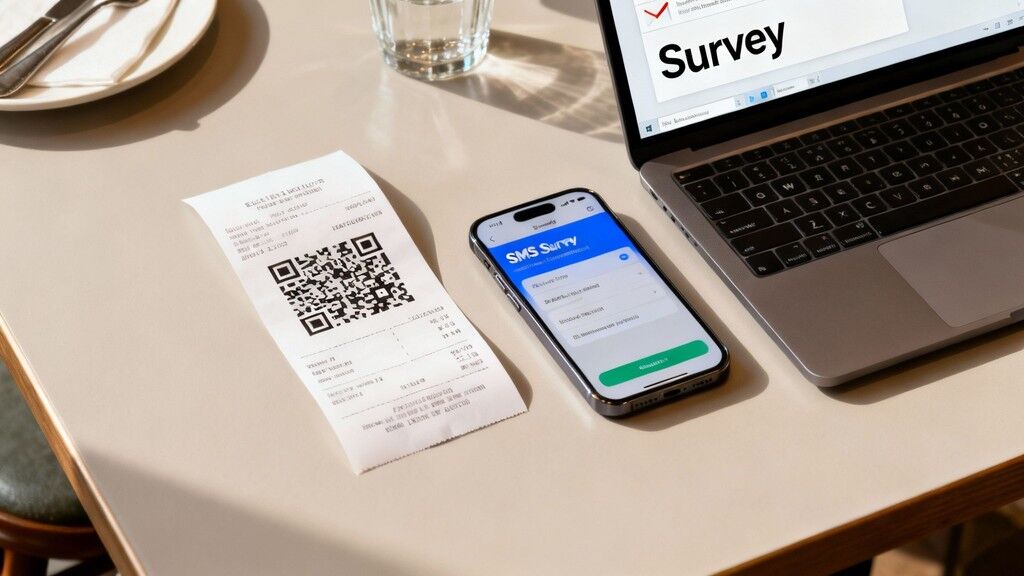
Comparing High-Impact Feedback Channels
Let's break down the channels that really move the needle for hospitality and service businesses. Each one has its own strengths, and the best results almost always come from combining them into a seamless system.
Email Surveys: The classic for a reason. Email is perfect for getting more detailed, thoughtful feedback after the experience is over. By integrating with your Mews property management system or Toast POS, you can automatically send a survey a few hours after a guest checks out or a diner pays their bill.
SMS (Text Messaging): Nothing beats SMS for speed and ridiculously high open rates—often over 90%. It’s the best way to get a quick pulse check while the customer is still on-premise. A simple text like, "How was your check-in? Rate it 1-5," captures crucial data in the moment.
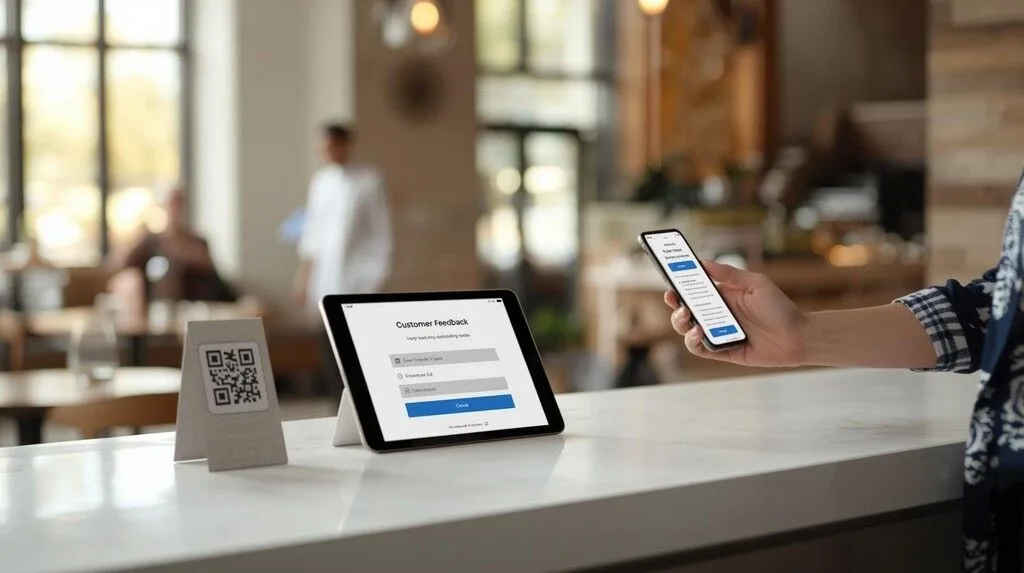
QR Codes: Your secret weapon for on-site feedback. Put QR codes on tables, receipts, in-room coasters, or at the front desk. Customers just scan with their phone and share their thoughts in seconds. No apps, no emails to dig through.
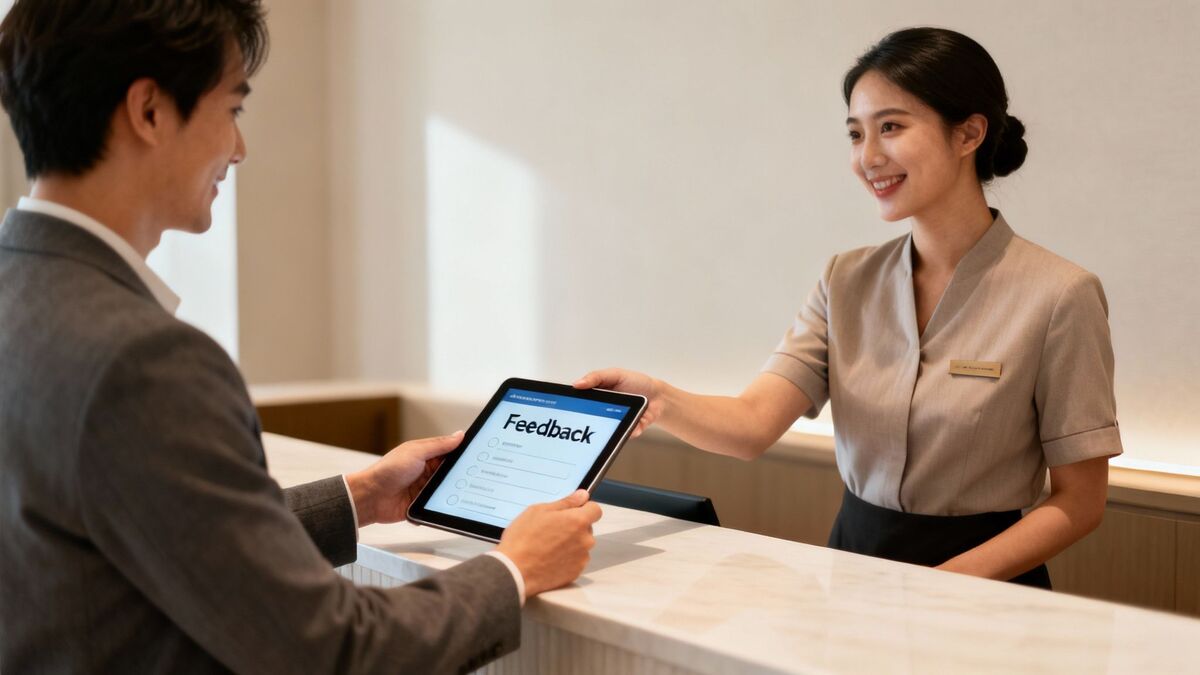
In-Person Prompts: Never forget the power of a human ask. Training your staff to say, "We'd love to hear how we did; you can scan the code on your receipt," can dramatically increase response rates. It shows you genuinely care.
If you want to go deeper on texting, our guide on SMS for customer feedback has a ton of practical tips. Using these methods together helps you capture both the immediate gut reactions and the more considered, after-the-fact reflections.
Turn an Idea into a Live Survey in Seconds
One of the biggest roadblocks for busy owners is time. You get a great idea—"I wonder what our brunch crowd thinks of the new menu?"—but then you have to build a survey, format it, and figure out how to send it. That friction means most of those brilliant ideas die.
We built our Prompt to Survey feature to kill that friction for good.
Prompt to Survey is a powerful AI feature inside the FeedbackRobot Operating System that takes a simple idea you type out and turns it into a fully built, ready-to-go survey in seconds. You just talk to it like a person.
Picture this: you're walking through your restaurant and a thought pops into your head.
You pull out your phone, open FeedbackRobot, and type: "Create a 3-question survey for weekend brunch guests about the new avocado toast and the service speed."
Instantly, the AI generates a polished survey with the right question types—maybe a star rating for the toast, multiple choice for service speed, and an open comment box.
With one more click, you get a unique QR code to print on menus, an SMS link to send out, or an email campaign ready to launch.
This feature completely removes the technical and creative roadblocks. It lets you collect smarter by launching targeted feedback campaigns right when you think of them, ensuring you never miss a chance to learn from your customers.
Turn Raw Feedback into Actionable Intelligence—Instantly
Collecting feedback is just the start. A mountain of survey responses won't help you grow if they just sit in a spreadsheet. The real magic happens when you turn that raw data into clear, actionable intelligence, and do it fast enough to make a difference.
This is where most owners get bogged down, drowning in data they don't have time to sort through. You can’t spend hours sifting through hundreds of individual comments to figure out what’s really going on. You need insights, not just more information.
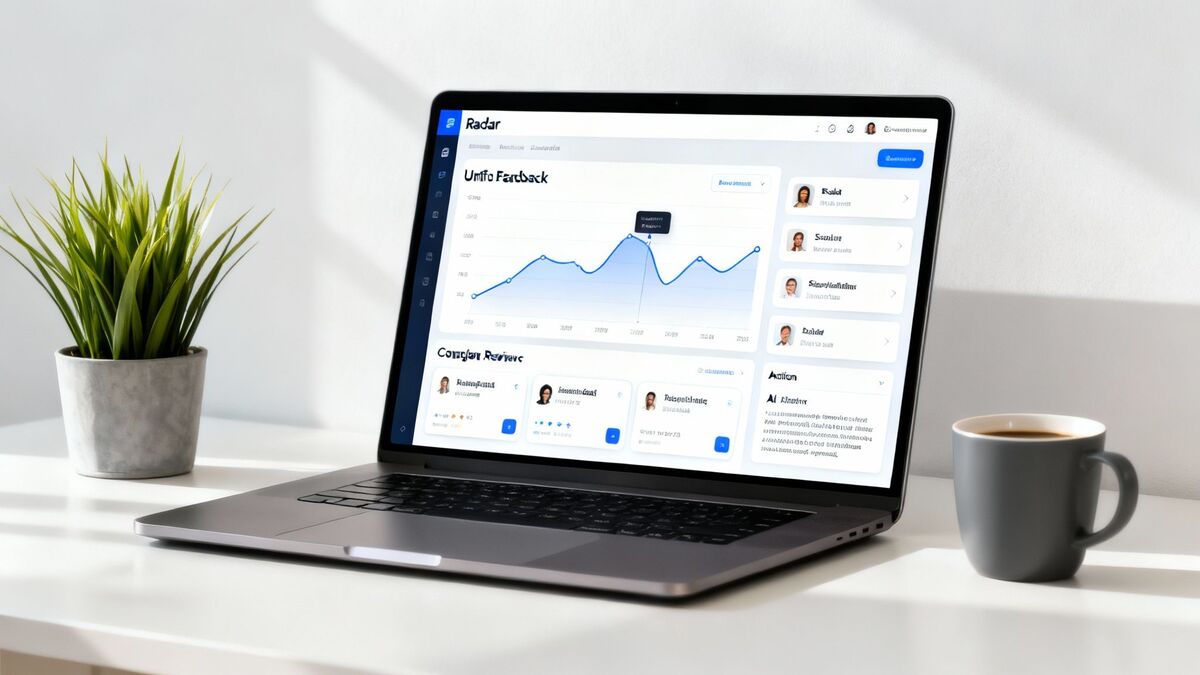
Unify Your Feedback into a Single Command Center
Let's be real—your customers are talking about you all over the place. They might leave a glowing review on Google, complain about slow service on Yelp, and fill out your direct survey about room cleanliness, all in the same week. If you're manually logging into each platform, you’re only catching fragments of the story. That’s why a unified view is non-negotiable for anyone serious about how to collect feedback from customers effectively.
Our Feedback Operating System solves this with Radar. Think of it as your business's air traffic control for customer sentiment.
Radar is your unified review intelligence command center. It pulls all your public reviews from Google, Yelp, and TripAdvisor and combines them with your private survey feedback from direct channels. Instead of juggling a dozen logins, you get one 360-degree dashboard showing you the complete picture of your customer experience.
This consolidated view helps you spot patterns you'd otherwise miss. You might see that a spike in negative TripAdvisor reviews about your pool's temperature correlates directly with a handful of 2-star survey ratings from a specific hotel wing. That’s an insight you can act on immediately.
Get Instant Insights with AI-Powered Analysis
Once all your feedback is in one place, the next hurdle is making sense of it at a glance. You need to know—fast—if a few negative comments are just one-off incidents or the start of a costly trend.
This is where our AI Summaries feature becomes your secret weapon, turning qualitative comments into hard data so you can act faster.
AI Summaries instantly analyze all incoming text feedback—from survey comments to online reviews—to give you instant insights and sentiment analysis.
Instant Sentiment Analysis: It automatically detects whether feedback is positive, negative, or neutral, giving you a real-time pulse on customer happiness.
Key Theme Identification: The AI groups comments by topic, showing you that 25% of feedback this week mentioned "friendly staff," while 15% brought up "slow check-in."
Urgent Issue Flagging: It can be trained to recognize keywords like "food poisoning" or "dirty room" and immediately flag them for a manager to review.
This means that instead of spending your morning reading every single review, you get a digestible summary of what your customers are saying right now. To see how this works, learn more about using a feedback summary generator to distill key insights.
Why Real-Time Analysis is Crucial
The speed of your response has a direct impact on customer loyalty. Globally, customer experience scores are under pressure, partly because most businesses aren't set up to handle feedback efficiently.
A recent KPMG report covering over 81,000 customers revealed a 3% global dip in customer experience scores, with "resolution" being a major pain point. This decline is largely because old-school feedback systems don't empower businesses to act swiftly. You can dive into more of these customer experience trends in the full report.
By transforming raw data into intelligence with tools like Radar and AI Summaries, you're not just collecting feedback—you're building a system to collect smarter, act faster, and grow stronger. You can pinpoint operational weaknesses, celebrate team successes, and make informed decisions backed by real customer data, not guesswork.
Turn Unhappy Customers Around with Automated Service Recovery
When a customer has a bad experience, the clock starts ticking. Every second that passes between their frustration and your response is a moment where loyalty hangs in the balance. A slow reply doesn't just feel like bad service; it communicates that you don't care, turning a fixable issue into a scathing public review.
Closing that feedback loop with speed and empathy is everything. But let's be realistic—if you're running a busy restaurant or hotel, you can't be everywhere at once. This is where smart automation becomes your most valuable player. It's not about replacing the human touch; it's about scaling it so you can act faster than ever before.
Your Automated Service Recovery Specialist
Imagine a system that operates like your best-trained manager, instantly jumping on negative feedback the moment it comes in. That’s exactly what our Resolutions Engine does.
The Resolutions Engine is the automated service recovery feature of the FeedbackRobot Operating System. It acts as your dedicated, 24/7 specialist, building powerful, automated workflows that trigger based on specific feedback. This isn't about a generic "Sorry to hear that" email. This is about delivering a tailored, immediate, and impactful response that makes the customer feel genuinely heard.
You can set up rules based on all kinds of triggers:
A low star rating, like 1 or 2 stars, on a survey.
Negative keywords our AI catches, like "cold food," "rude staff," or "long wait."
A poor score on a specific question, such as "How was the cleanliness of your room?"
When one of these triggers is hit, the Resolutions Engine springs into action.
How to Turn a Bad Experience into a Second Chance
Let's play this out. A guest at your restaurant finishes their meal, scans a QR code, and leaves a 2-star rating, mentioning "slow service."
Normally, that feedback might sit in an inbox until the next morning. By then, the diner is long gone and has probably already complained to a few friends.
But with the Resolutions Engine, the story is completely different:
Instant Detection: The moment that 2-star feedback is submitted, the system flags it.
Automated Response: A workflow kicks in immediately. The diner gets a personalized SMS: "Hi [Customer Name], we're so sorry to hear your service was slow tonight. We're always working to improve. Please accept this 15% off coupon for your next visit."
Internal Alert: At the same time, the on-duty manager gets a notification on their phone with the customer's comment, letting them address the issue with their team in that very moment.
In less than a minute, you’ve acknowledged the problem, apologized, offered a real reason to come back, and alerted your team to an operational slip-up. You didn't just handle a complaint; you actively prevented a bad review and showed a powerful commitment to service.
This isn't just a nice idea—it drives real business results. Studies consistently show that businesses that respond to negative feedback see a significant increase in customer retention. Why? Because it proves you're listening and willing to make things right.
Customizing Your Automated Responses
The power of the Resolutions Engine is its flexibility. You can design different automated responses for different situations.
For a hotel that integrates with its Mews PMS, a 1-star review mentioning a noisy room could automatically trigger an offer for a complimentary room upgrade on their next stay. For a retail shop, a comment about a sold-out item could trigger an alert straight to the inventory manager.
This kind of intelligent automation lets you act faster, turning would-be detractors into loyal fans. By resolving issues before they escalate, you protect your public reputation, cut down on churn, and build a brand known for incredible service recovery.
For in-person feedback collection, FeedbackRobot's QR code survey integration generates codes for tables, receipts, or packaging — with automatic routing that sends satisfied customers straight to Google or Yelp to leave a public review.
Showcase Your Success to Build Social Proof
After you’ve collected the feedback, dug into the insights, and followed up with your customers, there’s one last piece of the puzzle. It’s time to turn all that positive feedback into your most powerful marketing asset.
Think about it: 93% of consumers say online reviews influence what they buy. In that world, social proof isn't just a "nice-to-have"—it's the engine that brings new business through your door.
This is the moment you shift from reacting to feedback to proactively using it to build trust. Your happy customers are your best advocates. Their genuine words will always carry more weight than any slick ad campaign ever could. The goal is to get their voices out there to attract the next wave of customers.
Curate and Display Your Best Reviews
Manually copying and pasting testimonials onto your website is a pain. It's clunky, takes forever, and often looks dated. It’s a static approach that doesn't capture the real, ongoing conversation you’re having with customers. You need a way to show off your best feedback that looks great and runs itself.
This is exactly why we built Spotlight: Feedback Wall.
Spotlight: Feedback Wall is a feature inside the FeedbackRobot Operating System that automatically pulls and displays your best testimonials and reviews in a stunning, live format right on your website. It’s social proof on autopilot.
Instead of hunting for great comments, you just set the rules. For example, you can tell it to automatically display any review that’s 4 stars or higher and contains positive keywords our AI picks up on, like "amazing service" or "delicious food."
This keeps your website packed with fresh, glowing praise from real people, helping turn hesitant visitors into confident buyers.
Turn Positive Feedback into a Conversion Tool
Your feedback wall isn't just for show; it’s a strategic tool designed to drive conversions.
Imagine a potential guest is on your hotel’s booking page. Seeing a real-time feed of recent, happy reviews can be the final nudge they need to click "Book Now." It instantly answers their unspoken question: "Are other people actually happy with their stay here?"
By making social proof a visible part of your site, you’re constantly reinforcing your reputation. It shows you’re not just confident in what you offer, but that you have an army of happy customers ready to back you up.
This final step brings our whole philosophy full circle. You collect smarter by identifying your happiest customers, you act faster by instantly showcasing their praise, and you grow stronger by using that powerful social proof to attract more business. You've officially turned your feedback process from a simple data-gathering task into a complete growth engine.
Ready to turn customer feedback into your most powerful growth strategy? FeedbackRobot gives you the tools to collect smarter, act faster, and grow stronger. Generate your Hotel Management Guest Experience Survey.
What is the 'Owner's Playbook' for collecting feedback?
Start by identifying your 'Magic Moments'—the exact points in the journey where a customer's opinion is most valuable. Then, automate a request at those moments using SMS or QR codes.
How do I ask for feedback without being annoying?
Keep it short and explain *why* it matters. A message like 'We want to make your next visit even better! How did we do today?' is much better than a generic 'Take our survey.'
Should I offer a reward for every piece of feedback?
No. Offer a 'Thank You' reward for the *time* spent, not for the *positive score*. This maintains data integrity and shows you value the customer's input, not just their praise.
How do I ensure my team actually uses the feedback collected?
Gamify it. Share the 'Wins' in your team huddles and use the 'Service Gaps' to drive collaborative training sessions, making the feedback a tool for staff growth, not just monitoring.
How do I ensure my team actually uses the feedback collected?
Gamify it. Share the 'Wins' in your team huddles and use the 'Service Gaps' to drive collaborative training sessions, making the feedback a tool for staff growth, not just monitoring.
Stop reading about it. Let your agent handle it.
25 free AI actions · no credit card required
Start Free