
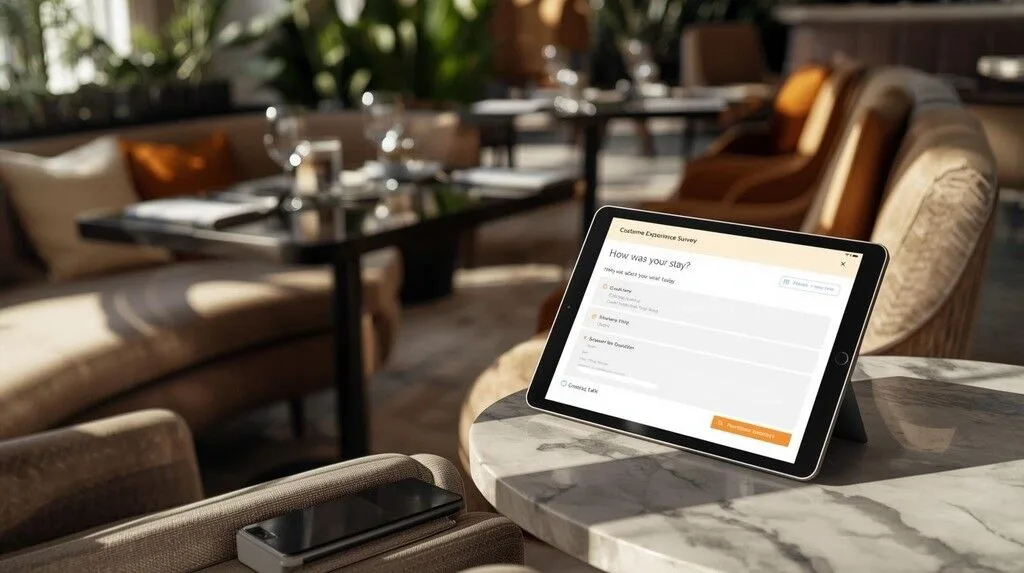
How Customer Experience Surveys Power Growth in Hospitality and Service
Master customer experience surveys with our guide. Learn how to design, distribute, and analyze feedback to increase loyalty and grow your business.

Feb 2, 2026 · 16 min read
Free tool
AI Negative Review Responder
Turn 1-star reviews into recovery opportunities with AI-crafted responses.
Think of a customer experience survey as a direct line to your guests—a structured way to ask what they really think about their time with you. This isn't just a questionnaire. It's your chance to see your business through their eyes, giving you the unfiltered truth about what's working and, more critically, what’s costing you money.
For a busy owner in hospitality or service, these insights are gold. They are the key to fixing nagging problems, elevating your service, and building a stronger, more profitable business.
Why Customer Experience Surveys Are Your Growth Engine

You already know that happy customers are the lifeblood of your business. But guessing what makes them happy? That's a direct path to wasted effort and lost revenue. Customer experience surveys remove the guesswork, turning whispers and hunches into actionable data you can use to grow.
A well-designed survey isn't an interruption; it's a conversation. It’s how you learn what turns a first-time visitor into a loyal regular, what stops a small service hiccup from becoming a scathing online review, and which operational tweaks will make the biggest impact on your bottom line. For a deeper dive, check out this ultimate guide to customer experience surveys.
The FeedbackRobot Advantage: Your Feedback Operating System
Our entire platform is built on one simple, powerful philosophy: collect smarter, act faster, and grow stronger. It’s not about bombarding people with endless forms. It’s about asking the right questions at the perfect moments to reduce churn, fine-tune your operations, and build a brand people genuinely trust.
Our Feedback Operating System is designed to make this easy for busy owners, yet incredibly powerful:
Prompt to Survey: Instantly create perfectly optimized surveys from a simple text prompt. Just describe your goal, and our AI builds the survey for you in seconds.
Radar: See all your feedback—including public reviews from Google, Yelp, and TripAdvisor—in one clean dashboard. It's a unified intelligence hub that shows you the complete picture of your reputation.
AI Summaries: Get immediate insights and sentiment analysis from thousands of comments, no manual reading required. Instantly understand what customers love and what needs fixing.
Resolutions Engine: Automatically kick off service recovery flows to fix issues before they blow up. This is your automated system for turning unhappy customers into loyal fans.
The goal isn't just to listen; it's to create a system where feedback automatically drives improvement. When you connect what customers are telling you directly to your operations, you create a powerful, self-improving growth cycle.
This is the shift that separates businesses that thrive from those that just get by—moving from passively listening to actively solving problems.
From Feedback to Revenue: The CX Survey Value Chain
This table illustrates the direct link between effective survey strategies and tangible business outcomes. It shows how connecting a simple action to a real insight leads directly to a stronger business.
Action (Collect Smarter) | Insight (Act Faster) | Business Outcome (Grow Stronger) |
|---|---|---|
Post-stay hotel survey via QR code | Identify slow check-in process as a key friction point | Streamline front-desk operations, leading to higher NPS and more positive reviews. |
In-restaurant QR survey after a meal | Learn a popular menu item is consistently served cold | Address kitchen-to-table process, preventing negative reviews and improving diner satisfaction. |
Post-purchase e-commerce survey | Discover confusing website navigation is causing cart abandonment | Optimize UX to increase conversion rates and average order value. |
As you can see, the right feedback at the right time isn't just "nice to have." It's a direct path to better reviews, happier customers, and a healthier bottom line.
Designing Surveys People Actually Want to Complete
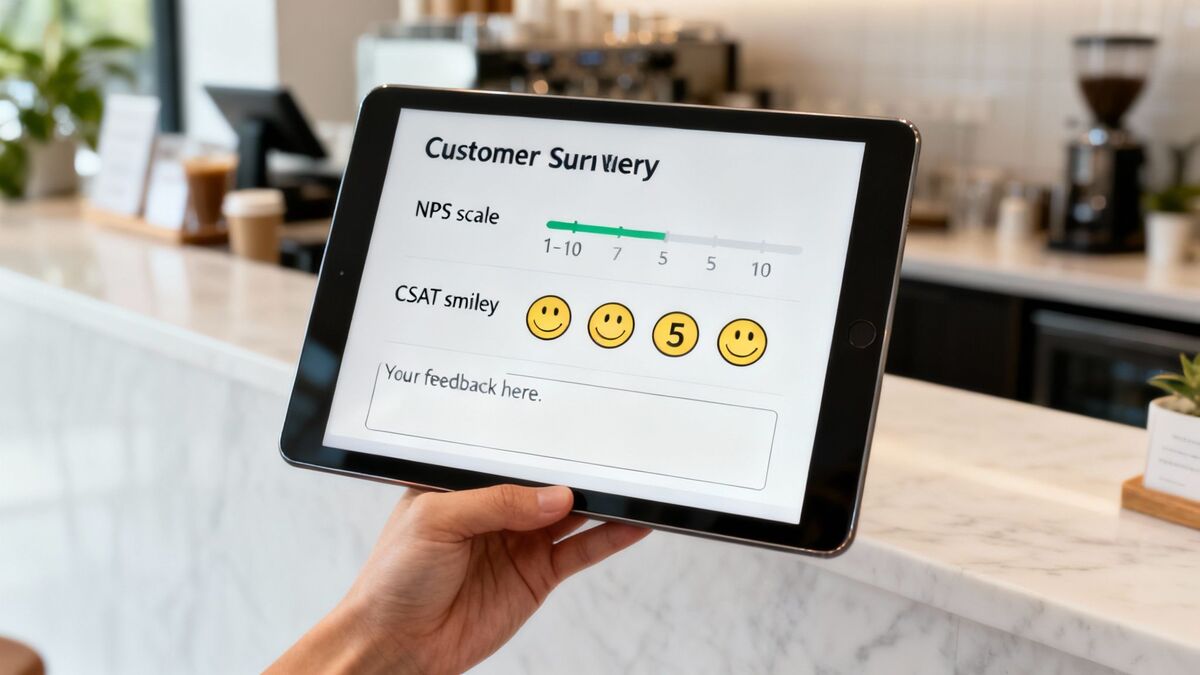
Let's be direct—the biggest hurdle with any customer survey isn't what you ask. It’s getting people to answer in the first place.
Think of your customer’s attention like a currency; they only have so much to spend. A long, confusing survey is an immediate dealbreaker. If you want high response rates, you must design surveys that are short, engaging, and respect their time.
The golden rule here is brevity. Aim for a survey that takes no more than two minutes to complete. For most businesses, that means sticking to just 3-5 focused questions. Go any longer, and you'll watch participation fall off a cliff.
Crafting Questions That Get Real Answers
A great survey is more than a checklist; it's a strategic mix of questions designed to give you both hard data and the stories behind the numbers. You need to balance quantitative metrics with qualitative insights to see the full picture.
Here’s a simple but incredibly effective structure:
Start with a Score: Kick things off with a core metric like Net Promoter Score (NPS) or Customer Satisfaction (CSAT). This gives you a quick, measurable benchmark of the overall experience.
Dig a Little Deeper: Follow up with a multiple-choice question that helps diagnose the "why" behind their score. For a hotel stay, you might ask, "What was the most important factor in your rating?" with options like 'Check-in,' 'Room Cleanliness,' or 'Staff Friendliness.'
Open the Floor: End with one open-ended question. This is where you’ll find the real gold. A simple prompt like, “Is there anything else you’d like to share?” gives customers the space to tell you what’s really on their minds.
A well-structured survey is like a good conversation. It starts broad, gets a little more specific, and then gives the other person a chance to speak freely. This flow feels natural and encourages more thoughtful responses.
If you need more inspiration, our detailed guide has a ton of customer experience survey questions examples to get you started.
The Smartest Way to Build Your Survey
As a busy owner, you don’t have hours to spend wordsmithing questions and designing layouts. This is exactly why we built Prompt to Survey, a core feature of the Feedback Operating System. It completely changes the game.
Instead of wrestling with clunky survey builders, you simply type your goal directly into FeedbackRobot. For example: "Create a short survey for my hotel to understand the check-in experience."
Instantly, our AI generates a fully optimized, ready-to-send survey based on proven best practices. It picks the right question types, writes clear and unbiased language, and structures it for the highest possible response rate.
This feature lets you collect smarter by turning your business questions into powerful data-gathering tools in seconds, not hours. It’s the fastest way to move from a problem to a real plan of action.
Asking for Feedback at the Right Time and Place
Even the most brilliant survey questions will fall flat if you ask them at the wrong time or in the wrong place. Timing is everything. Asking a guest to fill out a form while they’re juggling luggage at checkout is just as bad as asking a confusing question. To get real results, you have to master survey distribution.
Think of it as finding the "moment of truth"—that perfect window when the experience is still fresh in your customer's mind. The goal is to make giving feedback feel like a natural, almost effortless part of their journey. Nailing how you go about collecting feedback effectively is what separates a good customer experience program from a great one.
It all comes down to meeting customers where they already are, removing as much friction as possible.
Matching the Channel to the Experience
There’s no magic, one-size-fits-all channel. The right one depends entirely on your business, but there are clear winners for different industries. The key is to show up right at the peak of their experience, or immediately after it ends.
Here are some channels that consistently deliver for service and hospitality businesses:
Restaurants: A simple QR code on the table, receipt, or a tabletop tent is a powerhouse. It captures feedback while the taste of the meal is still top of mind. Many of our users get incredible results integrating FeedbackRobot directly with their POS, like Toast.
Hotels: Use QR codes on key cards or in-room TVs for mid-stay feedback. For post-stay, an email or SMS sent 2-4 hours after check-out hits the sweet spot. Integrating with your PMS, such as Mews, can automate this entire process.
Retail: A link or QR code on the receipt is standard. For online stores, a follow-up email sent a few days after delivery gives them time to actually use the product.
Services (Clinics, Salons): An SMS or email sent within an hour of their appointment is incredibly effective. The experience is immediate and personal, so the feedback is too.
The best distribution strategy feels like a thoughtful follow-up, not an intrusive demand. It meets customers where they are, on the channel they prefer, at a time that makes sense for them.
Seeing the Full Picture with Unified Intelligence
Your direct surveys are just one piece of the puzzle. Customers are also talking about you on Google, Yelp, TripAdvisor, and dozens of other public forums. To truly collect smarter, you need to see all this feedback in one place. When your data lives in silos, you end up with massive blind spots.
This is where FeedbackRobot’s Radar comes in. As our unified review intelligence dashboard, Radar doesn't just show your survey results; it actively pulls in all your public reviews from across the web and organizes them into a single, comprehensive view.
By blending internal survey data with external public reviews, Radar gives you a true 360-degree understanding of your customer experience. You can instantly spot trends you’d otherwise miss—like seeing if a problem mentioned in a private survey is also popping up in your Google reviews. This holistic view helps you deploy surveys more strategically and respond to the issues that matter most, wherever they appear. It’s the ultimate tool for turning scattered comments into a clear, actionable roadmap for growth.
Turning Raw Data Into Actionable Intelligence
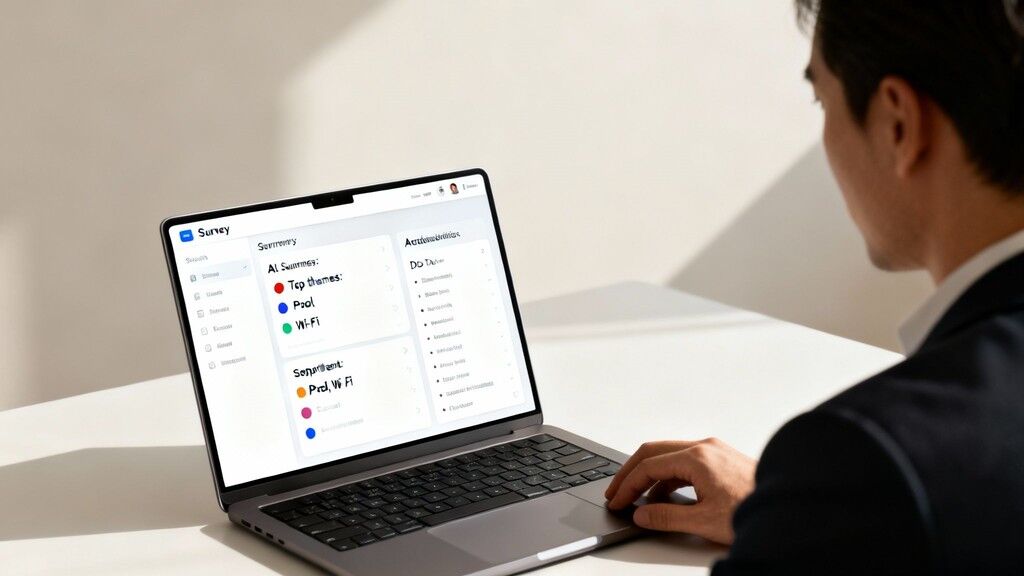
Collecting feedback is a great start, but it’s only half the battle. The real magic happens when you turn that mountain of individual responses into clear, actionable intelligence that tells you exactly what to do next. Let’s be honest, as a busy owner, you don’t have time to manually sift through hundreds of comments, trying to connect the dots.
The key is to move beyond just the scores. While metrics like Net Promoter Score (NPS), Customer Satisfaction (CSAT), and Customer Effort Score (CES) are crucial for benchmarking, they only tell you what happened, not why.
The "why" lives in the open-ended, free-text comments. The problem? Analyzing them has always been the most time-consuming part. Until now.
Beyond the Numbers: Uncovering the Why
To truly improve your customer experience, you need to understand the themes and emotions hidden in your qualitative feedback. Are customers consistently praising your friendly staff but complaining about slow service? Do they love your new menu but find the online ordering system clunky?
These are the insights that drive meaningful change. Without the right system, however, these golden nuggets stay buried in raw data. You need a way to spot patterns, identify recurring issues, and understand the overall sentiment of your guests at a glance.
Your Instant Insight Engine: AI Summaries
Manually reading every comment and tagging themes is no longer a viable option. It’s slow, prone to bias, and simply impossible to scale as your business grows. This is why we built AI Summaries directly into FeedbackRobot. Think of it as your always-on data analyst, working 24/7 to make sense of your feedback.
Our AI Summaries is a powerful feature that instantly analyzes all your open-ended survey responses and public reviews to give you:
Top Themes: It automatically identifies and surfaces the most frequently mentioned topics, like 'room cleanliness,' 'check-in speed,' or 'staff attitude.'
Sentiment Analysis: It instantly gauges the emotion behind every comment—positive, negative, or neutral—so you can see how customers feel about specific topics.
Actionable Summaries: It delivers a clear, bulleted list of the most critical takeaways. Imagine logging in and seeing a summary like: “Guests love the new pool area, but many are frustrated with the slow Wi-Fi in rooms on the third floor.”
This technology transforms raw, unstructured text into a strategic to-do list. It’s the fastest way to stop guessing and start focusing your energy on the improvements that will make the biggest difference to your customers.
With this level of clarity, you can confidently make operational changes, retrain staff on specific issues, or invest in upgrades you know your customers are asking for. It’s how you act faster, turning feedback into a direct line to a stronger, more resilient business. To get a better handle on the process, check out our guide on the fundamentals of analyzing survey data.
Automating Service Recovery and Closing the Loop
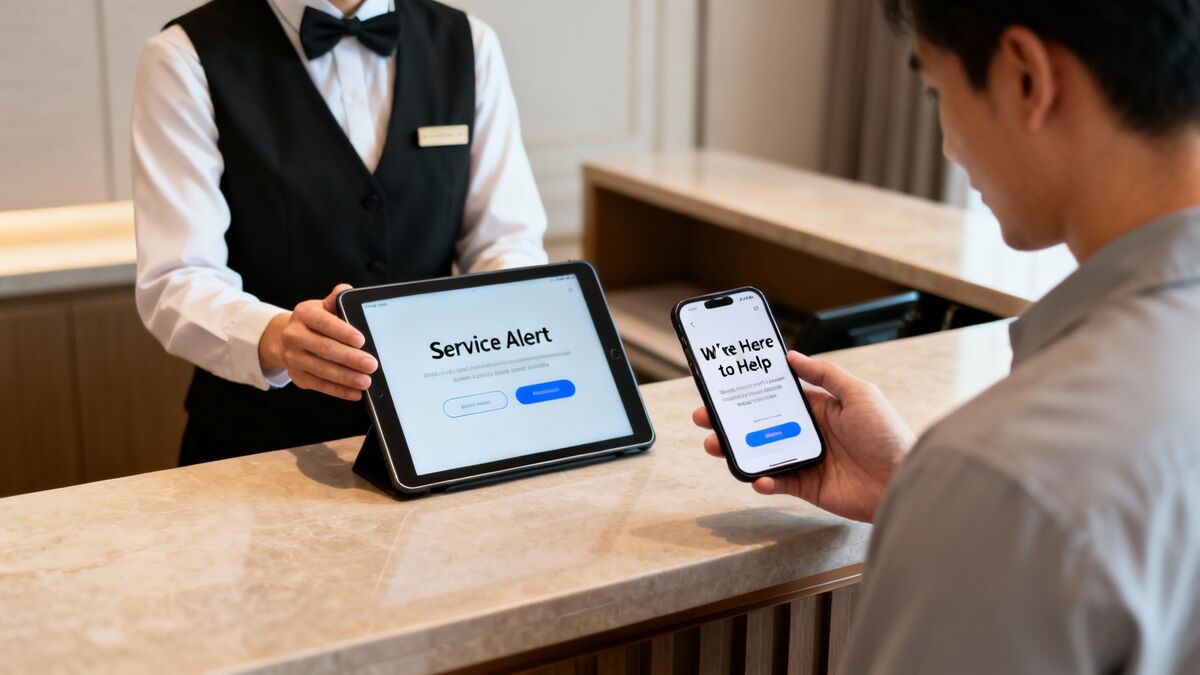
What’s worse than a bad customer experience? A bad experience that goes completely ignored. When a frustrated customer takes the time to fill out your survey, they aren't just venting—they're giving you one last chance to make it right before they walk away for good.
Closing the feedback loop is arguably the most critical part of any CX program. It's the moment you flip a negative event into an opportunity to earn serious loyalty. But for a busy manager, manually tracking every low score or negative comment is a recipe for disaster. Important issues will inevitably slip through the cracks.
This is where automation becomes your secret weapon, making sure you can act faster on the feedback you worked so hard to get.
Your Automated Service Recovery System
Imagine a system that works like a vigilant front-desk manager, instantly spotting trouble and launching a recovery plan without you lifting a finger. That's exactly what FeedbackRobot’s Resolutions Engine does. As your automated service recovery system, it's built to close the loop in real-time, every single time, turning negative experiences into positive outcomes.
You can set up simple but powerful rules that trigger specific actions based on incoming survey feedback. This guarantees a consistent, immediate, and empathetic response the moment a problem is detected.
Here's how it completely changes your service recovery process:
Rule-Based Triggers: You can set up automations based on specific conditions. For example, if a customer gives an NPS score of 4 or lower or uses a keyword like 'dirty' or 'disappointed' in their comment, a workflow kicks off instantly.
Immediate Communication: The second a trigger is met, the Resolutions Engine can fire off a personalized, empathetic email to the customer, acknowledging their issue and apologizing for the experience.
Smart Actions: At the same time, the system can issue a unique discount code for their next visit and create a high-priority task in your team's inbox for a manager to dig into the root cause.
The goal is to stop problems before they explode into scathing public reviews. An automated, real-time response shows customers you're listening and you care, which is often enough to win back their trust and stop them from leaving that one-star review on Google or TripAdvisor.
Why Speed Is Non-Negotiable
In today's market, customers have very little patience for poor service. A delay of just a few hours can mean the difference between keeping a customer and losing them forever. The data on this is crystal clear.
Analysis from Webex shows that 70% of consumers will ditch a brand after just two bad experiences. Even worse, 54% will leave if they have to repeat their issue to multiple people, which shows just how costly an uncoordinated response can be. These numbers prove that a rapid, automated service recovery system isn't a "nice-to-have"—it's essential for survival. You can dig deeper into these critical customer experience statistics to see the full picture.
The Resolutions Engine ensures no complaint is ever ignored, empowering you to turn potential detractors into your most loyal fans. By automating that first response, you not only solve the customer's problem but also free up your team to fix the underlying operational issues. This is how you grow stronger, one resolved issue at a time. Learn more about how you can streamline this entire process in our guide to feedback resolution automation.
Showcasing Your Success to Build Social Proof
After you’ve done the hard work—collecting feedback, digging into the insights, and fixing what’s broken—there’s one last, crucial step. What do you do with all that positive feedback? You turn it into one of your most powerful marketing assets. It’s the proof that you don’t just listen; you actually deliver.
In a crowded market, proving you offer a better experience is a massive advantage. This is more true now than ever. Forrester's 2025 Global Customer Experience Index uncovered a worrying trend: 21% of brands actually got worse at CX, while only a tiny 6% improved.
By turning your positive survey feedback into public social proof, you immediately stand out from the 73% of competitors whose service quality is just coasting. You can check out all the details in Forrester's research on CX quality. This is how you directly influence new customers looking for a business they can count on.
Turning Private Praise into Public Acclaim
The goal here is to complete the feedback loop, turning your CX program into a genuine growth engine. The first step is to gently guide your happiest customers toward sharing their experiences where everyone can see them.
When a customer leaves a fantastic survey response—say, an NPS score of 9 or 10—that’s your signal to act. You can set up an automated, personalized thank-you email that not only shows you appreciate them but also includes direct links to your Google, TripAdvisor, or Yelp profiles. This makes it completely effortless for them to share their story.
"Your best marketing is a happy customer. Don't just thank them for their feedback; make it easy for them to become your biggest advocate."
This simple, proactive approach essentially turns your most satisfied customers into a volunteer marketing team. They build a stellar online reputation for you, and that reputation organically attracts new business.
Effortlessly Build Trust with the Feedback Wall
To make this entire process seamless, we're excited to introduce the upcoming Feedback Wall from FeedbackRobot. Think of it as the ultimate tool for automatically turning your hard-won praise into compelling social proof.
The Feedback Wall will curate your best survey responses and top online reviews, then display them on a beautiful, shareable public page. You can even embed this dynamic wall of testimonials right on your website.
It’s a living, breathing testament to your commitment to excellence. It shows potential customers that you are a business that listens, acts, and consistently delivers outstanding experiences.
This closes the loop perfectly. You collect feedback to get better, and then you use that very same feedback to attract your next wave of loyal customers. It ensures you not only act faster but also grow stronger.
Your Top CX Survey Questions, Answered
Got questions about setting up your customer experience survey program? You're not alone. Here are the answers to the most common questions service and hospitality owners ask. Getting these right from the start will help you collect smarter and get your feedback strategy moving quickly.
How Long Should My Survey Be?
Shorter is almost always better. Keep your customers in mind—their time is precious.
Aim for 3-5 essential questions that someone can answer in under two minutes. This simple act of respect will dramatically boost your completion rates. A great starting point is a core metric question (like NPS), a quick diagnostic question (“What did we do best?”), and one open-ended question for the details.
A short, focused survey tells your customer you value their time. That respect pays off with more responses and higher-quality feedback.
This is exactly why we built FeedbackRobot’s AI-powered Prompt to Survey feature. Just tell it your goal, and it automatically generates a perfectly balanced survey designed for high engagement, no guesswork required.
What’s the Difference Between NPS, CSAT, and CES?
Think of them as different tools in your toolbox, each measuring a unique part of the customer experience. A smart strategy uses a mix of all three at different moments in the customer journey to paint the full picture.
NPS (Net Promoter Score): This measures big-picture brand loyalty. It answers, "Are our customers happy enough to recommend us to friends?"
CSAT (Customer Satisfaction): This is all about the "right now." It measures satisfaction with a specific interaction, like how smoothly check-in went or how a support call was handled.
CES (Customer Effort Score): This one measures friction. It tells you how easy—or difficult—it was for a customer to get something done, like booking a table online.
How Often Should I Send Surveys?
It really depends on your business. If you run a restaurant or a retail shop where interactions are frequent and transactional, sending a survey after each visit works wonders. The memory is fresh, and the feedback is immediate.
For businesses with longer-term relationships, like a hotel or a clinic, you'd send one after key touchpoints—a completed stay or an appointment, for instance. On top of that, a broader relationship survey every 6-12 months can give you a high-level view of customer loyalty.
The main thing is to avoid "survey fatigue." You don't want to annoy your best customers. That's where a platform like FeedbackRobot comes in. It intelligently manages your sending frequency to make sure you're not asking the same people for feedback too often, which keeps your response rates high and your customers happy.
Ready to turn feedback into your biggest growth driver? FeedbackRobot helps you collect smarter, act faster, and grow stronger with an all-in-one Feedback Operating System.
Why are 'Experience' surveys different from 'Satisfaction' surveys?
Satisfaction is about the end result; Experience is about the *feeling* during the journey. Experience surveys ask about wait times, lighting, and staff friendliness—the 'Nuance' of the visit.
Should I survey every single customer?
For hospitality, yes. Automation makes this 'Zero-Effort.' The more data points you have, the more accurate your sentiment analysis becomes for identifying small operational issues.
How do I keep my experience surveys 'Frictionless'?
Use 'Smart Branching.' If a guest gives a 5-star rating, the survey ends. If they give a 1-star, it opens a box to ask 'What happened?' This respects the happy guest's time.
Can I use experience surveys to benchmark multiple locations?
Yes. You can compare the 'Vibe' of your Downtown location vs. your Suburb location. If one is winning, you can study their processes and 'copy-paste' that success to the other.
What is the 'ROI' of a customer experience survey?
The ROI comes from 'Churn Reduction.' Catching an unhappy guest before they stop visiting saves you the cost of acquiring a new customer, which is 5-10x more expensive.
Stop reading about it. Let your agent handle it.
25 free AI actions · no credit card required
Start Free

![How to Measure Customer Satisfaction Without Surveys [10 Methods]](/images/legacy/HZ9HoLgQGt0VJJpCMqdS6vtTcAE.webp)