
Guide
10 Survey Questions Answerable by Yes or No
Get 10 ready-to-use survey questions answerable by yes or no. Drive growth with examples for hospitality, retail, and healthcare. Collect smarter feedback now.

Apr 28, 2026 · 18 min read
Free tool
Likert Scale Generator
Generate custom rating scales and survey questions tailored to your feedback needs.
A guest checks out. A diner pays and walks out. A retail customer leaves without saying much. You want feedback, but you don't want to hand them a form that feels like homework.
That's where survey questions answerable by yes or no do their best work. They reduce effort, speed up responses, and give your team something they can act on right away. Surveys with fewer than 10 closed-ended questions achieve 35% higher completion rates than longer open-ended formats, according to the analysis cited by SurveyMars on yes or no questionnaires. For busy hospitality, retail, and healthcare operators, that matters. (Yes/no questions are one of the basic formats every operator should know — see our full bank of sample survey questions for the rest.)
The catch is simple. A yes or no answer is only useful if it leads to the next action. A "No" should trigger a follow-up, an alert, or a service recovery. A "Yes" should help you reinforce what's already working. That's where an AI-driven system changes the value of a simple binary question.
While yes/no questions offer a streamlined approach to gathering immediate feedback, a comprehensive online feedback strategy involves more than just binary choices. To truly leverage customer insights and enhance your reputation management, exploring advanced methods for collecting and analyzing feedback is crucial. Discover how to move beyond surveys and master your online feedback form strategy for deeper engagement and actionable intelligence.
With FeedbackRobot, Prompt to Survey helps teams turn a basic customer prompt into a ready-to-send survey. AI Summaries turn replies into instant themes and sentiment signals. Radar gives you unified review intelligence across locations and channels, so patterns don't stay buried in separate tools. Resolutions Engine turns negative answers into automated service recovery, follow-ups, and internal escalation. Used together, they help you collect smarter, act faster, and grow stronger.
Below are 10 yes/no questions worth using when you want fast, usable customer feedback.
1. Net Promoter Score NPS Foundation Question
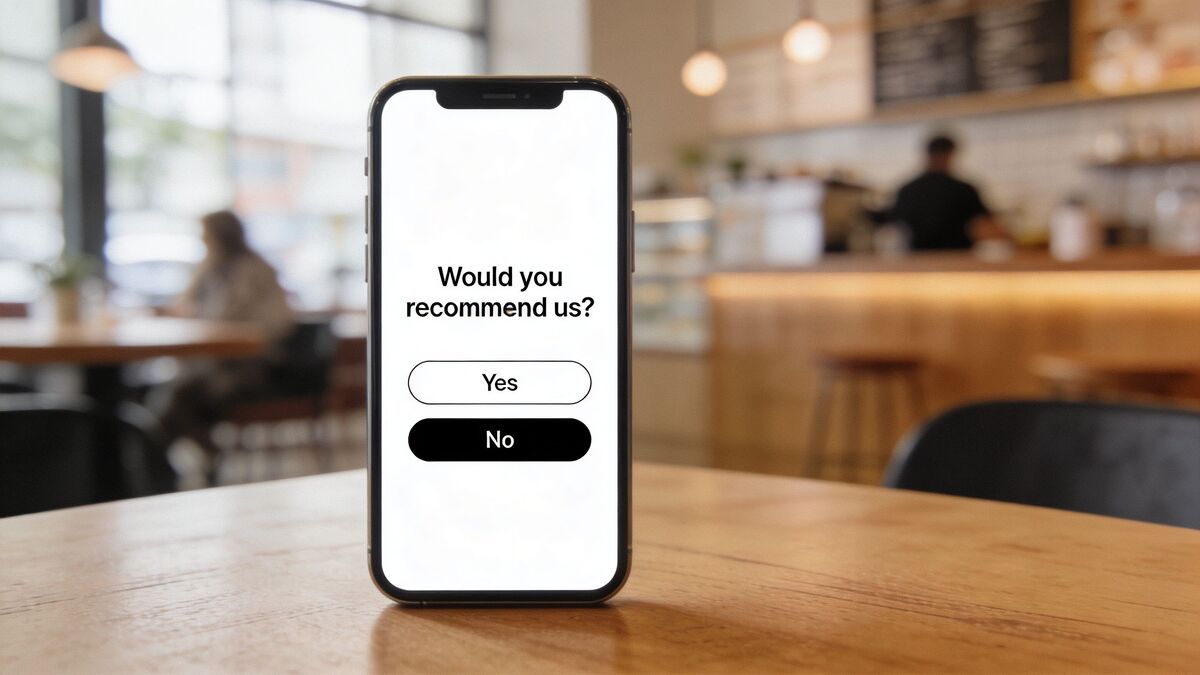
Ask this when you need a clean read on loyalty.
Question: Would you recommend us?
Traditional NPS uses a rating scale, but the yes/no version works well when speed matters more than nuance. In a hotel checkout SMS, restaurant QR survey, or clinic follow-up email, this question quickly tells you who is willing to advocate for your business and who isn't.
A yes/no recommendation prompt also maps well to operational action. "Yes" respondents can be thanked and invited to leave a review. "No" respondents can be routed into a short follow-up so your team can intervene before the customer complains publicly.
What works in practice
The strongest version is specific and immediate. Ask it right after the stay, meal, purchase, or appointment while the experience is still clear in the customer's mind.
Use a second question right after it:
If yes: What stood out most?
If no: What would have needed to be better?
Practical rule: Never leave "Would you recommend us?" as a standalone question. The answer tells you sentiment. The follow-up tells you what to do next.
If you want more context on the metric itself, FeedbackRobot's guide to what is a good Net Promoter Score is a useful companion.
For operators using Radar, this question becomes more valuable across multiple sites because you can compare advocacy patterns by location, shift, or service line instead of treating every response as a one-off.
2. Service Product Satisfaction Question

A customer finishes a purchase, leaves the appointment, or checks out of the hotel. You need a fast read on whether the core experience worked.
Question: Were you satisfied with your experience?
This question earns its place because it gives you a quick operating signal. Used well, it helps you sort routine wins from issues that need attention now. Used poorly, it produces a pile of vague "yes" and "no" answers that no one can act on.
Ask about the part of the experience you can improve
The strongest version is tied to a specific service or product moment:
Hotel: Was your room clean and comfortable?
Restaurant: Was your meal prepared to your satisfaction?
Clinic: Were you satisfied with your appointment?
Store: Did you find what you were looking for?
That level of specificity matters. "Were you satisfied with your experience?" is useful as a high-level check. The adapted versions are better for fixing real problems because they point to the part of the operation that likely caused the response.
A common mistake is asking a broad satisfaction question and stopping there
That leaves too much interpretation to your team.
A "Yes" does not tell you whether customers liked the product quality, the speed, the staff interaction, or the convenience. A "No" does not tell you whether the issue came from pricing, wait time, stock availability, or a service failure. Add one follow-up and the question becomes operational.
Use a simple rule:
If yes: What specifically worked well?
If no: What should we have done better?
That is where a basic yes/no question starts producing measurable growth. In FeedbackRobot, a negative answer can trigger an alert, route the customer into a recovery workflow, and group similar complaints automatically. A positive answer can feed review requests, retention campaigns, or location-level reporting. The input is simple. The action does not have to be.
The article on customer satisfaction survey best practices explains how to structure that follow-up without making the survey feel long.
For service businesses with multiple teams or locations, this question also helps separate product issues from people issues. If satisfaction drops while staff scores stay high, the problem may sit with inventory, fulfillment, or the offer itself. Teams that also review smarter people decisions questions can keep those categories distinct instead of blaming frontline employees for every bad outcome.
One practical standard works across industries: ask the question right after the transaction, visit, delivery, or appointment, then connect the answer to an automated next step. That is how a one-click response becomes something a business owner can use.
3. Staff Employee Performance Question
A single interaction with one employee often shapes the whole experience.
Question: Did our staff member provide excellent service?
This question works best when tied to a role or moment, not a vague impression. "Was the front desk staff helpful and friendly?" is better than "Was our team good?" "Did the doctor listen to your concerns?" is more useful than "Were staff professional?"
Make the question concrete
Bias creeps in when businesses ask abstract or absolute questions. The better approach is to anchor the question to a specific visit or action. That's especially important in healthcare, hospitality, and other high-stakes service settings, as discussed in Customer Thermometer's piece on unbiased customer satisfaction survey questions.
Good examples:
On this visit, did your server check on you when needed?
During check-in, did the front desk explain everything clearly?
During this appointment, did the provider answer your questions?
Bad examples:
Is our staff always attentive?
Are we the friendliest team in town?
Does everyone here provide excellent service?
Ask about a recent, observable behavior. Don't ask customers to judge your entire culture in one click.
When paired with AI Summaries, positive staff mentions can be grouped and shared with managers quickly. Negative responses can move through the Resolutions Engine so supervisors know where coaching or service recovery is needed. You can also use this question alongside broader people-review frameworks such as smarter people decisions questions, but customer-facing phrasing should stay specific and situational.
4. Cleanliness and Facility Condition Question

Some questions are operationally essential. This is one of them.
Question: Were the facilities clean and well-maintained?
In hotels, that might mean room readiness. In restaurants, it often means restrooms and dining areas. In clinics, it's treatment rooms and waiting spaces. In retail, it's floors, fitting rooms, and shelf condition.
The reason this question matters is simple. Customers don't usually write long essays about cleanliness unless something went wrong. A yes/no prompt catches the issue earlier.
Best use cases
Use versions like these:
Was your room clean upon arrival?
Were the restroom facilities clean and stocked?
Was the treatment area clean?
Was the store clean and easy to shop?
What works:
Ask soon after the visit: The customer still remembers the condition clearly.
Route by area: Housekeeping, maintenance, and operations teams need different alerts.
Add one follow-up for No: Ask which area needs attention.
What doesn't work:
Bundling too much together: "Was the property clean, safe, comfortable, and welcoming?" creates muddy data.
Waiting too long: If you ask days later, the response is less reliable.
Ignoring repeat patterns: A single "No" might be noise. A cluster from the same shift or location is not.
Radar earns its place by addressing this challenge. Instead of scattered complaints across reviews, surveys, and inboxes, your team gets unified review intelligence that shows whether a cleanliness problem is isolated or recurring.
5. Return Loyalty Intent Question
A customer can say they were satisfied and still never come back. That's why return intent deserves its own question.
Question: Would you visit us again?
This is one of the most practical survey questions answerable by yes or no because it directly points to retention risk. For a hotel, "Will you stay with us again on your next trip?" says more about future revenue than a generic thumbs-up. For a retailer, "Will you shop with us again?" gives you an early churn signal.
Why this question is different from satisfaction
Satisfaction looks backward. Loyalty intent looks forward.
A diner may have enjoyed the food but found the wait too long. A patient may have liked the provider but disliked the booking process. A guest may have had a fine stay but felt the price didn't match the experience. This question surfaces those cracks.
Use it with branching logic:
Yes: Ask what would bring them back sooner.
No: Ask what nearly lost them, or what would need to change.
Research summarized by Formbricks on open-ended survey questions highlights a common problem with closed questions. They identify the outcome, but not the reason behind it. That's exactly why a return-intent question needs a follow-up if you want operational insight.
FeedbackRobot's Prompt to Survey makes that easy to deploy fast, and the Resolutions Engine can route "No" responses into a win-back flow before the customer departs unnoticed.
6. Problem Resolution Question
If a customer had an issue, don't ask how they felt in general. Ask whether the fix worked.
Question: Was your issue resolved to your satisfaction?
This is one of the highest-value yes/no questions for clinics, law firms, hotels, restaurants, and support teams because unresolved complaints often become public reviews later.
A hotel guest reports a noisy room. A retail customer requests an exchange. A patient calls with a billing concern. After your team responds, this question tells you whether the matter is closed or still at risk.
The timing matters
Send it after the attempted resolution, not at the start of the problem. If you ask too early, you'll measure frustration, not outcome.
In one hospitality example described in HeySurvey's yes or no survey examples, a mid-sized hotel chain switched from open-ended CSAT surveys to yes/no questions with branching logic and saw a 73% increase in response rates, from 12% to 20.8%, over six months. In the same case, automations triggered empathetic replies and offers after negative responses, helping improve NPS by 28 points, from 42 to 70.
Those details matter because they show what operators often miss. Resolution tracking works best when:
The question is short
The follow-up path is automatic
The internal owner is clear
With FeedbackRobot, Resolutions Engine can turn a "No" into immediate service recovery, while AI Summaries help managers spot recurring causes behind unresolved cases.
7. Value for Money Price Fairness Question
Price complaints often show up late. This question helps you catch them before they turn into churn.
Question: Did you feel the price was fair for the value you received?
Ask it when the customer has enough context to judge the experience as a whole. After checkout, after the meal, after the appointment, or after the service is completed usually works better than asking too early.
Keep the wording neutral
Don't push the answer with loaded phrasing like:
Wasn't our premium package worth every penny?
Did you agree our pricing was excellent?
Was the experience a bargain?
Use plain language instead:
Was the room rate justified by the experience?
Was the meal worth the price?
Did the service feel fairly priced?
This question is especially useful when paired with comments from AI Summaries. "No" responses often mask different issues:
Actual pricing resistance
Weak service delivery
Poor expectation setting
Missing features or amenities
Price feedback is rarely just about price. It's usually about the gap between what the customer paid and what they believe they got.
In practice, that means you shouldn't hand every "No" to finance. Some belong with operations, training, merchandising, or marketing.
8. Recommendation Referral Program Question
A customer finishes the job, thanks your team, and leaves happy. Then nothing happens. No referral ask, no follow-up, no easy way to share your business. That is missed revenue.
Question: Would you refer us to a friend or colleague?
Ask this after the customer has seen the full value of the experience. For a consultant, that might be after the project milestone. For a clinic, after the visit and follow-up. For hospitality, after checkout. Timing matters because referral intent is strongest when trust is fresh.
Use the answer to trigger an action
This question works best as an operational trigger, not just a score.
Yes: Send a thank-you, a referral link, or a short review request while the experience is still top of mind.
No: Ask one follow-up question: "What would need to improve before you would recommend us?"
Repeat "Yes" responses from loyal customers: Route them to a referral campaign or ambassador list.
Sudden drop in "Yes" rates: Send an alert to the owner, location manager, or customer success lead.
That is where a simple yes/no question becomes more valuable than it looks. With an AI feedback platform like FeedbackRobot, the response can trigger the next step automatically instead of sitting in a dashboard until someone remembers to check it.
Referral intent is different from general satisfaction
Some satisfied customers will not refer. The reason is usually risk.
Referring a business puts the customer's own reputation on the line. That makes this question especially useful in high-trust categories like legal services, financial services, wellness, home services, and healthcare. A "Yes" here signals confidence strong enough to attach their name to your business.
A "No" also needs careful handling. It does not always mean the service failed. Sometimes the result was fine, but the process felt inconsistent, the communication was slow, or the customer is still unsure what a friend would experience.
What to look for in the responses
If referral willingness drops, check for patterns such as:
Strong outcomes but weak communication
Uneven service across staff or locations
Confusion about who your offer is best for
Friction after the sale, such as billing, scheduling, or follow-up
Radar helps spot those patterns across teams or locations. Prompt to Survey helps get the question live quickly. Spotlight helps turn confirmed promoters into visible proof on landing pages and other conversion points.
Referral intent is one of the clearest yes/no signals tied to growth. Ask it at the right moment, then connect each answer to an immediate next action.
9. Expectation vs Reality Question
A guest checks in after choosing your business based on polished photos and clear promises online. The service itself may be fine, but if the room, product, or experience feels different from what was advertised, trust drops fast.
Question: Did the experience match your expectations?
This question helps separate service problems from promise problems. That distinction matters because the fix is different. If customers consistently answer "No," the issue may sit in your photos, ad copy, menu descriptions, booking page, sales script, or third-party listings, not just in day-to-day delivery.
Where this question pays off
Use it anywhere customers buy based on a preview of the experience:
Hotels comparing the property to listing photos
Restaurants comparing dishes to menu descriptions
Clinics comparing wait time or care experience to what was promised
Retail and e-commerce comparing the product to the website presentation
Home services comparing the finished job to the quoted scope
A yes/no response works well here because it gives you a clean trigger. Teams can act on it quickly instead of arguing about whether a three-star comment was "really" about quality, communication, or marketing.
What a "No" usually points to
Expectation gaps often come from one of these issues:
Outdated photos or inaccurate visuals
Overpromising in ads or product copy
Marketplace listings that no longer match operations
Staff descriptions that set a different expectation than the final experience
Inconsistent delivery across locations or shifts
This is one of the best yes/no questions to connect with automation. A "No" should not sit in a dashboard. In FeedbackRobot, that answer can trigger a follow-up question, route the case to the right team, and tag the root cause so you can see whether the problem belongs to marketing, operations, or front-line execution.
How to use the response
If the answer is "Yes":
Confirm which promise matched reality
Ask for a review while confidence is high
Tag the message or page that set the right expectation
If the answer is "No":
Ask one short follow-up: "What felt different?"
Route the response to the owner of that promise
Review the page, listing, or script that influenced the purchase
Compare answers by location, product, or campaign
If you want to pair this with a process-focused metric, FeedbackRobot's guide to customer effort score and when to use it helps clarify whether the disappointment came from the offer itself or from the work required to get it.
Expectation alignment affects revenue in a quiet but expensive way. Customers who feel misled are less likely to return, less likely to trust your next offer, and more likely to leave reviews that mention "not as described." A simple yes/no question catches that early, then gives you a clear path to fix the promise before it keeps costing sales.
10. Ease of Transaction Process Question
A customer is ready to buy, then hits a confusing checkout screen, a slow card terminal, or a booking form that asks for too much. The sale may still go through, but the experience leaves drag behind. That drag shows up later in lower repeat visits, more support requests, and abandoned carts.
Question: Was it easy to complete your transaction?
This question works best at the point where payment, booking, ordering, or return activity has just finished. It fits:
E-commerce checkout
Restaurant ordering and payment
Hotel booking or check-in
Appointment scheduling
Returns and exchanges
The strength of this question is speed. Customers can answer it in seconds, and your team can act before the issue turns into churn. A yes/no response also maps cleanly to automation, which matters if you want feedback to improve operations instead of sitting in a report.
If you want a stronger process metric behind the yes/no response, FeedbackRobot's guide to customer effort score and when to use it explains how to measure how hard the transaction felt, not just whether it was completed.
Here's a short explainer that pairs well with this question:
What to do with the answer
If the answer is "Yes":
Identify which channel had the smoothest flow
Protect that process before redesigns or system changes
Ask for a review or repeat booking while confidence is high
If the answer is "No":
Trigger one follow-up question: "What slowed you down?"
Route the issue to the right owner, such as e-commerce, front desk, POS, or support
Tag the friction point by theme, device, location, or staff handoff
Review drop-off patterns by transaction type
A simple yes/no question offers more value than it first appears. In FeedbackRobot, a "No" can start an automated workflow: collect the reason, classify the issue, alert the right team, and track whether fixes reduce friction over time. That turns a basic survey response into a measurable operating metric.
Process problems are expensive because they often hide in completed sales. Customers may finish the transaction and still decide not to come back. This question catches that risk early, while the details are still fresh enough to fix.
Comparison of 10 Yes/No Survey Questions
Question Type | Implementation Complexity | Resource Requirements | Expected Outcomes | Ideal Use Cases | Key Advantages |
|---|---|---|---|---|---|
Net Promoter Score (NPS) Foundation Question | Low, simple yes/no prompt | Minimal, basic survey tool and tracking | High-level advocacy signal and trend comparison | Hospitality, restaurants, retail | High response rates, easy benchmarking |
Service/Product Satisfaction Question | Low, direct post-experience ask | Minimal, immediate deployment via SMS/QR/email | Instant satisfaction snapshot for rapid fixes | All sectors; critical in hospitality and healthcare | Quick diagnostic of service quality, high completion |
Staff/Employee Performance Question | Medium, needs staff mapping and routing | Moderate, staff IDs, HR integration, privacy controls | Individual performance insights and coaching leads | Hospitality, restaurants, retail, healthcare | Targets recognition and training, supports fair reviews |
Cleanliness and Facility Condition Question | Low–Medium, simple ask but rapid follow-up needed | Moderate, operations coordination for immediate action | Safety and compliance alerts; maintenance issue detection | Hotels, restaurants, healthcare, retail | Critical for hygiene compliance and customer confidence |
Return/Loyalty Intent Question | Low, single yes/no retention indicator | Moderate, CRM linkage and retention workflows | Predicts churn risk and lifetime value opportunities | Hospitality, retail, subscription services | Direct business outcome predictor for retention efforts |
Problem Resolution Question | Medium, timing and context sensitive | Moderate–High, case linkage, escalation workflows | Measures recovery effectiveness and reduces repeat complaints | Customer support, professional services, healthcare | Identifies unresolved cases and drives retention post-complaint |
Value for Money/Price Fairness Question | Medium, needs segmentation and context | Moderate, analytics to correlate price and revenue | Insights into pricing perception and revenue impact | Restaurants, retail, professional services, hospitality | Actionable for pricing strategy and segment targeting |
Recommendation/Referral Program Question | Medium, requires referral mechanics and follow-up | Moderate, incentive fulfillment and tracking systems | Identifies advocates and potential referral conversions | Professional services, healthcare, hospitality | Drives low-cost customer acquisition via referrals |
Expectation vs. Reality Question | Low–Medium, needs marketing linkage | Moderate, channel attribution and content audits | Reveals gaps between marketing promises and delivery | Marketing-driven businesses, e-commerce, hospitality | Improves messaging accuracy and reduces disappointment |
Ease of Transaction/Process Question | Medium, may need technical instrumentation | Moderate, UX analytics, platform/device tracking | Identifies friction points and increases completion rates | E-commerce, digital services, appointment booking | Reduces abandonment and improves conversion efficiency |
Start Collecting Smarter Feedback Today
Simple yes/no questions work because they're fast for customers and easy for teams to act on. They reduce effort, make patterns visible sooner, and fit naturally into the moments where you need feedback most. In hospitality, retail, healthcare, and service businesses, that speed matters because the window to recover a poor experience is short.
The best results don't come from asking more questions. They come from asking sharper ones, then connecting them to the next action. That's the primary advantage of survey questions answerable by yes or no. They help you identify advocates, detect churn risk, flag process friction, and uncover unresolved issues without forcing customers through a long survey.
There are trade-offs. Binary questions can oversimplify complex experiences if you use them alone. They can also introduce bias if the wording is vague, absolute, or too broad. The fix isn't to abandon yes/no questions. It's to use them as the first step in a smarter workflow. Ask one clear question. Trigger a relevant follow-up. Route the answer to the person who can fix the problem.
That's exactly where FeedbackRobot fits. Prompt to Survey helps you launch targeted questions fast instead of overbuilding forms. AI Summaries convert quick responses and follow-up comments into usable themes and sentiment. Radar gives your team unified review intelligence across channels, locations, and trends, so you can spot recurring issues before they become reputation problems. Resolutions Engine makes service recovery automatic, which is what turns a "No" from a warning sign into an opportunity to retain the customer.
If you're running a hotel, clinic, restaurant, retail brand, or professional service firm, you don't need more feedback sitting untouched in spreadsheets. You need feedback that moves. Ask a simple question. Get a clear answer. Trigger the next step.
Ready to put these questions to work? Start your free 14-day trial of FeedbackRobot and see how automated feedback can transform your business. Want to show off your great reviews? Be the first to see our new Spotlight: Feedback Wall and turn happy customers into your best marketing asset. You can also start by exploring our free tools, like the Free Survey Question Generator.
Feedback moves your business only when your team can act on it fast. FeedbackRobot helps you turn simple yes/no answers into surveys, AI insights, service recovery workflows, and public-facing social proof so you can collect smarter, act faster, and grow stronger.
Stop reading about it. Let your agent handle it.
25 free AI actions · no credit card required
Start Free