
Guide
What is Customer Effort Score: A Clear Guide to Friction Reduction and Loyalty
Discover what is customer effort score and how reducing friction boosts loyalty. A practical guide for hospitality and service leaders on measuring CES.

Feb 8, 2026 · 12 min read
Free tool
AI Survey Generator
Describe what you want to learn and get a ready-to-send survey in seconds.
Imagine a guest checking out of your hotel. Is it a five-minute ordeal with a confusing bill and a long line, or a seamless tap-and-go experience? The difference is effort, and that’s precisely what Customer Effort Score (CES) measures.
For you as a busy hospitality or service owner, CES answers one critical question: How easy was it for your customer to get what they needed from you? It's not about feelings; it's about friction.
What Is Customer Effort Score

Unlike metrics that gauge general satisfaction or brand loyalty, Customer Effort Score zeroes in on the friction in your customer journey. This is gold. It shines a direct spotlight on the operational hurdles that frustrate customers and quietly push them toward your competitors.
These hurdles can be anything that makes a customer work too hard:
A clunky online booking website.
A slow response to a service request.
Confusing instructions for a self-service kiosk.
CES first came on the scene around 2010 with a game-changing insight: customers value getting their problems solved quickly and efficiently far more than being "delighted" by over-the-top service.
In fact, research shows that customer effort is 40% more accurate at predicting customer loyalty than customer satisfaction alone. When a process is easy, people stick around. When it's hard, they leave.
For a quick overview, here’s what CES boils down to.
Customer Effort Score At a Glance
Component | What It Means for Your Business |
|---|---|
The Question | "How easy was it to [get your issue resolved]?" |
The Scale | Typically a 1-7 scale from "Very Difficult" to "Very Easy." |
The Focus | Measures transactional friction, not overall brand sentiment. |
The Goal | Pinpoint and eliminate specific operational roadblocks. |
Understanding these components helps you see CES not just as a number, but as an actionable roadmap to a smoother, more reliable customer experience.
Why Reducing Effort Matters
By focusing on making every interaction effortless, you're not just improving a score on a dashboard. You're building a powerful reputation for reliability and efficiency that keeps customers coming back. This is the foundation of our philosophy at FeedbackRobot—to help you collect smarter, act faster, and grow stronger.
To truly get a handle on customer effort, you have to understand the nuances of mastering the modern contact center experience. When you prioritize ease, you directly impact customer retention and create a smoother operational flow for your entire team.
For a deeper dive into the different ways to track this, check out our guide on how to measure customer service effectively.
How to Measure and Calculate Your CES
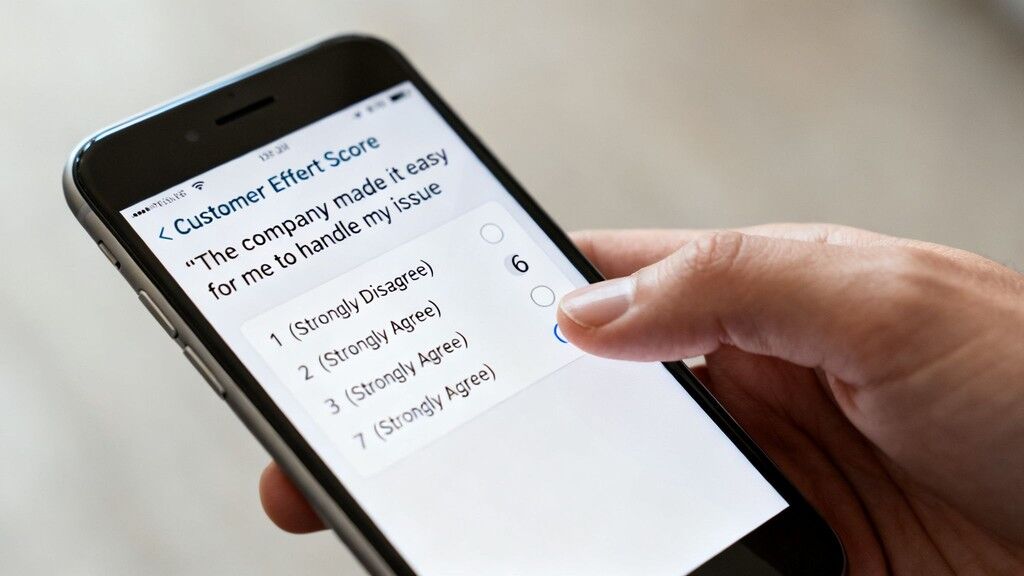
Getting started with Customer Effort Score is a lot simpler than you might think. The whole thing hinges on one simple idea: asking the right question at exactly the right moment. Forget those long, clunky questionnaires. CES is all about a single, direct query that gets straight to the heart of the matter.
The standard CES question isn't really a question at all. It's a statement that you ask customers to rate. This tiny shift is important—it puts the focus on your company's performance, not just the customer's feelings.
“The company made it easy for me to handle my issue.”
Customers respond on a 7-point scale, where 1 is "Strongly Disagree" and 7 is "Strongly Agree." This gives you a clear spectrum of how much friction they hit during that specific interaction.
The Simple Calculation
Don't worry, you won't need a statistics degree to figure out your score. The math is as straightforward as it gets.
Sum All Scores: Just add up the numerical value of every single response you've collected.
Count Responses: Tally up the total number of surveys people completed.
Divide to Find the Average: Divide the sum of the scores by the total number of responses. That's it.
Let's say you collect 100 responses and the scores add up to 550. Your CES is 5.5 (550 ÷ 100). The higher the number, the smoother the journey for your customers—and that’s exactly the goal.
The real trick is timing. You need to send this survey immediately after a key interaction—like a completed booking, a resolved support ticket, or right after checkout. This gives you clean, in-the-moment data you can actually use. If you wait, memories fade and the feedback gets fuzzy. For a closer look at crafting effective questions, you can find some helpful survey questions examples in our detailed guide.
This is how you start to collect smarter, not harder. With FeedbackRobot's Prompt to Survey feature, you can turn a basic idea into a perfectly worded CES survey in seconds. It takes the guesswork out of the equation, ensuring you ask the right thing every single time. That way, you're set up to get the high-quality insights you need to act faster and grow stronger.
Why CES Is Your Most Actionable Metric
While metrics like Net Promoter Score (NPS) and Customer Satisfaction (CSAT) have their place, Customer Effort Score gives you the most direct, actionable insights to fix your operations.
Think of it this way: NPS measures loyalty ("Will you recommend us?"), which is an outcome. CSAT measures emotion ("Were you satisfied?"). But CES measures the process ("Was it easy?").
A low CES score isn't just a sign of an unhappy customer; it's a bright, flashing arrow pointing to a broken process. It cuts through the ambiguity and tells you exactly why customers are getting stuck.
This directness makes CES incredibly powerful. It points a finger at a confusing menu, a slow check-in system, or a buggy payment page on your Toast integration. It shows you exactly where to invest your time and resources to make the biggest impact.
From Vague Feelings to Specific Fixes
Other metrics can leave you guessing. A low NPS might mean your prices are too high or your brand image is off. A poor CSAT score could be about anything from the lighting in your restaurant to an employee having a bad day.
CES cuts through that noise. It isolates friction points within specific moments of the customer journey.
A high-effort experience is one of the fastest ways to lose a customer. The data is stark: 96% of high-effort customers become disloyal, compared to just 9% of those who have a low-effort experience. Conversely, 94% of customers who find interactions easy intend to repurchase. Find more compelling data about why low-effort experiences drive loyalty on cleartouch.in.
This is where the FeedbackRobot Operating System becomes your command center for action. When a low CES score comes in, our platform doesn't just log it—it gets to work.
Radar provides unified review intelligence, pulling scores from all sources to show you if this is an isolated incident or a growing trend.
AI Summaries deliver instant insights & sentiment analysis from any open-ended comments, telling you why the effort was high.
The Resolutions Engine triggers automated service recovery, sending a personalized apology or alerting a manager to follow up, turning a negative moment into a chance to prove you care.
For any service business, reducing effort is one of the most reliable paths to loyalty. When customers trust that every interaction will be smooth and hassle-free, they have no reason to look elsewhere. To dive deeper into this topic, explore our comprehensive guide on the analysis of survey data.
This relentless focus on operational excellence is how you build a stronger, more resilient business.
Turning CES Insights Into Action
Collecting Customer Effort Score data is just the starting line. The real win comes from using those insights to systematically hunt down and eliminate friction in your customer's journey. This is where you turn numbers on a dashboard into tangible improvements for your business. You have to move from just measuring problems to actively solving them.
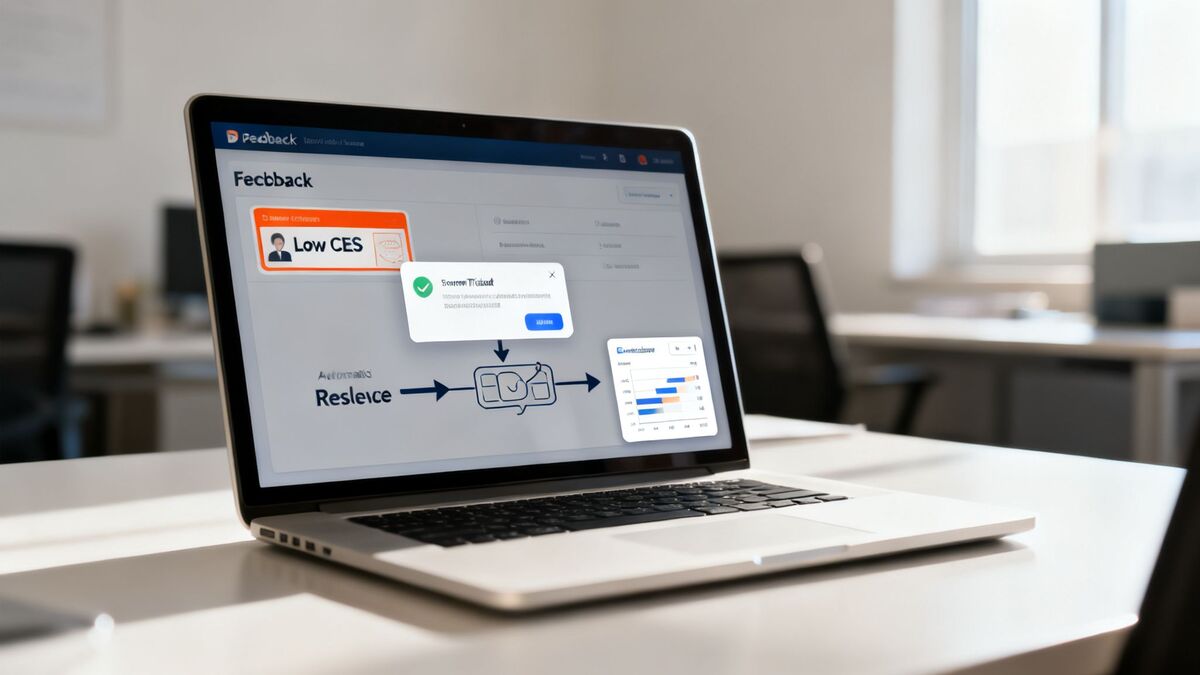
Imagine a guest gives you a low CES score after a frustrating online booking experience with your integrated Mews property management system. Without the right tools, that critical feedback might get buried in a spreadsheet. But with a Feedback Operating System, that single score triggers a powerful, automated response.
This is exactly how you start to act faster. You close the loop on bad experiences before they escalate, showing customers that their feedback isn't just collected—it's heard and immediately acted upon.
From Raw Data to Real-Time Resolution
FeedbackRobot turns a simple score into a golden opportunity for instant improvement. As soon as that low CES rating hits our system, a coordinated process kicks into gear to give you a complete, actionable picture.
First, our Radar feature immediately flags this negative trend. Think of Radar as your unified review intelligence hub—it pulls in data from all your review platforms like Google and TripAdvisor to show you if this is an isolated incident or part of a bigger problem. It provides context you’d never get from a single survey.
At the same time, our AI Summaries get to work on any open-ended comments the guest left. Instead of your team spending hours sifting through feedback, this feature gives you instant insights and sentiment analysis. It pinpoints the root cause in seconds—maybe the payment page was timing out, or the room selection tool was confusing.
This process transforms a vague complaint into a specific, fixable operational issue. You’re no longer guessing why a customer had a hard time; you know the exact point of friction that needs smoothing out.
Automating Service Recovery and Growth
The most crucial step is closing the loop, and this is where automation becomes your best friend. Even before a manager sees the alert, our Resolutions Engine jumps into action to start a service recovery workflow.
The Resolutions Engine is built for automated service recovery, letting you define actions based on specific feedback triggers. For that frustrated guest who struggled to book, it could:
Automatically send a personalized apology email that includes a discount code for a future stay.
Create a high-priority ticket for your IT or support team, complete with the AI-generated summary of the exact problem.
Alert the front desk manager to be ready for the guest's arrival, turning a potential negative review into a chance to really impress them.
This proactive approach doesn't just put out one fire; it builds a system for continuous improvement. By turning insights into immediate, intelligent action, you reduce friction, build loyalty, and prove to every customer that you’re committed to making their experience truly effortless. This is how you grow stronger.
Common CES Mistakes to Avoid
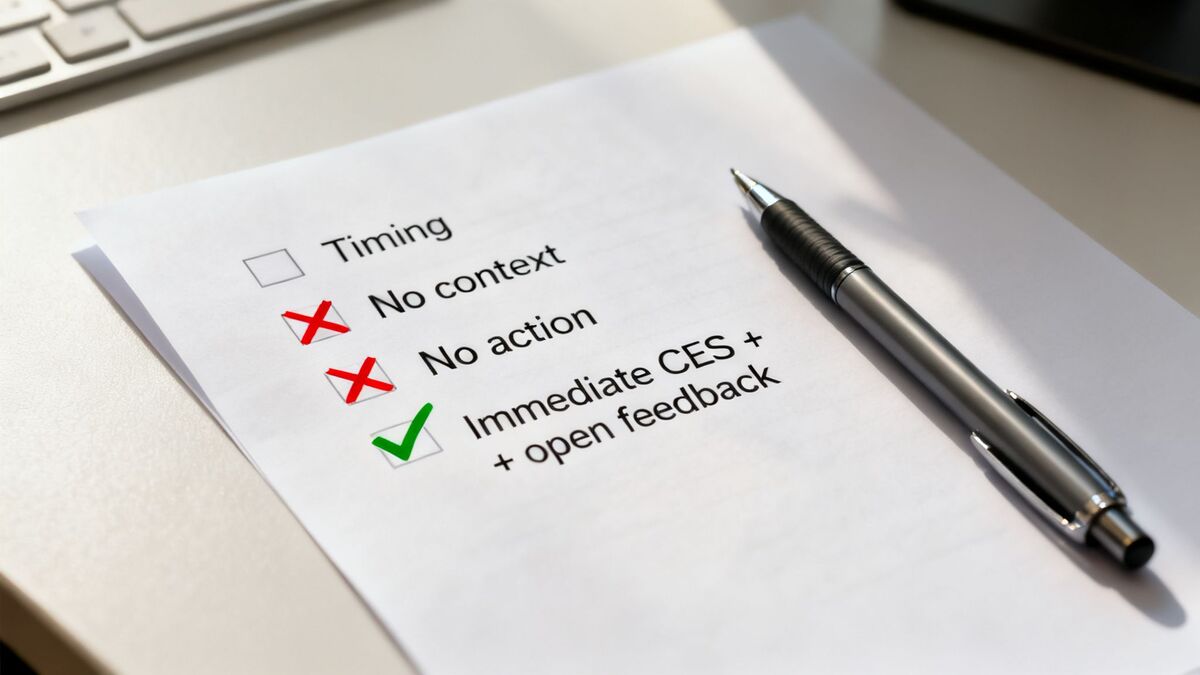
While Customer Effort Score is a powerful tool for sharpening your operations, a few common mistakes can completely undermine its value. Knowing what to watch for ensures you collect smarter data you can actually use.
The first major error is bad timing. If you ask a customer about the effort of a specific interaction days after it happened, you’ll only get hazy, unreliable feedback. Memories fade fast. You have to survey them immediately after the touchpoint.
Another frequent misstep is only collecting a number without getting the story behind it. A score tells you what happened, but you need the qualitative feedback to understand why.
Moving Beyond the Score
Simply knowing an interaction was "difficult" isn't enough to fix anything. You have to include an open-ended follow-up question, like, "What could we do to make that easier?" This is where the real gold is.
A CES score without context is just a number. It's the open-ended feedback that provides the roadmap for real, actionable improvements to your processes and training.
With FeedbackRobot, our AI Summaries feature processes all this qualitative feedback in real-time, giving you instant insights and sentiment analysis. You can spot patterns and root causes right away, without digging through hundreds of comments by hand.
The Biggest Mistake of All
The third mistake is using CES to measure the wrong thing. Remember, CES is for specific transactions, not the overall relationship. Use it to check the ease of a booking process or a support call, not their entire journey with your brand—that's what NPS is for.
Finally, the biggest pitfall is letting all this valuable data gather dust. Without a system to act on the feedback, you're just measuring problems instead of actually solving them.
This is exactly why a closed-loop system is so critical. Our Resolutions Engine provides automated service recovery, making sure every piece of negative feedback is assigned, tracked, and resolved. It turns your CES insights into tangible operational improvements, helping you act faster and grow stronger.
Start Reducing Customer Effort Today
Mastering Customer Effort Score isn't just about another metric—it's your first step toward building a smarter, more customer-friendly business. Loyalty isn't won with grand, one-off gestures. It's built in the trenches, through one consistently easy experience after another.
By focusing on CES, you can finally put a finger on the friction points that frustrate your customers and quietly chip away at your profits. To get started, you could implement solutions like understanding what is a queue management system, which is a fantastic way to streamline flow and cut down on those maddening waits.
Stop Guessing and Start Measuring
Ready to pinpoint exactly where your customers are struggling? It’s time to stop guessing and start measuring. With FeedbackRobot, you can get your first CES survey out the door in minutes and see actionable insights roll in almost immediately.
Our whole platform is designed to help you turn that feedback into fuel for growth. Instead of letting operational snags and frustrating processes define your brand, you can take back control and build a reputation for being smooth, easy, and reliable.
Don’t let another customer slip away just because their experience was harder than it needed to be. The faster you find and fix the friction, the faster you build the kind of loyalty that sticks around.
Turn Positive Feedback Into Social Proof
And with our new Spotlight: Feedback Wall feature, you can take your strategy a step further. Spotlight automatically showcases your best low-effort experiences, turning your happiest customers into powerful social proof. It attracts new business and builds trust from the very first impression.
It’s time to stop just collecting feedback and start putting it to work. Sign up for a free 14-day trial of FeedbackRobot today. No credit card required.
Collect smarter, act faster, and grow stronger.
Answering Your Top CES Questions
What Is a Good Customer Effort Score?
That's the million-dollar question, isn't it? But the honest answer is: it depends entirely on the scale you’re using.
If you're on the common 7-point scale, anything 5 or higher is generally a good sign. It tells you the experience was low-effort. But chasing a universal "good" number is a mistake. The only benchmark that truly matters is your own.
Your real goal shouldn't be to hit an industry average, but to consistently improve your score. Focus on finding and squashing friction for your customers, and your CES will naturally climb.
When Is the Best Time to Send a CES Survey?
Timing is everything with CES. You want to capture the feeling of effort (or ease) while it’s still fresh in the customer's mind.
Send the survey immediately after the interaction is over. This could mean:
The second a support chat ends.
Right after an online checkout is complete.
As a guest is checking out of your hotel.
Waiting even a few hours can blur the memory, leading to less accurate feedback. The closer you ask to the moment of effort, the better your data will be.
Can CES Replace NPS and CSAT?
Not quite. Think of them as a team, not competitors. Each one tells you something different, and together they give you the full picture of your customer experience.
CES is your go-to for measuring the ease of a specific task. Did we make it simple for them?
NPS zooms out to measure the overall brand relationship and long-term loyalty. Will they recommend us?
CSAT hones in on satisfaction with a single product or interaction. Were they happy with this one thing?
Using all three gives you a complete operational dashboard. You’ll know if your processes are easy, if your customers are happy, and if they’re likely to stick around.
What is Customer Effort Score (CES)?
CES measures how easy or difficult it was for a customer to interact with your business (e.g., 'To what extent do you agree that it was easy to book a table?'). It is a powerful predictor of loyalty.
Why is CES often more accurate than NPS?
While NPS measures 'Feeling,' CES measures 'Friction.' A customer might like your brand (NPS) but stop visiting because your booking process is too hard (CES). High friction is the #1 killer of repeat business.
How do I calculate my Customer Effort Score?
Ask: 'The company made it easy for me to handle my issue.' Use a 1-7 scale. Your score is the average of all responses. A higher number equals a 'lower effort' experience for the guest.
How can I use CES to improve my hospitality website?
Identify where guests 'drop off.' If they rate the 'Ease of finding info' low, your CES data tells you exactly which pages need a UX redesign to increase conversions.
Can CES help reduce my staff's support workload?
Yes. By identifying and fixing 'High-Effort' processes, you reduce the number of phone calls and emails guests have to send to get what they need, freeing up your team for in-person hospitality.
Stop reading about it. Let your agent handle it.
25 free AI actions · no credit card required
Start Free