How to Measure Customer Service the Right Way
Discover how to measure customer service with KPIs that matter. Move beyond basic surveys to gain actionable insights that build loyalty and fuel growth.

Feb 3, 2026 · 17 min read
Free tool
AI Survey Generator
Describe what you want to learn and get a ready-to-send survey in seconds.
You can't manage what you don't measure. For busy hospitality and service owners, this isn't just a business cliché—it's the absolute truth. It’s about shifting from gut feelings and anecdotal evidence to cold, hard data. Measuring your service means defining what success looks like, picking the right KPIs (like CSAT or NPS), and consistently gathering feedback to learn not just if your customers are happy, but why.
That's how you turn raw insights into real, measurable growth. That's how you collect smarter, act faster, and grow stronger.
Why Traditional Customer Service Metrics Fall Short
If you're a busy owner in hospitality, retail, or healthcare, guessing about customer happiness is a high-stakes game. You might feel like your team is delivering amazing service, but vague feelings don’t stop a single bad review from tanking your reputation overnight. This is where meaningful measurement flips the script, moving you from a reactive scramble to a proactive strategy.

Knowing how to measure customer service isn't just about chasing a high score. It's about uncovering the "why" behind every single interaction. Honestly, it’s the only way to turn one-time visitors into loyal advocates who actively champion your business.
Beyond Surface-Level Scores
Relying solely on an overall star rating from Google or a simple thumbs-up emoji gives you a dangerously incomplete picture. Sure, a 4-star review is decent, but what specific part of the experience kept it from being a 5-star? Was it the check-in wait time? The room temperature? A simple miscommunication with a staff member?
Without that context, you’re just guessing where to invest your time, money, and training. This guide gives you a practical framework to not only collect feedback but to turn it into your most powerful engine for growth.
Your feedback data shouldn't just sit in a spreadsheet. It should tell you exactly where your next dollar and your next minute of training will have the biggest impact on customer loyalty.
Take Customer Satisfaction (CSAT), for example. It's still the king of service metrics. Research shows that 76% of customer service teams actively measure CSAT scores, making it a cornerstone KPI. More importantly, 73% of business leaders report a direct link between their customer service quality and overall financial performance. The proof is right there: happy customers directly fuel your bottom line.
Connecting Feedback to Growth
The real breakdown for most businesses happens between collecting feedback and actually doing something with it. You don't just need data; you need a system that translates that data into immediate, actionable steps. This is where a proper Feedback Operating System becomes a non-negotiable.
Here’s how you bridge that gap:
Centralize Your Insights: Stop logging into a dozen different platforms. Imagine seeing all your reviews from Google, Yelp, and TripAdvisor in one clean dashboard. Our Radar feature gives you this unified review intelligence, saving you hours and instantly revealing trends you'd otherwise miss.
Automate Recovery: A bad experience doesn’t have to mean a lost customer. With our Resolutions Engine, you can automate service recovery. A low score can instantly trigger a personalized apology and an offer to make things right, showing customers you care before they post a damaging public review.
Get Instant Answers: Forget spending hours manually reading every single comment. AI Summaries delivers instant insights & sentiment analysis, telling you what customers are consistently praising or complaining about. This means you can act faster and get stronger.
By connecting these dots, you build a powerful feedback loop where every piece of customer input directly drives retention and sharpens your operations. A great next step is to dive deeper into the key customer retention metrics that this feedback powers.
Choosing KPIs That Actually Drive Business Growth
Not all metrics are created equal. You could easily drown in data, tracking dozens of numbers that don't really tell you anything useful. The real secret is to build a focused dashboard that tells the full, unvarnished story of your customer experience. This is how you move beyond vanity metrics and start measuring what truly matters.
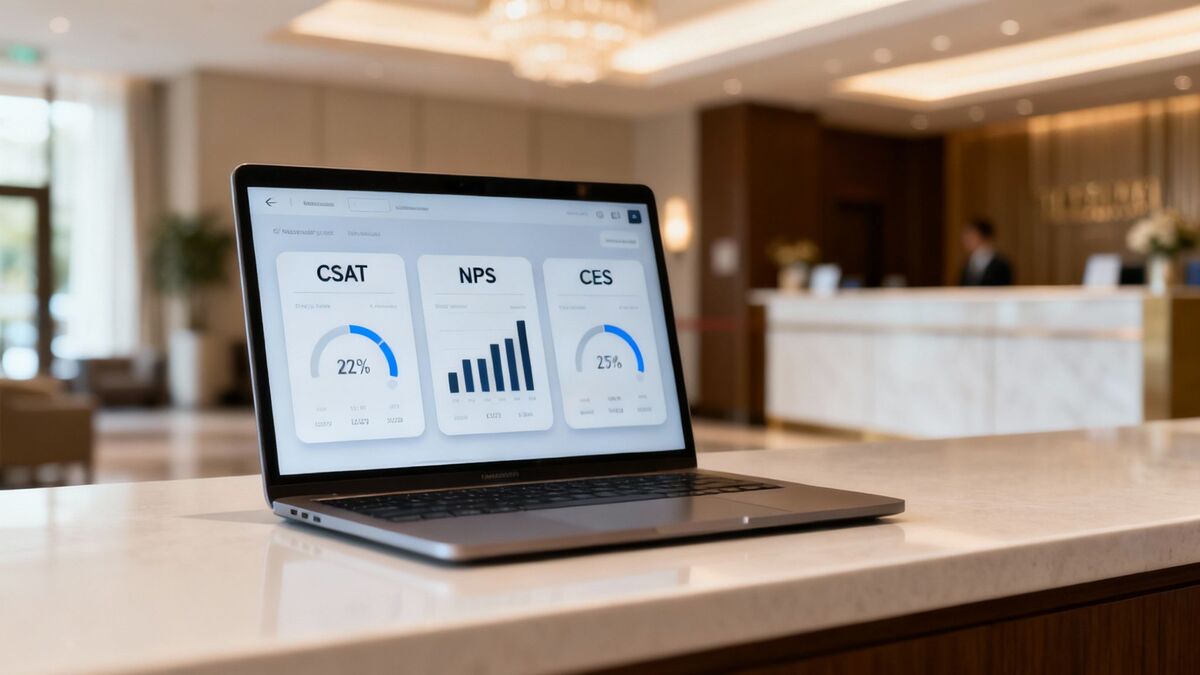
For busy service and hospitality owners, it’s all about balancing how customers feel with how your team is actually performing. You need both sides of the coin. This combination gives you a clear, at-a-glance view of your service health, letting you spot issues before they blow up and double down on what your team does best.
The Big Three: Customer Sentiment KPIs
To get a true read on what your customers are thinking, you have to start with these three core metrics. Each one tells a slightly different part of the story, and together, they paint a remarkably complete picture.
Customer Satisfaction (CSAT): This is your in-the-moment check-in. It’s usually asked as, "How satisfied were you with [your stay, your meal, your service] today?" and it’s brilliant for capturing immediate feelings about a specific interaction. A high CSAT score means you're nailing it right now.
Net Promoter Score (NPS): This metric is all about long-term loyalty. The classic "How likely are you to recommend us?" question sorts your customers into Promoters, Passives, and Detractors. Your NPS is a powerful predictor of future growth and tells you how strong your word-of-mouth marketing really is.
Customer Effort Score (CES): This KPI gets straight to the point: how easy are you to do business with? By asking, "How easy was it to resolve your issue today?" you immediately uncover friction. A low-effort experience is a massive loyalty driver; in fact, 94% of customers who have a low-effort interaction will buy from that same company again.
The smartest measurement strategies don't just pick one KPI. They blend CSAT, NPS, and CES to understand the immediate experience, long-term loyalty, and the operational friction that impacts both. This is how you get the complete picture.
Don't Forget Your Operational Metrics
While customer feelings are critical, you also need to measure how your team is performing behind the scenes. These operational KPIs have a direct and powerful impact on customer perception, even if the customer never sees the number itself.
Think about it. A restaurant guest waiting an eternity for their check or a hotel guest calling a front desk that never picks up—the speed and efficiency of your team's response shapes their entire experience.
Here are a few non-negotiable operational metrics to track:
First Response Time (FRT): How long does a customer have to wait for an initial reply after reaching out? A fast FRT shows you're attentive and that you value their time.
Average Resolution Time: This tracks the total time it takes to completely solve a customer's issue from the moment they report it. A lower number here means your team is efficient and effective at problem-solving.
Essential Customer Service KPIs at a Glance
To tie this all together, here’s a quick-reference table breaking down the most important metrics. Think of this as your starting lineup for building a world-class service dashboard.
KPI | What It Measures | Why It Matters for Your Business |
|---|---|---|
CSAT | Immediate satisfaction with a specific interaction or service. | Provides a real-time pulse check on daily operations and service quality. |
NPS | Long-term customer loyalty and willingness to recommend your brand. | Predicts future growth, repeat business, and the power of your brand's reputation. |
CES | The ease of a customer's experience when getting help or a resolution. | Directly impacts customer loyalty; reducing effort is a key driver of retention. |
FRT | The speed of your team's initial reply to a customer inquiry. | Shows attentiveness and respect for the customer's time, setting a positive tone. |
Resolution Time | The total time taken to fully resolve a customer's issue. | A direct measure of your team's efficiency and problem-solving capability. |
These five metrics give you a powerful, balanced view of both customer perception and internal performance.
To truly understand your service performance, it's essential to grasp how to measure customer satisfaction as the foundation of your strategy.
Putting all these metrics together can feel like a lot, but a centralized system makes it simple. With a tool like FeedbackRobot’s Radar, all your key metrics are pulled into one unified dashboard. You can see your CSAT, NPS, response times, and review trends from across the web in a single glance. It removes the guesswork and gives you the clarity to collect smarter, act faster, and grow stronger.
How to Collect Feedback Without Annoying Your Customers
The way you ask for feedback is just as important as the questions you ask. Your customers are busy people, and "survey fatigue" is a real problem. Push a long, clunky survey at the wrong time, and you risk damaging the very relationship you're trying to improve.

The trick is to make giving feedback a seamless, almost invisible part of their experience. You have to meet customers where they already are, using smart, low-effort ways to hear from them right in the moment.
This means moving beyond the generic "how was your stay?" email that lands in their inbox three days too late. It’s about being present and making it ridiculously easy for them to share their thoughts while the experience is still fresh. Knowing the right way to ask for customer reviews is key to getting responses without frustrating your patrons.
Meet Customers in Their Moment
Modern feedback collection isn't about sending a mass email blast and crossing your fingers. It’s about weaving the request into the natural flow of the customer’s journey. The opportunities are all around you—you just need to know where to look.
Here are a few practical examples I’ve seen work wonders:
For Restaurants: Pop a simple QR code on the table tent or at the bottom of the receipt. A quick scan can pull up a two-question survey about their meal and the service, all captured before they even walk out the door.
For Hotels: Set up an automated, mobile-friendly survey sent via SMS or email on the morning of checkout. The timing is perfect because their stay is top of mind.
For Retail: Print a survey link on the receipt that offers a small discount on their next purchase for completing it. This little incentive can dramatically boost your response rates.
The goal is to reduce friction to near zero. If a customer can give you valuable feedback in less than 30 seconds using the phone already in their hand, your chances of getting a response skyrocket.
Integrate and Automate Your Feedback Requests
The most powerful way to collect feedback is to tap into the systems you already use. Your Point of Sale (POS) or Property Management System (PMS) knows the exact moment a customer has checked out or paid their bill. Tying your feedback requests to these triggers is a total game-changer.
Think about it: a guest checks out of your hotel, and your Mews PMS automatically sends a personalized feedback request. Or a diner pays for their meal using your Toast POS, and a prompt for a quick rating pops up right on the screen. This is how you collect smarter. You're not guessing when to ask; you're using real-time data to ask at the perfect moment.
This is where a modern feedback platform becomes your best friend. With FeedbackRobot, you can turn a simple idea into a functional survey in seconds using our Prompt to Survey feature. This tool lets you just type an idea, like asking about a new menu special or the check-in experience, and our AI generates a survey ready to send via QR code, email, or SMS. You’ll never miss an opportunity to gather crucial insights again. You can discover more strategies on how to collect feedback from customers to sharpen your approach.
Turn Raw Feedback into Action-Ready Intelligence
Collecting feedback is just the start. The real magic happens when you turn that mountain of comments and ratings into something you can actually use. A flood of raw data is just noise without the right tools to analyze it quickly. This is where modern tech, especially AI, gives you a serious edge.
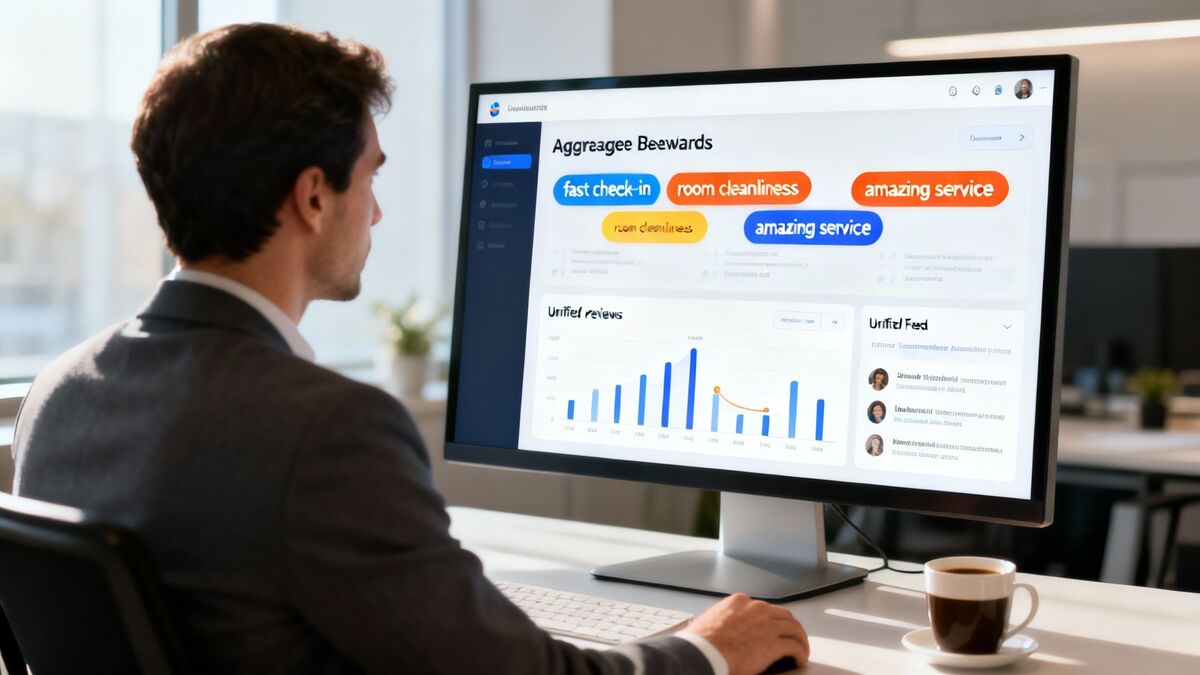
You have to stop spending hours manually sifting through reviews. It’s time to instantly understand the trends and feelings hidden within them. The goal is to shift from fighting individual fires to strategically fixing the root causes of service issues—saving you time and stopping problems from happening again.
Unify All Your Feedback Channels
Your customers aren't just leaving feedback on your surveys. They're on Google, TripAdvisor, Yelp, and social media. Hopping between all those platforms to piece together the full story is a massive time sink and a recipe for missing crucial insights.
The first step is bringing all that scattered data into one place.
This is exactly why we built Radar, our unified review intelligence feature. Radar pulls every piece of feedback—from your direct surveys to public review sites—into a single, easy-to-digest dashboard. No more logging into five different accounts just to see what’s going on. You get a complete, at-a-glance view of your brand’s reputation, helping you collect smarter and spot patterns you’d otherwise miss.
Let AI Do the Heavy Lifting
Once your feedback is in one place, the next challenge is making sense of it. Reading through thousands of individual comments to find common themes is an impossible task for any busy team. That manual approach is slow, biased, and just doesn't scale.
This is where AI analysis changes everything. Our platform’s AI Summaries feature provides instant insights & sentiment analysis. It digs through all your qualitative feedback—the written comments and reviews—and does the hard work for you.
You’ll immediately see what customers love, like your "fast check-in process" or "amazing server attentiveness." More importantly, you'll see exactly what needs work, such as "room cleanliness issues" or "long wait times on Saturday nights."
By automating the analysis, you get straight to the 'why' behind your scores. Instead of just knowing your CSAT dropped, you’ll know exactly what caused it, allowing you to act with precision.
This shift toward smarter measurement is happening across the entire service industry. In fact, 25% of global brands are expected to move from CSAT to Customer Effort Score (CES) as they seek more actionable metrics. And the payoff is real: early adopters of AI tools for customer experience are reporting a 128% higher ROI than other organizations. Looking ahead, 60% of service firms plan to supplement surveys with text and voice analytics. You can explore more about the proven power of customer experience.
From Insights to Action
Seeing these themes is one thing, but true intelligence connects those insights to real operational improvements. A great system doesn't just show you the data; it helps you make better business decisions because of it. For a deeper dive, check out our guide on the analysis of survey data.
Here’s how this plays out in the real world:
A Hotel Manager uses AI Summaries and sees a recurring theme of "slow elevator service." Instead of guessing, they now have hard data to justify prioritizing an elevator modernization project.
A Restaurant Owner notices Radar picking up multiple mentions of "cold coffee" from Google reviews. They can immediately check their equipment and retrain baristas, fixing a small problem before it damages their reputation.
This is what it means to be truly data-driven. You’re not just collecting scores; you’re building a system that turns customer voices into a clear roadmap for improvement. This is how you act faster and grow stronger.
Automate Service Recovery and Close the Loop
Ignoring negative feedback is one of the fastest ways to lose a customer for good. But here’s the flip side: research shows that a swift, effective resolution can actually create a fan out of someone who was just moments away from walking away unhappy.
The challenge for any busy team is closing this feedback loop consistently and at scale—which is pretty much impossible to do manually.
This is where automation becomes your secret weapon for service recovery. Instead of waiting for a manager to spot a bad review, you can build a system that acts instantly. It's about showing customers you genuinely care by fixing problems before they turn into those damaging one-star reviews that live on forever.
Build Your Automated Recovery Playbook
Automating your response doesn't mean sending out cold, robotic replies. It’s about creating smart, empathetic workflows that kick in the moment a customer expresses any dissatisfaction. This allows your team to act faster when every second counts.
This is exactly what the FeedbackRobot Resolutions Engine was built for. Think of it as your system for automated service recovery. It turns sour experiences into positive outcomes by letting you set the rules based on the feedback you get, and the engine handles the initial response. This buys your team the breathing room they need to dive in and solve the real issue.
Here’s how you can put this into practice:
Set a Trigger: First, define what kind of feedback needs immediate action. This could be a CSAT score below 3, a Net Promoter Score in the "Detractor" range (0-6), or even specific keywords like "dirty" or "rude" that our AI Summaries pick up.
Define the Action: Next, decide what happens. The Resolutions Engine can instantly create a high-priority ticket assigned to the right manager, log the issue for tracking, and send a personalized, empathetic email back to the customer.
Empower Your Team: That automated first touch acknowledges the issue and buys your team valuable time. The ticket that gets created has all the context they need to follow up with a genuine, human touch.
Imagine a guest leaves a 2-star CSAT score after their hotel stay. Instantly, the Resolutions Engine sends them an apology email with a 15% discount code for their next visit. At the same time, it alerts the front desk manager to investigate and follow up personally. That's how you turn a problem into a real opportunity.
Why Closing the Loop Matters
Failing to respond to feedback sends a crystal-clear message: you're not listening.
Closing the feedback loop, on the other hand, is one of the most powerful things you can do for customer loyalty. It shows you value your customers' opinions and are committed to making things better.
This isn’t just about making one person happy; it’s about protecting your brand’s reputation. A single unresolved complaint can quickly spiral into a public grievance on Google or TripAdvisor, scaring off countless potential customers. Automated service recovery is your first line of defense.
By systematizing your response to negative feedback, you make sure every customer feels heard and valued. This process reinforces the core idea of the service-profit chain—where better service quality directly leads to higher customer loyalty and, ultimately, more profit. You’re not just fixing problems; you’re investing in long-term relationships that fuel sustainable growth. This is how you grow stronger.
Turn Positive Feedback into Your Best Marketing
Measuring customer service isn't just about plugging leaks; it's about finding the fountains. Your best moments—the glowing reviews and five-star ratings—are incredible assets. But if they're just sitting on third-party sites, you're missing a huge opportunity. It’s time to put that hard-earned praise to work.
When you turn great customer experiences into compelling social proof, you complete the feedback loop. You've already used the data to get better. Now, you can use it to grow faster. Showcasing your best reviews across your website, social media, and marketing builds instant trust with potential customers before they even speak to you.
Showcase Your Success with a Feedback Wall
Making your customer success stories visible is one of the most powerful ways to build a rock-solid reputation. But manually curating testimonials for your website is a chore. It's time-consuming, and the content gets stale fast. A dynamic, automated display keeps your social proof fresh and, more importantly, trustworthy.
That’s why we’re so excited to introduce Spotlight: Feedback Wall. This new feature automatically pulls in and displays a live, trustworthy stream of your best customer testimonials right on your website.
Instead of just telling prospects you offer great service, let your happiest customers do it for you. A live feed of authentic, positive reviews is often the final piece of validation a new customer needs to choose you over a competitor.
The Spotlight: Feedback Wall makes it effortless to build on your positive momentum. It integrates seamlessly with our entire Feedback Operating System, pulling verified reviews captured through your surveys and our Radar intelligence hub.
By making customer praise a prominent part of your online presence, you create a virtuous cycle. Great service fuels powerful marketing, which brings in more customers to delight. This is the ultimate way to grow stronger.
Still Have Questions? Let's Clear Them Up.
Even with a solid plan, a few questions always pop up when you start measuring customer service. Here are some quick answers to the most common ones I hear from business owners.
How Often Should I Send Customer Feedback Surveys?
Honestly, it depends entirely on your business. For a busy cafe or retail shop, catching someone right after they pay is golden—a simple QR code on the receipt works wonders. If you're running a hotel, an automated email the day after checkout is pretty much the standard.
The cardinal rule? Don't annoy your customers. You're building a relationship, not just mining for data. Using a smart platform like FeedbackRobot lets you set rules to avoid pinging the same person over and over. That way, you get thoughtful responses without burning out your audience.
What’s a Good CSAT or NPS Score to Aim For?
This is a classic question, but fixating on universal benchmarks can be a trap. Sure, you'll see numbers thrown around—a CSAT score between 75-85% is often called "good," and an NPS score over 50 is considered "excellent." But those are just vanity metrics if they don't lead to action.
The only benchmark that truly matters is your own. The goal isn't to beat a national average; it's to get consistently better than you were last month.
This is where a tool like our Radar feature really shines. It helps you track your scores over time, so you can see your actual progress and celebrate real wins with your team.
How Can a Small Team Even Manage All This Feedback?
I get it. The idea of opening the feedback floodgates can feel overwhelming, especially for a small team. This is precisely where modern tech stops being a "nice-to-have" and becomes your most valuable player. An AI-powered system is designed to turn that potential data chaos into a clean, manageable stream of insights.
For example, our AI Summaries feature reads through all the written comments for you and instantly flags what's important. At the same time, the Resolutions Engine can automate service recovery by intelligently responding to negative feedback and creating follow-up tasks. It frees your people from tedious, manual work so they can focus on making the high-impact changes that actually move the needle. You really can collect smarter, act faster, and grow stronger, even with a lean team.
Ready to stop guessing and start measuring what matters? FeedbackRobot gives you the tools to turn every piece of customer feedback into measurable growth.
What are the core metrics for measuring customer service?
Focus on 'Response Time,' 'Resolution Rate,' and 'Net Promoter Score (NPS).' Together, these tell you how fast you are, how effective you are, and how much your customers trust you.
Is 'First Response Time' the most important metric?
It's critical. In modern service, customers expect an acknowledgment within minutes, not days. Fast responses de-escalate frustration and signal that you are a proactive business.
How do I measure the 'Quality' of my service, not just the speed?
Use sentiment analysis on your feedback comments. High scores are good, but 'delighted' words in the text comments are the true signal of high-quality service.
Should I benchmark my service against my competitors?
Yes. Knowing where you stand in your local market's 'Sentiment Ranking' helps you identify competitive advantages and areas where you are losing market share.
Should I benchmark my service against my competitors?
Yes. Knowing where you stand in your local market's 'Sentiment Ranking' helps you identify competitive advantages and areas where you are losing market share.
Stop reading about it. Let your agent handle it.
25 free AI actions · no credit card required
Start Free