Guest Feedback: How to Collect It + 12 Hotel Survey Examples (2026)
What guest feedback is, six ways hotels collect it, and 12 copy-paste survey examples for pre-arrival, in-stay, check-out and post-stay.

Dec 15, 2025 · 31 min read
Free tool
Likert Scale Generator
Generate custom rating scales and survey questions tailored to your feedback needs.
In the hospitality and service industries, guest feedback isn't just a "nice to have"—it's the engine that powers your growth. As a busy owner, you know collecting feedback is crucial, but the real challenge is asking the right questions at the right time. Generic surveys lead to low response rates and vague data, forcing you to guess what guests truly want. This leads to missed opportunities and costly operational mistakes. Your goal is to collect smarter, act faster, and grow stronger.
This guide moves beyond theory to deliver a comprehensive collection of guest feedback survey examples you can implement immediately. These are not just templates; they are strategic tools for hotels, restaurants, and service businesses, packed with questions designed to uncover meaningful, actionable insights. You won't just get a list of questions; you'll understand the objective behind each one, the ideal timing for deployment, and how to automate follow-up actions to close the loop effectively.
Our goal is to help you transform raw responses into a clear roadmap for improving guest satisfaction, loyalty, and your bottom line. By optimizing your survey structure and delivery, you can significantly boost engagement. To further refine your approach to gathering guest feedback, consider insights into enhancing the overall survey experience to ensure every touchpoint is seamless. This article provides the practical tools you need to stop guessing and start making data-driven decisions that foster sustainable growth.
While the 12 survey examples below provide a masterclass in feedback strategy, the highest-performing surveys in 2026 are those built for a specific operational goal. Instead of manually adapting a static template, describe your business to our free AI survey generators—whether it’s a ‘boutique mountain resort’ or a ‘high-volume urban bistro’—and get a targeted, ready-to-deploy survey in seconds.
What Is Guest Feedback and Why It Matters
Guest feedback is any information guests share about their stay — survey responses, online reviews, in-stay messages, and direct comments to staff — that a property uses to improve operations and reputation. It spans both solicited input (the surveys in this guide) and unsolicited signals (a TripAdvisor review, a complaint at the front desk), and the properties that improve fastest treat the two as one stream of intelligence rather than separate chores.
Why it matters comes down to three compounding effects:
Revenue: Review scores directly influence booking decisions and the rates you can charge — travelers filter by rating before they ever read a property description, so the feedback that shapes your rating shapes your revenue.
Reviews: Guests who are asked for feedback privately are far less likely to vent publicly. A mid-stay check-in catches the noisy air-conditioner while you can still fix it — before it becomes a 2-star review.
Repeat bookings: Guests who see their feedback acknowledged and acted on come back. Closing the loop — replying, fixing, following up — is what turns a one-time stay into a relationship.
How to Collect Guest Feedback: 6 Channels That Work
Every effective feedback program runs on a handful of channels, each catching guests at a different moment in the journey. These are the six that consistently work for hotels and hospitality operators — completion-rate benchmarks for each channel are in the distribution section at the end of this guide.
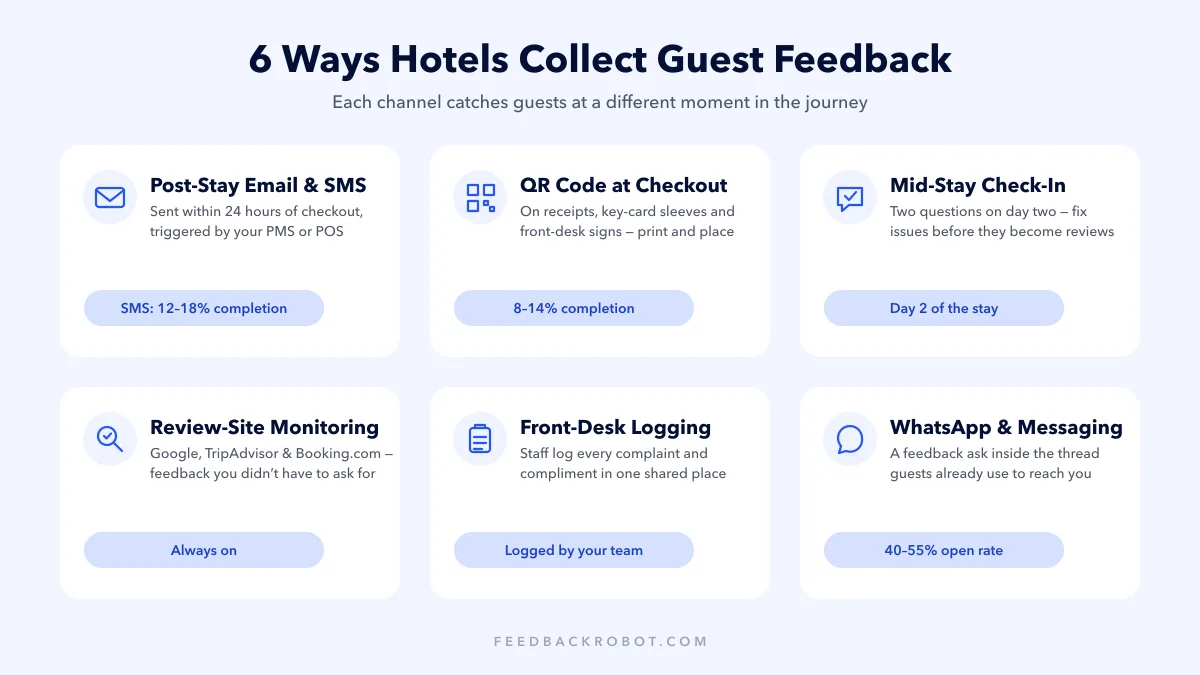
Post-stay email and SMS surveys. The workhorse channel: a short survey sent within 24 hours of checkout, ideally triggered automatically by your PMS or POS. SMS outperforms email on both open and completion rates, so use it wherever you have consent.
QR codes at checkout and on-premise. A code on the receipt, key-card sleeve, or front-desk sign catches guests in the moment, while the stay is freshest. It is also the cheapest channel to set up — print, place, done.
In-stay and mid-stay check-ins. A two-question message on day two (“How is your stay going? Anything we can take care of?”) is your last chance to fix a problem before it reaches a review site. Keep it to two or three questions maximum.
OTA and review-site monitoring. Google, TripAdvisor, and Booking.com reviews are guest feedback whether you asked for it or not. Monitor them as systematically as survey responses — they carry the exact language future guests will read.
Front-desk conversations logged by staff. Guests tell your team things they will never type into a form. A simple habit — staff logging every complaint and compliment in one shared place — turns hallway conversations into trend data.
WhatsApp and messaging. Where guests already message you for bookings and requests, a feedback ask in the same thread feels natural — and messaging channels post the highest open rates of any option in the benchmarks below.
How to Manage and Respond to Guest Feedback
Collection is only half the system. What separates properties that improve from properties that merely accumulate data is what happens in the 24–48 hours after feedback arrives:
Triage negative feedback within 24 hours. Route every low score and complaint to a named owner — front-office manager, housekeeping lead — with a deadline. Tools like FeedbackRobot’s automated service recovery can open and assign these tickets the moment a detractor score lands, so nothing waits for someone to check a spreadsheet.
Respond to public reviews — every negative one, and the standouts. Future guests read your responses as a preview of how you handle problems. Our negative review response examples show wording that de-escalates rather than argues.
Close the loop with the guest. Tell the guest what changed because of what they said — a short reply, a fixed issue, a follow-up on their next stay. It is the strongest signal you can send that feedback is worth giving, and it converts critics into repeat bookers more reliably than any discount.
1. Net Promoter Score (NPS) Survey: The Loyalty Barometer
The Net Promoter Score (NPS) is a cornerstone of experience measurement. It's a powerful yet simple metric that gauges guest loyalty with a single, crucial question: "On a scale of 0 to 10, how likely are you to recommend our [business/service/product] to a friend or colleague?" This is one of the most essential guest feedback survey examples because it provides a clear, universally recognized benchmark for customer sentiment.
Based on their score, guests are segmented into three categories: Promoters (9-10), who are your loyal brand advocates; Passives (7-8), who are satisfied but unenthusiastic; and Detractors (0-6), who are unhappy and pose a risk to your reputation. The final NPS score is calculated by subtracting the percentage of Detractors from the percentage of Promoters.
Strategic Breakdown
Objective: To measure overall customer loyalty and predict business growth. It's not about a single transaction but the entire brand relationship.
Ideal Timing & Channel: Send 24 hours post-checkout via SMS or email to capture a fresh, top-of-mind impression. This can be automated with Prompt to Survey, a feature that triggers surveys from your POS (like Toast) or PMS (like Mews).
Response Length: Ultra-short, typically 1-2 questions, which dramatically increases completion rates.
Sample NPS Survey Template
How likely are you to recommend [Your Company Name] to a friend or colleague?
Question Type: Numerical Scale (0-10)
(Conditional Logic) Based on your score, what is the primary reason for your rating?
Question Type: Open-Text
Note: This follow-up is critical. It provides the "why" behind the score, turning a simple number into actionable feedback.
Pro Tip: Use conditional logic to tailor the follow-up question. For Detractors, ask, "We're sorry we didn't meet your expectations. What could we have done better?" For Promoters, ask, "What did you love most about your experience?"
Activating Your NPS Feedback
Collecting the score is just the start. With a Feedback Operating System, you can automate your response and recovery. Set up triggers in the Resolutions Engine, our automated service recovery tool, to instantly create a ticket for any guest who leaves a Detractor score (0-6). This ensures no unhappy guest slips through the cracks, allowing your team to act fast and turn a negative experience around.
2. CSAT (Customer Satisfaction) Survey: The Transactional Snapshot
Where NPS measures overall loyalty, the Customer Satisfaction (CSAT) score zeroes in on the guest's happiness with a specific interaction or touchpoint. It typically asks, "How would you rate your overall satisfaction with [the service/product/experience]?" and uses a 1-5 or 1-7 scale. This makes it one of the most direct and versatile guest feedback survey examples for gauging immediate sentiment after a transaction.
CSAT is highly effective for isolating strengths and weaknesses in your operational chain. Whether it's the check-in process, a dining experience, or a support call, CSAT provides a clear, real-time pulse on performance. The score is calculated as the percentage of "satisfied" respondents (those who chose 4 or 5 on a 5-point scale).
Strategic Breakdown
Objective: To measure guest satisfaction with a specific, recent interaction or transaction. This helps identify and improve individual touchpoints in the customer journey.
Ideal Timing & Channel: Immediately after the interaction concludes. For a restaurant, this could be a QR code on the receipt. For a hotel, it might be an email sent within an hour of checkout.
Response Length: Very short, usually 3-5 questions to maximize completion rates while the experience is still fresh.
Sample CSAT Survey Template
Overall, how satisfied were you with your [check-in experience / recent meal / etc.]?
Question Type: Likert Scale (e.g., 1-5, Very Unsatisfied to Very Satisfied)
Please rate your satisfaction with the following:
Friendliness of our staff: Likert Scale (1-5)
Cleanliness of the facility: Likert Scale (1-5)
Value for your money: Likert Scale (1-5)
(Conditional Logic) Could you tell us a bit more about why you chose that rating?
Question Type: Open-Text
Note: This follow-up question is your key to unlocking specific, actionable insights.
Pro Tip: Keep your rating scale consistent across all CSAT surveys you deploy. This ensures you can accurately benchmark performance over time and across different departments or locations.
Activating Your CSAT Feedback
A low CSAT score is a direct signal of a service failure that needs immediate attention. Use the Resolutions Engine to create an automation that instantly opens a ticket for any guest who leaves a score of 1 or 2 ("Very Unsatisfied" or "Unsatisfied"). This ticket can be assigned to the relevant department manager, ensuring prompt follow-up and service recovery. This proactive approach shows guests you are listening and committed to fixing issues, which is crucial for preventing negative online reviews and customer churn.
3. Customer Effort Score (CES) Survey: The Friction Finder
The Customer Effort Score (CES) measures how easy it was for a guest to get their needs met. It operates on a simple premise: customers are more loyal to businesses that are easy to work with. The core question asks guests to rate the effort required to complete a specific task, such as making a booking, resolving a support issue, or checking out. This is one of the most practical guest feedback survey examples for pinpointing and eliminating friction in your customer journey.
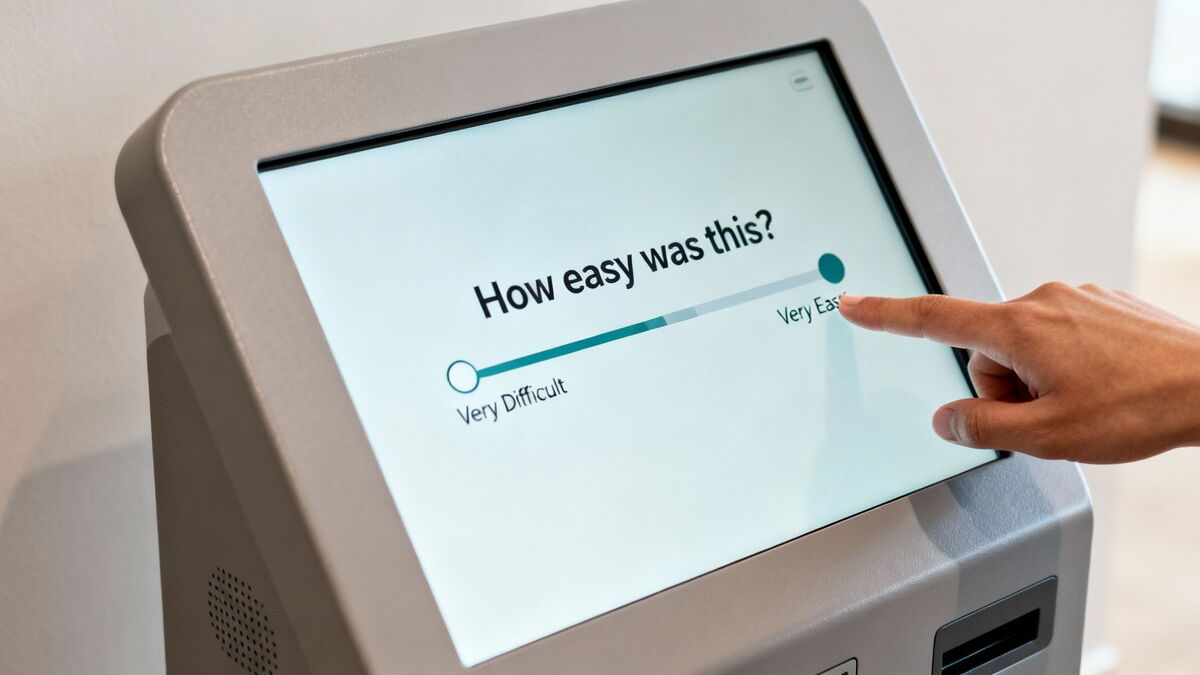
Unlike NPS, which gauges the overall relationship, CES focuses on the efficiency of a single, recent interaction. Businesses like Amazon use CES to streamline their checkout process, while service centers use it to measure the ease of issue resolution. A low-effort experience is a strong predictor of repeat business and positive word-of-mouth.
Strategic Breakdown
Objective: To identify and reduce customer effort at critical touchpoints, thereby increasing satisfaction and loyalty.
Ideal Timing & Channel: Immediately after a specific transaction or interaction. Use a Prompt to Survey trigger from your POS (like Toast) or booking system right after a payment is made or a support ticket is closed. Email, SMS, or an on-site tablet are effective channels.
Response Length: Very short, typically 2 questions, to capture feedback in the moment with minimal intrusion.
Sample CES Survey Template
To what extent do you agree or disagree with the following statement: [Your Company Name] made it easy for me to [handle my issue/complete my purchase].
Question Type: Likert Scale (Strongly Disagree to Strongly Agree)
(Conditional Logic) What could we have done to make it even easier for you?
Question Type: Open-Text
Note: This follow-up question is your roadmap for improvement, directly highlighting process flaws or friction points.
Pro Tip: Avoid generic CES questions. Be specific about the interaction you're measuring. Instead of "How was your experience?" ask, "How easy was it to make a reservation on our website today?"
Activating Your CES Feedback
High effort is a red flag for potential customer churn. Configure the Resolutions Engine to automatically flag any "Difficult" or "Strongly Disagree" response and create a task for a manager to review the interaction. This allows your team to understand the friction point and follow up with the guest personally. Over time, use AI Summaries to analyze open-text feedback from high-effort scores. This feature provides instant insights and sentiment analysis, helping you spot trends and prioritize process improvements that will have the biggest impact.
4. SERVQUAL (Service Quality) Survey: The Diagnostic Tool
The SERVQUAL survey is a comprehensive research instrument designed to measure service quality by comparing guest expectations against their actual perceptions. It breaks down the service experience into five distinct dimensions: Reliability (dependable and accurate service), Assurance (knowledge and courtesy of staff), Tangibles (physical facilities and appearance), Empathy (caring, individualized attention), and Responsiveness (willingness to help promptly). This is one of the most in-depth guest feedback survey examples for identifying specific service gaps.
Developed by Parasuraman, Zeithaml, and Berry, this model asks guests a series of paired questions for each dimension. The first question gauges their expectation of an excellent service provider, while the second measures their perception of your specific business. The "gap" between these two scores reveals precise areas for operational improvement.
Strategic Breakdown
Objective: To conduct a deep diagnostic of service quality across multiple dimensions and pinpoint the largest gaps between customer expectations and performance.
Ideal Timing & Channel: Best deployed annually or bi-annually via a dedicated email campaign. Due to its length, it's not suited for immediate post-experience feedback but for strategic planning.
Response Length: Comprehensive, typically 22 paired questions plus demographics. Incentivizing completion with a small offer can boost response rates.
Sample SERVQUAL Survey Template
(Example questions for the "Responsiveness" dimension)
Expectations: Excellent companies will provide prompt service to their customers.
Question Type: Likert Scale (1-7, Strongly Disagree to Strongly Agree)
Perceptions: [Your Company Name] provides prompt service to its customers.
Question Type: Likert Scale (1-7, Strongly Disagree to Strongly Agree)
Expectations: Employees of excellent companies are always willing to help customers.
Question Type: Likert Scale (1-7, Strongly Disagree to Strongly Agree)
Perceptions: Employees at [Your Company Name] are always willing to help you.
Question Type: Likert Scale (1-7, Strongly Disagree to Strongly Agree)
Pro Tip: Don't just look at the overall gap score. Analyze the gaps within each of the five dimensions. A large gap in "Tangibles" might require capital investment, while a gap in "Responsiveness" points to a need for staff training.
Activating Your SERVQUAL Feedback
While SERVQUAL is a strategic tool, its insights can fuel immediate action. Use AI Summaries within your Feedback Operating System to analyze open-text comments related to the dimensions with the largest gaps. For instance, if "Reliability" is your weakest area, this instant insights & sentiment analysis feature can identify recurring themes like "late appointments" or "incorrect orders," giving you a clear, data-backed mandate for operational changes.
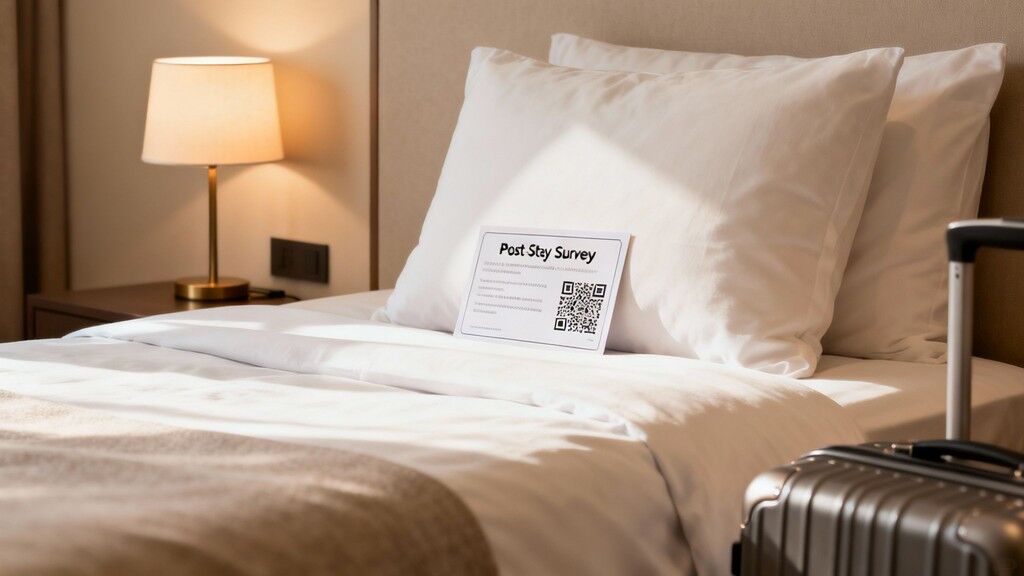
5. Post-Stay Hotel Survey: The Operational Deep Dive
While NPS measures overall loyalty, the Post-Stay Hotel Survey is designed to dissect the guest experience piece by piece. This multi-dimensional survey delves into specific touchpoints like check-in, room cleanliness, staff service, and amenities. It is one of the most crucial guest feedback survey examples for hoteliers because it provides a detailed operational roadmap for improvement, pinpointing exact areas that delighted or disappointed a guest.
Leading brands like Marriott Bonvoy and Hilton Honors have perfected this approach, using detailed feedback to maintain brand standards across thousands of properties. This survey moves beyond a single score to create a comprehensive performance review of your entire operation, from the front desk to housekeeping.
Strategic Breakdown
Objective: To gather granular, actionable feedback on specific operational areas (e.g., room comfort, staff helpfulness, amenity quality) to drive targeted improvements.
Ideal Timing & Channel: Send via email within 24 hours of checkout to ensure the stay is still fresh in the guest's mind. Including the room number in the survey data is critical for tracking issues to a specific location or staff member.
Response Length: Medium, typically 6-12 questions. Offering a small incentive, like loyalty points or a future discount, can significantly boost completion rates.
Sample Post-Stay Hotel Survey Template
Overall, how satisfied were you with your stay at [Hotel Name]?
Question Type: 5-Point Scale (Very Dissatisfied to Very Satisfied)
Please rate the following aspects of your stay:
Question Type: Matrix/Rating Scale (Poor, Fair, Good, Excellent)
Items: Check-in process, Room cleanliness, Comfort of bed, Staff friendliness, Wi-Fi quality, F&B services.
Did you use any of our amenities (e.g., pool, gym, spa)? If so, please rate your experience.
Question Type: Conditional Logic with Rating Scale
On a scale of 0-10, how likely are you to recommend our hotel to others?
Question Type: Numerical Scale (NPS)
Is there anything our team could have done to make your stay more memorable?
Question Type: Open-Text
Pro Tip: Don't just analyze individual answers. Use a platform with AI Summaries to instantly process all open-text comments, identifying recurring themes like "slow check-in" or "excellent breakfast" without manual reading.
Activating Your Post-Stay Feedback
This detailed feedback is only valuable if acted upon swiftly. Integrate your survey tool with your PMS (like Mews) to automatically trigger these surveys post-checkout. Then, configure the Resolutions Engine to create and assign tickets based on specific low scores. For example, a rating of "Poor" for "Room Cleanliness" can automatically generate a task for the head of housekeeping to inspect the room and follow up with the guest. This automated, closed-loop system ensures no detail is missed. Learn more about the best practices with hotel guest feedback software.
6. Restaurant Guest Feedback Form: The In-the-Moment Insight
The Restaurant Guest Feedback Form is a classic yet highly effective tool for capturing immediate, in-the-moment impressions of the dining experience. Unlike post-visit surveys, this method gathers feedback while the details of the meal, service, and ambiance are still fresh. This is one of the most direct guest feedback survey examples, allowing operators to evaluate food quality, service speed, cleanliness, and overall value right at the source.
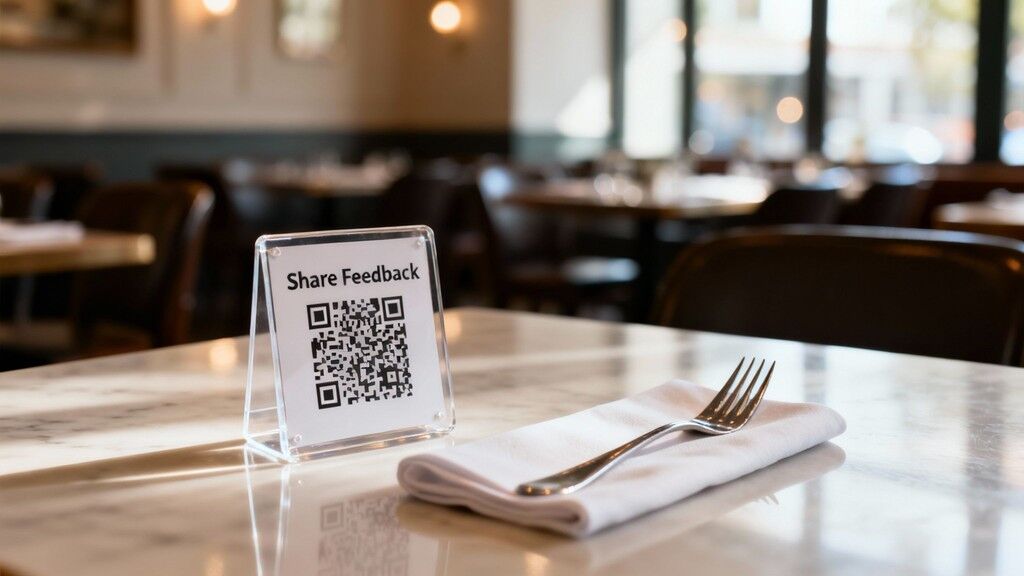
These forms have evolved from simple paper cards to sophisticated QR code-based digital surveys on guest receipts or tabletop signs, as seen with chains like Chipotle and Panera. They provide a frictionless way for diners to share their thoughts before they even leave the building, giving you a chance to address issues instantly.
Strategic Breakdown
Objective: To gather granular, real-time feedback on key aspects of the dining experience, from the first greeting to the final bite.
Ideal Timing & Channel: On-premise, delivered via QR codes on tables, menus, or receipts, or through tabletop tablets at the end of the meal.
Response Length: Very short, ideally 5-7 questions to maximize completion rates during the busy checkout process.
Sample Restaurant Guest Feedback Template
How would you rate the quality of your food today?
Question Type: Star Rating (1-5 Stars)
How would you rate the service you received from our team?
Question Type: Star Rating (1-5 Stars)
Please rate the cleanliness and ambiance of our restaurant.
Question Type: Star Rating (1-5 Stars)
How likely are you to dine with us again?
Question Type: Numerical Scale (0-10)
Is there anything our team could have done to make your experience better?
Question Type: Open-Text
Pro Tip: Offer a small, instant incentive for completion, such as a 10% discount on their next visit or a free dessert. This small gesture can significantly boost your response rates and encourage repeat business. Learn more about how a dedicated restaurant customer feedback tool can automate this process.
Activating Your Restaurant Feedback
Real-time feedback demands a real-time response. Configure the Resolutions Engine to create an urgent ticket for your on-duty manager the moment a guest submits a poor rating (e.g., 1 or 2 stars) on service or food quality. This allows the manager to address the issue table-side, potentially turning a negative review into a positive recovery story before the guest even walks out the door.
7. Airline/Travel Guest Satisfaction Survey
The travel experience is a complex journey with multiple touchpoints, from the initial booking to baggage claim. An Airline/Travel Guest Satisfaction Survey is designed to dissect this journey, capturing detailed feedback on each distinct phase. This is one of the more comprehensive guest feedback survey examples, as it allows operators like United Airlines or Expedia to pinpoint specific friction points and moments of delight across the entire guest lifecycle.
By breaking down the experience into segments like booking, check-in, in-flight service, and arrival, travel companies can gather granular data. This allows for precise operational improvements, whether it's streamlining the boarding process, enhancing onboard amenities, or improving the baggage handling system. It moves beyond a single satisfaction score to provide a holistic performance review.
Strategic Breakdown
Objective: To evaluate guest satisfaction across the entire travel journey, identify operational strengths and weaknesses at specific touchpoints, and gather feedback to improve service quality and loyalty.
Ideal Timing & Channel: Send via email or a push notification from the airline's app within 24-48 hours of arrival. This timing is crucial for capturing accurate details while the trip is still fresh in the traveler's mind.
Response Length: Medium, typically 5-10 questions. It needs to be comprehensive enough to cover the journey but short enough to avoid survey fatigue.
Sample Airline/Travel Survey Template
Overall, how satisfied were you with your recent trip on [Airline Name/Travel Company]?
Question Type: Star Rating (1-5)
Please rate your satisfaction with the following aspects of your journey:
Question Type: Matrix/Likert Scale (Very Dissatisfied to Very Satisfied)
Booking Process
Check-in Experience
Boarding Process
In-Flight Crew Service
Aircraft Cleanliness & Comfort
Baggage Handling
On a scale of 0 to 10, how likely are you to recommend [Airline Name] to a friend or colleague?
Question Type: Numerical Scale (NPS)
Do you have any specific feedback about the crew, aircraft, or any other part of your experience?
Question Type: Open-Text
Pro Tip: Segment your survey questions based on the guest's travel details. Use data you already have, like their fare class (Economy, Business) or loyalty status, to ask more relevant questions about their specific experience, such as lounge access or priority boarding.
Activating Your Travel Feedback
The detailed nature of this survey provides a wealth of structured and unstructured data. Use AI Summaries to instantly analyze open-text feedback and identify recurring themes, such as "delayed baggage" or "friendly crew on flight UA456." This turns thousands of comments into clear, actionable insights. For negative ratings on critical touchpoints like baggage handling, set up a Resolutions Engine trigger to automatically create a high-priority ticket for your support team to investigate and follow up with the guest, potentially offering loyalty points to recover the relationship.
8. Retail Store Experience Survey: Capturing In-Store Sentiment
The Retail Store Experience Survey is designed to capture immediate feedback on a customer's physical shopping journey. From store cleanliness and layout to staff helpfulness and product availability, this survey zeroes in on the tangible elements that define a brick-and-mortar visit. This is one of the most vital guest feedback survey examples for retailers because it provides a direct line of sight into operational performance at the store level.
Brands like Target, Home Depot, and Ulta Beauty use these surveys, often triggered by a receipt or a QR code at checkout, to gather a high volume of location-specific data. This feedback is crucial for identifying training opportunities, optimizing store layouts, and ensuring product merchandising meets customer expectations.
Strategic Breakdown
Objective: To measure and improve key aspects of the in-store customer experience, including staff performance, store environment, and checkout efficiency.
Ideal Timing & Channel: Immediately post-purchase. Deploy via QR codes at registers, on receipts, or through an SMS or email sent by a Prompt to Survey trigger connected to your POS system.
Response Length: Medium, typically 5-8 questions to cover key touchpoints without causing survey fatigue.
Sample Retail Store Experience Survey Template
How would you rate the overall cleanliness and organization of our store today?
Question Type: Star Rating (1-5)
Were you able to easily find everything you were looking for?
Question Type: Yes/No
How would you rate the helpfulness and friendliness of our staff?
Question Type: Star Rating (1-5)
Please rate your checkout experience regarding speed and efficiency.
Question Type: Likert Scale (Very Unsatisfied to Very Satisfied)
Is there anything we could do to improve your in-store experience?
Question Type: Open-Text
Pro Tip: Offer a small incentive for completion, such as entry into a gift card drawing or loyalty points. Train your cashiers to actively mention the survey during checkout to significantly boost response rates.
Activating Your Retail Feedback
In-store feedback requires a rapid response. For any low ratings on staff helpfulness or checkout experience, use the Resolutions Engine to automatically create a ticket and assign it directly to the relevant store manager. This empowers local leadership to address issues like long queues or staff training gaps in near real-time, preventing small problems from becoming widespread reputation issues.
9. Event and Venue Feedback Survey: Capturing the Post-Event Buzz
From corporate conferences to once-in-a-lifetime weddings, events are complex experiences with many moving parts. An event and venue feedback survey is a critical tool for organizers and venue managers to evaluate everything from registration and organization to catering and overall atmosphere. This is one of the most vital guest feedback survey examples for understanding attendee satisfaction and securing future bookings.
This survey aims to capture a holistic view of the guest experience, identifying both standout successes and areas for improvement. Feedback can be used to refine future events, share performance data with vendors (like caterers or A/V teams), and generate testimonials for marketing.
Strategic Breakdown
Objective: To measure attendee satisfaction across all key touchpoints of an event, including organization, venue, content, and amenities, in order to improve future offerings.
Ideal Timing & Channel: Deploy a QR code at the event exit for immediate feedback, or send an email/SMS survey within 24 hours while the experience is still fresh.
Response Length: Medium, typically 5-10 questions. Balance detail with the need to respect the attendee's time.
Sample Event and Venue Survey Template
Overall, how satisfied were you with your experience at [Event Name]?
Question Type: Customer Satisfaction (CSAT) Scale (1-5, Very Dissatisfied to Very Satisfied)
Please rate the following aspects of the venue: (Location, Cleanliness, Ambiance, Staff Friendliness)
Question Type: Matrix/Rating Scale
How would you rate the quality of the catering/food and beverage?
Question Type: Star Rating (1-5)
(Conditional Logic) For conferences/corporate events: Please rate the relevance and quality of the sessions/speakers.
Question Type: Matrix/Rating Scale
What was the most memorable part of your experience?
Question Type: Open-Text
How likely are you to recommend [Venue Name/Event Series] to a friend or colleague?
Question Type: Net Promoter Score (NPS) Scale (0-10)
Pro Tip: Offer a small incentive for completion, such as entry into a prize drawing or a discount on a future event ticket. This can significantly boost response rates for longer surveys.
Activating Your Event Feedback
Don't let valuable feedback sit unread. Use AI Summaries to instantly analyze open-text responses, identifying common themes like "confusing signage" or "excellent keynote speaker." For any guest who leaves a low satisfaction or Detractor score, a trigger in the Resolutions Engine can automatically create a ticket, alerting your event manager to follow up personally. This rapid response demonstrates a commitment to guest experience and can help retain attendees for future events. Learn more about how to enhance the event and entertainment experience with a dedicated feedback system.
10. Spa and Wellness Facility Survey: Gauging Tranquility and Treatment Quality
For businesses centered on relaxation and rejuvenation, feedback must go beyond standard service metrics. The Spa and Wellness Facility Survey is a specialized tool designed to evaluate every sensory detail of the guest journey, from the ambiance of the waiting area to the skill of the therapist. This is one of the most nuanced guest feedback survey examples, as it measures both the technical execution of a service and the emotional outcome of the experience.
This survey helps operators understand satisfaction with staff expertise, facility cleanliness, treatment effectiveness, and the overall environment. By dissecting the experience, you can pinpoint specific drivers of guest satisfaction, whether it's the comfort of the massage table or the playlist in the relaxation lounge.
Strategic Breakdown
Objective: To gather detailed feedback on both service delivery (therapist skill, professionalism) and environmental factors (cleanliness, ambiance, comfort) that contribute to the guest's sense of well-being.
Ideal Timing & Channel: Send via email or SMS within 3-6 hours post-treatment. This allows the guest time to fully appreciate the benefits of their service while the details are still fresh.
Response Length: Medium, typically 6-8 questions to cover key aspects without causing fatigue.
Sample Spa and Wellness Survey Template
How would you rate the overall quality of your [Treatment Name] experience today?
Question Type: Star Rating (1-5)
Please rate the following aspects of our facility:
Cleanliness
Ambiance and Atmosphere
Comfort of the Treatment Room
Question Type: Matrix/Likert Scale (Poor to Excellent)
How would you rate the professionalism and expertise of your therapist, [Therapist Name]?
Question Type: Star Rating (1-5)
(Optional) Please provide any specific feedback for [Therapist Name].
Question Type: Open-Text
Note: Frame this to be constructive. Feedback is shared privately with management.
How likely are you to recommend our spa to a friend or colleague?
Question Type: Numerical Scale (0-10)
Pro Tip: Integrate your booking system with Prompt to Survey to automatically send this survey and dynamically insert the specific treatment and therapist name. Personalization like this shows you value the guest's individual experience and significantly boosts response rates.
Activating Your Wellness Feedback
Spa feedback can be highly personal and sensitive, especially if it involves a specific staff member. Use the Resolutions Engine to create an automated workflow that flags any rating for a therapist below 3 stars. This trigger should create a high-priority ticket assigned directly to the spa manager for immediate and discreet follow-up, protecting both guest privacy and staff morale while ensuring service excellence.
Comparison of the 10 Core Guest Feedback Surveys
Survey Template | Implementation complexity | Resource requirements | Expected outcomes | Ideal use cases | Key advantages |
|---|---|---|---|---|---|
Net Promoter Score (NPS) Survey | Very low — single question + optional follow-up | Minimal time and analysis; easy distribution | High-level loyalty metric; benchmarkable trend data | Hotels, restaurants, airlines, retail, guest-facing businesses | Simple, scalable, predictive of growth |
CSAT (Customer Satisfaction) Survey | Low — 1–5 short items | Low effort to collect and analyze; quick turnaround | Immediate satisfaction scores; problem spotting | Hotels, restaurants, retail stores, quick-service businesses | Direct measure of satisfaction; easy to report |
CES (Customer Effort Score) Survey | Low — single effort-focused question | Minimal collection cost; actionable for ops teams | Identifies friction; strong predictor of retention | Check-in, customer service, complaint resolution, booking systems | Highlights process pain points; actionable improvements |
SERVQUAL (Service Quality) Survey | High — 22 items across five dimensions | Higher survey fatigue; advanced analysis and benchmarking | Detailed gap analysis across service dimensions | Luxury hospitality, healthcare, financial services, quality programs | Comprehensive, validated, identifies specific service gaps |
Post-Stay Hotel Survey | Medium — multi-dimensional hotel-specific | Moderate time to complete and analyze; may use incentives | Operational feedback on rooms, staff, amenities; trend tracking | All hotel categories, resorts, extended-stay properties | Granular hotel insights; actionable for operations and staff |
Restaurant Guest Feedback Form | Low–Medium — focused dining questions | Low cost (paper/QR/tablet); quick responses | Immediate fixes for food, service, cleanliness issues | Fine dining, casual, fast-casual, cafes | Timely in-experience feedback; high completion potential |
Airline/Travel Guest Satisfaction Survey | Medium–High — multi-touchpoint questionnaire | Moderate to high effort; cross-department coordination | End-to-end journey insights; touchpoint pain points | Airlines, travel platforms, airports, travel agencies | Captures full travel journey; actionable across teams |
Retail Store Experience Survey | Low–Medium — store visit focused | Low cost; QR/email/SMS deployment; possible incentives | Store-level issues, staff performance, checkout friction | Department stores, specialty retailers, supermarkets | Rapid deployment; useful for in-store improvements |
Event and Venue Feedback Survey | Medium — event-specific multi-item survey | Onsite digital setup or post-event email; moderate analysis | Attendee satisfaction, vendor and logistic feedback | Conferences, weddings, trade shows, festivals, venues | Comprehensive attendee insights; supports future planning |
Spa and Wellness Facility Survey | Medium — service and outcome focused | Moderate resources; private feedback options recommended | Treatment effectiveness, therapist performance, retention signals | Day spas, medical spas, fitness centers, wellness retreats | Balances technical and soft-quality feedback; therapist tracking |
Turn Your Feedback into Fuel: It's Time to Act
You now have a playbook of expert-vetted guest feedback survey examples, from the loyalty-gauging NPS to detailed operational forms. These templates are your starting point, but the real power isn't just in asking the questions; it's in what you do with the answers. Simply collecting data creates a feedback graveyard where valuable comments are forgotten. To win, you must build a living feedback loop where guest voices directly shape your operations and fuel your growth. This is how you collect smarter, act faster, and grow stronger.
The goal is to move beyond individual surveys and build a cohesive Feedback Operating System. A post-stay hotel survey isn't just a form; it’s a trigger for service recovery and staff recognition. A restaurant QR code survey is more than a rating; it’s a real-time pulse on your menu and service quality.
Your Blueprint for Actionable Insight
To truly operationalize guest feedback, you need more than just templates; you need a system that turns raw data into strategic fuel. This is where a dedicated platform makes all the difference:
Radar: Your feedback doesn't just come from surveys. Radar is our unified review intelligence feature that brings reviews from Google, TripAdvisor, and other public sites into one dashboard alongside your direct survey feedback. This gives you a 360-degree view of your brand reputation.
Prompt to Survey: Turn your existing systems into feedback machines. Our Prompt to Survey feature integrates with your PMS (like Mews) or POS (like Toast) to automatically send the right survey at the right time—for example, right after a guest checks out or pays their bill.
AI Summaries: Instead of manually reading hundreds of open-ended responses, AI Summaries provides instant insights and sentiment analysis. You'll immediately know that "long checkout lines" and "helpful staff" are your top themes, without spending hours on manual work.
Resolutions Engine: A negative score shouldn't be just a data point. The Resolutions Engine is our automated service recovery tool that can instantly create a ticket for your manager, send a personalized apology to the guest, and track the issue to completion, turning a detractor into a loyal advocate.
Ultimately, the goal of collecting and analyzing feedback is to implement effective strategies to increase repeat business and cultivate a loyal customer base. By systematizing your approach, you transform feedback from a reactive chore into a proactive engine for continuous improvement and sustainable growth. The examples in this guide are your building blocks; now it's time to construct your feedback-driven future.
Ready to turn these examples into a powerful, automated feedback engine? FeedbackRobot provides all the tools you need—from customizable surveys and AI-powered analytics to automated service recovery. Stop guessing what your guests want and start making data-driven decisions.
Generate your Boutique Hotel Guest Experience Survey.
Guest Journey Survey Templates: Right Question, Right Moment
The best guest feedback comes from asking at the right point in the journey, not just at check-out. Each touchpoint reveals a different type of problem — and gives you a different window to fix it in real time.
Pre-Arrival Survey Template
Sent 24–48 hours before check-in via email or SMS. Goal: personalise the stay, flag any special needs, set expectations.
Sample questions:
Is there anything we can prepare for your arrival? (e.g. early check-in, dietary requirements, occasion)
How did you hear about us?
Is this your first stay with us?
What is the primary purpose of your visit? (Business / Leisure / Special occasion)
Any accessibility requirements we should be aware of?
Why it works: Guests who are asked before arrival report higher satisfaction scores — even when nothing changes. The act of asking signals you care. You also capture flags you can act on before they become complaints.
In-Stay Survey Template (Mid-Stay Check-In)
Sent on day 2 of a 3+ night stay, or at the halfway point of longer stays. Goal: catch and resolve issues before the guest checks out — and before they write a review.
Sample questions (keep it short — 2–3 questions max):
How is your stay going so far? (1–5 stars)
Is there anything we can improve or take care of for you right now?
Is there anything you'd like to book or arrange for the remainder of your stay?
Why it works: A mid-stay check-in is your last chance to recover a bad experience before it becomes a public review. Hotels using mid-stay surveys report a 23% reduction in 1- and 2-star post-stay reviews. The fix costs less than the public reputation damage.
Check-Out Survey Template
Administered at the front desk on departure, or via SMS/email within 1 hour of check-out. Goal: capture immediate reactions while the experience is fresh.
Sample questions:
Overall, how would you rate your stay? (1–5 stars)
How would you rate: Room cleanliness / Staff friendliness / Check-in process / Food & beverage (if applicable)?
Was there anything that didn't meet your expectations?
Would you recommend us to a friend or colleague? (Yes / No / Maybe)
Is there anything you'd like us to know before you leave?
Distribution tip: A QR code on the checkout receipt converts at 2–3x the rate of an emailed survey link at this touchpoint. Guests are already on their phone completing checkout — one scan and it's done.
Prefer a printed card at the front desk? Build one with the free Customer Feedback Form Builder — it includes a ready-made hotels & hospitality question set.
Post-Stay Survey Template (24–72 Hours After Check-Out)
The most common survey type, but timing matters. 24 hours is the sweet spot — response rates drop 60% after 72 hours. Keep it short or you'll get completions only from guests with strong emotions (very happy or very unhappy).
Sample questions:
How likely are you to return? (1–10)
How likely are you to recommend us to others? (NPS: 0–10)
Which aspect of your stay stood out most (positively or negatively)?
Compared to your expectations, how was your stay? (Exceeded / Met / Below expectations)
Is there anything we should know to improve your next stay?
Short-Stay and Boutique Property Templates
Large hotel chains can afford long, structured surveys. Boutique properties, B&Bs, and short-stay operators need to be lean — 3–5 questions max, and they must feel personal, not corporate.
Boutique Hotel Guest Feedback Template
Hi [First Name],
Thanks for staying with us at [Property Name]. We'd love 90 seconds of your time to help us improve.
How would you rate your overall stay? ★★★★★
What was the highlight of your time with us?
Was there anything we could have done better?
Would you recommend us to someone you know? (Yes / Probably / No)
Your feedback goes directly to [owner/manager name] — we read every response.
The "goes directly to [owner]" line increases response rates by ~35%. Guests at boutique properties want to be heard by a person, not a system.
Airbnb and Short-Term Rental Guest Feedback Template
For short-term rental operators where the feedback loop feeds public reviews (Airbnb, VRBO, Booking.com):
Hi [Name], thank you for staying at [Property]! Before you share your experience publicly, we'd love to hear from you first. If anything didn't meet your expectations, please tell us — we'd rather fix it than have you leave with an unresolved issue.
How was the check-in process?
How would you rate the cleanliness of the property?
Did the property match what was described in the listing?
Anything we should know for future guests?
This "tell us first" framing turns private feedback into service recovery. Hosts who use a pre-review survey see fewer 3-star reviews and more 5-star reviews — because issues get resolved before the review is written.
Platform-Specific Review Collection Templates
If your goal is driving public reviews on specific platforms, the follow-up message matters as much as the survey itself. These templates direct happy guests to the right review platform.
Google Review Request (Post-Stay)
Hi [Name], we're so glad you enjoyed your stay. If you have a moment, sharing your experience on Google helps other travellers find us — and it means the world to our team. [Google Review Link]. Takes 60 seconds.
TripAdvisor Review Request (Hotel/Restaurant)
Hi [Name], thank you for dining/staying with us. We'd love to see your review on TripAdvisor — it helps travellers like you discover us. [TripAdvisor Link]. Your honest feedback helps us improve too.
Booking.com Review Request
Hi [Name], thank you for your recent stay. Booking.com sends a review request automatically, but if you have extra feedback for us directly, please reply to this message. We'd love to know what we could have done better.
Note: Booking.com has its own automated review prompt — don't duplicate it. Use your direct message for private feedback collection instead.
For shorter, recurring check-ins between full survey cycles, pulse surveys are the standard tool. Our pulse survey questions + free template has 50 ready-to-use questions across guest, employee, and hospitality use cases.
How to Distribute Guest Feedback Surveys
The best survey template is worthless if no one completes it. Distribution channel affects completion rates more than the survey content itself.
Channel Completion Rate Benchmarks (Hospitality, 2026)
QR code at checkout / on table: 8–14% of guests surveyed
SMS sent within 1 hour of checkout: 25–35% open rate, 12–18% completion
Email sent within 24 hours: 20–28% open rate, 6–10% completion
Email sent after 72 hours: 12–15% open rate, 2–4% completion
In-person tablet at front desk: 15–25% of departing guests (varies heavily by staff engagement)
Post-stay WhatsApp message: 40–55% open rate where WhatsApp is primary communication channel
The fastest ROI is a QR code at the checkout point — it captures the moment when feedback is freshest and requires no follow-up system. Set one up in minutes using the FeedbackRobot QR feedback generator.
What is a good example of a hospitality guest survey?
A classic hospitality survey asks: 1. Overall experience. 2. Staff friendliness. 3. Cleanliness. 4. One thing we could improve. 5. Would you return? This covers all the bases for service growth.
Should I use different surveys for 'Dine-In' vs 'Takeaway'?
Yes. A takeaway guest cares about 'Packaging' and 'Order Accuracy,' while a dine-in guest cares about 'Atmosphere' and 'Server Attentiveness.' Tailoring the questions shows you value their specific experience.
How do I phrase a question about 'Value for Money'?
Instead of 'Was it expensive?', ask 'How would you rate the value received for the price paid?' This shifts the focus from 'Cost' to 'Value,' which is a more useful metric.
Can I use photos in my guest surveys?
Yes! Asking guests to 'tap the photo' of the dish they ordered to rate it specifically is a great way to get menu-level feedback that drives kitchen improvements.
What is a 'Social Proof' survey question?
Ask: 'Was there a specific staff member who made your day?' When you get a name, you can use that in your marketing or on your 'Team of the Month' board.
What is guest feedback?
Guest feedback is any information guests share about their experience with a property — survey responses, online reviews, in-stay messages, and direct comments to staff. Hotels use it to fix operational issues, protect review scores, and win repeat bookings. The most useful programs combine solicited feedback (surveys at set touchpoints) with unsolicited feedback (reviews and complaints) in one place, so trends surface regardless of where a guest chose to speak up.
How quickly should you respond to guest feedback?
Within 24 hours for negative feedback, and within 24–48 hours for public reviews. Speed matters twice: an unhappy guest contacted the same day can often be recovered before they post publicly, and review platforms surface response recency to future travelers — a week-old unanswered complaint reads as a property that has stopped paying attention.
Stop reading about it. Let your agent handle it.
25 free AI actions · no credit card required
Start Free