50+ Basic Survey Questions: Sample Questions by Type (2026)
50+ basic survey questions with samples: demographic, multiple choice, Likert scale and open-ended, plus the 8 core questions (NPS, CSAT, CES).

Aug 16, 2026 · 26 min read
Free tool
Likert Scale Generator
Generate custom rating scales and survey questions tailored to your feedback needs.
You need a survey, and you need questions that work. This guide is a basic survey questions sample bank: 50+ ready-to-use questions organized by category — demographic questions, multiple choice and rating scales, Likert scale statements, open-ended and closed-ended formats — plus the 8 core customer experience questions (NPS, CSAT, CES and more) that every hospitality, retail, and service business should be tracking. Copy them as written, or adapt the wording to your business.
Our core value at FeedbackRobot is to help you collect smarter, act faster, and grow stronger — so beyond the questions themselves, we cover why each one works and how to turn the answers into action. For the collection side, this guide on how to get feedback from customers is a useful companion.
50+ Basic Survey Questions by Category
The bank below is organized the way you actually build a survey: who is answering (demographic questions), how they rate you (multiple choice, rating scales, and Likert statements), and what they tell you in their own words (open-ended questions). Pick 3–7 questions total for any single survey — completion rates drop sharply beyond that. Want questions tailored to your specific industry? Generate them in seconds with our free AI Survey Question Generator.
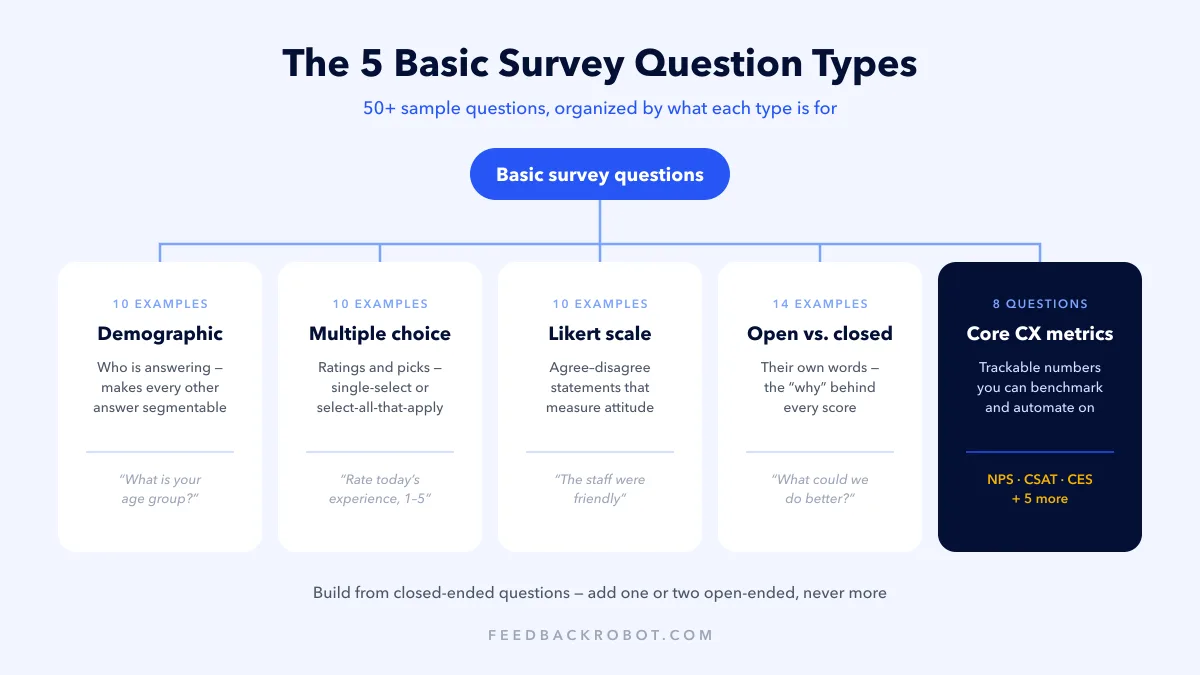
Demographic survey questions (10 examples)
Multiple choice and rating scale questions (10 examples)
Likert scale question examples (10 examples)
Open-ended vs. closed-ended survey questions (14 examples)
The 8 core customer survey questions (NPS, CSAT, CES and more)
Demographic Survey Questions (10 Examples)
Demographic questions tell you who is answering, which is what makes the rest of your data segmentable — a 3-star rating means something different from a first-time visitor than from a weekly regular. Three rules: make every demographic question optional, include a “Prefer not to say” choice on anything personal, and place them at the end of the survey so they never cost you a completion.
- What is your age group? — Multiple choice (Under 18 / 18–24 / 25–34 / 35–44 / 45–54 / 55–64 / 65+). Use ranges, never exact age; it feels less intrusive and is easier to analyze.
- How would you describe your gender? — Multiple choice with a self-describe option and “Prefer not to say.” Only ask if you will actually segment by it.
- Where are you located? — Dropdown (city/region) or a ZIP/postcode field. Essential for multi-location businesses mapping their catchment area.
- What best describes your occupation or industry? — Dropdown. Most useful for B2B, professional services, and event venues profiling their audience.
- What is your current employment status? — Multiple choice (Employed full-time / part-time / self-employed / student / retired / other). Helps explain visit-time and price-sensitivity patterns.
- What is the highest level of education you have completed? — Dropdown. Standard in research surveys; skip it in routine customer feedback unless you have a clear use.
- What is your approximate annual household income? — Multiple choice ranges with “Prefer not to say.” The most sensitive item here — ask only when pricing decisions genuinely depend on it, and always last.
- How many people are in your household? — Dropdown (1 / 2 / 3–4 / 5+). Useful for hotels, resorts, and restaurants weighing family versus couples positioning.
- Is this your first visit (or purchase) with us? — Yes/No. The single most useful demographic split: new-customer impressions versus regular-customer loyalty read completely differently.
- How did you hear about us? — Multiple choice (Google search / review site / social media / friend or family / walked past / other). Your cheapest marketing-attribution data.
Multiple Choice and Rating Scale Questions (10 Examples)
These are the workhorses of any basic survey: fast to answer, easy to chart. One distinction matters when you write them — single-select questions force one answer (best for ratings and either/or facts), while multi-select questions (“select all that apply”) capture combinations. Mixing them up is the most common beginner error: a “What did you enjoy?” question built as single-select silently throws away data.
- Overall, how would you rate your experience today? — Rating scale 1–5 (Poor to Excellent). The universal opener.
- How would you rate the quality of your [meal / room / treatment / purchase]? — Rating scale 1–5. Swap the noun for your business.
- How would you rate the speed of service? — Rating scale 1–5. Pairs naturally with a follow-up when the score is low.
- How would you rate the cleanliness of our [location / rooms / facilities]? — Rating scale 1–5. A leading indicator of negative public reviews.
- How easy was it to [book / order / check in / get help]? — Rating scale 1–5 (Very difficult to Very easy). A lightweight effort question.
- How often do you visit or buy from us? — Single-select (First time / A few times a year / Monthly / Weekly or more). Anchors every other answer in context.
- Which of the following did you use during your visit? — Multi-select (e.g., dine-in / takeaway / delivery; pool / spa / restaurant / gym). Shows which touchpoints actually shape the experience.
- What matters most when you choose a [restaurant / hotel / clinic / store]? — Single-select (Price / Quality / Location / Service / Reviews). Reveals what you are actually competing on.
- How does our pricing compare to similar businesses you use? — Single-select (Lower / About the same / Higher). Safer than asking “are we too expensive?” and yields more honest data.
- When do you usually visit us? — Single-select (Weekday daytime / weekday evening / weekend). Operationally useful for staffing and promotions.
Likert Scale Question Examples (10 Examples)
Likert questions present a statement and ask how strongly the respondent agrees, usually on a 5-point scale from Strongly disagree to Strongly agree. They shine when you want to measure attitude rather than fact — and because every item uses the same scale, you can compare scores across statements and over time. Keep every statement single-idea: “The staff were friendly and the food arrived quickly” is two questions wearing one label.
- The staff were friendly and welcoming.
- My experience was worth what I paid.
- It was easy to find what I was looking for.
- The wait time was reasonable.
- The facility was clean and well maintained.
- Communication before my visit was clear and helpful.
- Any issue I raised was resolved quickly.
- I felt like a valued customer.
- I would recommend this business to a friend or colleague.
- I intend to return within the next three months.
Need more variations, or a different scale (frequency, importance, likelihood)? Browse our full library of likert scale examples, or generate a statement set tailored to your specific industry with the free Likert scale generator.
Open-Ended vs. Closed-Ended Survey Questions
Every question above is closed-ended: the respondent picks from answers you defined. Open-ended questions hand them a blank box. Closed-ended data is fast to answer and easy to chart; open-ended answers are slower to give and harder to analyze, but they contain the why — and the problems you did not think to ask about. The practical rule: build the survey from closed-ended questions, then add one or two open-ended questions, never more.
Closed-ended examples:
Did a member of staff greet you when you arrived? (Yes/No)
Was your order correct? (Yes/No)
Did you find everything you were looking for today? (Yes/No)
Would you book with us again? (Yes/No/Not sure)
How many times have you stayed with us? (0 / 1–2 / 3–5 / 6+)
Which location did you visit? (Dropdown)
How satisfied were you with today’s visit? (1–5 scale)
Open-ended examples:
What is one thing we could do to make your next visit perfect?
What almost stopped you from booking with us?
What was the highlight of your experience?
If you could change one thing about our [menu / rooms / service], what would it be?
What is the main reason for the score you gave?
How would you describe us to a friend?
Is there anything we should have asked about but didn’t?
Section 4 of the core questions below covers how to analyze open-ended responses at scale without reading every comment by hand.
The 8 Core Customer Survey Questions (NPS, CSAT, CES and More)
The categories above give you the building blocks. These next eight are different: each is a proven customer experience question that produces a trackable metric — a number you can benchmark, watch over time, and wire to automated action. If your survey only has room for a handful of questions, draw them from this list. For each one, we break down why it works and how to act on the answers.
1. Net Promoter Score (NPS) Question
The Net Promoter Score question is a cornerstone of customer feedback, designed to measure loyalty with a single, direct inquiry. It asks, “On a scale from 0 to 10, how likely are you to recommend our [business/product/service] to a friend or colleague?” This question is a powerful starting point for any basic survey questions sample because its simplicity produces a clear, actionable metric for predicting business health and growth.

Based on their 0-10 rating, respondents are grouped into three categories:
Promoters (9-10): Your most loyal and enthusiastic customers. They are brand advocates who drive referrals and fuel growth.
Passives (7-8): Satisfied but unenthusiastic customers. They are vulnerable to competitive offers and aren't actively recommending you.
Detractors (0-6): Unhappy customers who can damage your brand through negative word-of-mouth and online reviews.
Why NPS is a Critical First Step
NPS provides a fast, reliable pulse on customer sentiment. For a hotel, it can identify a guest who had a poor stay before they post a damaging review on TripAdvisor. For a busy restaurant, a low score from a diner can trigger an immediate service recovery action from the manager.
The real power of NPS is unlocked when you pair it with the right tools. Inside FeedbackRobot, your NPS results are not just a number. Our Radar (unified review intelligence) feature connects your NPS Detractors to their public review activity, showing you if an unhappy customer is also broadcasting their dissatisfaction on Google or other key sites.
Strategic Insight: The true value of NPS comes from the follow-up. Always ask an open-ended question like, "What is the primary reason for your score?" This qualitative feedback explains the why behind the number.
Actionable Tips for Using NPS
To collect smarter and act faster, integrate NPS into your daily operations. Instead of just calculating a score, use it as a trigger for action. For example, FeedbackRobot's AI Summaries (instant insights & sentiment analysis) can analyze thousands of open-ended NPS responses in seconds, instantly identifying themes like "slow check-in" or "cold food" that are driving down your scores. This allows you to pinpoint and fix operational issues without manual effort.
2. Customer Satisfaction (CSAT) Question
The Customer Satisfaction (CSAT) question directly measures a customer's contentment with a specific interaction or experience. It typically asks, “How satisfied were you with your [experience/service/product]?” with responses on a simple scale, such as 1-5 (Very Dissatisfied to Very Satisfied). Unlike NPS, which gauges long-term loyalty, CSAT provides an immediate, transactional snapshot of happiness. This makes it an essential part of any basic survey questions sample for businesses focused on service quality.

The results are typically expressed as the percentage of respondents who chose a satisfied answer (e.g., 4 or 5 on a 5-point scale). Common applications include:
Hospitality: Post-checkout surveys on room cleanliness or front-desk service.
Restaurants: Post-meal feedback on food quality, service speed, and ambiance.
Healthcare: Exit surveys measuring satisfaction with wait times or provider interaction.
Retail: In-store feedback on staff helpfulness or product availability.
Why CSAT is a Critical Operational Metric
CSAT offers a real-time health check on your core operations. For a restaurant manager, a low CSAT score on "service speed" from a specific table can pinpoint a bottleneck in the kitchen or an overwhelmed server. For a hotel operator, consistently low scores for "room cleanliness" in a certain wing can signal a need for staff retraining or deeper maintenance.
This is where FeedbackRobot turns a simple score into a powerful operational tool. Our Resolutions Engine (automated service recovery) can be configured to automatically trigger a service recovery workflow when a CSAT score falls below a set threshold, like a 3 out of 5. This instantly notifies the right manager, assigns a task, and tracks the issue until it's resolved, ensuring no unhappy guest is ignored.
Strategic Insight: CSAT is most powerful when deployed immediately following a service interaction. The feedback is more accurate and visceral, providing a true-to-the-moment account of the customer’s experience.
Actionable Tips for Using CSAT
Integrate CSAT surveys at key touchpoints to gather continuous feedback. Use QR codes on receipts or table tents to make it easy for customers to respond. Instead of just collecting scores, use them to drive immediate improvements. For example, FeedbackRobot's AI Summaries (instant insights & sentiment analysis) can analyze thousands of open-ended comments tied to your CSAT scores, instantly surfacing themes like "rude barista" or "long check-in line" that are hurting satisfaction. This allows you to diagnose and fix the root causes of dissatisfaction without spending hours reading individual comments.
3. Customer Effort Score (CES) Question
Customer Effort Score (CES) measures the ease of a customer's interaction with your business. It directly asks, "To what extent do you agree or disagree with the following statement: The company made it easy for me to handle my issue?" on a scale from 'Strongly Disagree' to 'Strongly Agree.' This question is a vital part of any basic survey questions sample because research by Gartner shows that low effort is the single biggest driver of customer loyalty.
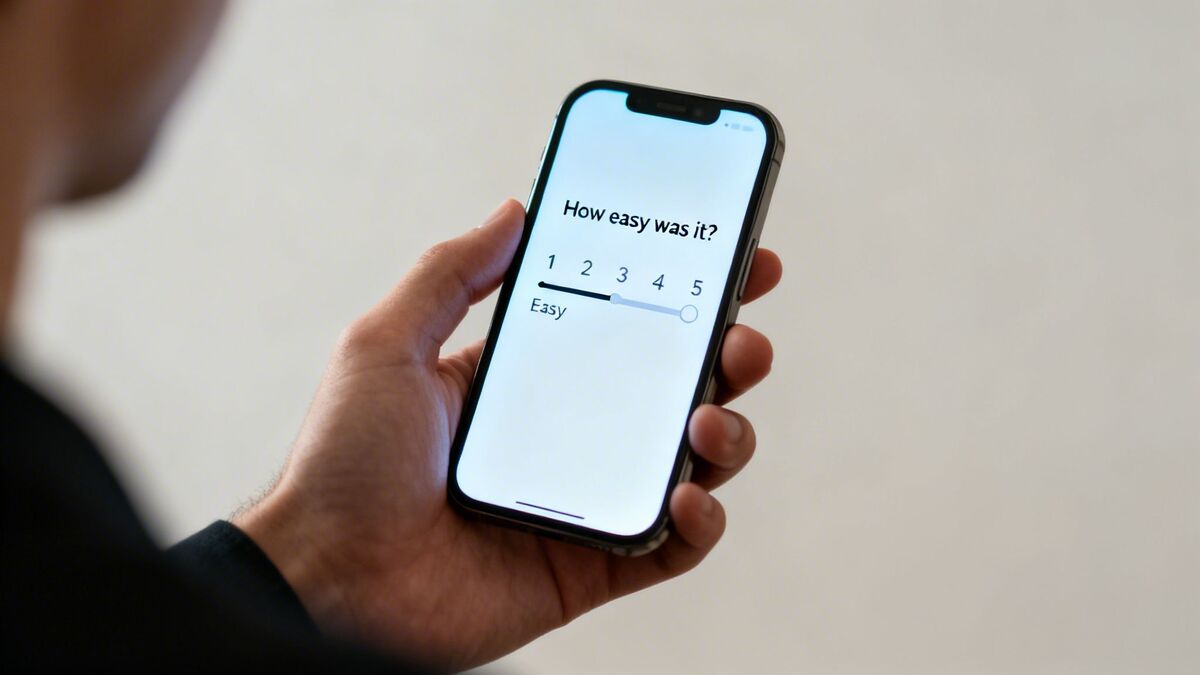
Unlike NPS, which gauges overall loyalty, CES hones in on the friction within specific processes. Scores are typically on a 1-7 or 1-5 scale, where a higher score indicates lower customer effort.
Low Effort (High Scores): Customers found it simple to get what they needed, which strongly predicts they will return and spend more.
High Effort (Low Scores): Customers struggled, a clear warning sign of potential churn and negative word-of-mouth.
Why CES is Critical for Operational Excellence
CES pinpoints operational roadblocks that frustrate customers and strain your team. For a hotel, a low score can flag a confusing online check-in process. In a healthcare clinic, it can reveal that patients find booking appointments or understanding their bills difficult. By measuring effort, you identify exactly where to focus your improvements for the biggest impact.
The true power of CES is its diagnostic capability. Inside FeedbackRobot, our Radar (unified review intelligence) dashboard connects low CES scores to specific touchpoints. You can see if complaints about "effort" are linked to your new payment system or your online ordering platform, giving you a clear, data-backed path to resolution.
Strategic Insight: The most effective CES surveys are triggered immediately after a specific interaction. Ask about the ease of booking right after a reservation is made, not in a general survey a week later.
Actionable Tips for Using CES
To collect smarter and act faster, integrate CES questions at key moments in the customer journey. For example, a restaurant using a Toast POS system can automatically send a CES survey via FeedbackRobot after a customer pays their bill to measure the ease of the payment process. FeedbackRobot's AI Summaries (instant insights & sentiment analysis) then analyze open-ended feedback like "What made this process difficult?" to instantly surface themes like "QR code didn't work" or "split bill was confusing," allowing managers to fix friction points immediately.
4. Open-Ended Feedback Question
While rating scales provide a quick quantitative snapshot, open-ended questions like, “What could we have done better?” are where you find the rich, narrative details that drive meaningful improvements. This type of question invites customers to share their experiences in their own words, capturing nuanced insights, emotional context, and unexpected issues that a 0-10 scale would miss. As a foundational part of any basic survey questions sample, open-ended feedback provides the critical why behind your quantitative scores.

This qualitative data is essential for understanding the complete customer story. Examples include:
Hotels: A guest might mention the “surprisingly comfortable bed” or “the amazing city view from room 802,” giving your marketing team specific, positive quotes to use.
Restaurants: A diner could describe how a server went above and beyond to accommodate a food allergy, highlighting a staff member for recognition.
Retail Stores: A shopper might explain their frustration with a disorganized checkout area, pointing to a direct operational fix.
Why Open-Ended Questions Unlock Deeper Insights
Numerical ratings tell you what happened, but open-ended responses tell you why it mattered. For a healthcare clinic, a low satisfaction score is a signal, but a written comment about “a 45-minute wait past my appointment time with no communication” gives you a specific, actionable problem to solve.
The challenge has always been analyzing this text-based feedback at scale. This is where FeedbackRobot's AI Summaries (instant insights & sentiment analysis) become indispensable. Our AI instantly analyzes thousands of written responses, performing sentiment analysis and identifying recurring themes like "rude staff," "cleanliness issues," or "slow service." It transforms a mountain of text into a clear, prioritized list of operational strengths and weaknesses.
Strategic Insight: Keep your open-ended questions focused. Instead of a vague "Any comments?", ask a specific question like, "What is one thing we could do to make your next visit perfect?" This guides the customer to provide more targeted, useful feedback.
Actionable Tips for Using Open-Ended Feedback
To collect smarter and act faster, integrate open-ended questions alongside your rating scales. Limiting them to one or two per survey is key to maintaining high completion rates.
Inside FeedbackRobot, you can set up automated alerts for specific keywords within open-ended responses. For example, an alert for "food poisoning" or "never coming back" can trigger an immediate notification for your management team, enabling rapid service recovery. Our Resolutions Engine (automated service recovery) can even automate the first step, assigning the issue to the right person and tracking it until closure.
5. Return Intent & Value Perception Question
The Return Intent & Value Perception question is a dual-purpose inquiry designed to measure future revenue stability and price sensitivity. It asks, “How likely are you to return to our [business/property/restaurant]?” and follows with, “Based on your experience, did our [product/service] provide good value for the price?” This combination is a vital part of any basic survey questions sample because it separates customer loyalty from their perception of cost, giving you two distinct but connected data points.
This method provides a more complete picture of customer health. A guest might be satisfied with a hotel stay but feel the room rate was too high, making them unlikely to return. Conversely, a diner might have had a minor issue at a restaurant but feel the meal was such great value that they plan to come back. The two questions work together to reveal these important distinctions:
Return Intent: A direct measure of repurchase likelihood and customer lifetime value.
Value Perception: An indicator of your price positioning and competitiveness in the market.
Why Return Intent & Value are Critical Metrics
These questions directly predict future revenue and identify customers at risk of churn before they disappear. For a healthcare clinic, low return intent from a patient flags a potential loss of ongoing treatment revenue. For a retail store, a customer who feels prices are not fair is a prime target for competitors, even if they liked the product.
The true power of this data is realized when you automate your response. Within FeedbackRobot, you can use these questions to trigger immediate, intelligent actions. For example, our Resolutions Engine (automated service recovery) can be configured to automatically send a targeted discount offer to a customer who indicates they are "unlikely to return" but had a positive value perception. This smart incentive can secure their next visit.
Strategic Insight: Always ask the value question separately from satisfaction. A customer can be satisfied with quality but still feel the price was unfair. Isolating value perception helps you diagnose if churn risk is related to your operations or your pricing strategy.
Actionable Tips for Using These Questions
Integrate these questions to turn feedback into revenue. Instead of just tracking scores, use them as a catalyst for growth. For example, a restaurant can use FeedbackRobot's AI Summaries (instant insights & sentiment analysis) to analyze open-ended feedback following a low-value score. If themes like "small portion size" or "overpriced drinks" emerge, the management team has clear, data-backed evidence to adjust its menu pricing or promotions. This allows you to protect margins while keeping customers happy, a crucial balance for any service business.
6. Service Quality Rating Question
The Service Quality Rating question moves beyond overall satisfaction to dissect the specific components of the customer experience. It asks customers to rate distinct service dimensions, such as, “How would you rate the responsiveness of our front desk staff?” on a scale (e.g., 1-5, Poor to Excellent). This item is a crucial part of any basic survey questions sample because it provides granular, actionable data on operational performance.
By isolating different service elements, you can pinpoint exactly where your team excels and where they need support. Common applications include:
Hotels: Rating front desk responsiveness, housekeeping professionalism, or concierge helpfulness.
Restaurants: Evaluating server attentiveness, food quality, or problem resolution skills.
Healthcare: Assessing a provider's communication, staff courtesy, and wait time satisfaction.
Retail: Gauging staff helpfulness, checkout speed, and product knowledge.
Why Service Quality Ratings are Essential
This question provides a diagnostic tool for your operations. While a low Customer Satisfaction (CSAT) score tells you there's a problem, service quality ratings tell you where the problem is. For a hotel group, it can reveal that one property's check-in process is lagging, while for a multi-location clinic, it might show that a specific provider needs more training on patient communication.
This targeted feedback becomes even more powerful within FeedbackRobot. Our platform allows you to segment service quality ratings by location, team, or even individual staff members. This data feeds directly into the Resolutions Engine (automated service recovery), which can automate service recovery workflows. For example, a low rating for "server attentiveness" can automatically assign a follow-up task to the restaurant manager, ensuring no guest issue goes unresolved.
Strategic Insight: The key is specificity. Instead of asking about "service," ask about "staff friendliness," "speed of service," and "problem resolution." This breaks down a vague concept into measurable, coachable behaviors.
Actionable Tips for Using Service Quality Ratings
To collect smarter, integrate these questions into post-interaction surveys. Instead of just gathering data, use it to build a better team and operation. FeedbackRobot's AI Summaries (instant insights & sentiment analysis) can analyze thousands of comments linked to these ratings, instantly identifying recurring themes like "slow checkout" or "unhelpful staff" that are pulling down scores. This lets you move from measurement to management. You can also connect these internal survey ratings to public reviews using our Radar (unified review intelligence) feature to see if internal service gaps are spilling over into negative Google or Yelp reviews.
7. Recommendation Reason/Attribute Question
The Recommendation Reason/Attribute question is the essential follow-up to a quantitative rating, such as NPS. It bridges the gap between the “what” (the score) and the “why” (the reason) by asking respondents to explain their rating. Typically phrased as “What was the main reason for your score?” or asking customers to select from a list of attributes, this question transforms a simple number into a powerful diagnostic tool for your business.
This inquiry is a vital part of any basic survey questions sample because it gives context to your customer feedback. For hotels, it reveals if a low score was due to room cleanliness, staff friendliness, or location. For a retail store, it can pinpoint whether a customer's loyalty is driven by product selection, pricing, or the checkout experience. This adds a critical layer of detail that a standalone score cannot provide.
Based on the response, you can categorize feedback into operational buckets:
Service: Issues related to staff interaction, speed, or helpfulness.
Product/Quality: Feedback concerning food quality, room comfort, or product performance.
Price/Value: Comments about whether the cost aligns with the perceived value.
Facilities/Atmosphere: Mentions of cleanliness, ambiance, location, or decor.
Why This Question Delivers Deeper Insights
While a rating gives you a pulse, the reason behind it gives you a diagnosis. A restaurant might see a dip in its NPS, but without this follow-up, management won't know if the problem is the new menu, slow service on weekends, or an issue with the reservation system. This question directs your attention to the exact area that needs fixing or celebrating.
Within FeedbackRobot, this data becomes even more potent. Our AI Summaries (instant insights & sentiment analysis) feature processes thousands of these attribute selections and open-ended comments in seconds. It automatically identifies and groups themes, so you can instantly see that "wait time" was the top complaint last month or that "staff courtesy" is your biggest strength. This frees you from manually sorting feedback and delivers immediate, actionable intelligence.
Strategic Insight: Use a predefined list of 3-6 attributes plus an "Other" option. This structure makes it easy for customers to respond while still giving you clean data for analysis and capturing any unexpected issues.
Actionable Tips for Using Attribute Questions
Integrate this question directly after your primary rating question to capture the most accurate, top-of-mind reasons. You can then use the responses to trigger specific internal workflows. For instance, if a customer at a healthcare clinic selects “wait time” as a negative factor, FeedbackRobot’s Resolutions Engine (automated service recovery) can automatically create a task for the practice manager to review that day's schedule and follow up. This system turns feedback into immediate operational improvements, helping you act faster to solve problems before they escalate.
8. Likelihood to Share/Review Question
While NPS measures private recommendation intent, this question gauges a customer's willingness to create public social proof. It directly asks, “How likely are you to share your experience on social media or leave a review?” on a 0-10 scale. This query is a vital part of any modern basic survey questions sample because it specifically predicts the generation of user-generated content (UGC) and online reviews, which are currencies of trust for new customers.
Unlike NPS, which focuses on loyalty, this question zeroes in on public amplification. A high score (9-10) identifies customers ready to post on Google, TripAdvisor, or Instagram, while a low score (0-6) flags a reputation risk. The responses provide a forecast for your organic review volume.
Amplifiers (9-10): These customers are ready to become public advocates. They are your most valuable source for positive reviews and social media buzz.
Neutrals (7-8): They had a good experience but are unlikely to post about it without a specific nudge or incentive.
Risks (0-6): These unhappy customers are not just Detractors; they have a high potential to voice their dissatisfaction publicly, directly impacting your online ratings.
Why Predicting Public Feedback is Essential
Knowing who is likely to post a review gives you a massive advantage in reputation management. A restaurant can use this question to identify a diner who is thrilled with their meal and immediately send them a link to their Google review page. Conversely, a hotel can see a guest who is highly likely to post a negative review and intervene before it happens.
This predictive power is a core function of the FeedbackRobot platform. When a customer indicates a high likelihood to share but a low satisfaction score, our Radar (unified review intelligence) dashboard flags them as a priority. This allows your team to monitor key review sites and prepare a response if a negative review appears, turning a potential crisis into a manageable service recovery event.
Strategic Insight: The friction between intent and action is your biggest obstacle. A customer might be willing to leave a review but won't if it's too difficult. Make it effortless by providing direct links to the most important review platforms for your business.
Actionable Tips for Driving Reviews
Integrate this question into your post-service feedback flow to capture intent while the experience is fresh. Use a high score as a trigger for automated action. For example, FeedbackRobot's Prompt to Survey feature can intelligently identify your "Amplifiers" and automatically send a follow-up email or SMS with a direct link to your TripAdvisor or Yelp page, converting positive sentiment into powerful public reviews. For low scorers, our Resolutions Engine (automated service recovery) can automatically create a service recovery ticket, assigning it to a manager to connect with the guest and resolve their issue before they post online.
8-Point Survey Question Comparison
Question | Implementation complexity | Resource requirements | Expected outcomes | Ideal use cases | Key advantages |
|---|---|---|---|---|---|
Net Promoter Score (NPS) Question | Low — single-item; needs follow-up design | Low — minimal survey effort, basic analytics | Loyalty indicator, promoter/detractor segmentation, growth prediction | Brand-level loyalty tracking in hospitality, healthcare, services | Benchmarkable, quick, predictive of CLV |
Customer Satisfaction (CSAT) Question | Low — single transaction-focused item | Low — immediate deployment, simple triggers | Transaction-level satisfaction, operational fix signals | Post-service checks (checkout, POS, appointments) | High response rates, directly actionable for operations |
Customer Effort Score (CES) Question | Low–Medium — single item but requires journey mapping | Low–Medium — process mapping and diagnostic follow-ups | Identifies friction points, strong churn predictor | Process-heavy interactions (booking, billing, check-in) | Highlights operational bottlenecks, predictive of loyalty |
Open-Ended Feedback Question | Low (question) / High (analysis complexity) | Medium–High — needs AI or human analysis to scale | Qualitative insights, root causes, emotional context, quotes | Deep insight needs, discovering unexpected issues across industries | Reveals nuance and themes, provides testimonial content |
Return Intent & Value Perception Question | Low–Medium — combined questions for two constructs | Low–Medium — segmentation and occasional pricing follow-ups | Repurchase likelihood, price sensitivity, retention risk | Pricing strategy, retention programs in hospitality/retail/healthcare | Direct revenue signal, isolates value perception from quality |
Service Quality Rating Question | Medium — multiple dimensions to design and standardize | Medium — requires staff/location segmentation and reporting | Staff/location performance metrics, training priorities | Training, performance management in service organizations | Targets specific service improvements, measurable by dimension |
Recommendation Reason/Attribute Question | Low — follow-up multiple-choice or short open text | Low — predefined options and analysis workflows | Diagnostic drivers of ratings, prioritization of improvements | Post-rating diagnostics after NPS/CSAT in service industries | Explains "why" behind scores with manageable data volume |
Likelihood to Share/Review Question | Low — single item similar to NPS | Low — needs review links, platform automations | Predicts review/UGC volume, reputation risk/opportunity | Reputation management for hotels, restaurants, retail | Enables proactive review generation and early reputation control |
Turn Questions into Growth: Your Action Plan
You've just reviewed a powerful arsenal of basic survey questions, from the foundational Net Promoter Score to the more nuanced Service Quality and Recommendation Reason probes. These questions are the building blocks of understanding your customer. But here's the critical truth for busy operators in hospitality, retail, and healthcare: a list of questions is just a starting point. The real value isn't in asking; it's in what you do with the answers. True growth happens when feedback instantly becomes action.
A simple list of survey questions on a clipboard or in a basic form-builder tool creates a data silo. You, or someone on your team, must manually read the responses, identify trends, decide what to do, and then execute that decision. This process is slow, prone to error, and simply doesn't scale. In the time it takes to manually process a handful of negative responses from a weekend rush, those unhappy customers have already shared their experiences online. This is where a dedicated Feedback Operating System changes the game entirely.
From Manual Data Entry to Automated Growth
Imagine a system built to not just collect feedback, but to act on it in real-time. This is the core principle behind FeedbackRobot: collect smarter, act faster, and grow stronger. Instead of just getting a score, you get an automated response system that works for you 24/7.
Turn Negative Experiences into Saved Customers: Let’s say a guest at your hotel rates their stay a 3 out of 10 on a CSAT survey sent via your Toast or Mews integration. Instead of that score sitting in a spreadsheet, our Resolutions Engine (automated service recovery) immediately and automatically triggers a service recovery flow. It can send a personalized apology email with a specific offer, like a discount on their next stay, and alert your front desk manager to follow up personally. This turns a potential one-star review into a second chance.
Amplify Your Happiest Customers: A customer gives you a 9 or 10 on the NPS question. That's fantastic, but it's also a missed opportunity if you don't act on it. Our Prompt to Survey feature intelligently identifies these "Promoters" and automatically follows up, asking them to share their great experience on Google, TripAdvisor, or another review site that matters to your business. You build your online reputation without lifting a finger.
Gain Instant Clarity without Becoming a Data Analyst
As a business owner, you don't have time to sift through hundreds of open-ended comments to find out what's really going on. You need insights, not raw data. This is where automation delivers mission-critical clarity.
Our system uses AI Summaries (instant insights & sentiment analysis) to analyze all incoming feedback—from surveys and online reviews—and provides you with instant sentiment analysis. You can see, at a glance, if customers are suddenly talking more negatively about "cleanliness" at your restaurant or "wait times" at your clinic. You get real-time alerts so you can fix small problems before they become big trends. Furthermore, all this intelligence is unified in Radar (unified review intelligence), our central dashboard that pulls in feedback from every channel. It gives you a single, clear view of your customer experience, connecting the dots between a low CSAT score and a negative Google review from the same customer. To truly transform your customer interactions into actionable growth, understanding and tracking key performance indicators is paramount; explore these 7 Essential Customer Satisfaction Metrics to deepen your strategy.
The 50+ basic survey questions sample you've just explored is your blueprint. Now, it's time to build the machine that runs it automatically, turning every piece of feedback into a direct driver for retention, reputation, and revenue.
Ready to stop just collecting data and start growing your business with it? FeedbackRobot connects directly to the tools you already use, turning every basic survey question sample into an automated action.
Generate your own survey questions free with the AI Survey Question Generator.
What are the 5 basic questions every customer survey needs?
1. Overall satisfaction. 2. Quality of service. 3. Likelihood to recommend (NPS). 4. One thing we can improve. 5. Was there a specific staff member who stood out?
How do I phrase basic questions to avoid 'Yes/No' answers?
Use 'How' and 'To what extent' phrasing. Instead of 'Was it good?', ask 'How would you rate the quality of your experience today?' This encourages a more nuanced and useful response.
Should I ask about price in a basic survey?
Only if you phrase it as 'Value for Money.' Asking 'Was it expensive?' doesn't help growth; asking 'Did the experience justify the price?' tells you about your brand's perceived value.
How many questions are too many for a basic survey?
Once you exceed 5 questions, completion rates drop by nearly 20% for every additional ask. For basic checks, 3-5 high-impact questions is the sweet spot.
Can I use emojis for my basic survey questions?
Yes! For quick feedback in high-traffic environments, emoji-based ratings are highly effective because they take less than 2 seconds for a guest to process and answer.
What are the 3 basic types of survey questions?
Single-select (the respondent picks one answer — ratings, either/or questions), multi-select (“select all that apply” — capturing combinations), and open-ended (a free-text box for answers in the respondent's own words). Most good surveys combine all three: single-select for metrics, multi-select for behavior, and one open-ended question for the why.
What demographic questions should every survey include?
For customer surveys, three earn their place: whether it's a first visit or a repeat visit, how the customer heard about you, and their general location. Age, gender, income, and education are only worth asking when you will genuinely segment by them — and they should always be optional, with a “Prefer not to say” choice, placed at the end of the survey.
Stop reading about it. Let your agent handle it.
25 free AI actions · no credit card required
Start Free