What is customer experience strategy: A Practical Guide for Hospitality & Service Owners
Explore what is customer experience strategy and learn actionable steps to design, measure, and optimize experiences that boost loyalty and growth.

Mar 15, 2026 · 19 min read
Free tool
AI Negative Review Responder
Turn 1-star reviews into recovery opportunities with AI-crafted responses.
A customer experience (CX) strategy is your actionable plan for every single interaction a guest has with your business. It's not just one department's job; it's a company-wide commitment to delivering smooth, helpful, and personal experiences at every step—from the first time someone hears about you to the support they get long after a visit. For busy hospitality and service owners, this isn't about adding more work; it's about making the work you already do more profitable. It’s how you collect smarter, act faster, and grow stronger.
Thinking Beyond Service: A Modern Definition of CX Strategy

As a busy hospitality or service owner, you’re already juggling a dozen things—operations, staffing, and keeping the lights on. The thought of adding another "strategy" to your plate probably sounds exhausting. But a customer experience strategy isn't about more work. It’s about making the work you’re already doing more profitable.
Think of it like a master chef crafting a tasting menu. Each dish, or touchpoint, is designed and timed perfectly to create one unforgettable meal. It isn't about how good a single dish tastes on its own; it’s about the flow, the story, and the feeling the guest has when they walk out the door.
That feeling is where you win. While your competitors are busy slashing prices, a great CX strategy lets you compete on loyalty—something far more valuable.
Why a CX Strategy Matters Now
Your customers have more choices than ever before. A single bad moment—a slow check-in, a clunky website, or a complaint that goes unanswered—can send them running to your competition. And it's not just a hunch; studies show that by 2026, a massive 89% of businesses expect to compete primarily on customer experience.
A strong CX strategy shifts your team from being reactive to proactive. It's the difference between providing customer service (fixing problems after they happen) and designing a customer experience (making sure things go right from the start).
A CX strategy isn't just another task on your to-do list; it’s the foundation of your business. It’s the playbook for turning everyday interactions into lasting loyalty and real growth.
This plan has to line up your people, your processes, and your tech around one simple goal: making every customer feel seen, heard, and valued. The best part? Modern tools finally make this possible for any business, not just the giants with huge budgets.
The Framework for Success: Collect Smarter, Act Faster, Grow Stronger
To build a CX strategy that actually works, you need a simple but powerful framework. At FeedbackRobot, we boil it down to three core principles that should guide every decision:
Collect Smarter: Stop guessing what your customers want. Gather feedback right when and where it matters most, turning every interaction into an opportunity to learn.
Act Faster: Don't let great insights die in a spreadsheet. Use automation to analyze feedback, alert your team, and fix issues in real-time before they turn into bad reviews.
Grow Stronger: Turn positive experiences into your most powerful marketing. Use great feedback as social proof to build trust and attract new customers, creating a cycle of growth that feeds itself.
When you adopt this mindset, you stop managing simple transactions and start building real relationships. This guide will walk you through exactly how to put this framework into action.
The Real Cost of Ignoring Customer Experience
Let's cut right to it. For busy owners in hospitality and service, where margins are already tight, ignoring customer experience is a direct hit to your bottom line. It’s not a small mistake; it’s a silent profit killer.
A poor experience shows up everywhere: negative online reviews scaring off new customers, regulars who no longer feel valued, and a constant uphill battle to get people in the door while your competitors with better reputations pull ahead.
This isn't just a hunch. The data is clear. Businesses are pouring money into CX because they see the financial payoff. A superior customer experience can lift revenues by 4-8% above the market average. On the flip side, a poor one can cost you 20% of your revenue each year from customers who simply don't come back.
From Guesswork to Growth
For too long, trying to understand what customers really think has felt like a guessing game. You might overhear a complaint at the front desk or spot a random one-star review, but you’re missing the full picture. That fragmented view makes it impossible to build a real strategy.
You can't fix what you don't see, and you can't double down on what’s working if you don't know what it is. This is where you stop guessing and start knowing.
To see how high the stakes are, just think about the damage one bad review can do. Learning how to respond to negative Google reviews is a crucial skill for damage control. But just reacting isn't enough.
The real goal isn't just to manage negative feedback—it's to get ahead of it by finding the root cause. This is how you shift from constantly putting out fires to building a fireproof business.
A Smarter Way to See Feedback
This is where a modern feedback operating system becomes your most important tool. It helps you collect smarter and act faster, turning CX from a vague idea into a measurable part of your day-to-day operations.
Take FeedbackRobot’s Radar for example. Radar is your unified review intelligence dashboard, pulling all your customer reviews—from Google, TripAdvisor, Yelp, and social media—into one clear, actionable view.
Instead of logging into five different sites to piece things together, Radar gives you a single, real-time pulse on your reputation. You can see everything at a glance, connecting dots you’d otherwise miss.
Is one location getting constant complaints about wait times? Is that new menu item a smash hit? Radar shows you these trends instantly. It gives you the power to fix issues before they blow up and to lean into what customers already love. It turns feedback from a chore into your biggest strategic advantage.
The Five Pillars of a Winning CX Strategy

Building a customer experience strategy that actually drives growth doesn't have to be some complex, theoretical exercise. Forget the jargon. It really boils down to five core pillars.
Think of these as the structural supports for your business. When you get them right, you build a reputation that can withstand any market shift and keep customers coming back. They give you a clear framework for turning customer feedback from a messy inbox into your most powerful asset.
A solid CX strategy is built on a simple foundation: you listen, understand what you’ve heard, act on it, measure the results, and then repeat the cycle to keep getting better.
To give you a clearer picture, here’s a quick overview of how these pillars support your strategy.
The 5 Pillars of CX Strategy
Pillar | Focus | Example Action for a Hotel |
|---|---|---|
Listening | Systematically collecting feedback at key moments. | Using QR codes at checkout for a quick satisfaction survey. |
Understanding | Analyzing feedback to find patterns and root causes. | Seeing that multiple guests mention "slow check-in" on Friday afternoons. |
Acting | Empowering your team to resolve issues quickly. | Automatically alerting the front desk manager when a low rating comes in. |
Measuring | Tracking key metrics to prove the impact of your efforts. | Monitoring NPS scores to see if they improve after staff training. |
Evolving | Creating a culture of continuous improvement. | Holding weekly team meetings to review feedback and celebrate wins. |
These components work together to create a cycle of constant improvement. Let’s break down what each one looks like in practice.
Pillar 1: Listening
Everything starts here. Listening isn't just about passively waiting for reviews to trickle in. It’s about actively and systematically capturing the Voice of the Customer at every important moment.
Real listening means making it easy for customers to share their thoughts when the experience is fresh in their minds. This is how you collect smarter.
For example, FeedbackRobot's Prompt to Survey feature turns any interaction into a listening post. Prompt to Survey lets you instantly create feedback opportunities with QR codes on key cards, links in post-stay emails, or even on receipts. This simple tool meets customers where they are, dramatically increasing the volume and quality of the feedback you receive.
You can learn more about building a complete system for this in our guide to the Voice of the Customer program.
Pillar 2: Understanding
Collecting feedback is just step one. The next pillar, Understanding, is about connecting the dots to see the bigger picture. This means mapping the entire customer journey and analyzing feedback in the context of where it happened.
It's not enough to know a guest was unhappy. You need to know why and where things went sideways. Was it a confusing online booking process? A long wait for their table? A noisy air conditioner in their room?
Understanding is the bridge between raw data and real insight. It’s what lets you move from fighting individual fires to fixing the root causes of problems for good.
This is where you hunt for patterns. If multiple reviews mention "slow service on weekends," you don't just have a few unhappy customers—you have a systemic staffing or process issue that needs attention. True understanding gives you a strategic roadmap for improvement.
Pillar 3: Acting
Insights are worthless if you don't do anything with them. This pillar is about empowering your team and your systems to resolve issues fast, turning negative experiences into opportunities to build loyalty. This is where you learn to act faster than your competitors.
A swift, empathetic response can completely change a customer's perception of your brand. But manual follow-ups are slow and inconsistent, especially for busy teams. This is where automation becomes your secret weapon for making service recovery a reliable part of your operation.
This is exactly what FeedbackRobot’s Resolutions Engine is designed for. The Resolutions Engine is an automated service recovery tool that triggers immediate actions based on feedback. For instance, imagine a guest leaves a survey mentioning a cold meal. The engine can instantly:
Alert the restaurant manager via SMS.
Automatically send the guest a personalized apology email with a discount for their next visit.
Log the issue for your weekly operations review.
By automating the response, the Resolutions Engine ensures no complaint falls through the cracks. It helps you turn a potentially lost customer into a loyal advocate before they even think about writing a public review.
Pillar 4: Measuring
You can't improve what you don't measure. A winning CX strategy isn't based on gut feelings; it's driven by data. This pillar is all about tracking the right key performance indicators (KPIs) to see if your efforts are actually moving the needle on satisfaction, loyalty, and revenue.
Key metrics to watch include:
Customer Satisfaction (CSAT): Measures happiness with a specific interaction, like checking in or speaking with support.
Net Promoter Score (NPS): Gauges overall customer loyalty and their likelihood to recommend you.
Customer Effort Score (CES): Shows how easy or difficult it is for customers to get things done with your business.
Tracking these metrics over time shows you whether your changes are working. Are your service recovery efforts improving your NPS? Did streamlining your checkout process lower your Customer Effort Score? This data is how you prove the ROI of your CX initiatives.
Pillar 5: Evolving
Finally, a great CX strategy is never "finished." The last pillar, Evolving, is about building a customer-first culture where continuous improvement becomes second nature. Your customers' expectations will change, and your business must be ready to adapt with them.
This means regularly reviewing feedback, celebrating wins with your team, and constantly looking for new ways to reduce friction and create memorable moments. It’s a flywheel: you listen, understand, act, and measure, then use those lessons to evolve your approach.
This commitment to evolution is how you not only grow but grow stronger, building a resilient business that customers love for the long haul.
How to Build Your CX Strategy in Six Actionable Steps
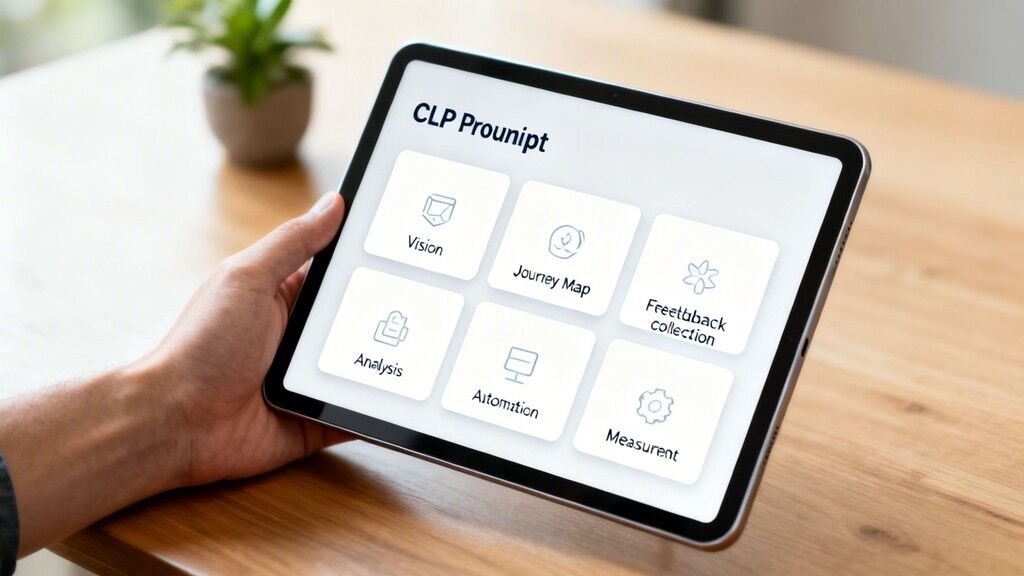
Alright, enough with the theory. It’s time to get our hands dirty and build a customer experience strategy that actually works. We're going to break it down into six straightforward steps you can follow.
This isn't about lofty goals you can't measure. This is a practical framework for turning what your customers say into your biggest driver for growth. Each step builds on the one before it, so let's jump in.
Step 1: Define Your CX Vision
First, you need a North Star. Your CX vision is a simple, clear statement that defines the experience you want your customers to have. It’s not some fluffy mission statement; it’s a practical guide for your team.
A great CX vision answers two questions:
What feeling do we want every customer to have when they interact with us?
How will delivering that feeling help our business grow?
For instance, a boutique hotel’s vision might be: "To make every guest feel like a local insider, so they come back and tell their friends." That one sentence guides everything—from lobby design to the tone of a follow-up email.
Step 2: Map Your Customer Journeys
You can’t fix an experience you don’t fully understand. That’s where customer journey mapping comes in. It’s the process of visualizing every single interaction a customer has with your business, from their first Google search to their final feedback.
Think of it like tracing a route on a map. You identify every touchpoint—the good, the bad, and the just okay. This process shines a light on the "moments of truth" where a customer's experience is either made or broken. You might discover your staff is amazing, but your online booking system is a clunky mess.
This is how you find friction points and opportunities to truly impress your customers. To go deeper, check out our guide on the digital customer journey.
Step 3: Collect Feedback at Key Touchpoints
Now that you have your map, you know exactly where to listen. The next step is to start collecting feedback at the most important moments you’ve identified. This is how you stop passively waiting for reviews and start actively gathering intelligence.
Instead of just crossing your fingers for a good review, you proactively ask for feedback right after key interactions:
Post-Check-in: A quick SMS survey asking about their arrival.
After a Meal: A QR code on the receipt that leads to a two-question survey.
Post-Stay: A targeted email asking for detailed thoughts on their entire visit.
Modern tools make this incredibly easy. You can use simple prompts to gather high-quality, in-the-moment feedback that gives you a real-time pulse on your business.
Step 4: Analyze Feedback to Find Priorities
Collecting feedback is just the start. The real value comes from analyzing it to find clear, actionable insights. But who has time to manually sift through hundreds of comments? This is where AI becomes your secret weapon.
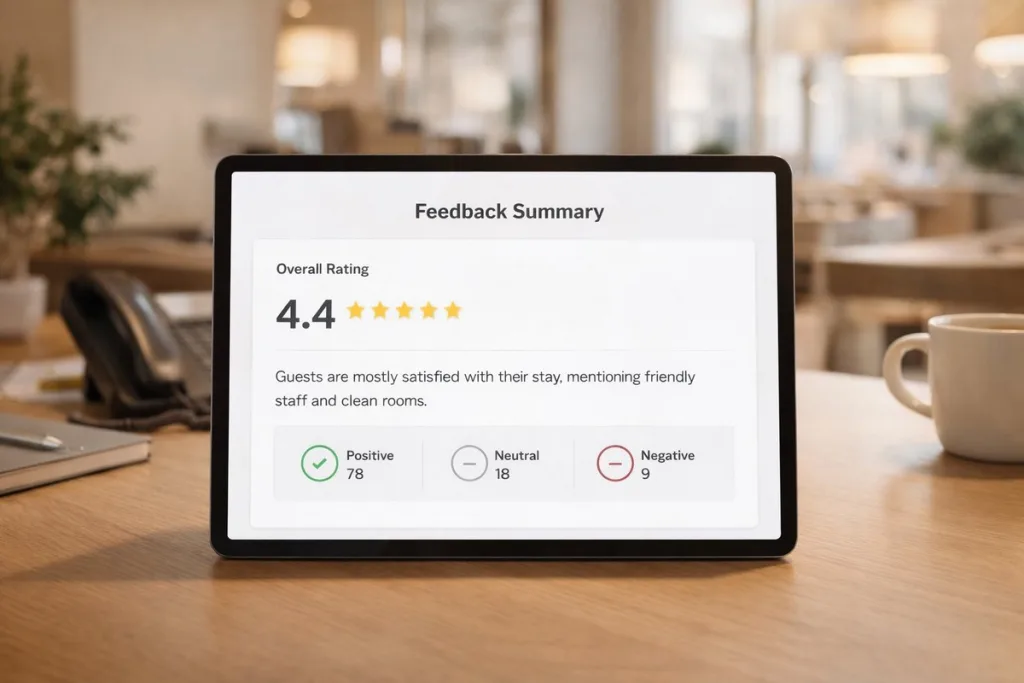
FeedbackRobot’s AI Summaries are built for exactly this problem. This feature acts as your personal data analyst, instantly processing all of your feedback to provide instant insights and sentiment analysis.
Instead of reading every single comment, AI Summaries tell you at a glance: "Customers love the new patio, but many are complaining about slow Wi-Fi in rooms 301-310." It turns a mountain of raw feedback into a clear, prioritized to-do list. You know exactly where to put your time and money for the biggest impact.
This is how you move from being overwhelmed by data to being empowered by it.
Step 5: Empower Your Team with Automation
Once you know what to fix, you need to act fast. This step is about connecting feedback directly to your daily operations and empowering your team to resolve issues in real time.
Imagine integrating your feedback platform with your core systems, like a property management system (Mews) or a point-of-sale system (Toast). When a guest leaves negative feedback tied to their stay or meal, the system knows exactly who they are and what happened.
This connection lets you automate service recovery. You can trigger an alert to the manager on duty with the guest’s details or even send a personalized apology with a specific offer, like a free dessert on their next visit, logged right in their Toast profile. It shows the customer you’re not just listening—you’re acting on their specific experience.
Step 6: Measure, Iterate, and Improve
A CX strategy is never "done." The final step is to create a continuous loop of measuring, iterating, and improving. You need to track key metrics to prove your efforts are working and to find new areas to focus on.
The business world is changing fast. By 2026, a massive 89% of businesses are expected to compete primarily on customer experience, blowing past price and product. In this new reality, customers use an average of six touchpoints per purchase and expect a flawless experience across all of them. Companies that get this right see 250% higher engagement and 90% better retention. To dive deeper into these trends, you can find more customer experience statistics and insights on onramp.us.
By consistently tracking your metrics, celebrating wins with your team, and using new feedback to tweak your approach, you build a culture of excellence. This cycle is what lets you adapt to shifting customer expectations and, ultimately, grow stronger.
Measuring the True ROI of Your CX Strategy
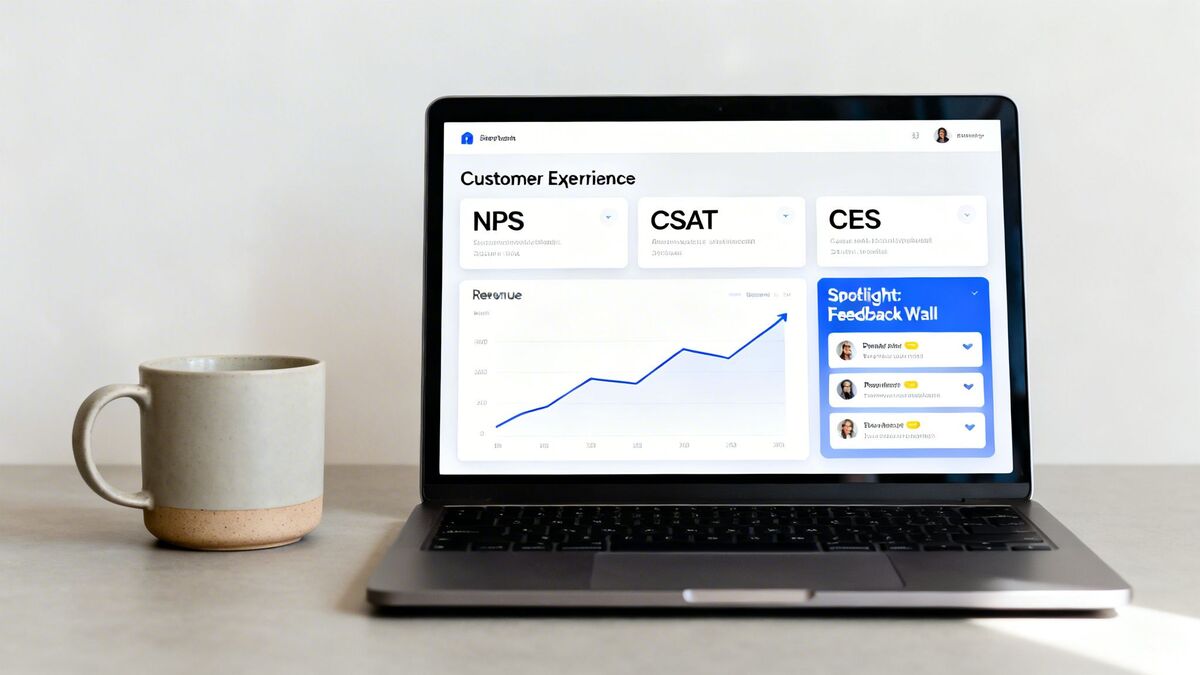
Pouring time and money into your customer experience is a great start, but it’s not enough. You need to prove it’s actually working. This isn't about gut feelings or good vibes; it’s about drawing a straight line from your CX efforts to the numbers that run your business.
Measuring the return on investment (ROI) of your strategy is how you turn "happy customers" into cold, hard data. It’s what justifies your budget, gets your team fired up, and helps you make smarter bets on growth.
Tying CX Metrics to Business Outcomes
First, you need to track the right Key Performance Indicators (KPIs). Think of these metrics as the vital signs of your customer experience. They tell you, at a glance, how people really feel about you.
There are three core metrics you absolutely must know:
Net Promoter Score (NPS): This is the classic loyalty question: "How likely are you to recommend us to a friend?" It separates your biggest fans from those who might be steering others away.
Customer Satisfaction (CSAT): This is your in-the-moment report card. You ask it right after a key interaction, like a checkout or a support call. A simple, "How satisfied were you?" gives you instant feedback on specific touchpoints.
Customer Effort Score (CES): This measures how easy you are to do business with. A low-effort experience is one of the strongest predictors of repeat business—people love companies that don't make them work hard.
But just collecting these scores is only half the job. The real magic happens when you connect them to your business metrics. Does a 10% jump in NPS lead to a 5% drop in customer churn? Do higher CSAT scores correlate with more repeat purchases or a higher average order value? That's the connection that proves financial impact.
From Data to Dollars
Trying to connect these dots by hand in a spreadsheet is a recipe for frustration. As a busy owner, you need a system that does the heavy lifting, showing you exactly how your CX performance is hitting the bottom line.
A platform like FeedbackRobot automatically collects and organizes these core KPIs in one central dashboard. No more wrestling with spreadsheets or guessing at what the numbers mean. You can see, week over week, how your efforts to act faster on feedback are directly moving your scores.
For a deeper look at the mechanics, check out our full guide on how to measure customer experience.
The goal isn't just to collect scores; it's to see the story they tell about your business. A rising NPS isn't just a number—it's a leading indicator of future revenue and a healthier bottom line.
By tracking these metrics clearly, you can finally draw that line from a happy customer to a more profitable business.
Turn Great Feedback into New Customers
Once you’ve used feedback to tighten up your operations and boost your scores, it's time to close the loop. Your best feedback is a powerful marketing tool, but only if potential customers can see it. This is where you learn to grow stronger.
This is exactly why we built the Spotlight: Feedback Wall.
This feature automatically showcases your best, most recent reviews and testimonials directly on your website. It’s a living, breathing stream of social proof that builds trust with new visitors the second they arrive.
Picture this: a new customer lands on your site. They’re interested but a little hesitant. Then they see a wall of authentic, glowing reviews from real people who just had a great experience. That hesitation melts away, replaced by confidence.
You didn't spend an extra dime on ads. Your own happy customers did the selling for you. The Spotlight: Feedback Wall turns positive CX into a direct driver of new bookings and revenue, completing the growth cycle of your customer experience strategy.
Alright, let's bring this all home. A great customer experience strategy isn't just a "nice-to-have" anymore. It's how you win on loyalty and stop competing on price alone.
Think of it this way: collect smarter, act faster, and grow stronger. This simple loop turns feedback from a problem you have to manage into your best tool for growth. Every interaction becomes a chance to build a real connection and make a meaningful improvement.
The real work begins when you stop just thinking about a better customer experience and start doing something about it.
A winning CX strategy needs the right tools to back it up. A true feedback operating system connects all the dots and makes your strategy work. Imagine if you could:
See every review from every source in one dashboard with Radar.
Turn any customer message into a survey with Prompt to Survey.
Understand what customers mean instantly with AI Summaries.
Solve problems before they escalate with the Resolutions Engine.
This is exactly how modern hospitality businesses build experiences that keep people coming back for more.
See how FeedbackRobot makes this happen with a free 14-day trial. Or be the first to turn your best reviews into your best marketing with our new Spotlight: Feedback Wall.
For a structured playbook you can put in place immediately, our guide to customer service best practices covers 12 tactics ranked by real-world impact — from AI-automated responses to proactive outreach before complaints escalate.
Frequently Asked Questions About CX Strategy
When owners start digging into CX strategy, the same practical questions always come up. Here are the answers we give them.
How Can I Implement a CX Strategy With a Small Team?
You don’t need a massive team or a six-figure budget to make a real impact. The secret is to stop trying to do everything at once.
Pick one critical moment in your customer’s journey—like the post-checkout experience—and focus all your energy on perfecting it. Affordable, automated tools can handle the heavy lifting, letting you collect smarter feedback with almost zero manual effort.
A simple QR code on a receipt, for example, can become your feedback engine. This lets even a one-person team start building a powerful customer experience strategy from day one.
What Is The Difference Between Customer Service and Customer Experience?
It’s simple: customer service is reactive, but customer experience is proactive.
Customer Service is just one piece of the puzzle. It’s what happens when a customer runs into a problem, and you step in to fix it. It’s about managing specific, and often negative, interactions.
Customer Experience (CX) is the whole puzzle. It’s the sum of every single touchpoint a customer has with your business, from the first time they see your ad to the follow-up email they get a week after their visit.
A great CX strategy designs a smooth, positive journey from the very beginning. That way, your team spends less time putting out fires and more time building the kind of loyalty that keeps customers coming back.
A customer experience strategy is about designing the entire journey, not just reacting when things go wrong. It’s your proactive plan for how every single touchpoint should feel.
How Quickly Will I See Results From Improving My CX?
You'll see two kinds of results, and they arrive on different timelines. Some wins are immediate.
Using an automated tool like our Resolutions Engine to instantly recover an unhappy guest can save that relationship in real time. This is how you act faster and stop negative reviews before they’re ever written.
But the deeper, more powerful results—like unshakable brand loyalty—build over months of consistent effort. Becoming the go-to choice in your area doesn't happen overnight. That’s why it’s critical to track your progress with tools that show you satisfaction and sentiment trends, so you can see the real, lasting impact of your work.
Ready to turn these answers into action? FeedbackRobot provides all the tools you need in its Feedback Operating System—from our Radar dashboard and AI Summaries to the Resolutions Engine—to build a winning CX strategy.
How does a formalized CX strategy specifically influence the bottom line for high-volume hospitality businesses?
Beyond the intangible benefit of "happy guests," a structured strategy directly mitigates the 20% annual revenue loss typically caused by customer churn. By implementing a framework that prioritizes "Acting Faster," businesses can achieve revenue lifts of 4–8% above market averages. This financial gain is realized by transforming feedback from a stagnant data point into a predictive tool that secures repeat bookings and prevents the "silent profit killer" of unaddressed negative experiences.
In what way does the 'Resolutions Engine' change the traditional approach to service recovery?
Traditional service recovery is often reactive and inconsistent, relying on staff to manually identify and address disgruntled guests. The Resolutions Engine shifts this to a proactive, automated system that triggers immediate SMS alerts to managers and sends personalized apology offers the moment a low rating is submitted. This systematic speed ensures that friction points are neutralized before the guest even leaves the premises, effectively "fireproofing" the brand against damaging public reviews.
Why is the Customer Effort Score (CES) highlighted as a critical metric alongside traditional loyalty scores like NPS?
While the Net Promoter Score (NPS) gauges overall brand advocacy, the Customer Effort Score is a more precise predictor of repeat business because it measures the friction within the guest journey. In the hospitality sector, loyalty is frequently a byproduct of ease—how simple it was to book a room, request a late checkout, or resolve a billing error. Reducing the effort required for a guest to interact with your business is one of the most effective ways to drive long-term retention and 250% higher engagement levels.
How can owners move from passive review monitoring to the 'Collect Smarter' methodology?
Moving to a "Collect Smarter" approach requires capturing the "Voice of the Customer" at the precise moment of interaction rather than waiting for a post-visit post on third-party sites. By utilizing "Prompt to Survey" tools—such as QR codes on key cards or links in digital receipts—owners can gather high-fidelity, in-the-moment insights. This proximity to the experience provides a much more accurate data set for operational improvements compared to the fragmented and often biased feedback found on public review platforms.
How does a unified dashboard like 'Radar' assist in identifying systemic operational failures across multiple locations?
Managing reputation across siloed platforms like TripAdvisor, Google, and Yelp often hides broader trends behind isolated incidents. A unified intelligence dashboard consolidates these disparate streams into a single real-time pulse, allowing leadership to spot patterns—such as a specific location struggling with Friday afternoon wait times or a recurring maintenance issue in certain room blocks. This high-level visibility transitions management from "putting out fires" to making strategic, data-driven adjustments that evolve the entire organization’s service standards.
Stop reading about it. Let your agent handle it.
25 free AI actions · no credit card required
Start Free