
Guide
Mastering Rank Order Survey Questions: The Busy Owner's Guide
Learn how to use rank order survey questions to discover what customers truly prioritize. Get expert examples, analysis tips, and templates for your business.

Apr 6, 2026 · 18 min read
Free tool
Likert Scale Generator
Generate custom rating scales and survey questions tailored to your feedback needs.
As a busy hospitality or service owner, you need clear, actionable feedback, not vague ratings that leave you guessing. This is where rank order survey questions come in—they are your most powerful tool for discovering what truly matters to your customers so you can collect smarter, act faster, and grow stronger.
Stop asking them to rate ten different features on a 1-to-5 scale. You know how that goes. Everything ends up a '4,' and you're left wondering what to improve first. Ranking questions force a decision.
Stop Guessing and Start Knowing What Customers Want
Do guests prefer a faster check-in over a free welcome drink? Is menu variety more important than service speed? These questions cut through the noise and reveal concrete priorities.
This guide will show you how to use this simple method to collect smarter feedback, act on insights faster, and invest your resources where they’ll make the biggest impact on guest satisfaction and your bottom line.

Why Ranking Beats Rating
Traditional rating scales often produce ambiguous data. When a guest rates both the 'pool' and the 'breakfast buffet' a 4 out of 5, you know they're generally satisfied. But you don't know which one they value more. This leaves you guessing where to allocate your budget.
Rank order questions eliminate this ambiguity. By asking customers to stack a list of options from most to least important, you get a definitive hierarchy of what they actually care about. This forced-choice format reveals the trade-offs people are willing to make, giving you a clear roadmap for action.
To see the difference in action, let's compare how each question type works and the kind of insight you get from them.
Rating Scales vs Rank Order What Is the Difference
Attribute | Rating Scale Question (1-5) | Rank Order Question | Business Insight |
|---|---|---|---|
Question | "Please rate the importance of: | "Please rank these from most to least important: | |
Typical Data | Cleanliness: 4 | 1. Room Cleanliness | |
Clarity | Low. Everything looks important. | High. Clear priority is established. | You know exactly what matters most. |
Action | Where do you invest? It's a guess. | Invest in cleanliness first, then speed. | Your budget allocation is now data-driven. |
The table makes it obvious: ranking gives you a to-do list, while rating gives you a list of maybes. For a business owner, that difference is everything.
Uncover True Customer Priorities
Understanding what drives guest decisions is the first step toward growth. You can't act on what you don't know, and vague feedback leads to misspent time and money. For instance, 85% of customers say they're willing to go out of their way for better service—but "better" means different things to different people.
By forcing a choice, rank order questions move you from assumption to certainty. You stop wondering what customers might want and start knowing what they actually prioritize.
This clarity is essential for making smart operational and financial decisions. You might discover your guests would much rather have an exceptionally clean room than a state-of-the-art gym.
Of course, ranking is one of several tools for understanding your audience. To validate your findings on a larger scale, methods like A/B testing in marketing can also be invaluable for confirming which features or messages resonate most.
How to Design Effective Rank Order Questions
Crafting a great rank order question is a mix of art and science. The goal is to get clear, decisive data on what your customers really want without overwhelming them. When you nail the design, you get a to-do list for your business that's backed by hard data.
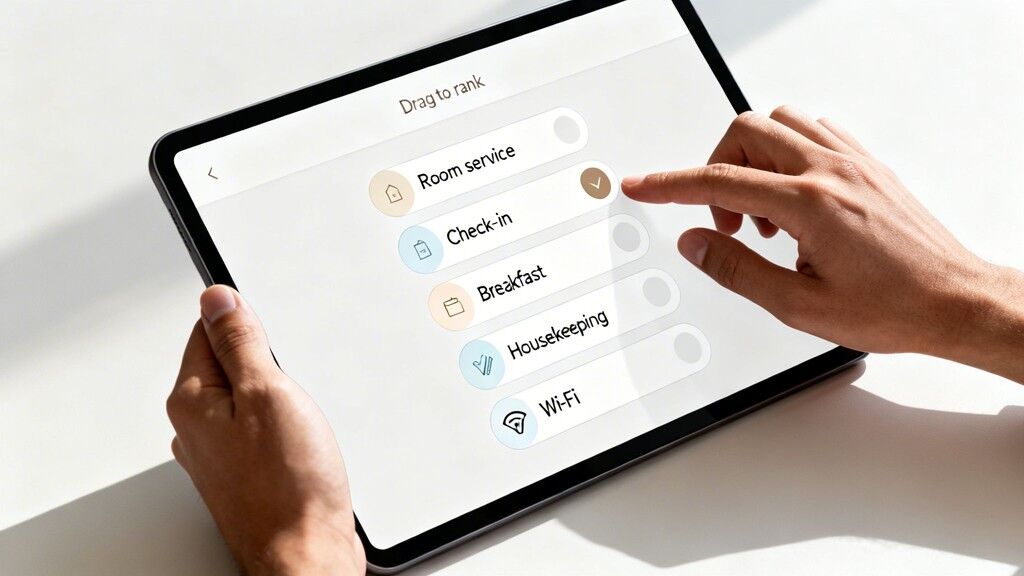
The single biggest mistake we see is creating a long, confusing list of options. This triggers "respondent fatigue"—a real phenomenon where customers get tired, stop paying attention, and either abandon your survey or just click randomly. The data you get back is a mess, and the whole effort is wasted.
Keep Your Lists Short and Sweet
To get quality results, you need to be disciplined. The golden rule is to limit your list to 5-7 items. This is the sweet spot. It’s just long enough for meaningful comparisons but short enough to keep people focused.
Think of it like a wine tasting. Asking a guest to compare five wines is manageable and reveals genuine preferences. Asking them to compare fifteen will just overwhelm their palate, and the feedback becomes useless.
What if you have a longer list of priorities? Break it up. Run multiple, smaller rank order questions, perhaps targeting different customer segments.
Ensure Options Are Distinct and Comparable
Your options need to be apples-to-apples, not apples-to-oranges. A customer can easily rank "room cleanliness," "check-in speed," and "breakfast quality." These are distinct parts of their stay that they can weigh against each other.
But asking them to rank "friendly staff" versus "helpful staff"? That's a recipe for confusion. The options are so similar they force an arbitrary choice, giving you zero actionable insight.
Your goal is to force a trade-off between genuinely different choices. Each item on your list should represent a unique value proposition or feature you can take direct action on.
Here are a few quick rules for creating comparable options:
Maintain a consistent level of detail: Don't mix broad concepts like "service quality" with specific items like "free bottled water."
Avoid jargon: Use simple, clear language everyone understands. "In-room dining" is a lot better than "culinary provision logistics."
Focus on one dimension: If you're asking about hotel amenities, stick to amenities. Don't throw in questions about staff attitude or the booking process. For more on this, check out our guide on how to write effective survey questions.
Make It Easy and Interactive
How you present the question matters. A lot. Old-school text boxes where users manually type numbers (1, 2, 3...) feel clunky and are a magnet for errors. With over 57% of surveys now completed on mobile devices, a smooth UX isn't a nice-to-have; it's non-negotiable.
Modern survey tools give you interactive formats that drive up completion rates.
Drag-and-Drop: This is the most intuitive method. Customers simply drag items into their preferred order. It’s visual, engaging, and works beautifully on any screen.
Click-to-Rank: Users click on items in the order they prefer, and the numbers appear automatically. It’s a clean, simple alternative to dragging.
These interactive methods do more than just look good—they reduce the cognitive load on your customer. By making the process easy and even a little fun, you show you respect their time. In return, you're far more likely to get the thoughtful, decisive data you need to grow.
Automating Feedback with a Feedback Operating System
Let’s be honest: building, sending, and analyzing even simple rank order survey questions is a huge time sink. The manual work piles up fast. You’re stuck designing questions, getting the formatting right, sending them out, and then pulling your hair out trying to calculate mean ranks in a spreadsheet. It’s just not a sustainable way to gather feedback.
This is exactly where a Feedback Operating System like FeedbackRobot steps in. It transforms a task that takes hours into one that takes just a few minutes, helping you collect smarter, act faster, and grow stronger.
Instead of fighting with disconnected, clunky tools, you can put the entire feedback workflow—from creation to analysis—on autopilot. Our platform is designed to help you get smarter feedback without slowing you down.
Turn Ideas into Surveys Instantly
The first roadblock is always creating the survey. You have a great idea for a question, but the thought of actually building the survey feels like starting a whole new project.
With FeedbackRobot, you can skip that manual setup entirely. Our Prompt to Survey feature turns a simple thought into a polished, ready-to-go survey in seconds.
Prompt to Survey uses AI to build your surveys for you. Just type in what you want to ask, and the system instantly generates a clean, interactive ranking question, eliminating tedious design work so you can focus on the why.
For instance, you could type:
"Create a survey for my hotel guests to rank our top 5 most important amenities from a list: pool, gym, free breakfast, late check-out, and on-site restaurant."
Just like that, our AI builds a clean, interactive drag-and-drop ranking question.
Here’s what it looks like when a simple prompt generates a fully functional survey, ready for your guests to use.
As you can see, the platform instantly converts that plain-text request into a mobile-friendly survey that's ready to capture what your guests value most.
From Collection to Insight Without Lifting a Finger
Once your survey is out in the wild, responses start rolling in from all your channels—emails, QR codes on restaurant tables, or even through direct integrations with your existing systems like Mews or Toast. This is where the real magic happens. There’s no waiting around and no manual data exporting.
All that feedback flows directly into a unified dashboard where our AI Summaries get to work right away.
AI Summaries instantly analyze your results. This feature automatically crunches the numbers on your rank order data, identifies key themes, and even performs sentiment analysis to reveal the emotion behind the feedback.
It hands you:
Clear Priority Rankings: Instantly see which features or amenities are consistently ranked highest and which fall to the bottom.
Sentiment Analysis: Go beyond the numbers to understand the emotion. Are guests happily ranking "free breakfast" at the top, or are they frustratedly putting "check-in speed" last?
Key Themes: The AI also spots recurring topics in any open-ended comments, giving you the bigger picture at a glance.
Imagine knowing, in real-time, that "room service speed" has suddenly become your guests' #1 priority this month, while the "hotel bar atmosphere" has slipped. That’s how you act faster and grow your business—all inside a single, connected platform.
You can learn more about turning this kind of data into action by checking out our guide on choosing a powerful feedback analysis tool for your small business. It’s all about moving from just gathering data to making confident decisions that drive real results.
Turning Ranked Data Into Actionable Business Strategy
Collecting ranked data is a huge step forward, but that's only half the battle. The real magic happens when you turn those numbers into a concrete action plan for your business. Let's break down how to move past simply counting which item got the most #1 votes.

You don't need a degree in statistics to find the story in your data. The good news is, a few simple techniques can help you make confident decisions that improve your customer experience and, ultimately, your bottom line.
Beyond First Place: Finding What Really Matters
The most common mistake is focusing only on the "winner"—the item that collects the most #1 ranks. While that's an important signal, it doesn't give you the full picture.
Think about it this way: an item that consistently ranks #2 or #3 across all your customers might be a smarter priority than an item ranked #1 by a small, passionate group but last by everyone else. This is where mean rank comes in.
By calculating the average position for each item, you create a clear, weighted hierarchy of what people prefer overall. An item with a lower mean rank (like 2.1) is more important to your entire customer base than one with a higher mean rank (like 4.5).
Another powerful metric is the first-choice share. This simply shows the percentage of people who ranked an item as their absolute top priority. If 67% of diners rank 'food quality' as #1, you know exactly where to focus your kitchen's training budget.
Research shows that items in rank order survey questions naturally fall into tiers. Typically, about 15-20% of items land in the top preference group, while another 15-20% consistently end up at the bottom. Your job is to find out which items fall into that top tier for your customers. You can find more great examples of these ranking methods over at SurveyPlanet.
Okay, so you have these numbers. But what do they actually mean? Here's a simple breakdown of how to translate these analysis methods into real-world actions.
Simple Ways to Analyze Your Ranking Data
This table helps you understand what your ranking results are telling you and what to do next.
Analysis Method | What It Tells You | Example Action |
|---|---|---|
First-Choice Share | The single most popular item. | If "fast Wi-Fi" is #1, make upgrading your network a top budget priority. |
Mean Rank | The overall preference across all customers. | An item with a low mean rank is a safe bet for investment, even if it isn't #1. |
Borda Count | A weighted score showing broad appeal. | Use it to find a "crowd-pleaser" feature that satisfies the most people. |
Simple Counting | The total number of #1, #2, #3 ranks. | Good for a quick snapshot of the top and bottom performers. |
These methods give you a much clearer view than just looking at the top-ranked item. They help you spot the hidden gems and avoid overinvesting in niche preferences.
Visualizing Trends with a Feedback Operating System
Manually calculating mean ranks and tracking changes over time in a spreadsheet is tedious and a recipe for error. This is where a Feedback Operating System automates the grunt work and brings your data to life.
FeedbackRobot's Radar feature acts as your command center for understanding customer priorities.
Radar provides unified review intelligence. It automatically pulls in data from all your rank order surveys and other feedback channels, visualizing the results on a clean, intuitive dashboard so you see the complete picture.
Radar does more than just show you a static snapshot. It's a dynamic tool that tracks how customer priorities shift over time, letting you measure the direct impact of your operational changes.
For example, you might see that "check-in speed" is consistently ranked low. After you implement a new process to streamline guest arrivals, you can watch its mean rank improve over the following weeks, validating that your change worked and the investment paid off.
Connecting Data to Your Budget
This is how you move from just collecting feedback to acting on it with speed and precision. The insights from your ranked data give you a clear, justifiable reason to reallocate your team's focus and budget.
Stop funding low-ranked amenities: Is that expensive gym equipment gathering dust while guests are begging for better in-room coffee? The data will tell you where to cut costs without hurting satisfaction.
Double down on high-impact services: If 'staff responsiveness' is consistently ranked near the top, you know that investing in more training or another front-desk team member is a smart move that will directly boost loyalty.
Test new ideas with confidence: Let your customers prioritize a list of potential new menu items or service offerings with a rank order question before you spend a dime developing them.
This process gives you a data-driven roadmap for making strategic decisions. For a deeper dive into the numbers, our comprehensive guide to the analysis of survey data offers even more techniques. By connecting what customers want to where you spend your money, you ensure every dollar is working to grow your business.
Real-World Examples from Hospitality and Service Industries
Theory is great, but the real learning starts when you see how your peers use rank-order questions to get ahead. These aren't just abstract survey tactics; they're data-driven strategies that deliver clear, measurable results. Let's dig into how hospitality and service businesses are turning customer preferences directly into profit.
The hospitality sector, in particular, has been a frontrunner in adopting rank-order surveys. Data from 2020-2026 shows just how quickly this method became a go-to tool. By 2026, an estimated 54% of hospitality operators were already putting these questions to work.
Why? Because ranking is exceptionally good at revealing trade-offs. For instance, when restaurants asked diners to rank the most important factors for a repeat visit, 41% of customers placed ambiance and service quality well above price. That’s the kind of insight that tells you exactly where to focus your energy to build real loyalty. For a deeper dive into the research methodology, you can explore the do's and don'ts of ranking questions on Qualtrics.com.
The Boutique Hotel Loyalty Revamp
A boutique hotel wanted to overhaul its loyalty program perks. Instead of guessing what their members might want, they just asked. They deployed a simple rank-order survey with five potential benefits: 'room upgrades,' 'late check-out,' 'free breakfast,' 'spa credits,' and 'airport transfer.'
The results were a game-changer. Management had put their money on 'room upgrades' or 'spa credits' being the top draws. But the data showed a clear, undeniable winner: 'late check-out.'
This was a massive win. Late check-out is an incredibly low-cost benefit to offer, yet it was the single most valued perk for their most loyal guests.
This is the power of ranking in action. It cuts straight through assumptions to pinpoint high-impact, low-cost opportunities that a simple rating scale would have missed entirely.
Optimizing a New Restaurant Menu
A restaurant group was planning to launch a new seasonal menu—a notoriously risky and expensive project. To avoid a costly flop, they went to their customers first. They used a rank-order survey, asking a segment of their regulars to rank five potential new main courses.
This one step gave them a clear hierarchy of what their diners actually wanted to eat. The dish that the marketing team was sure would be a home run? It came in fourth. The dish the chefs were most passionate about? It ranked number one.
They launched the top two dishes with full confidence. Both became best-sellers, saving the company the cost and waste of rolling out an unpopular menu item.
The Professional Services Firm Retention Boost
It’s not just hotels and restaurants, either. A financial advisory firm was bleeding clients, and they couldn’t figure out why. Their fees were competitive, so that wasn't it.
They used a rank-order question to ask departing clients to rank their reasons for leaving. The options included 'service fees,' 'investment performance,' 'proactive communication,' and 'digital tools.'
To their surprise, 'proactive communication' was consistently ranked as a more significant factor for leaving than 'lower fees.' Armed with this insight, the firm implemented a new client communication protocol with scheduled check-ins and personalized market updates.
The outcome? A documented 18% increase in client retention over the next 18 months. For another powerful example of how listening to customer feedback shapes loyalty programs, just look to the Starbucks Rewards Program as a model for growth.
These examples all share a common thread. They used rank-order questions not just to listen, but to uncover the relative importance of different options. This crucial context is what lets you collect smarter feedback, act on what truly matters most, and grow your business with confident, data-backed decisions.
Closing the Loop with Automated Service Recovery
Knowing your customers’ top priorities from rank-order survey questions is a huge win. But what happens when feedback shows you’re falling short on that number one priority? This is your moment to close the loop—turning a potential disaster into a massive win for guest loyalty.
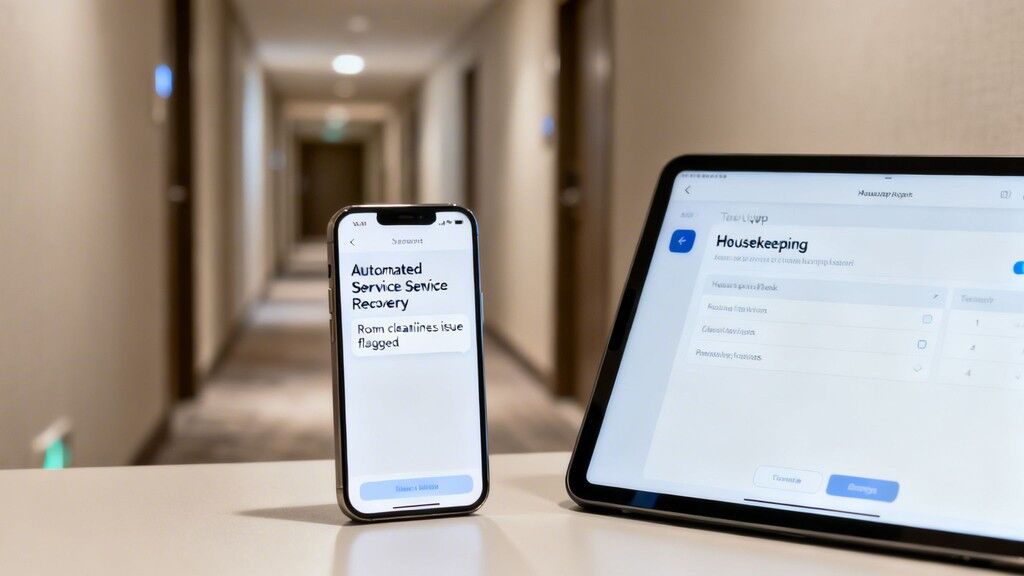
Picture this: your unified review dashboard, Radar, flags a troubling pattern. Your hotel guests consistently rank ‘room cleanliness’ as their top priority, but the sentiment score tied to it has started to nosedive. That’s a five-alarm fire. Instead of scrambling to figure out what went wrong, FeedbackRobot’s Resolutions Engine jumps on it instantly.
The Resolutions Engine provides automated service recovery. It triggers instant, pre-defined workflows when negative feedback comes in, ensuring no guest complaint is ever missed.
This isn't just about good customer service. It’s about automated service recovery that works around the clock, even when you’re not.
From Problem to Resolution in Seconds
The moment a negative review comes in that fits your rules—say, any mention of 'cleanliness' with a low score—the Resolutions Engine gets to work. It doesn’t wait for your team's morning huddle.
Here’s a glimpse of how the engine transforms a complaint into a structured, automated recovery mission.
This workflow shows a negative cleanliness review automatically sending an alert to the housekeeping manager and a personalized apology to the guest. This multi-step response ensures no complaint ever slips through the cracks, turning a poor experience into a chance to really impress someone.
How Automated Recovery Forges Loyalty
By acting immediately on insights from your rank-order questions, you do more than just fix a problem. You send a clear, powerful message to your guests: we hear you, we care, and your priorities are our priorities. That rapid, personal response is what turns a one-time critic into a raving fan.
The Resolutions Engine lets you build custom workflows for any situation you can imagine:
Immediate Alerts: Automatically flag negative comments about 'food quality' and send an instant notification to your head chef's phone.
Automated Apologies: Trigger a personalized email to the guest who ranked 'check-in speed' last, offering a sincere apology and a small discount on their next stay.
Internal Follow-Up: Create a task in your system for the front desk manager to personally call a guest who reported a noisy room.
Research shows time and again that customers who have a problem solved effectively become more loyal than those who never had a problem in the first place. Automated recovery makes this level of service possible at any scale.
This is how you complete the feedback loop. You use rank-order questions to find out what truly matters, and you use automated resolutions to prove you’re acting on it.
And once you’ve turned that situation around and earned a glowing new review, you can automatically show it off on your Spotlight: Feedback Wall. This powerful tool takes your service recovery wins and turns them into compelling social proof, attracting new customers by showcasing your commitment to excellence. It’s the ultimate expression of our core philosophy: collect smarter, act faster, and grow stronger.
Frequently Asked Questions
When it comes to rank order questions, a few common questions always pop up. Here's what we tell hospitality and service owners when they're getting started.
How Many Options Should I Include in a Rank Order Question?
We've found the sweet spot is between 5 and 7 options. That range consistently delivers the clearest results.
If you give people fewer than five choices, you often don't get enough detail to spot real priorities. But go over seven, and you’ll run right into respondent fatigue. Customers get overwhelmed and start dragging and dropping randomly just to get it over with, which makes the data useless.
When Are Rank Order Questions Most Effective?
Rank order questions are at their best when you need to understand trade-offs. They force a decision, which is perfect when you’re asking guests to choose between comparable items—like potential hotel amenities, new service features, or a list of menu ideas.
But they aren’t the right tool for measuring standalone satisfaction. If you just want to know how happy a guest was with their stay, a simple rating scale like our free Net Promoter Score Calculator will get you a much cleaner answer for that specific job.
The biggest mistake in analyzing ranking data is only looking at the #1 ranked item. While important, analyzing the 'mean rank' of all items gives you a more complete picture of the overall preference hierarchy.
What Is the Biggest Mistake in Analyzing Ranking Data?
The most common mistake we see is focusing only on the item that gets the most #1 votes. It’s tempting to just look at the winner, but that doesn’t tell you the whole story and can even point you in the wrong direction.
A much better approach is to look at the 'mean rank' for every single item. This gives you a weighted average that reveals the true preference hierarchy. Think about it: an item that everyone ranks #2 or #3 can be far more valuable to your business than an item that a small, vocal group loves but everyone else hates.
Ready to stop guessing and start knowing what your customers truly want? FeedbackRobot is the all-in-one Feedback Operating System that helps you collect smarter feedback, act faster on insights, and grow stronger. Launch powerful rank order surveys in seconds and see what really matters.
Ready to stop guessing? Use our AI Review Question Generator to find the perfect ranking questions for your industry and start collecting smarter feedback in seconds.
Why are rank order questions superior to standard 1-5 rating scales for strategic operational planning?
Rating scales often suffer from a "ceiling effect" where guests rate every attribute a 4 or 5, leaving management with no clear sense of priority. Rank order questions eliminate this ambiguity by forcing respondents to make difficult trade-offs. This "forced-choice" format reveals a definitive hierarchy of value, allowing you to identify which high-cost amenities are truly non-negotiable and which can be scaled back without significantly impacting overall satisfaction.
If a business has ten or more service attributes to evaluate, how should they structure a ranking question to avoid respondent fatigue?
Attempting to rank more than seven items typically triggers "cognitive overload," leading respondents to abandon the survey or provide randomized data that lacks integrity. To maintain data quality for longer lists, you should segment the attributes into thematic sub-categories—such as "In-Room Technology" versus "Facility Amenities"—or utilize FeedbackRobot's Prompt to Survey tool to create multiple, shorter survey versions distributed to different customer segments. This ensures respondents remain focused and the resulting data remains actionable.
From an analytical perspective, why is the "Mean Rank" often a more reliable indicator for ROI than the "First-Choice Share"?
The "First-Choice Share" only highlights a polarizing winner, which may appeal strongly to a niche group while being irrelevant to the majority. In contrast, the "Mean Rank" provides a weighted average that reflects the collective sentiment of your entire guest base. An attribute that consistently places second or third across all respondents often represents a safer, higher-ROI investment than a luxury feature that is "number one" for a few but "last" for everyone else.
How can a hospitality or healthcare provider use ranking data to refine an automated service recovery strategy?
By integrating ranking insights with a platform like the Resolutions Engine, you can prioritize automated workflows based on identified guest values. If your data indicates that "proactive communication" is the top priority for your clientele, you can configure the system to trigger an immediate, high-priority alert to a department head the moment negative sentiment regarding communication is detected. This ensures your recovery efforts are laser-focused on the specific friction points that have the greatest influence on retention.
What are the risks of including non-comparable options, such as "staff attitude" and "Wi-Fi speed," within the same ranking list?
For ranking data to be valid, options must be "apples-to-apples" so that the trade-off is logically consistent for the respondent. Mixing a broad, interpersonal quality like "staff attitude" with a specific technical amenity like "Wi-Fi speed" creates confusion because they address different dimensions of the experience. To ensure the results can drive budget decisions, keep each list focused on a single dimension—comparing either specific physical amenities or distinct service interactions—so the trade-offs represent clear, actionable choices.
Stop reading about it. Let your agent handle it.
25 free AI actions · no credit card required
Start Free