

Guide
What Are Feedback Analytics Tools? A 2026 Buyer's Guide
The best feedback analytics tools in 2026 — core features, implementation steps, and how to turn customer feedback into real decisions.

May 4, 2026 · 8 min read
Free tool
AI Survey Generator
Describe what you want to learn and get a ready-to-send survey in seconds.
You're Drowning in Data. It's Time to Learn How to Swim.
Every day, your business is flooded with a tidal wave of customer feedback. It comes from everywhere: five-star Shopify reviews, frustrated support tickets, lengthy NPS survey comments, off-the-cuff mentions on social media, and even QR code scans at a physical location. You have more data on what your customers think, feel, and want than ever before. Yet, for many businesses, this wealth of information feels less like a strategic asset and more like chaotic noise. Most of it sits unread in a dozen different systems, its potential value evaporating with each passing day.
This is the critical gap where feedback analytics tools operate. They are the engine that transforms raw, unstructured customer opinions into structured, actionable intelligence. In 2026, these platforms are no longer a luxury for enterprise giants; they are a fundamental component of a modern tech stack for any company serious about retention and growth. They move beyond simple data collection and dashboarding to provide deep, automated analysis that uncovers the 'why' behind customer behavior. While many tools can perform this function, the most advanced solutions are leveraging artificial intelligence to deliver insights at a scale and speed previously unimaginable. For a detailed breakdown of the leading platforms, our comprehensive guide on the Top AI Customer Feedback Analysis Tools for 2026 provides an essential market overview.
Defining the Category: More Than Just a Survey Tool
Let's clarify what a feedback analytics tool is—and what it isn't. It is not simply a survey platform like SurveyMonkey or a basic review widget. While those tools are excellent for *collecting* feedback, they often fall short on the *analysis* part. A true feedback analytics platform is a centralized intelligence hub designed to perform several key functions:
Data Aggregation: It connects to all your disparate feedback channels—CRMs, helpdesks, review sites, app stores, social media platforms, and internal databases—to pull all qualitative data into a single, unified view.
Sentiment Analysis: Using Natural Language Processing (NLP), the tool automatically determines the emotional tone of each piece of feedback, classifying it as positive, negative, or neutral with a high degree of accuracy.
Topic and Theme Extraction: It moves beyond simple keyword counting to identify the core topics and themes customers are discussing. It understands that "the app is slow" and "the load times are terrible" are both about 'Performance.'
Trend Analysis: It visualizes how feedback sentiment and topics change over time. You can instantly see the impact of a new feature launch, a price change, or a marketing campaign on customer sentiment.
Root Cause Analysis: The most powerful tools help you connect the dots between feedback trends and business outcomes, helping you identify the fundamental reasons behind customer churn or loyalty.
In essence, these tools automate the work that would require a team of data analysts, saving thousands of hours while uncovering insights that would be impossible to find manually.

Why You Can't Afford to Ignore Feedback Analytics in 2026
Relying on anecdotal evidence or manually sifting through feedback is a recipe for falling behind. Investing in a dedicated analytics tool provides a clear, defensible return on investment across multiple business functions.
1. Shift from Reactive to Proactive Problem Solving
Instead of waiting for an issue to become a firestorm of one-star reviews, feedback analytics tools act as an early warning system. Imagine a slight uptick in support tickets mentioning a 'confusing checkout button' after a recent website update. An analytics tool can flag this emerging theme automatically, alerting your product team to a potential UX issue long before it impacts conversion rates on a larger scale. This proactive stance protects revenue and brand reputation.
2. Data-Driven Product Roadmap Prioritization
Product teams constantly debate which features to build next. Feedback analytics replaces guesswork with evidence. By quantifying qualitative feedback, you can definitively say, "Over the last quarter, 35% of all feature requests were related to improving integration capabilities, making it the most demanded improvement by our user base." This data provides a clear mandate for your product roadmap, ensuring you invest development resources where they will have the greatest impact on customer satisfaction and retention.
3. Enhance Customer Retention and Reduce Churn
Understanding why customers leave is critical. Feedback analytics tools allow you to analyze the feedback of churned customers as a specific cohort. You can identify the common themes and pain points that preceded their decision to cancel. Was it poor customer service? A missing feature? High pricing? By pinpointing the primary drivers of churn, you can implement targeted strategies to mitigate those issues for your existing customer base, directly improving your retention rate.
4. Gain a Sharp Competitive Edge
Your competitors' feedback is a public goldmine of strategic information. Modern analytics platforms can be pointed at public review sites like G2, Capterra, or Google Maps to analyze what customers love and hate about competing products. If you discover a recurring complaint about a competitor's poor onboarding process, you can double down on making your own onboarding experience seamless and highlight that strength in your marketing.
Core Features: A Checklist for Evaluating Feedback Analytics Tools
The market is crowded, and not all tools are created equal. As you evaluate potential solutions, prioritize platforms that excel in these five critical areas.
1. Comprehensive Multi-Channel Integrations
Your feedback is fragmented. A powerful tool must unify it. Look for native, one-click integrations with the systems you already use: CRMs (Salesforce, HubSpot), Helpdesks (Zendesk, Intercom, Freshdesk), Review Platforms (Google Reviews, Trustpilot, G2), Survey Tools (SurveyMonkey, Typeform), and Team Communication (Slack, Microsoft Teams). A robust API is also essential for pulling in data from proprietary or custom systems, like a manual spreadsheet or an internal database.
2. Truly Advanced AI and Natural Language Processing (NLP)
This is the engine of the platform. Don't settle for basic keyword matching. Demand sophistication:
Aspect-Based Sentiment: The AI should understand that in the sentence, "The battery life is amazing, but the camera quality is poor," the sentiment about the 'battery' is positive while the sentiment about the 'camera' is negative. This level of granularity is crucial for actionable insights.
Intent Recognition: Can the system differentiate between a bug report, a feature request, a pricing question, and general praise? This allows for automatic routing of feedback to the correct department (e.g., bug reports go to Engineering, pricing questions go to Sales).
Contextual Understanding: A sophisticated NLP model can understand industry-specific jargon, sarcasm, and complex sentence structures, leading to far more accurate analysis than simplistic models.
3. Customizable Dashboards and Stakeholder Reporting
Different teams need different views of the data. The C-suite needs a high-level overview of brand health and NPS trends. The product team needs a granular look at feature requests and bug reports. The marketing team needs to see sentiment trends related to recent campaigns. The right tool allows you to easily build and share role-specific dashboards and schedule automated reports, ensuring everyone gets the insights they need without information overload.
4. Intelligent Automation for Tagging and Workflows
Manual effort doesn't scale. A core value proposition of these tools is automation. The system should be able to automatically tag and categorize 90% or more of incoming feedback based on predefined rules and machine learning. Furthermore, it should enable workflow automation. For example: 'If a customer with an LTV over $5,000 leaves a negative review, automatically create a high-priority ticket in Zendesk and send a notification to the #vip-alerts Slack channel.' This closes the loop between insight and action.
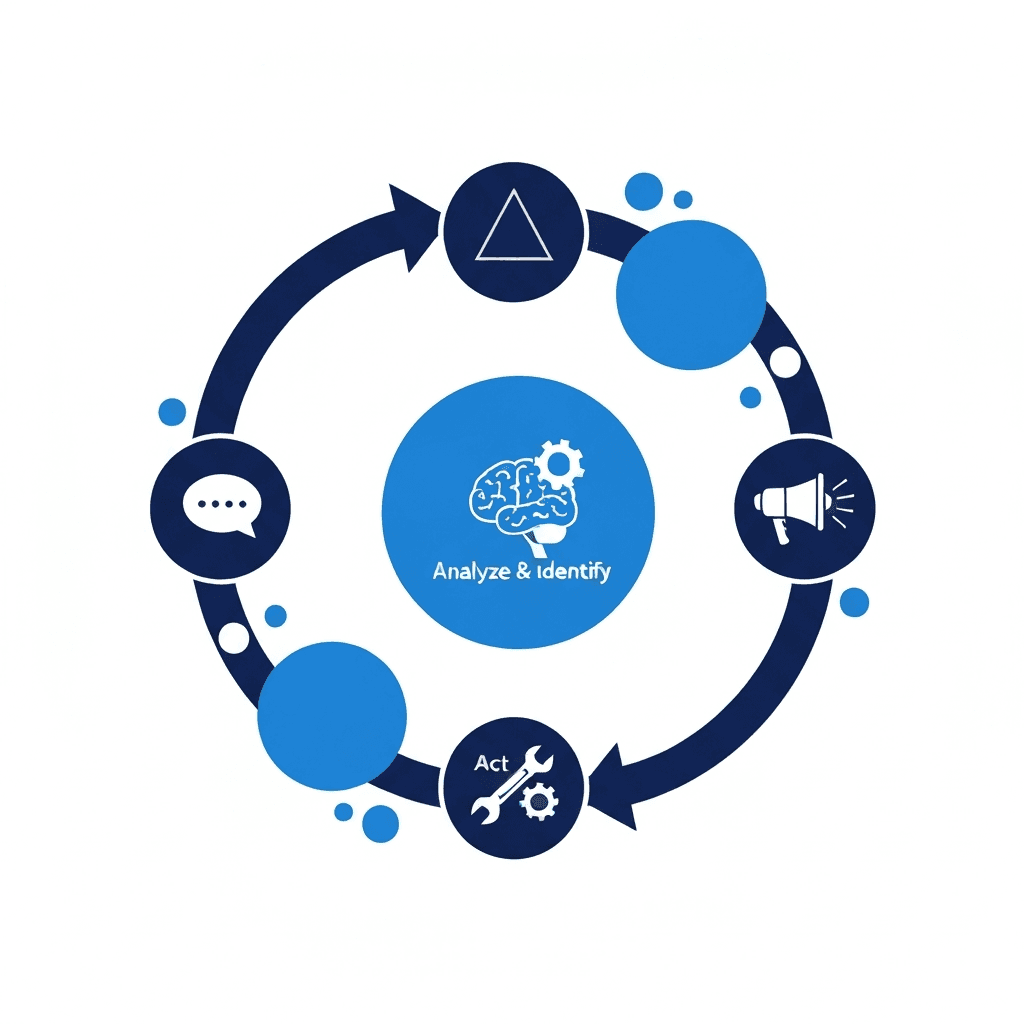
How to Implement a Feedback Analytics Tool: A 4-Step Framework
Buying the tool is only the first step. Driving real business value requires a thoughtful implementation process.
Step 1: Define Your Primary Objective
Start with a clear, measurable goal. Don't just "listen to customers." Instead, aim to "Reduce support ticket volume by 15% by identifying and fixing the top three recurring product issues" or "Improve our App Store rating from 4.2 to 4.5 stars within six months." A specific goal will guide your entire setup and ensure you can measure the tool's ROI.
Step 2: Conduct a Feedback Source Audit
Before you integrate anything, map out every single place your company receives customer feedback. Create a spreadsheet listing the source (e.g., Zendesk, App Store, Twitter), the data owner (e.g., Head of Support), and the format (e.g., tickets, reviews, mentions). This audit ensures you don't miss any valuable data streams and helps you prioritize which sources to connect first.
Step 3: Configure, Integrate, and Validate
Begin by connecting your two or three most valuable feedback sources. Work with the vendor's support team to ensure data is flowing correctly. Spend time configuring your initial topic tags and dashboards based on your primary objective. Run the analysis on a historical data set (e.g., the last three months of feedback) to validate that the AI's tagging and sentiment analysis align with your team's manual assessment.
Step 4: Establish a Cross-Functional 'Feedback Loop'
A tool is useless in a silo. Create a recurring meeting (e.g., monthly) with stakeholders from Product, Marketing, Support, and Success. In this meeting, review the key insights and trends from the platform and assign clear action items. Who is responsible for investigating the spike in negative feedback about shipping? Who will scope the most-requested feature? This formal process ensures that insights are consistently translated into business improvements, which you can then communicate back to your customers.
Industry-Specific Applications
The value of feedback analytics can be tailored to the unique challenges of any industry:
SaaS: Prioritize analysis of feedback from Intercom, Jira, and G2 to pinpoint sources of user friction, identify bugs, and validate the roadmap for the next development sprint.
E-commerce: Connect to Shopify, Amazon Reviews, and post-purchase CSAT surveys. Focus on themes related to product quality, shipping times, packaging, and the returns process to optimize operations and drive repeat purchases.
Hospitality & Retail: Aggregate data from Google Maps, Yelp, and in-store QR code surveys. Analyze feedback on a location-by-location basis to identify issues with staff training, store cleanliness, or product availability.
B2B Enterprise: Analyze qualitative data from quarterly business reviews (QBRs), client-facing Slack channels, and high-touch support tickets. The lower volume of feedback is offset by its high value, making nuanced analysis critical for retaining key accounts.
Conclusion: From Noise to Navigation
In the digital economy of 2026, the voice of the customer is your most valuable and abundant natural resource. Leaving it untapped is no longer an option. Feedback analytics tools provide the machinery to refine this raw material into pure, actionable strategy. They transform the cacophony of customer opinions into a clear signal that can guide your product development, improve your operational efficiency, and build a base of fiercely loyal customers.
By centralizing data, applying intelligent analysis, and automating action, you can finally move from being overwhelmed by feedback to being guided by it. The brands that win in the years to come will be the ones that listen best, and in the world of big data, listening requires the right technology. It's time to stop drowning and start navigating.
How does a dedicated feedback analytics platform differ from the standard survey and review tools we already use?
Standard survey tools are primarily designed for data collection; they capture the "what" but struggle to synthesize the "why" across multiple channels. In contrast, a feedback analytics platform acts as a centralized intelligence hub. It aggregates fragmented data from disparate sources—such as Shopify reviews, Zendesk tickets, and social media mentions—into a single environment. By utilizing Natural Language Processing, these platforms move beyond basic data storage to provide automated theme extraction and root cause analysis, essentially replacing hours of manual data entry with real-time, actionable insights.
What is "Aspect-Based Sentiment Analysis," and why is it superior to traditional sentiment scoring?
Traditional sentiment analysis often assigns a single emotional score to an entire comment, which frequently obscures critical details. Aspect-based sentiment analysis is a more granular AI capability that evaluates individual components within a single piece of feedback. For example, if a guest notes that "the room was immaculate but the check-in process was agonizingly slow," the system correctly identifies a positive sentiment for 'facility maintenance' and a negative sentiment for 'front desk operations.' This level of precision allows department heads to address specific operational failures without being misled by an aggregate "neutral" score.
Can these tools assist in product development, or are they strictly for customer service teams?
These platforms are indispensable for product roadmap prioritization. Rather than making development decisions based on anecdotal requests or the loudest voices in a forum, feedback analytics allows you to quantify qualitative data. You can identify exactly what percentage of your user base is requesting a specific integration or reporting a recurring UX friction point. This evidence-based approach ensures that engineering resources are allocated to features that will have the highest measurable impact on customer satisfaction and retention.
How can a business use feedback analytics to monitor and outperform its competitors?
Strategic advantage is gained by pointing these analytics tools at public data sources such as G2, Capterra, or Google Maps to ingest your competitors' customer reviews. By analyzing their feedback trends, you can identify recurring pain points in their service delivery or product features. If the data reveals a consistent complaint regarding a competitor’s onboarding experience or pricing structure, you can proactively refine your own processes and adjust your marketing messaging to highlight those specific areas as your own brand's competitive strengths.
What is the most effective way to ensure that the insights generated by the tool actually lead to business changes?
The most sophisticated tool will fail to deliver value if the insights remain siloed. To drive real results, you must establish a cross-functional "Feedback Loop." This involves a recurring meeting with stakeholders from Product, Marketing, and Operations to review the AI-generated trends and assign clear accountability for specific action items. Closing the loop also requires communicating these changes back to the customers; letting them know their feedback directly resulted in a product update or a policy change is a powerful driver of long-term brand loyalty.
Stop reading about it. Let your agent handle it.
25 free AI actions · no credit card required
Start Free