

Guide
Advantages of Customer Feedback: 8 Benefits & Real Examples (2026)
The 8 key advantages of customer feedback — better products, higher retention, stronger reputation and lower costs — with real examples.

Aug 16, 2026 · 18 min read
Free tool
AI Survey Generator
Describe what you want to learn and get a ready-to-send survey in seconds.
In the fast-paced hospitality and service world, you don't have time for guesswork. Wasted resources, missed opportunities, and customer churn are the high costs of not knowing what your guests and customers truly think. The most successful operators don't guess; they ask, listen, and act with precision. This article moves beyond generic advice to give you a concrete, scannable list of the most impactful benefits of customer feedback. We will explore eight distinct advantages you can unlock—from refining your service roadmap to boosting your brand reputation and driving real growth.
Starting with a robust customer feedback analysis strategy is the first step. Each point here is designed to be immediately actionable, showing you how to turn raw comments, reviews, and survey responses into a powerful engine for data-driven decisions. By learning to collect smarter, act faster, and grow stronger, you'll ensure every piece of feedback contributes directly to your bottom line and long-term success.
The 8 Advantages of Customer Feedback at a Glance
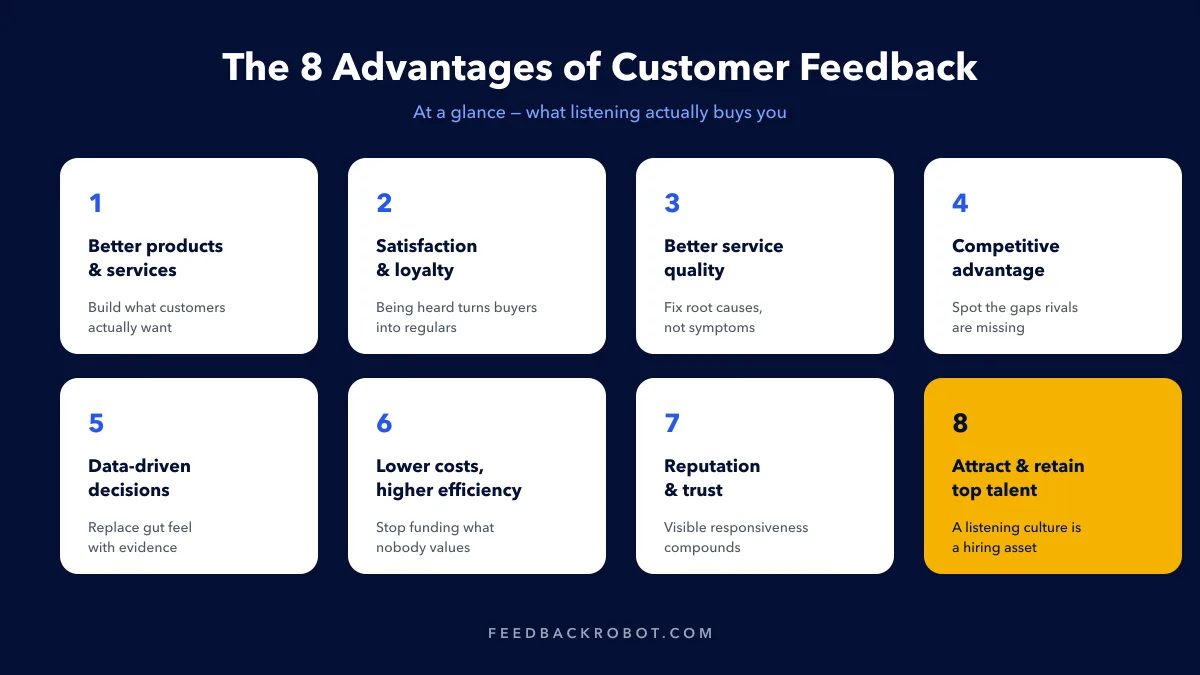
Here are the eight advantages of customer feedback in plain language. Each one links to a full section below with real hospitality and retail examples, implementation steps, and the metric to track.
- Improve your products and services — build what customers actually want, not what you assume they want
- Increase customer satisfaction and loyalty — being heard is what turns a transaction into a relationship
- Better customer service and support quality — fix root causes instead of symptoms
- Gain a decisive competitive advantage — spot the gaps your competitors are missing
- Make smarter, data-driven decisions — replace gut feel with evidence
- Lower costs and higher operational efficiency — stop funding what nobody values
- Stronger brand reputation and customer trust — visible responsiveness compounds over time
- Attract and retain top talent — a listening culture is a hiring asset too
1. Improve Your Products and Services
One of the most powerful benefits of customer feedback is its direct impact on product and service innovation. Instead of relying on internal assumptions, consistent feedback provides a direct line to what your customers truly want, need, and are willing to pay for. This data transforms your development process, ensuring every new feature, service refinement, or menu item is rooted in genuine market demand. You stop building in the dark and start co-creating with your customers.
While understanding customer needs is crucial for product development, implementing effective strategies for addressing those needs directly impacts customer satisfaction and loyalty. Learning from feedback allows you to refine your offerings, but mastering contemporary customer service ensures those refinements are delivered exceptionally. Explore modern customer service best practices to create consistently positive customer experiences that build lasting relationships.

This feedback loop allows you to prioritize development efforts, allocate resources more effectively, and significantly reduce the risk of launching services that miss the mark. You close the gap between what you think customers want and what they actually experience, turning them into partners in your brand’s future.
How to Implement It
Restaurant Example: A restaurant owner notices a recurring request in post-meal surveys for "more gluten-free options." They use this insight to partner with a local gluten-free bakery and redesign the menu, then announce the change on social media, highlighting it was based on customer suggestions. This not only improves the offering but also builds loyalty.
Hotel Example: A hotel chain uses in-stay feedback forms to identify that guests frequently ask for a simpler Wi-Fi login process. The IT team uses this specific, actionable data to implement a one-click connection through their Mews or Toast integration, leading to higher guest satisfaction scores from the moment they check in.
Tracking Success
Metric to Track: Feature Adoption Rate. Measure the percentage of guests or customers who use a new service that was developed based on their feedback within the first 30 days.
Goal: Aim for a 15-20% higher adoption rate for feedback-driven features compared to those developed from internal ideas alone.
FeedbackRobot in Action: Instead of manually sifting through thousands of reviews, FeedbackRobot's AI Summaries instantly identify trending topics and requests, like "more vegan options" or "easier checkout." This instant insights & sentiment analysis allows your team to pinpoint the most impactful development opportunities without the manual effort, helping you collect smarter and act faster on innovative ideas.
2. Increase Customer Satisfaction and Loyalty
Among the most crucial benefits of customer feedback is its direct line to building lasting loyalty. When you actively solicit, acknowledge, and act on customer input, you send a clear message: "We hear you, and you matter." This simple act of listening transforms a transaction into a relationship, fostering a powerful emotional connection that keeps customers coming back. This dialogue is the foundation of customer retention and advocacy.

This process proves to customers that their success is your priority, increasing their lifetime value and turning them into brand evangelists. To see how leading companies achieve this, you can explore various real-world customer success stories that highlight the impact of a customer-centric approach. Ultimately, a strong feedback loop is one of the most effective strategies for preventing customer churn and building a loyal base. Not measuring satisfaction systematically yet? Start measuring these advantages with the free AI Survey Question Generator — it drafts NPS and satisfaction questions for your specific business in seconds.
How to Implement It
Quick-Service Restaurant Example: A coffee shop includes a QR code on receipts that links to a short survey. After receiving feedback about a lukewarm latte, the manager immediately triggers an apology email with a voucher for a free drink on their next visit and uses the data to retrain the barista team. This fast response turns a negative experience into a loyalty-building moment.
Hotel Example: A resort trains its front-desk staff to not only ask about a guest's stay at checkout but also to log specific comments into their property management system. When a guest mentions loving the poolside service, a manager can send a personalized thank-you email, reinforcing the positive experience and encouraging a return visit.
Tracking Success
Metric to Track: Net Promoter Score (NPS). Regularly measure your NPS to gauge overall customer loyalty and their willingness to recommend your brand to others.
Goal: Aim for a 5-10 point increase in your NPS score within six months of implementing a structured feedback and response system.
FeedbackRobot in Action: When negative feedback surfaces, you need to act immediately. FeedbackRobot's Resolutions Engine provides automated service recovery. It can instantly detect a low rating, create a support ticket, assign it to the right team member, and even send a personalized apology with a special offer, turning potential detractors into loyal fans before they post a negative online review.
3. Better Customer Service and Support Quality
One of the most immediate benefits of customer feedback is its ability to directly improve the quality of your customer service. Feedback on support interactions shines a light on training gaps, inefficient processes, and communication breakdowns. This allows you to stop guessing what went wrong and start fixing the root causes of customer frustration.
Analyzing this targeted feedback helps you identify common pain points, streamline support workflows, and train your team on real-world scenarios. The result is faster issue resolution, a more empowered support staff, and a significant boost in customer satisfaction, transforming your support team from a cost center into a loyalty-building engine.
How to Implement It
Hotel Example: A resort manager uses post-stay surveys and finds a pattern of complaints about slow check-in times. The feedback reveals a bottleneck in processing payments with their Mews system. They implement a new pre-arrival payment link, cutting check-in time by half and improving initial guest satisfaction scores.
Restaurant Example: A large restaurant group analyzes support chat transcripts and notices many customers are confused about the reservation policy for large parties. They use this insight to create a clear, concise FAQ page and train hosts to proactively share the link, reducing repeat inquiries and freeing up staff for more complex guest needs.
Tracking Success
Metric to Track: First Contact Resolution (FCR) Rate. Measure the percentage of customer support issues that are successfully resolved during the first interaction.
Goal: Increase your FCR rate by 10% within three months by addressing the top three issues identified in customer service feedback.
FeedbackRobot in Action: Instead of waiting for a negative review to escalate, our Prompt to Survey feature can automatically text a guest a link to a private survey moments after they check out or pay. If a poor experience is indicated, the Resolutions Engine triggers an immediate service recovery workflow, alerting a manager so you can solve the problem before it becomes a public complaint. This helps you act faster on service issues and grow stronger.
4. Gain a Decisive Competitive Advantage
One of the most strategic benefits of customer feedback is its ability to create a significant competitive advantage. While your competitors rely on market reports and internal assumptions, you can tap into a live stream of customer intelligence that reveals unmet needs, emerging trends, and points of friction they have missed. This insight allows you to pivot faster, innovate more effectively, and carve out a unique position in the market.
By systematically listening and acting on what customers say, you can build a brand known for being more responsive and customer-centric. This transforms your customer service from a cost center into a powerful differentiator, making your business the obvious choice for consumers who value being heard and understood.
How to Implement It
Restaurant Example: A local coffee shop owner notices through online reviews that customers are constantly complaining about the lack of comfortable seating at a competitor's popular location. She uses this insight to invest in better furniture and promote her shop as a "cozy work-from-anywhere hub," directly addressing a market gap and attracting a new customer segment.
Hotel Example: An independent hotel monitors feedback trends and sees that travelers are increasingly frustrated with the impersonal, automated service at large chain hotels nearby. The hotelier doubles down on personalized service, empowering staff to offer custom recommendations and surprise upgrades, then highlights these unique guest stories in their marketing to differentiate their brand.
Tracking Success
Metric to Track: Share of Voice (SOV). Monitor how often your brand is mentioned online in your market compared to your top three competitors.
Goal: Increase your brand's SOV by 10% within six months by responding to feedback and positioning your brand as the customer-centric alternative.
FeedbackRobot in Action: Use FeedbackRobot’s Radar to get unified review intelligence. It monitors not only your own reviews but those of your competitors across every major platform. The dashboard instantly shows you where rivals are failing and what their customers are asking for, handing you a ready-made roadmap for differentiation. This helps you collect smarter insights from the entire market and act faster on opportunities they miss.
5. Make Smarter, Data-Driven Decisions
Customer feedback transforms subjective opinions and gut feelings into quantifiable data that supports strategic business decisions. By systematically collecting and analyzing feedback, you can shift from intuition-based choices to a fact-based culture. This is one of the most critical benefits of customer feedback, as it leads to smarter resource allocation, more confident investments, and a significant reduction in business risk.
This data-centric approach ensures that every major decision, from marketing spend to operational changes, is backed by evidence directly from your customers. You replace guesswork with certainty, creating a clear, validated path forward. This process makes your business more agile, resilient, and aligned with the actual market you serve. Learn more about how to build a robust customer feedback insights platform for your business.
How to Implement It
Retail Example: A multi-location boutique uses sentiment analysis on reviews to find that customers in urban locations consistently praise the "click-and-collect" service. They use this data to reallocate marketing budget, promoting the service heavily in city centers and optimizing their ad spend.
Hotel Example: A resort analyzes feedback trends and discovers a strong correlation between guests who use the spa and those who leave 5-star reviews. Based on this data, management decides to invest in expanding spa facilities and creating stay-and-spa packages, confidently knowing it's a key driver of high satisfaction and repeat business.
Tracking Success
Metric to Track: Decision Success Rate. Monitor the business outcome (e.g., revenue increase, cost reduction, satisfaction score lift) of initiatives that were justified with customer feedback data versus those that were not.
Goal: Achieve a 25% higher success rate for decisions based on concrete feedback data compared to those based on internal assumptions.
FeedbackRobot in Action: FeedbackRobot’s AI Summaries provide instant insights & sentiment analysis, turning thousands of data points into clear, actionable reports. Instead of guessing, you can instantly see sentiment trends, filter feedback by location or keyword (like "breakfast" or "parking"), and pinpoint exactly what drives positive or negative experiences. This empowers you to make confident, data-backed decisions faster than ever before.
6. Lower Costs and Higher Operational Efficiency
Beyond improving services, one of the most impactful benefits of customer feedback is its ability to reveal hidden operational inefficiencies. Feedback acts as a diagnostic tool, highlighting friction points, redundant processes, and services that consume resources without adding real value to the customer experience. By listening, you can stop spending money on things customers don't care about and reinvest in what truly matters.
This customer-guided approach allows you to streamline workflows and cut unnecessary overhead. Instead of making top-down cuts based on assumptions, you use direct customer input to make surgical changes that enhance efficiency while simultaneously improving satisfaction, directly boosting your bottom line.
How to Implement It
Retail Example: A large retailer analyzes feedback and discovers that customers rarely use the in-store gift-wrapping service but frequently complain about long checkout lines. They reallocate staff from the underused gift-wrap station to open more checkout lanes during peak hours, reducing labor waste and improving a key customer pain point.
Hotel Example: A hotel group identifies through feedback that the expensive, nightly turndown service is not a valued amenity for most of their business travelers. They make the service "on-request" instead of standard, significantly cutting housekeeping labor costs without negatively impacting guest satisfaction scores.
Tracking Success
Metric to Track: Cost Per Service Ticket. Monitor the average cost to resolve a customer complaint or fulfill a service request.
Goal: Achieve a 10% reduction in the average cost per ticket by using feedback to eliminate the root causes of common, resource-intensive issues.
FeedbackRobot in Action: Your team might be wasting hours on manual tasks that cause friction. FeedbackRobot's Radar unifies feedback from all channels, and its AI Summaries can instantly flag recurring complaints about a "slow check-in process" or "confusing online ordering." This data gives you a clear business case to automate or fix broken processes, cutting operational drag and freeing up your team to focus on high-value guest interactions.
7. Stronger Brand Reputation and Customer Trust
One of the most significant benefits of customer feedback is its role in shaping public perception and fostering trust. When you actively and transparently listen, respond, and act on feedback, you demonstrate accountability and a genuine commitment to your customers. This simple act transforms a transactional relationship into one built on mutual respect, making customers feel valued and heard.

Actively managing feedback proves that you stand behind your service. Responding publicly to reviews, both positive and negative, builds a reputation for transparency and care. This process not only mitigates potential damage from negative experiences but also amplifies positive sentiment, turning satisfied customers into vocal brand advocates who trust your business.
How to Implement It
Restaurant Example: A restaurant receives a negative online review about slow service during a peak hour. The manager responds publicly within hours, apologizing for the specific issue, explaining the context without making excuses, and offering a direct line to discuss it further. This transparent handling shows potential diners that the management is responsive and cares about the guest experience.
Hotel Example: A hotel uses feedback to discover guests feel disconnected from the booking process. The hotel introduces a new chat feature on their website and publicizes this change in a newsletter, explicitly crediting "invaluable guest feedback." This reinforces their reputation as a customer-centric brand, building deeper trust.
Tracking Success
Metric to Track: Net Trust Score. Use a simple survey question like "On a scale of 1-10, how much do you trust our brand?" alongside your standard NPS or CSAT surveys.
Goal: Aim to increase your Net Trust Score by 10% quarter-over-quarter by consistently closing feedback loops and publicizing the resulting improvements.
FeedbackRobot in Action: Your online reputation is built one review at a time. FeedbackRobot's Radar feature provides a unified review intelligence dashboard of all your online reviews from every platform. This allows you to monitor brand sentiment in real time and respond instantly to any review, ensuring no customer comment, positive or negative, ever goes unaddressed.
8. Attract and Retain Top Talent
The benefits of customer feedback extend beyond your customers and directly impact your most valuable asset: your team. When employees see that their company actively listens to customer input, it fosters a sense of pride and purpose. This customer-centric culture is a powerful magnet for attracting top talent who want to be part of an organization committed to excellence.
Furthermore, customer feedback provides a clear, unbiased lens through which to view employee performance. It helps identify training gaps, pinpoint areas for coaching, and, most importantly, recognize and reward team members who deliver exceptional service. This creates a positive reinforcement loop where great service leads to happy customers, whose feedback then boosts employee morale and motivation.
How to Implement It
Restaurant Example: A restaurant chain shares positive customer reviews that mention specific servers by name during weekly team huddles. This public recognition not only boosts morale but also sets a clear standard for excellent service, motivating other staff to earn similar praise.
Hotel Example: A hotel uses client feedback to identify that front desk staff are struggling with a new booking software. Instead of penalizing them, the manager uses this data to implement a targeted training program, improving both employee skills and guest check-in times.
Tracking Success
Metric to Track: Employee Net Promoter Score (eNPS). Correlate eNPS scores with customer satisfaction (CSAT) scores on a quarterly basis to see how they influence each other.
Goal: Achieve a 5-point increase in eNPS within six months of implementing a customer feedback-driven employee recognition program.
FeedbackRobot in Action: Use Radar to filter reviews and survey responses by employee name or team. When a guest mentions a fantastic server or helpful front-desk agent, the manager gets an instant alert. This allows you to immediately share positive feedback with your staff and use specific examples of success during performance reviews, building a culture of recognition powered by real customer data.
Advantages and Disadvantages of Customer Feedback
For balance: customer feedback pays for itself many times over, but it is not free. There are three real disadvantages of customer feedback worth planning around — each with a straightforward mitigation.
Survey fatigue. Ask too often, or with too many questions, and response rates fall while annoyance quietly rises. Mitigation: keep surveys to 3–5 questions, trigger them at natural moments (post-checkout, post-stay), and cap how often any one customer is asked.
Vocal-minority bias. The angriest and the most delighted customers respond the most; the silent middle — usually your largest segment — goes unheard, which can skew decisions. Mitigation: combine solicited surveys with unsolicited signals (public reviews, support conversations) and weight themes by how many different customers raise them, not by how loudly one does.
The cost of acting on it. Collecting feedback and then visibly ignoring it damages trust more than never asking. Closing the loop takes staff time and sometimes capital. Mitigation: automate acknowledgment and triage so humans only handle the fixes that genuinely need judgment, and publicly close the loop on the changes you do make.
None of these disadvantages outweigh the eight advantages above — but unmanaged, they quietly erode the return on an otherwise sound feedback program.
Customer Feedback: 8-Benefit Comparison
Item | Implementation complexity | Resource requirements | Expected outcomes | Ideal use cases | Key advantages |
|---|---|---|---|---|---|
Product Development and Innovation | High — cross-functional processes and filtering needed | Significant dev/R&D, user research, testing resources | Better product-market fit, faster iteration, fewer failed launches | Roadmap prioritization, feature validation, new product design | Prioritizes real customer needs; accelerates innovation |
Enhanced Customer Satisfaction and Loyalty | Medium — requires consistent feedback handling and response workflows | CRM, CX teams, feedback channels, response processes | Higher retention, increased CLV, stronger advocacy | Churn reduction programs, CX improvement initiatives | Strengthens emotional loyalty; improves referrals |
Improved Customer Service and Support Quality | Medium — integrates surveys, training, and workflow changes | Support platform upgrades, training, analytics tools | Faster resolution, lower ticket volume, improved FCR | Support process optimization, multi-channel support | Reduces support costs; improves customer experience |
Competitive Advantage and Market Differentiation | Medium–High — ongoing monitoring and rapid action required | Competitive intelligence, market research, feedback systems | Early trend detection, market positioning, potential premium pricing | Strategic positioning, new market entry, product differentiation | Identifies unmet segments; creates defensible positioning |
Data-Driven Decision Making | High — needs analytics infrastructure and skilled analysts | BI platforms, NLP/sentiment tools, dashboards, analyst time | Reduced bias, measurable outcomes, higher project success rates | Strategic planning, A/B testing, resource allocation decisions | Converts qualitative feedback into quantifiable insights |
Cost Reduction and Operational Efficiency | Medium — requires process mapping and change management | Process improvement teams, automation tools, analytics | Lower operating costs, streamlined workflows, better margins | Operations optimization, cost-cutting and automation projects | Eliminates waste; improves resource utilization |
Brand Reputation and Trust Building | Medium — needs transparent communication and consistent follow-through | PR/communications, review management, community teams | Improved trust, better online reputation, increased advocacy | Reputation management, long-term brand building, PR response | Builds credibility; turns customers into advocates |
Talent Attraction, Retention, and Employee Satisfaction | Medium — cultural change and internal feedback sharing required | HR programs, internal comms, recognition and training systems | Higher engagement, lower turnover, stronger employer brand | Employer branding, employee engagement, internal recognition | Aligns employees to customer impact; improves retention |
Final Thoughts
We've explored the extensive benefits of customer feedback, moving far beyond "just listening." From fueling service innovation and enhancing loyalty to building an unshakeable brand and improving employee satisfaction, the voice of the customer is the central nervous system of a thriving business. Ignoring it is navigating without a map. Actively harnessing it provides a clear, data-driven path to sustainable growth.
The key takeaway is that feedback is an active, strategic asset. The real power isn't just in collecting feedback, but in the speed and intelligence with which you analyze and act upon it.
Your Actionable Roadmap to Mastering Feedback
Transforming these insights into practice requires a strategic shift. Your next steps should focus on creating a robust system to turn scattered comments into structured, actionable intelligence.
Centralize Your Channels: Stop chasing feedback across dozens of platforms. Unify all your feedback streams—from Google and Yelp reviews to direct surveys from your Mews or Toast system—into a single dashboard for a true 360-degree view.
Automate Analysis: Manual analysis is slow and biased. Implement tools that can instantly process and categorize vast amounts of text. You need to know not just that customers are talking about "room cleanliness," but the underlying sentiment and emerging trends.
Operationalize Action: The most critical step is to connect insights directly to action. Create automated workflows that route specific issues to the right teams and trigger service recovery processes for negative experiences. This closes the loop, ensuring every piece of feedback drives meaningful improvement.
Embracing the full spectrum of benefits of customer feedback is about building a proactive, customer-centric culture. It's about empowering your team with the right information at the right time. This is how you collect smarter, act faster, and grow stronger.
Ready to transform customer feedback from a chaotic stream of data into your most powerful growth engine? FeedbackRobot is the all-in-one Feedback Operating System designed for busy hospitality and service businesses. Our platform unifies reviews with Radar, captures direct insights with Prompt to Survey, delivers instant understanding with AI Summaries, and automates service recovery with the Resolutions Engine.
We're also excited to announce our newest feature, Spotlight: Feedback Wall, designed to showcase your best reviews directly on your website to build social proof and drive conversions.
Ready to put these advantages to work? Try the free AI Survey Question Generator — industry-specific survey questions, generated in seconds.
What are the main advantages of customer feedback?
The eight main advantages are: better products and services, higher customer satisfaction and loyalty, improved customer service quality, a competitive advantage, smarter data-driven decisions, lower operational costs, a stronger brand reputation, and better talent attraction and retention. Together they turn scattered comments into a measurable growth engine.
What are the disadvantages of customer feedback?
The three main disadvantages are survey fatigue (over-asking lowers response rates), vocal-minority bias (the angriest and happiest customers dominate while the silent majority goes unheard), and the cost of acting on what you collect. All three are manageable: keep surveys short, blend surveys with unsolicited signals like reviews, and automate acknowledgment and triage.
How does customer feedback improve customer retention?
Feedback improves retention through two mechanisms: it catches at-risk customers early — a low survey score lets you fix the problem before the customer churns or posts publicly — and the act of being heard itself builds loyalty. Customers who see their input acknowledged and acted on return more often and are more likely to recommend you.
What is the difference between customer feedback and customer reviews?
Customer feedback is what customers tell you directly and privately — surveys, comment cards, support conversations — while reviews are public opinions posted on platforms like Google, Yelp, or TripAdvisor. Feedback gives you a chance to fix problems privately; reviews shape what future customers see. A strong program manages both in one place.
Stop reading about it. Let your agent handle it.
25 free AI actions · no credit card required
Start Free