
Guest feedback is the lifeblood of your hospitality or service business. But let's be honest, who has the time to read every single review? This is where an AI feedback analysis tool comes in. Think of it as your operational co-pilot, designed to automatically read, understand, and organize every customer comment from every source. It’s the fastest way to move from data chaos to actionable clarity, helping you collect smarter, act faster, and grow stronger.
From Feedback Overload to Actionable Insight

If you're a busy hospitality or service owner, you’re drowning in data. Feedback pours in from Google, TripAdvisor, social media, and your own internal surveys. You know the answers to your biggest questions are buried in there—like why one location thrives while another struggles, or what customers really think about your new menu.
The problem isn't a lack of information. It's a lack of time and resources to make sense of it all. Manually sifting through hundreds of comments pulls you and your managers away from what you do best: running the business and serving your guests.
The Shift from Manual Chaos to Automated Clarity
An AI feedback analysis tool completely changes this dynamic. Instead of spending hours reading comments and building spreadsheets, you get instant, automated insights. It’s like having a dedicated analyst who works 24/7, never gets tired, and delivers a perfect summary of what matters most, right to your dashboard.
This technology isn't just about saving time. It's about turning guest opinions from an overwhelming chore into your most powerful asset for growth. You can finally move from being reactive—constantly putting out fires—to being proactive and spotting trends before they become major issues.
Imagine knowing your top three guest complaints from last week across all locations without reading a single review. That’s the power of moving from manual review management to an automated Feedback Operating System.
Here’s a quick look at how your daily operations will change.
Operational Task | The Old Way (Manual) | The New Way (AI-Powered) |
|---|---|---|
Review Monitoring | Log into 5+ platforms daily | All feedback in one unified inbox |
Trend Spotting | Build weekly spreadsheets, hope to find patterns | AI spots trends instantly (e.g., "slow service") |
Urgent Issue Handling | Miss a bad review for hours or days | AI flags negative sentiment and creates a ticket |
Team Reporting | Spend hours creating summary reports | Dashboards update in real-time for everyone |
Service Recovery | Respond when you have time, maybe miss some | Automated workflows assign issues to managers |
This shift is crucial for staying competitive. While you're manually compiling reports, your competition might already be using AI to pinpoint service gaps and double down on what their customers love. The goal is to collect smarter, act faster, and grow stronger.
How a Feedback Operating System Works
A true Feedback Operating System goes beyond simple analysis. It connects insights directly to action. Here’s a glimpse of what that looks like in FeedbackRobot:
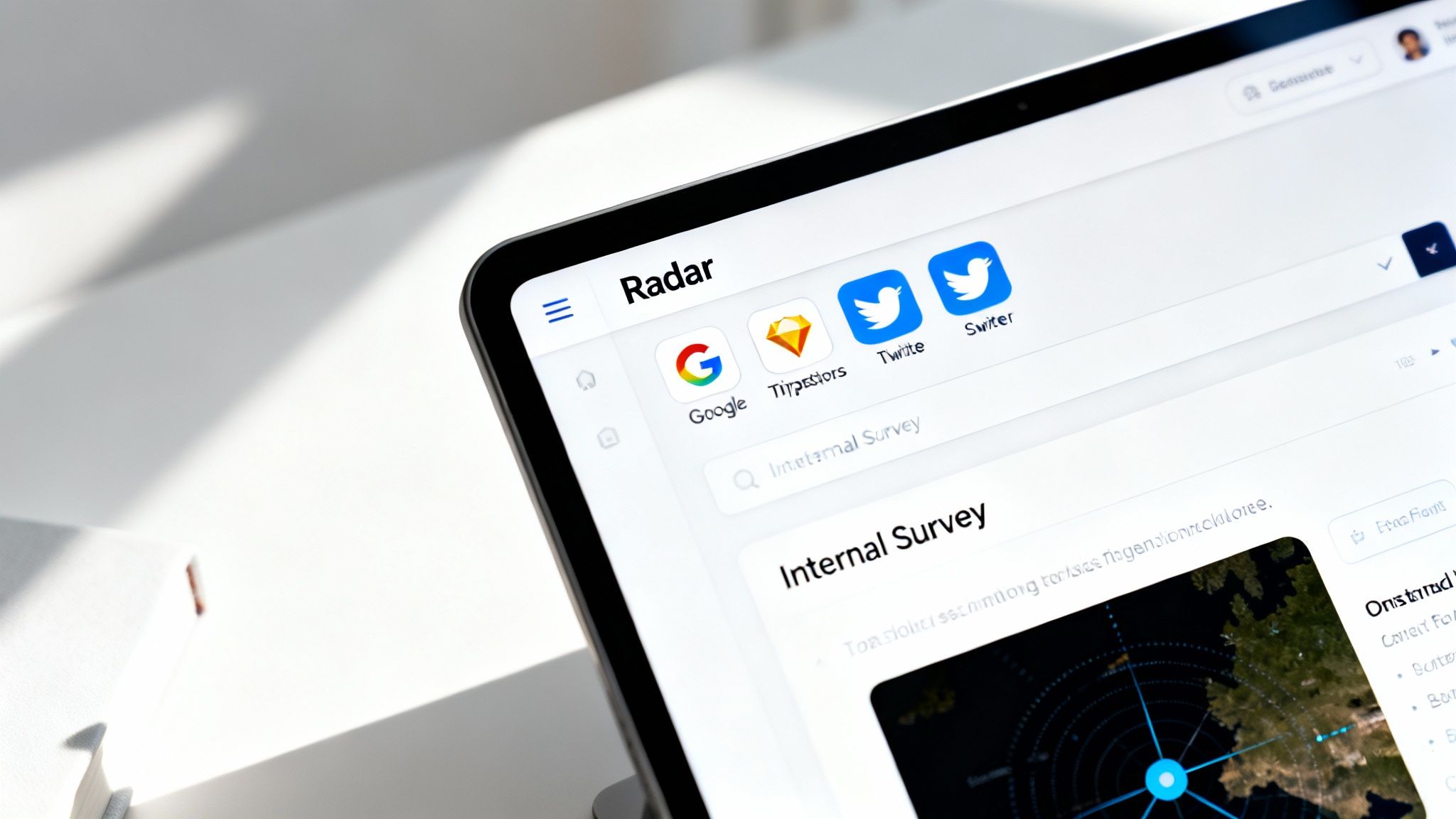
Radar: This is your unified review intelligence hub. It pulls all guest feedback from every platform—from Mews or Toast integrations to public review sites—into one clear, centralized dashboard. No more logging into ten different accounts.
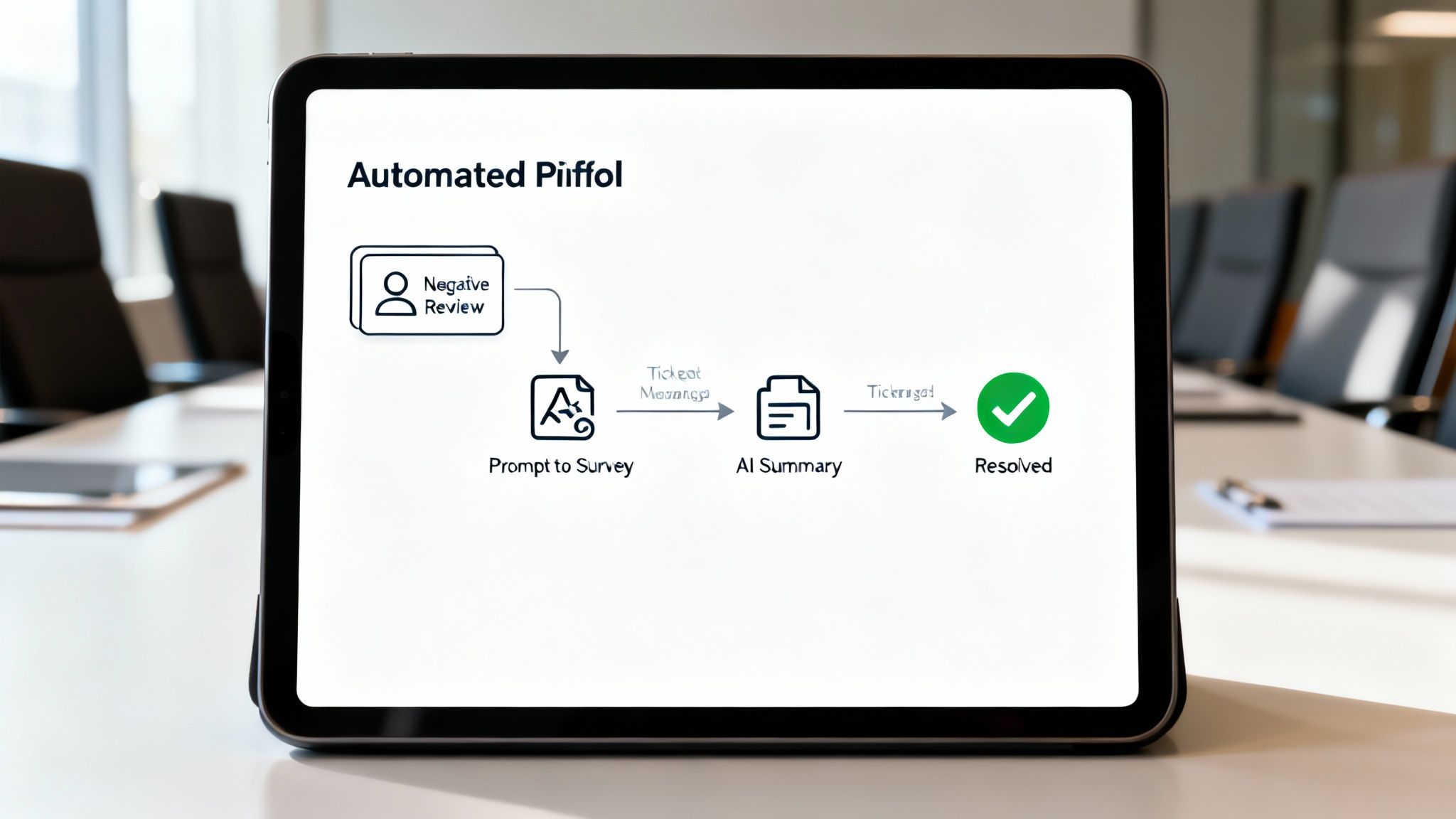
Prompt to Survey: A simple positive or negative review can automatically trigger an intelligent follow-up survey to dig deeper into the "why" behind a guest's rating.
AI Summaries: This feature provides instant insights & sentiment analysis. Our AI reads thousands of comments and tells you that "slow bar service on weekends" is your biggest issue, saving you hours of manual work.
Resolutions Engine: This is your automated service recovery powerhouse. It detects a negative review, creates an internal ticket, assigns it to the right manager, and tracks it to completion, turning bad experiences into loyalty-building moments.
What Exactly Is an AI Feedback Analysis Tool?
Let's cut through the jargon. At its simplest, an AI feedback analysis tool is a smart system that automatically reads, understands, and organizes customer feedback from all the places you collect it.
Think of it as the sharpest, most efficient manager on your team—one who digests every single review, survey response, and social media comment around the clock. Then, it hands you a clean summary of what your customers are really saying.
Instead of your team getting lost in spreadsheets trying to connect the dots, the tool does the heavy lifting in seconds. It uncovers the patterns hidden in thousands of comments, turning a mountain of messy, unstructured text into a clear, actionable to-do list for your business.
This isn't just some futuristic idea; it’s a practical solution to a massive problem. The need for this tech is exploding. The text analytics market, which is the engine behind these tools, grew from $4.5 billion in 2020 and is on track to hit $13.4 billion by 2025. This shows just how urgently businesses like yours need to make sense of all the customer data they’re drowning in.
Decoding the Core Functions
At its heart, an AI feedback tool is built to answer three simple but vital questions: What are customers saying, how do they feel about it, and who needs to know? It does this through a few key functions that work together seamlessly.
The system uses sophisticated methods to analyze qualitative data, taking raw, emotional language and turning it into organized insights. Without it, you'd need a team of people just to tag and sort comments manually.
It's like a translator. But instead of turning Spanish into English, it translates messy customer feedback into clear business intelligence that you can actually use to grow.
Here's a quick look at its main jobs:
Sentiment Analysis: This is the most basic but powerful feature. The AI reads a comment and instantly determines the emotion behind it—is the customer happy, upset, or just neutral? This gives you a real-time pulse check on customer happiness without reading a single word.
Theme Extraction: The tool doesn’t just read for emotion; it understands topics. It automatically groups recurring themes like ‘slow service,’ ‘clean rooms,’ or ‘great coffee,’ showing you exactly what’s working and what’s broken. You can learn more in our detailed guide on how to perform AI survey analysis.
Automated Routing and Tagging: Based on the sentiment or theme, the system can automatically tag issues and send them to the right person. A complaint about a cold steak can land directly in the kitchen manager's inbox, which means problems get solved faster.
Unifying Your Feedback into a Single Source of Truth
For most service businesses, the biggest headache is that feedback lives everywhere. You’ve got Google Reviews in one tab, TripAdvisor in another, internal surveys buried in an email folder, and social media mentions scattered across different apps. This fragmentation makes it impossible to see the big picture.
This is where a true Feedback Operating System shines. It pulls all these disconnected sources into one central hub.
For example, Radar, FeedbackRobot’s unified review intelligence dashboard, connects everything into a single, clear view. It means you can finally stop logging into ten different platforms and see your entire feedback landscape at a glance. You can collect smarter and, more importantly, act faster.
Turning Raw Feedback into Real-Time Actions
Information without action is just noise. Your customers are telling you exactly what they want, but if those insights stay locked in a spreadsheet or a cluttered inbox, they're useless. Modern feedback tools like FeedbackRobot are built to close this gap, transforming messy, unstructured comments into clear, automated actions for your team.
This is where you move from just collecting feedback to actively using it to drive improvements. It’s about building a system that doesn’t just report on problems but helps you solve them in real-time. Instead of your manager spending Monday morning decoding a weekend's worth of reviews, the system does it instantly, freeing them up to coach staff and delight guests.
Go Beyond the Star Rating with Prompt to Survey
A simple four-star review or a one-word comment like "disappointed" doesn't give you much to work with. You know a guest was either happy or unhappy, but you have no idea why. To fix anything, you need to dig deeper—intelligently, without piling more manual work onto your team.
Our Prompt to Survey feature is the first step in turning a vague rating into a specific, actionable insight. Its function is to automatically trigger an intelligent follow-up survey when a customer leaves a basic review. This follow-up asks the specific questions needed to uncover the story behind the score.
For instance, a negative review can trigger a survey asking, "We're sorry to hear about your experience. Was it related to the service, the food, or the ambiance?" This automated step gives you the context you need to actually fix a problem, turning a dead-end complaint into a valuable piece of operational data.
Instantly Understand What Matters with AI Summaries
Once you have richer feedback, you still face the challenge of volume. Reading through hundreds of detailed comments is impossible for a busy manager. You don't need to read every word; you need to understand the main takeaways, and fast.
This is the job of AI Summaries. This feature acts as your personal data analyst, scanning thousands of comments from all your sources and instantly identifying the most important trends and emotions. It uses instant insights & sentiment analysis to group recurring themes and measure the feelings behind them. You can learn more about this in our guide that explains what customer sentiment analysis is and why it's so crucial.
Instead of you manually discovering that "wait times on Saturdays" is your biggest issue after a dozen angry reviews, AI Summaries puts that insight on your dashboard before it becomes a reputation-damaging pattern.
Automate Service Recovery with the Resolutions Engine
Identifying a problem is only half the battle. The real magic happens when you can fix it quickly and turn a negative experience into a story of incredible service. For most businesses, this is where the ball gets dropped. A bad review is seen, but no one is assigned to fix it, and the customer is lost forever.
The Resolutions Engine is your automated service recovery powerhouse, ensuring no guest issue ever falls through the cracks. It’s designed to automatically trigger a complete workflow the moment negative feedback is detected.
Here’s how it works step-by-step:
Detect: The system identifies a negative review or a low survey score.
Create & Assign: It instantly creates an internal ticket and assigns it to the right person (e.g., a food complaint goes directly to the head chef).
Track: The system tracks the ticket’s progress from open to close, making sure it’s handled fast.
Resolve: The manager follows up with the guest, offers a solution, and marks the issue as resolved—turning a potential one-star review into a showcase of exceptional customer care.
How AI Feedback Analysis Fuels Business Growth
Powerful features are one thing, but what really matters is how they hit your bottom line. An AI feedback analysis tool isn't just another flashy dashboard; it’s a growth engine that connects what your customers are saying directly to how you run your business. It lets you collect smarter, act faster, and grow stronger.
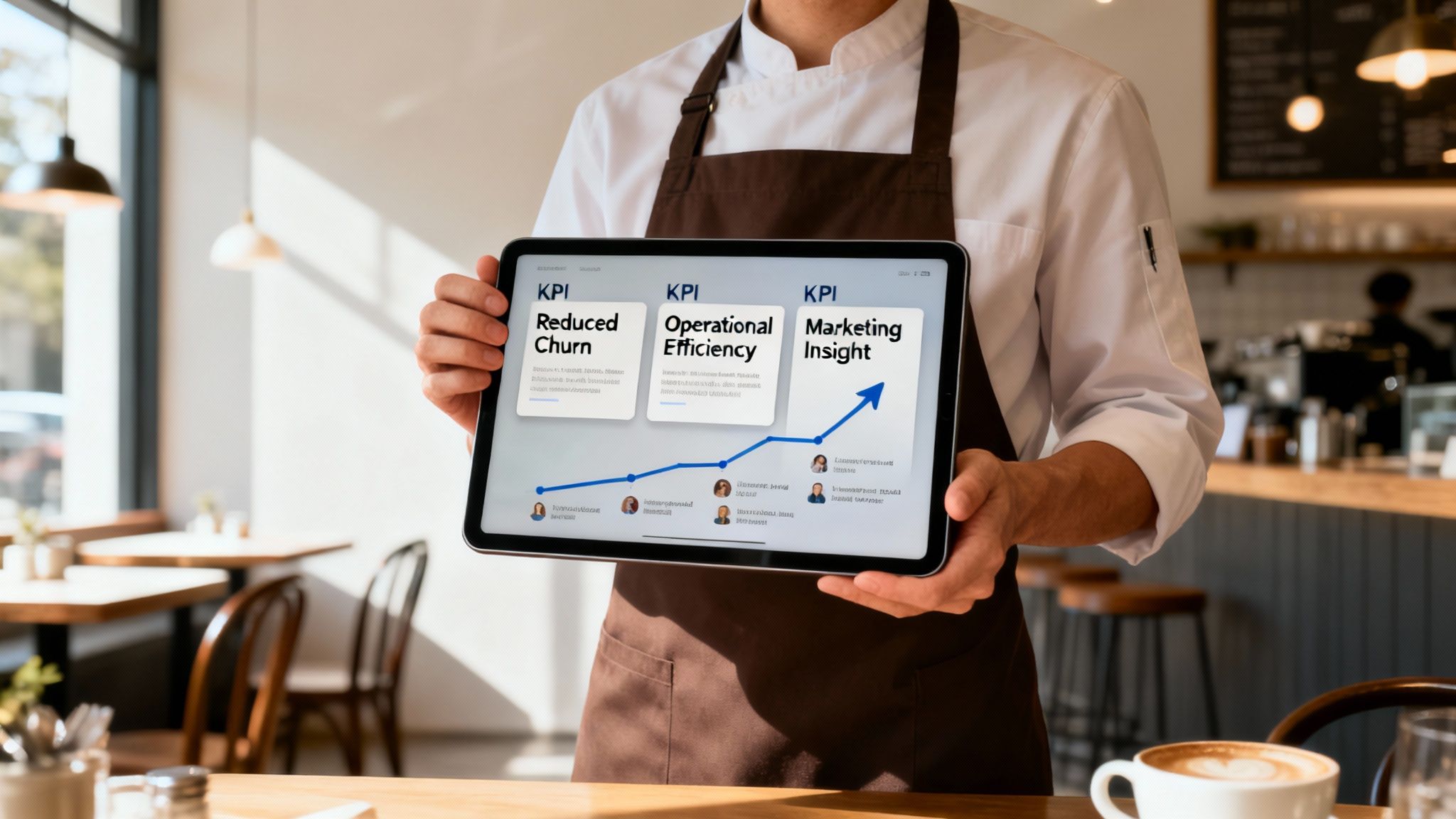
Let's break down the three core ways this technology delivers real, measurable results. These aren't just abstract ideas—they're the practical outcomes you can expect when you stop just collecting feedback and start putting it to work.
Reduce Customer Churn with Proactive Service Recovery
In the service world, a single bad experience can cost you a customer for good. The problem? By the time you spot a negative review online, the damage is usually done. A true Feedback Operating System changes that by acting as an early warning system, helping you save at-risk customers before they walk away forever.
Imagine a guest has a rough experience and leaves a two-star rating on a survey as they’re heading out.
Without AI, that feedback might sit in an inbox for days, completely unseen.
With a system like FeedbackRobot, the Resolutions Engine spots the negative sentiment instantly.
It automatically creates a service recovery ticket and assigns it to the manager on duty. Within minutes, that manager can find the guest, apologize, and offer a real solution. Just like that, you've turned a potential churn statistic into a loyal customer who feels heard.
This isn't just about damage control; it's about building resilience. By catching and fixing problems in real-time, you prevent small issues from becoming reputation-damaging patterns that drive customers to your competitors.
Boost Operational Efficiency and Empower Your Team
How much time do your managers waste digging through spreadsheets to manually compile feedback reports? Every hour they spend analyzing data is an hour they aren't on the floor coaching staff or talking with guests. That manual work is a huge drain on your most valuable asset: your leaders' time.
An AI feedback analysis tool puts that entire process on autopilot.
Radar brings all your feedback sources into one place, so there's no more logging into five different platforms.
AI Summaries give your team instant insights & sentiment analysis, telling them exactly what's working and what needs attention.
This frees your managers from tedious admin tasks and empowers them to actually lead. They can finally focus on high-impact work like staff training and improving the guest experience—the things that create real value.
Fuel Smarter Marketing and Business Decisions
Customer feedback is a goldmine of strategic intelligence. It tells you exactly what people love, what they put up with, and what they wish you’d change. An AI tool helps you dig up these insights and turn them into smarter business decisions.
For instance, AI Summaries might show a recurring theme about your "amazing patio ambiance" or "super-friendly baristas." That's not just a nice compliment; it's a powerful marketing angle. Now you can confidently feature your patio in your next ad campaign or build a loyalty program around your stellar coffee service, knowing it’s what actually resonates. This approach is quickly becoming the norm, with businesses increasingly using AI for research and sentiment evaluation. You can see just how much this is taking off by looking at current AI marketing statistics and how top performers are already using this tech.
By turning unstructured comments into clear, actionable trends, the tool gives you the confidence to double down on what works and fix what doesn't. This is the core of what we believe in: collect smarter, act faster, and grow stronger.
Choosing the Right Tool for Your Business
Not all AI tools are created equal, especially in the fast-paced, high-touch world of hospitality and local services. A generic analytics platform might spit out some interesting charts, but it won’t help you solve a guest's problem at 9 PM on a Saturday night.
What you really need is an AI feedback analysis tool designed for action, not just observation. Think of it less like a complex piece of software and more like an extension of your management team—one that’s always on, always listening, and always ready to help you fix things.
Your Practical Evaluation Checklist
When you're looking at different options, keep the day-to-day realities of your business front and center. Can your team actually learn it in an afternoon? Will it connect with the systems you already rely on?
To get a feel for the broader market, checking out a list of the 12 Best AI Tools for Small Business can offer some good perspective on what's available for automation and support. But for your specific needs, let's cut through the marketing fluff.
Use this simple checklist to stay focused on what truly matters:
Ease of Use: Your team is busy. The system has to be intuitive enough for a front desk manager or a head chef to jump in and use it without needing weeks of training. If the dashboard is a mess, it won't get used, and that's a wasted investment.
Crucial Integration Capabilities: A standalone tool just creates more work. Your feedback system absolutely must connect with your core software. Does it talk to your POS, like Toast? Or your PMS, like Mews? This is non-negotiable if you want a single, reliable source of truth for your operations.
Action-Oriented Features: Dashboards are nice to look at, but automated action is what really drives growth. Look for a system built to close the loop on customer issues. This is where features like a Resolutions Engine are critical—it can automatically detect negative feedback, create a service ticket, and assign it to the right person until the problem is solved.
Your AI Feedback Tool Evaluation Checklist
Picking the right AI partner is a big decision. This checklist will help you ask the right questions and focus on the features that directly impact your team's ability to act on feedback and improve the customer experience.
Feature or Capability | Why It Matters for Your Business | Key Questions to Ask Vendors |
|---|---|---|
Industry-Specific Focus | A tool built for hospitality or retail understands your unique challenges, like managing multiple locations or handling real-time guest issues. | Is your platform designed specifically for businesses like mine (e.g., restaurants, hotels, services)? |
Intuitive User Interface (UI) | Your team is busy. If the software is confusing, they won't use it. Simplicity leads to adoption. | Can my front-line staff learn to use the core features in under an hour? Can we get a live demo? |
Core System Integrations | Connecting to your POS, PMS, or CRM automates data flow and creates a single source of truth for customer interactions. | Do you offer direct, pre-built integrations with my key systems (e.g., Toast, Mews, Shopify)? |
Automated Ticketing & Routing | This ensures negative feedback never falls through the cracks. It turns a complaint into a trackable task for the right manager. | Can your system automatically create and assign a service ticket based on a negative review or survey response? |
Sentiment & Theme Analysis | Going beyond star ratings, AI can tell you why customers are happy or upset by identifying themes like "slow service" or "clean rooms." | Does your AI identify both the sentiment (positive/negative) and the specific topics mentioned in open-ended feedback? |
Multi-Location Management | If you have more than one location, you need to easily compare performance, spot trends, and manage feedback for each site. | How does your dashboard support multi-unit operators? Can I filter reports and alerts by location? |
Scalable Pricing & Features | The tool should grow with you. You don't want to be forced into a massive platform change after opening a few new locations. | What do your pricing tiers look like? How does the cost change as I add more locations or users? |
Ultimately, this checklist isn't just about features; it's about finding a tool that makes your team more effective and your customers happier.
Scalability for Future Growth
Think about where your business will be in one year, or even five. The right tool should be able to support you as you grow from one location to ten without forcing you to start all over with a new system.
A scalable system doesn't just mean it can handle more data. It means its features, from automated workflows to user permissions, can adapt to the increasing complexity of a multi-location operation.
Ask potential vendors how their platform supports growing businesses. Can you easily compare performance across different locations? Can you set up location-specific alerts and user roles? Planning for this now will save you from major headaches down the road. For a deeper dive into the options available, check out our guide on other powerful customer feedback analysis tools.
At the end of the day, your goal is to find a partner that helps you collect smarter, act faster, and grow stronger. Choose the tool that doesn't just show you data, but actually empowers your team to use it.
Putting Your AI Feedback System to Work
So, you’ve picked the right tool for your business. Now it's time to put it to work.
Getting an AI feedback analysis tool up and running isn’t like flipping a switch. It’s a process. Think of it as a "crawl, walk, run" approach that helps you build momentum without overwhelming your team.
The first step is always the simplest: connect your most critical feedback sources. For most hospitality and service businesses, that means starting with public review sites like Google Reviews and TripAdvisor. Integrating these is an immediate win, pulling your most visible customer opinions into one central dashboard.
Start with Automated Service Recovery
Once your core feedback is flowing in, your next priority is setting up your first automated workflow. Don't try to boil the ocean and automate everything at once. Instead, focus on the most urgent task: handling negative feedback. This is where you'll see a direct impact on guest retention and your online reputation, fast.
Using a Resolutions Engine—your automated service recovery powerhouse—you can create a simple but powerful rule. For example, you can set it to automatically spot any review with negative sentiment (like a 1-star or 2-star rating), create an internal service ticket, and assign it straight to the on-duty manager.
This single workflow ensures no unhappy customer ever slips through the cracks again. It can turn a potential disaster into a story of incredible service.
Train Your Team to See AI as an Assistant
Technology is only as good as the team using it. The key to getting everyone on board is to frame the new tool not as more work, but as a helpful assistant that makes their jobs easier.
Your managers no longer need to spend hours building spreadsheets; the AI does it for them. Your front-line staff can see exactly what guests are praising, giving them a morale boost.
The goal is to make the system an invisible but essential part of your operation. It frees up your team to focus on what they do best: creating exceptional guest experiences.
As you implement the system, you're joining a massive shift in how businesses operate. The global AI market is projected to skyrocket from $371.71 billion in 2025 to an incredible $2,407.02 billion by 2032. Specialized platforms like a dedicated AI feedback analysis tool are a key part of this growth, helping businesses turn customer insights into direct action. You can learn more about the explosive growth of the AI market here.
Experience the Power of a True Feedback Operating System
Reading about the benefits is one thing, but seeing it in action is another. A true Feedback Operating System connects every piece of customer feedback directly to your operational workflow, helping you collect smarter, act faster, and grow stronger.
Ready to turn your feedback from a daily chore into your greatest asset?
Start your Free Trial of FeedbackRobot today to experience the power firsthand. Or, see how top businesses showcase their success on our new Spotlight: Feedback Wall and begin your journey toward smarter, faster growth.
Frequently Asked Questions
Jumping into a new piece of technology can feel like a big step, especially when you're busy running a hospitality or service business. It’s totally normal to wonder how an AI feedback analysis tool actually fits into your day-to-day and if it's really worth it.
Let's walk through some of the most common questions we get from owners just like you.
Is an AI Feedback Tool a Pain to Set Up?
Not at all. Modern platforms like FeedbackRobot are built for busy owners, not IT wizards. The whole setup process is designed to be quick and painless.
It usually just means connecting your existing accounts—think Google My Business, your Toast POS, or your Mews property management system—with a few clicks. The dashboard is designed to be simple, turning a flood of data into clear, easy-to-read summaries. You'll get real insights in minutes, not weeks, letting you collect smarter from day one without some massive learning curve.
How Much Does an AI Feedback Analysis Tool Cost?
Pricing usually depends on things like how many locations you have and the amount of feedback you're getting. But honestly, the better way to think about the cost is through the lens of return on investment (ROI).
Just think about the cost of one unhappy customer who walks away for good because of a problem you didn't see. Or the hours your manager sinks into manually pulling together reports every week. A good tool pays for itself by keeping customers around and freeing up your team to focus on what they do best: serving guests. Most platforms, including ours, offer a free trial so you can see the value yourself before you commit.
Is My Business Too Small for an AI Tool?
Absolutely not. In fact, when you're a small business, every single customer experience is critical. You don't have the same buffer for mistakes that a big chain does, which makes getting ahead of issues even more important.
An AI tool is like an early warning system. It helps you catch the small friction points before they blow up and damage the reputation you've worked so hard to build.
It really levels the playing field, giving you the same kind of powerful insights big brands use to make their operations better. You can act faster on every piece of feedback, which helps you grow stronger by building a loyal customer base, one great experience at a time. It’s not about how big your business is; it’s about how much you value every single guest.
Ready to turn feedback from a chore into your biggest advantage? FeedbackRobot helps you collect smarter, act faster, and grow stronger. Launch your IT Support Provider User Feedback Tool.