8 Guest Satisfaction Survey Examples To Steal for 2025
Stop guessing. Explore our top 8 guest satisfaction survey examples with actionable templates & tips to collect smarter feedback and boost loyalty.

Dec 20, 2025 · 20 min read
Free tool
AI Survey Generator
Describe what you want to learn and get a ready-to-send survey in seconds.
As a busy hospitality owner, you know guest satisfaction isn't just a metric; it's the engine of your business. Positive experiences drive repeat bookings, glowing reviews, and a stronger bottom line. But how do you move from hoping guests are happy to knowing exactly what works and what doesn't? The answer lies in asking the right questions, at the right time, with the right tools.
This guide moves beyond generic templates to give you battle-tested guest satisfaction survey examples you can deploy today. We won't just show you what to ask. We'll break down the strategy behind each example, showing you precisely how to collect smarter, act faster, and grow stronger. This isn't just about data collection; it's about creating a powerful feedback loop that fuels your growth.
You'll learn not only which surveys to use for different scenarios—from a quick post-transaction check-in to a deep-dive post-stay analysis—but also how to operationalize the insights you gather. We’ll show you how a Feedback Operating System transforms raw data into actionable intelligence. Using features like AI Summaries (instant insights & sentiment analysis), you can immediately understand key themes without hours of manual work. And with a Resolutions Engine (automated service recovery), you can turn a negative experience into a moment of guest loyalty before a bad review even happens.
It's time to stop guessing and start growing. Let’s dive into the exact frameworks and guest satisfaction survey examples you need to turn every guest's voice into a measurable opportunity.
1. Net Promoter Score (NPS) Survey
The Net Promoter Score (NPS) is a cornerstone of guest satisfaction measurement, prized for its simplicity and predictive power. It revolves around a single, powerful question: “On a scale of 0-10, how likely are you to recommend our [business/service/product] to a friend or colleague?” This one question effectively gauges overall loyalty and satisfaction.
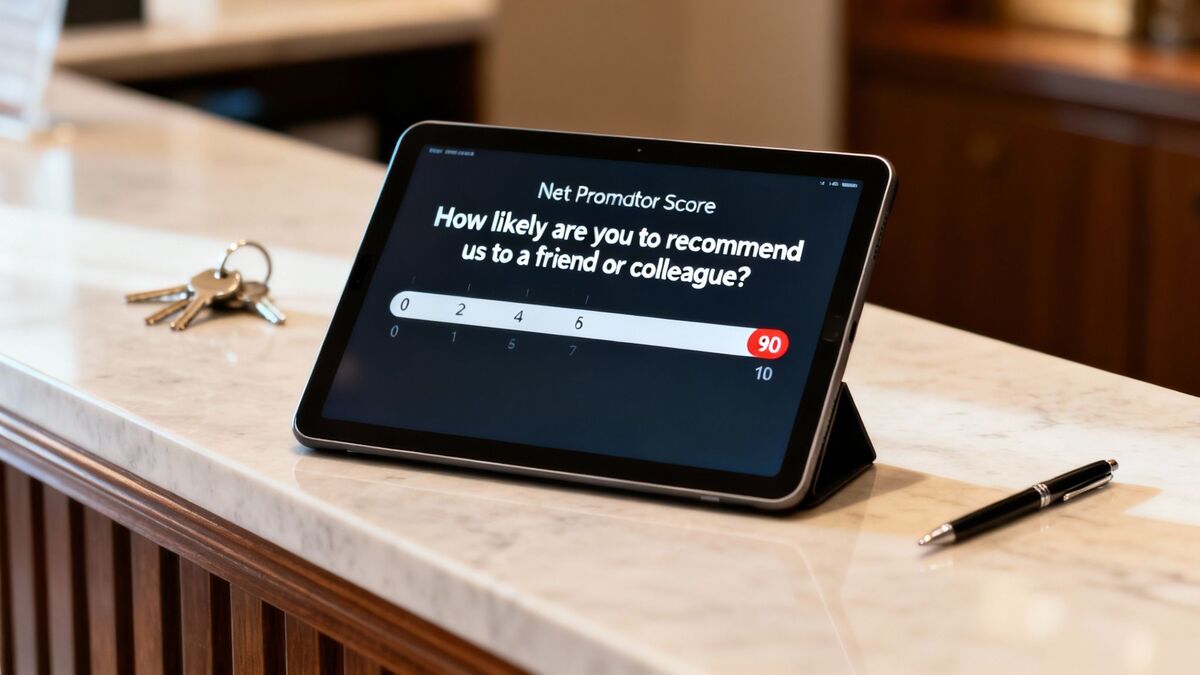
Based on their score, respondents are segmented into three distinct categories:
Promoters (9-10): Your most loyal and enthusiastic advocates.
Passives (7-8): Satisfied but unenthusiastic guests who are vulnerable to competitors.
Detractors (0-6): Unhappy customers who can damage your brand through negative word-of-mouth.
The final NPS is calculated by subtracting the percentage of Detractors from the percentage of Promoters. This provides a clear, quantifiable metric for tracking loyalty over time.
Strategic Application
The real power of NPS comes from the follow-up question: "What is the primary reason for your score?" This open-ended query transforms a simple number into actionable feedback. By analyzing this qualitative data, you uncover the specific drivers behind guest loyalty or dissatisfaction. For instance, a hotel might discover that while Promoters love the new breakfast menu, Detractors consistently mention slow check-in times.
Strategic Insight: Use your NPS score not just as a benchmark, but as a diagnostic tool. The "why" behind the score is where you'll find your biggest opportunities for operational improvement and service innovation.
How to Implement Your NPS Survey
Target Timing:
Post-Experience: Send within 24 hours of checkout, delivery, or service completion to capture fresh, accurate impressions.
Ideal Delivery Method:
Email or SMS: Automated messages triggered by a guest action (e.g., checking out of your PMS like Mews) ensure timely and consistent delivery.
Sample Questions:
Rating (Required): On a scale of 0-10, how likely are you to recommend [Your Business Name] to a friend or colleague?
Open-Text (Required): What is the primary reason for your score?
Categorical (Optional): What could we have done to make your experience better? (Provide options like Staff Friendliness, Cleanliness, Value, etc.)
For a deeper dive into transforming these scores into actionable insights, explore our guide to mastering survey data analysis. It provides a framework for turning raw numbers into strategic improvements.
2. SERVQUAL Gap Analysis Survey
The SERVQUAL model is a sophisticated diagnostic tool designed to pinpoint the exact locations of service failures. Unlike simpler surveys, it measures the gap between guest expectations and their actual perceived experience across five core dimensions of service quality. This "gap analysis" provides a rich, multi-faceted view of guest satisfaction.
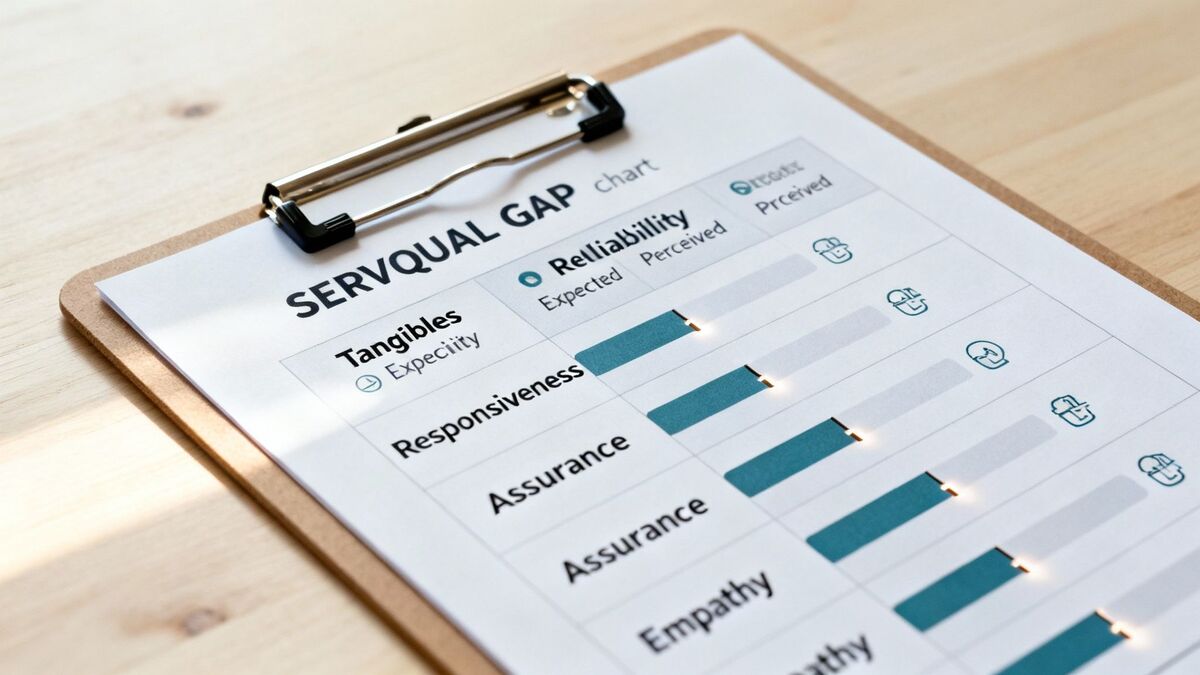
Developed by Parasuraman, Zeithaml, and Berry, this framework evaluates your performance on:
Tangibles: Appearance of physical facilities, equipment, personnel, and communication materials.
Reliability: Ability to perform the promised service dependably and accurately.
Responsiveness: Willingness to help customers and provide prompt service.
Assurance: Knowledge and courtesy of employees and their ability to inspire trust and confidence.
Empathy: Caring, individualized attention the firm provides its customers.
By asking guests to rate both the importance of and their satisfaction with each item, you identify where you're falling short of expectations. For example, Marriott International adapted SERVQUAL principles for its internal property audits to ensure brand standards are consistently met.
Strategic Application
The true value of SERVQUAL lies in its diagnostic precision. It moves beyond a single "satisfaction" score to show you why guests are dissatisfied. A large gap in "Reliability" might indicate inconsistent housekeeping, while a gap in "Responsiveness" could point to understaffing at the front desk. This allows for targeted operational changes rather than guesswork. Disney’s renowned service quality framework, for instance, borrows heavily from SERVQUAL methodology to train its cast members and design guest experiences that consistently exceed expectations.
Strategic Insight: Don't just look at overall scores. Prioritize closing the largest gaps identified by your SERVQUAL analysis. These represent the most significant disconnects between guest expectations and your service delivery, offering the greatest opportunity for impact.
How to Implement Your SERVQUAL Survey
Target Timing:
Post-Stay: Administer at checkout or send within 48 hours of departure while the details of their stay are still fresh.
Ideal Delivery Method:
In-person/Tablet or Email: A QR code at checkout can lead to a mobile-friendly survey, or an automated email can be triggered by a guest’s departure from your PMS.
Sample Questions:
Expectation (Rating): For an excellent hotel, modern-looking equipment is… (Scale: Not at all important to Extremely important).
Perception (Rating): The equipment at [Your Business Name] is… (Scale: Poor to Excellent).
Open-Text (Optional): Please share any specific comments about the reliability of our services during your stay.
You can use a tool like FeedbackRobot's Prompt to Survey feature to automatically send these detailed questionnaires to a representative sample of guests, ensuring your data isn't skewed by only the most vocal patrons.
3. Customer Satisfaction (CSAT) Survey
The Customer Satisfaction (CSAT) survey is a direct, transactional metric designed to measure guest happiness with a specific interaction or service. It typically asks a straightforward question like, “How satisfied were you with your [experience/service/product]?” Respondents answer on a simple scale, often 1-5 (e.g., Very Unsatisfied to Very Satisfied) or using visual cues like stars or smiley faces.
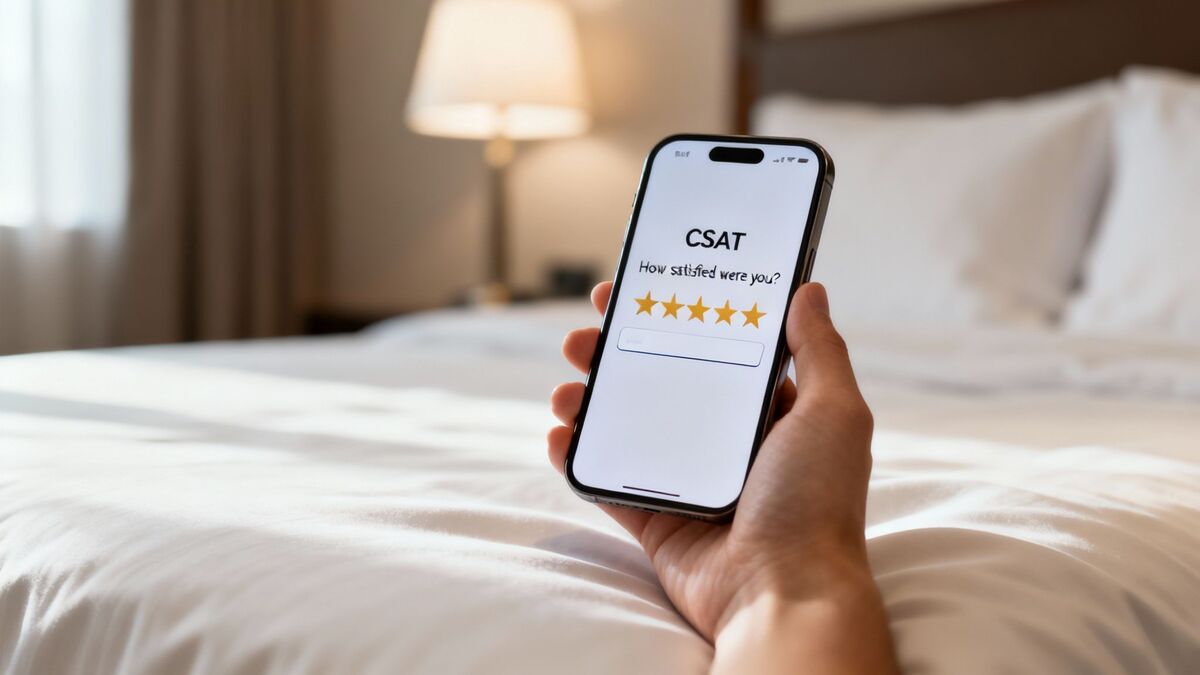
Unlike NPS, which measures overall loyalty, CSAT provides a real-time pulse on individual touchpoints. This makes it one of the most effective guest satisfaction survey examples for pinpointing immediate operational strengths and weaknesses. For instance, a hotel can use CSAT to gauge satisfaction with check-in, housekeeping, or a restaurant meal, allowing for granular analysis by department.
A positive CSAT score is typically calculated as the percentage of respondents who chose the top two satisfaction levels (e.g., "Satisfied" and "Very Satisfied" on a 5-point scale). This metric offers a clear, immediate signal of performance at key moments in the guest journey.
Strategic Application
The true value of CSAT lies in its immediacy and specificity. By deploying these short surveys right after a key interaction, you can identify and address issues before they escalate into negative reviews. For example, a restaurant using a POS system like Toast can trigger a CSAT survey via SMS the moment a bill is paid. If a guest reports dissatisfaction, you can intervene immediately.
This is where FeedbackRobot's Resolutions Engine becomes indispensable. By setting up automated workflows, a low CSAT score can instantly trigger a service recovery ticket, notify the on-duty manager, and send a personalized apology with a make-good offer to the guest. This transforms a moment of friction into an opportunity to demonstrate exceptional service and win back guest loyalty.
Strategic Insight: Use CSAT surveys as your frontline diagnostic tool. Their transactional nature allows you to measure and improve the individual moments that collectively create an outstanding overall guest experience.
How to Implement Your CSAT Survey
Target Timing:
In-the-Moment: Use QR codes or in-room tablets to capture feedback during the experience (e.g., after a meal at your hotel restaurant).
Post-Interaction: Send within 1-3 hours of a specific touchpoint like check-out, a spa treatment, or a customer service call.
Ideal Delivery Method:
SMS or QR Code: Perfect for capturing immediate, in-the-moment feedback with high response rates.
Email: Effective for a slightly more detailed post-experience survey focusing on a few key touchpoints.
Sample Questions:
Rating (Required): How satisfied were you with the check-in process? (Scale: 1-5 Stars or Smileys)
Rating (Optional): Please rate your satisfaction with the following: Cleanliness, Staff Friendliness, Room Amenities.
Open-Text (Required): What is the one thing we could do to improve your experience?
4. Likert Scale Guest Experience Survey
The Likert scale survey is a classic and highly effective tool for measuring nuanced guest opinions. Unlike a simple yes/no question, it asks respondents to rate their level of agreement with a series of specific statements on a balanced scale, typically ranging from 1 to 5 (e.g., "Strongly Disagree" to "Strongly Agree"). This format allows you to precisely measure attitudes across multiple touchpoints of the guest journey.
Leading hotel groups like Marriott Bonvoy and IHG frequently use 5-point Likert scales in their post-stay surveys to gather detailed feedback on everything from the check-in process to room cleanliness and dining quality. This method provides granular data that can be easily aggregated and analyzed to identify both high-performing areas and specific points of friction in the guest experience.
Strategic Application
The true value of a Likert scale lies in its ability to pinpoint exactly where service is excelling or falling short. By breaking down the guest experience into individual components (e.g., "The staff was attentive," "The room was quiet," "The Wi-Fi speed was excellent"), you can move beyond a general satisfaction score. The data reveals specific operational strengths and weaknesses that need attention.
For example, a restaurant might find that guests "Strongly Agree" that the food quality is excellent but only "Somewhat Agree" that the service speed was acceptable. This insight allows management to focus training and resources precisely where they will have the most impact. Within FeedbackRobot, our AI Summaries (instant insights & sentiment analysis) can instantly analyze thousands of these scaled responses to identify overarching trends and sentiment, saving you hours of manual work.
Strategic Insight: Use Likert scale data not as a single score, but as a multi-dimensional map of your guest experience. Analyze the mean scores for each statement to create a clear hierarchy of what you do best and where you need to improve most urgently.
How to Implement Your Likert Scale Survey
Target Timing:
Post-Experience: Send within 2-3 days of checkout or service completion, giving guests time to reflect on their entire experience.
Ideal Delivery Method:
Email: This allows for a more detailed and thoughtfully structured survey format, which is ideal for the Likert scale's statement-based approach.
Sample Questions:
Instructions: Please rate your level of agreement with the following statements about your recent stay.
Statement 1 (Cleanliness): The cleanliness of my room met my expectations. (Scale: Strongly Disagree to Strongly Agree)
Statement 2 (Staff): The front desk staff were friendly and helpful. (Scale: Strongly Disagree to Strongly Agree)
Statement 3 (Amenities): The hotel amenities (pool, gym, etc.) were well-maintained. (Scale: Strongly Disagree to Strongly Agree)
Open-Text (Optional): Is there any additional feedback you would like to share regarding your experience?
Crafting clear, unbiased statements is crucial for collecting accurate data. For guidance on structuring your questions effectively, explore our guide on how to create a questionnaire.
5. Post-Stay Email Survey with Multi-Question Format
While single-question surveys like NPS excel at capturing overall loyalty, the Post-Stay Email Survey with a multi-question format provides a much deeper, more comprehensive look into the guest experience. This classic approach involves sending an automated email 24-48 hours after checkout, asking 5-10 targeted questions about specific aspects of their stay, from check-in to cleanliness to staff interaction.
This method allows you to move beyond a single metric and dissect the entire guest journey. For instance, a guest might give a high overall satisfaction score but rate the room service poorly. This granular data is invaluable for pinpointing specific operational strengths and weaknesses that a broader survey might miss. Leading platforms like Expedia and Booking.com use this model to gather detailed reviews that inform other travelers.
Strategic Application
The multi-question format is designed for surgical precision. It allows you to systematically evaluate every key touchpoint of your service delivery. By asking about specific departments or amenities (e.g., "How would you rate the cleanliness of the swimming pool?" or "How satisfied were you with the speed of check-in?"), you collect structured data that can be tracked over time for departmental performance reviews.
This approach is also perfect for identifying silent issues. A guest might not mention a slow Wi-Fi connection in an open-ended comment, but they will rate it poorly if asked directly. Within FeedbackRobot, AI Summaries (instant insights & sentiment analysis) can instantly analyze thousands of these detailed responses, identifying recurring themes like "slow Wi-Fi" or "friendly bar staff" without manual effort.
Strategic Insight: Use this survey to create internal benchmarks for each department. By tracking scores for cleanliness, staff friendliness, and amenities separately, you empower department heads with the specific data they need to drive targeted improvements and celebrate team wins.
How to Implement Your Multi-Question Survey
Target Timing:
Post-Stay: Send 24-48 hours after checkout. This gives the guest time to reflect but ensures the experience is still fresh in their mind.
Ideal Delivery Method:
Automated Email: Integrate with your PMS (Mews, for example) to trigger the email automatically upon guest departure, ensuring consistency and efficiency.
Sample Questions:
Overall Rating (Required): Overall, how satisfied were you with your stay at [Your Business Name]? (Use a 1-5 or 1-10 scale)
Categorical Ratings (Required): Please rate your satisfaction with the following:
The check-in process
The friendliness of our staff
The cleanliness of your room
The value for money
Open-Text (Optional): What did you like most about your stay?
Open-Text (Optional): How could we have improved your experience?
6. In-Room Tablet or QR Code Survey
This method captures real-time feedback by placing digital surveys directly in the guest's immediate environment. By using in-room tablets, smart TVs, or strategically placed QR codes, you empower guests to share their thoughts during their stay, not after. This immediacy is a game-changer for service recovery, allowing you to resolve issues before a minor annoyance becomes a negative review.
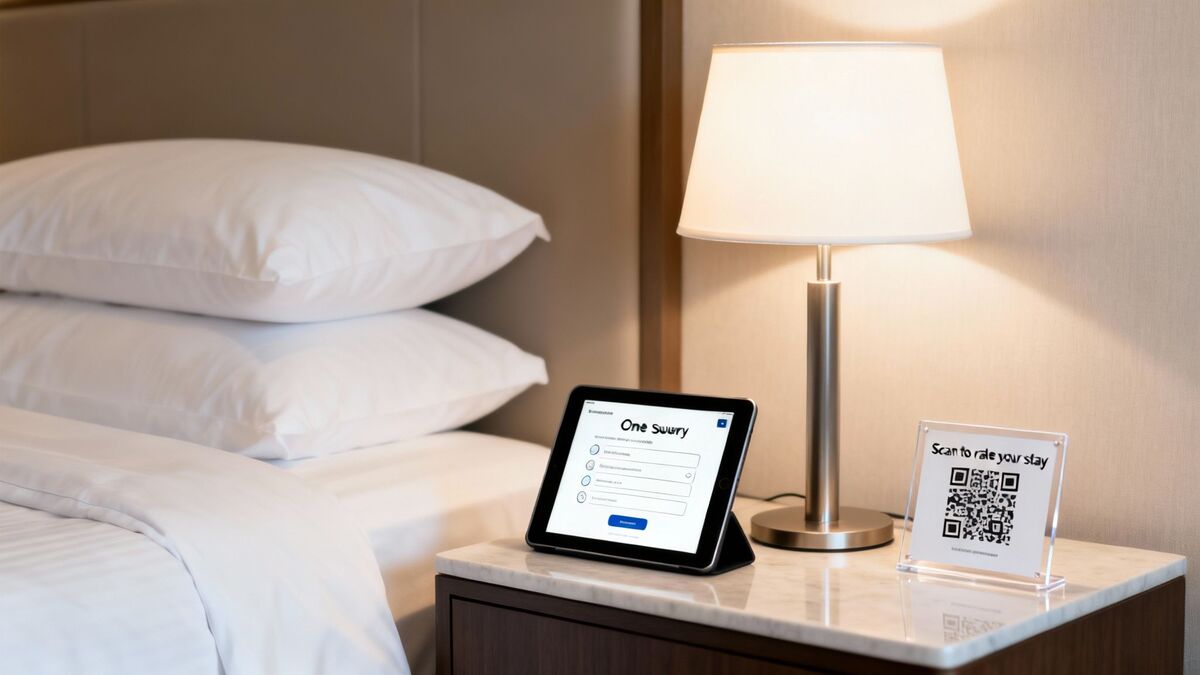
This approach is highly effective because it meets guests where they are, eliminating the friction of post-stay emails that often get ignored. Hotels like Marriott and Disney have successfully integrated these surveys into in-room entertainment systems, making feedback a natural part of the guest experience. The growing trend of QR codes on tables, mirrors, and even keycards further extends this accessibility.
Strategic Application
The primary advantage here is speed. A negative comment about room temperature or a leaky faucet can be flagged instantly, triggering an alert. With FeedbackRobot's Resolutions Engine (automated service recovery), a maintenance ticket can be automatically created and dispatched, turning a potential complaint into a showcase of exceptional, proactive service. This transforms the survey from a passive data collection tool into an active operational asset.
For effective implementation, it's crucial to understand the best practices for making QR Code stickers that actually work and guide guests seamlessly to your survey.
Strategic Insight: Leverage in-stay surveys to fix problems in real-time. Addressing a guest's concern while they are still on-property dramatically increases the likelihood of a positive final impression and prevents negative online reviews.
How to Implement Your In-Room Survey
Target Timing:
In-Stay: Accessible at any point during the guest's stay for continuous feedback.
Pre-Checkout: A prompt can appear on the TV or tablet the morning of departure.
Ideal Delivery Method:
QR Codes: Place on nightstands, restaurant tables, or lobby signage.
In-Room Tablets/Smart TVs: Integrate the survey into the device's main menu for easy access.
Sample Questions:
Rating (Required): How satisfied are you with your room so far? (5-star or smiley face scale)
Open-Text (Optional): Is there anything we can do right now to make your stay more comfortable?
Categorical (Required): Please select the area you'd like to comment on: (Cleanliness, Amenities, Staff, Wi-Fi)
To learn how to optimize these touchpoints, explore our complete guide on using QR codes for surveys.
7. Focus Group and Qualitative Interview Survey
While quantitative surveys provide the "what," qualitative methods like focus groups and in-depth interviews uncover the "why." This approach moves beyond scales and scores, gathering rich, narrative data through guided conversations with small groups (6-10 guests) or one-on-one interviews. It is an indispensable tool for exploring complex motivations, detailed experiences, and nuanced perceptions.
This methodology allows you to probe deeper than any standard survey. For example, luxury brands like Four Seasons and Ritz-Carlton use focus groups and guest interviews not just for feedback, but to co-create future experiences, test new service concepts, and understand the subtle emotional drivers behind guest loyalty. This direct dialogue generates profound insights that are simply unreachable through multiple-choice questions.
Strategic Application
The true value of qualitative research lies in its ability to reveal unmet needs and unarticulated desires. It provides context to your quantitative data. For instance, your CSAT scores might show a dip in satisfaction with "amenities," but a focus group could reveal the specific reason is a lack of family-friendly options or a desire for wellness-focused products. This is where you find the breakthrough ideas for service innovation.
You can use the rich transcripts from these sessions within your Feedback Operating System. By feeding this qualitative data into a tool like AI Summaries (instant insights & sentiment analysis), you can instantly identify recurring themes, sentiment shifts, and actionable patterns across multiple interviews, turning hours of conversation into a clear, concise strategic brief.
Strategic Insight: Use qualitative interviews not to validate what you already know, but to discover what you don't know you're missing. These conversations are your direct line to the emotional core of the guest experience and a goldmine for genuine, guest-centric innovation.
How to Implement Your Focus Group/Interview Survey
Target Timing:
Strategic Intervals: Conduct quarterly or semi-annually to track shifting perceptions.
Pre-Launch: Use before introducing a new service, amenity, or brand concept to gauge market fit and refine the offering.
Ideal Delivery Method:
Personal Invitation: Invite participants via personalized email based on their guest history (e.g., high-value, repeat, or recent first-time guests). An incentive, like a gift card or hotel credit ($50-$150), is standard practice.
Sample Questions:
Opening (Broad): "Tell me about your most recent stay with us, from the moment you booked to the moment you left."
Probing (Specific): "You mentioned the check-in process felt 'seamless.' What specific actions or details made it feel that way?"
Ideation (Forward-Looking): "If you had a magic wand and could change one thing to make your next stay perfect, what would it be?"
Comparative (Brand Perception): "When you think about [Your Brand] compared to [Competitor Brand], what words or feelings come to mind?"
8. Mystery Shopping Program with Evaluation Checklist
A Mystery Shopping Program offers an objective, "inside-out" perspective that traditional surveys can't capture. It involves trained, anonymous evaluators who pose as regular guests to experience your services firsthand. They follow a detailed script and complete an evaluation checklist, providing an unbiased assessment of everything from staff performance and cleanliness to brand standard compliance.
This method moves beyond perception to measure actual operational execution. While a guest survey tells you how a customer felt, a mystery shopper tells you if the floor was clean, if the staff followed the 3-step service script, and if the promotional signage was correctly displayed. Companies like Marriott International and Disney theme parks use this approach to ensure consistent, high-quality experiences across all touchpoints.
Strategic Application
The true value of a mystery shopping program lies in its ability to validate internal training and operational standards. It's a direct audit of the guest journey, identifying specific, coachable moments where brand promises are either met or broken. It provides granular, evidence-based feedback that is difficult to dispute, making it a powerful tool for training and performance management.
By integrating these detailed reports with your other feedback channels using a Feedback Operating System, you can triangulate findings for a complete picture. For example, if your guest surveys show low scores for "staff friendliness," a mystery shopper's report can pinpoint the exact behaviors—or lack thereof—causing the issue, such as staff not making eye contact or failing to offer a warm welcome.
Strategic Insight: Pair mystery shopping data with your guest survey feedback to connect operational execution with guest perception. Use the mystery shopper’s objective checklist to diagnose the "why" behind the subjective scores you receive from real guests.
How to Implement Your Mystery Shopping Program
Target Timing:
Ongoing/Periodic: Conduct quarterly or bi-annually to track performance over time and identify trends. Increase frequency for new locations or after implementing major operational changes.
Ideal Delivery Method:
Third-Party Agency or Internal Program: Use a professional mystery shopping service for objectivity or develop a highly structured internal program. The key is a consistent, detailed evaluation checklist aligned with your brand standards.
Sample Checklist Items:
Rating (Yes/No/N/A): Was the associate wearing a complete and clean uniform?
Timing (Measure): How long did you wait before being greeted? (e.g., <1 minute, 1-3 minutes, >3 minutes)
Open-Text (Required): Please describe your interaction with the check-in agent, including their name if possible.
Categorical (Required): Rate the cleanliness of the restroom on a scale of 1-5 (1=Poor, 5=Excellent) across these areas: Floors, Sinks, Toilets, Supplies.
To get a holistic view, feed these detailed reports into a platform like FeedbackRobot. Our AI Summaries (instant insights & sentiment analysis) can process the qualitative notes from shoppers alongside guest reviews and survey comments, giving you an instant, unified analysis of your operational strengths and weaknesses.
8-Method Guest Satisfaction Survey Comparison
Method | Implementation complexity | Resource requirements | Expected outcomes | Ideal use cases | Key advantages |
|---|---|---|---|---|---|
Net Promoter Score (NPS) Survey | Low — single-question setup | Minimal — basic survey tool, occasional follow-ups | High-level loyalty index; trend and benchmark indicator | Quick touchpoint feedback, benchmarking, growth tracking | Simple, scalable, high response rates |
SERVQUAL Gap Analysis Survey | High — 22-item, dual-measure design | Moderate–high — careful design, sampling, statistical analysis | Diagnostic gap scores across five service dimensions | Strategic quality assessment, training, property audits | Comprehensive, validated framework for root-cause gaps |
Customer Satisfaction (CSAT) Survey | Low — short transaction-focused surveys | Minimal — short forms, visual scales, fast deployment | Transaction-level satisfaction scores; actionable issues | Post-service feedback, departmental monitoring, real-time fixes | Fast, targeted, high completion and immediate actionability |
Likert Scale Guest Experience Survey | Medium — multi-statement scaling | Moderate — questionnaire design and analysis | Nuanced attitude measures; trendable quantitative data | Property comparisons, detailed guest-experience analysis | Balanced measurement, customizable, good for statistical testing |
Post-Stay Email Survey (Multi-Question) | Medium — automated sequencing and routing | Moderate — email platform, CRM integration, timing optimization | Detailed post-stay feedback with segmented insights | Comprehensive follow-up, segmentation, CRM-linked reporting | Cost-effective at scale, automated reporting, rich detail |
In-Room Tablet or QR Code Survey | High — devices/platforms and integrations | High — hardware/software, maintenance, multilingual support | Real-time feedback with high response and rapid issue resolution | In-stay feedback, service recovery, immediate escalation | Very high engagement, enables immediate corrective action |
Focus Group & Qualitative Interviews | High — planning and skilled facilitation | High — facilitators, incentives, transcription and analysis | Deep, contextual insights and exploratory findings | Concept testing, segment understanding, loyalty program design | Rich qualitative depth; uncovers motivations and unmet needs |
Mystery Shopping Program with Checklist | Medium–High — standardized scenarios and scoring | High — paid shoppers, coordination, reporting | Objective operational assessment; compliance and behavior insights | Operational audits, compliance checks, employee training validation | Unbiased observation of real service delivery; actionable compliance data |
Turn These Examples into Action with Your Feedback Operating System
We've explored a powerful arsenal of guest satisfaction survey examples. You've seen how NPS tracks loyalty, CSAT provides a quick pulse check, and how detailed methods like SERVQUAL pinpoint exact service gaps. Each template, from the post-stay email to the in-room QR code, is a tool designed for a specific moment in the guest journey.
But having a toolbox is one thing; building a remarkable business is another. The true differentiator isn't just collecting feedback. It's how quickly and intelligently you convert that raw data into meaningful action. The best survey examples are useless if the responses sit unread in a spreadsheet.
This is where a dedicated Feedback Operating System becomes the engine for your guest-centric strategy. Instead of manually deploying surveys and painstakingly analyzing responses, you build an automated, intelligent ecosystem designed to help you collect smarter, act faster, and grow stronger.
From Manual Effort to Automated Intelligence
Imagine this: a guest checks out, and your PMS, like Mews, automatically triggers the perfect post-stay survey. Or a diner pays their bill, and your POS system, like Toast, instantly sends a brief CSAT survey. This level of integration moves you from reactive to proactive feedback collection. This is exactly what FeedbackRobot is built to do.
Unifying Insights and Acting at Scale
Once the feedback starts flowing in from surveys, Google, TripAdvisor, and social media, the next challenge is making sense of it all. A Feedback Operating System centralizes this chaos.
See the Full Picture with Radar: Our Radar (unified review intelligence) feature pulls all your feedback streams into one clear, actionable view. No more jumping between ten different tabs to understand your reputation.
Get Instant Clarity with AI Summaries: Don't have time to read hundreds of comments? Our AI Summaries (instant insights & sentiment analysis) distill thousands of reviews into concise, theme-based insights in seconds. See exactly what guests love or where your process is failing.
Never Miss a Chance to Recover with the Resolutions Engine: When a negative experience is flagged, our Resolutions Engine (automated service recovery) automatically triggers a service recovery workflow. It can alert the right manager and create a ticket, turning a potential one-star review into a showcase of exceptional care.
The goal is to act faster, closing the loop on feedback before it escalates. Once you've gathered guest feedback through surveys, effectively managing your online presence and reviews becomes critical. This involves robust strategies for hotel online reputation management that amplify positive sentiment and mitigate negative impact.
By operationalizing these guest satisfaction survey examples within a system like FeedbackRobot, you build a resilient, guest-obsessed culture fueled by real-time intelligence.
Don't just collect data—put it to work. Transform raw feedback into your most powerful growth engine. Generate your Boutique Hotel Guest Experience Survey.
What is the 'Must-Ask' question for any guest survey?
The 'Recommend' question (NPS). 'How likely are you to recommend us to a friend or colleague?' It is the single best predictor of your business’s future growth.
Can you give an example of a good 'Food Quality' question?
Instead of 'Was the food good?', ask 'How would you rate the temperature and presentation of your meal?' This gives you specific variables to improve.
What is a good 'Open-Ended' question example?
'If you could change one thing about your visit today, what would it be?' This invites constructive criticism without sounding defensive.
Should I ask about the booking process in a guest survey?
Yes. The experience starts before they arrive. Asking about the ease of reservation helps you identify friction in your digital guest journey.
How many questions are in a standard guest satisfaction survey?
Keep it between 3 and 5. For every extra question you add, your completion rate drops. Focus on the 'High-Value' metrics only.
Put this on autopilot
Guest Satisfaction Survey
A ready-made FeedbackRobot automation that runs this for you — deploys free in under 5 minutes.
Stop reading about it. Let your agent handle it.
25 free AI actions · no credit card required
Start Free