Client Satisfaction Survey: 25 Questions, Free Template & Metrics
25 client satisfaction survey questions for agencies, professional services, and B2B — plus a copy-paste template, CSAT/NPS benchmarks, and how to automate the follow-up.

Nov 26, 2025 · 19 min read
Free tool
Likert Scale Generator
Generate custom rating scales and survey questions tailored to your feedback needs.
As a busy hospitality or service owner, you know that guessing what clients want is a gamble you can't afford to lose. A well-designed client satisfaction survey is your most direct line to understanding the customer experience, turning assumptions into actionable intelligence. It’s the foundation for making smarter operational decisions that drive real growth.
First, a quick scoping note. A client satisfaction survey is a short questionnaire a service business sends to the clients it serves on an ongoing basis — agencies, consultancies, law and accounting firms, B2B providers, and private practices — to measure satisfaction with the work, the communication, and the relationship itself. That relationship focus is what separates it from a transactional customer survey: a retail customer rates a single purchase, while a client rates a partnership that renews (or quietly doesn't) based on accumulated experience. This guide gives you 25 ready-to-use questions, a copy-paste template, and the metrics to track over time.
Why a Client Satisfaction Survey is Essential for Growth

In a crowded market, the gap between what you think clients value and what they actually experience can make or break your business. A client satisfaction survey closes that gap. It gives you raw, unfiltered data straight from the source. It’s not just about getting a score; it’s about understanding the "why" behind their feelings so you can take decisive action.
This direct feedback loop is critical for any service business that’s serious about sustainable growth. It lets you pinpoint friction points, celebrate team successes, and make informed decisions that have a real impact on your bottom line.
From Feedback to Financials
When you systematically collect feedback, you create a clear path to better business outcomes. Listening to your clients empowers you to improve the parts of your service that matter most to them. This proactive approach directly influences your financials.
Repeat Business: Happy clients come back. In fact, 81% of customers are more likely to do business with a company again after a positive experience.
Positive Online Reputation: Satisfied guests leave better reviews, which boosts your visibility and attracts new customers.
Increased Profitability: By focusing resources on improvements customers have explicitly asked for, you reduce waste and increase the lifetime value of each client.
To really dig into the long-term impact of your survey efforts, check out these strategies on how to improve customer satisfaction.
Ultimately, a consistent survey program is the engine of our core value: collect smarter, act faster, and grow stronger. It ensures you're always aligned with client expectations, ready to resolve issues before they escalate and build a resilient brand known for exceptional care.
25 Client Satisfaction Survey Questions
Don't send all 25 at once — a good client survey is 8–10 questions, tops. Treat this as a question bank: pick one or two from each category so you cover satisfaction, communication, quality, relationship, and loyalty in a single short survey.
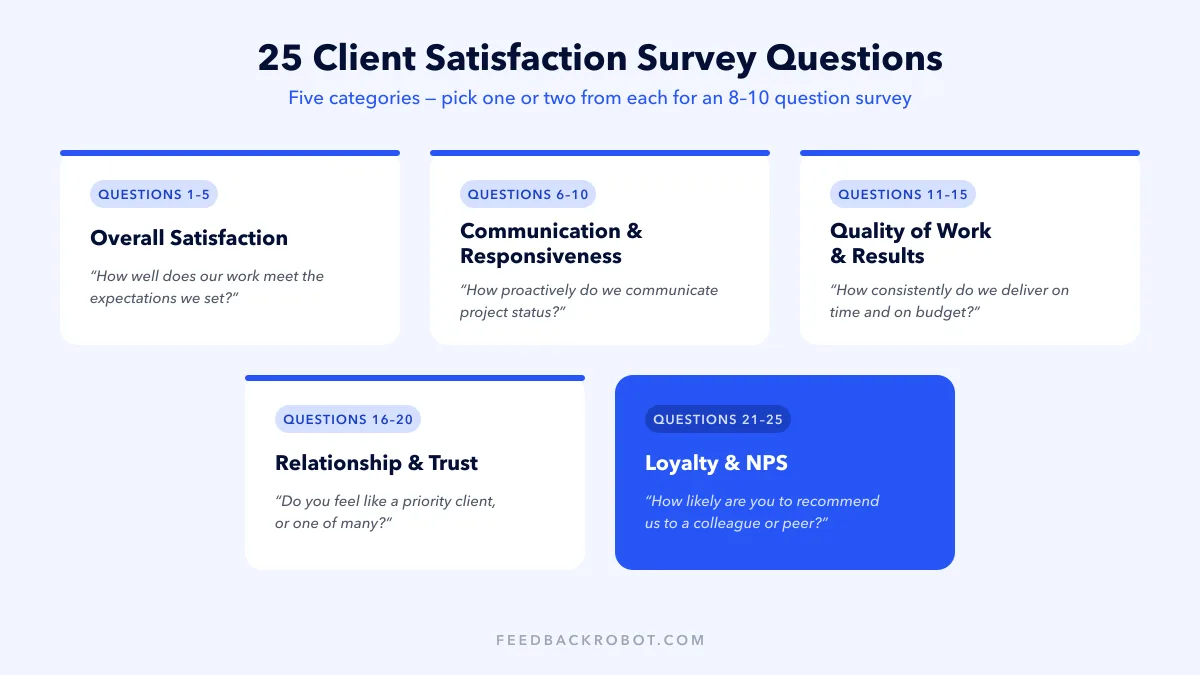
Overall Satisfaction
Overall, how satisfied are you with the service you've received from us over the past quarter?
How well does our work meet the expectations we set at the start of the engagement?
How satisfied are you with the value you receive relative to what you pay?
If you could change one thing about how we work together, what would it be?
Over the course of our engagement, has your satisfaction been improving, steady, or declining?
Communication & Responsiveness
How satisfied are you with how proactively we communicate project status?
When you raise a question or concern, how quickly do we get you a useful answer?
How clear and jargon-free are our reports, updates, and deliverables?
Do you hear about problems from us early, or do you tend to find out late?
How easy is it to reach the right person on our team when something is urgent?
Quality of Work & Results
How would you rate the quality of our most recent deliverable or project?
How well do our recommendations reflect a real understanding of your business and industry?
To what extent has our work contributed to the results you were hoping for?
How consistently do we deliver on time and on budget?
How well do we handle revisions and act on the feedback you give us?
Relationship & Trust
How much do you trust our team to act in your best interest?
Do you feel like a priority client, or one of many?
How comfortable would you be raising a difficult issue with us directly?
How well do we understand your goals for the next 12 months?
Does our team feel like an extension of yours, or like an external vendor?
Loyalty & NPS
On a scale of 0–10, how likely are you to recommend us to a colleague or peer?
What's the main reason for the score you just gave?
If your contract were up for renewal tomorrow, how likely would you be to renew?
Have you considered alternative providers in the past six months? If so, what prompted it?
What would we need to do for you to consider us indispensable?
Client Satisfaction Survey Template (Copy & Paste)
Here's a ready-to-send survey built from the bank above — nine questions, about two minutes to complete. Swap the bracketed details and send it as-is.
Subject: How are we doing? (2 minutes, honest answers welcome)
Hi [First name], we'd rather hear it from you than guess. Nine quick questions about how [Your company] has been doing this [quarter/project]:
1. Overall, how satisfied are you with our services this quarter? (1–5)
2. How satisfied are you with how proactively we communicate project status? (1–5)
3. How would you rate the quality of our recent work? (1–5)
4. How consistently do we deliver on time and on budget? (1–5)
5. When you raise a concern, how quickly do we resolve it? (1–5)
6. Do you feel our team understands your business goals? (Yes / Somewhat / No)
7. On a scale of 0–10, how likely are you to recommend us to a colleague?
8. What's one thing we should start, stop, or keep doing?
9. Anything else you'd like to share about working with us?
Questions 1–5 use a five-point satisfaction scale. If you're unsure how to label the scale points ("Very dissatisfied" through "Very satisfied"), our guide to likert scale examples covers the wording that keeps responses unbiased.
Prefer a version tailored to your industry? Generate a client satisfaction survey for consulting, legal, creative, or any other service business with our free survey question generators.
Choosing the Right Survey Metrics to Measure Success
Before you can get smarter feedback, you have to ask the right questions. Deciding on the best metric for your client satisfaction survey isn't just a technical choice—it’s about making sure your questions line up with your actual business goals. Different metrics tell you different things, from in-the-moment happiness to long-term loyalty.
This decision is more critical than you might think. Recent research uncovered a major disconnect: while half of customer experience professionals believe client satisfaction has improved, only 18% of consumers agree. Worse, 53% feel it has actually gotten worse. That gap is proof you can’t rely on assumptions. You have to measure what your clients are truly feeling.
So, where do you start? Let’s break down the three core metrics every business owner should know.
Customer Satisfaction Score (CSAT)
CSAT is your go-to for measuring immediate, short-term satisfaction with a specific interaction. It’s a direct pulse check.
You’d ask something like, "How satisfied were you with your dining experience today?" and measure it on a simple 5-point scale. Think of it as the "how did we do right now?" metric.
Best For: Getting instant feedback on a single transaction. It’s perfect for a guest checking out of your hotel or a diner finishing their meal.
Actionable Insight: A low CSAT score tied to a specific service, like "room cleanliness," gives you a clear, immediate signal on where to focus your team's attention. No guesswork needed.
Net Promoter Score (NPS)
NPS is all about the big picture. It measures long-term loyalty and how likely a client is to advocate for your brand.
It all comes down to a single, powerful question: "On a scale of 0-10, how likely are you to recommend our hotel/restaurant to a friend or colleague?"
Based on their answer, customers are grouped into Promoters (9-10), Passives (7-8), and Detractors (0-6). Your score is the percentage of Promoters minus the percentage of Detractors. To really dig in, it’s worth mastering the Net Promoter Score calculation.
Customer Effort Score (CES)
CES gets at a different, but equally important, question: how easy was it for a client to do business with you?
The question is straightforward: "How easy was it to book your reservation with us?" This is usually measured on a scale from "Very Difficult" to "Very Easy."
CES is a powerful predictor of future loyalty. Research consistently shows that reducing customer effort is a more reliable driver of repeat business than simply delighting them.
Not sure which one fits your situation? Here’s a quick breakdown to help you decide.
Comparing Key Client Satisfaction Metrics
A quick-reference comparison of the top three satisfaction metrics to help you choose the best one for your business goals.
Metric | What It Measures | Best For | Example Question |
|---|---|---|---|
CSAT | Short-term happiness with a specific interaction | Transactional feedback (e.g., support ticket, purchase) | "How satisfied were you with your recent support call?" |
NPS | Long-term customer loyalty and brand advocacy | Overall relationship health and growth potential | "How likely are you to recommend us to a friend?" |
CES | Ease of customer experience and friction points | Process improvement (e.g., booking, checkout, issue resolution) | "How easy was it to resolve your issue today?" |
By picking the right combination of these metrics, you can build a comprehensive client satisfaction survey that gives you both a snapshot of daily operations and a long-term view of your brand’s health. This is the first, most crucial step to making feedback truly operational.
How to Design Survey Questions That Get Honest Answers
The quality of the feedback you get is a direct result of the questions you ask. It's that simple. A poorly worded client satisfaction survey can give you confusing data or, even worse, biased answers that point your team in the completely wrong direction. To get smarter feedback, you have to design questions that are clear, concise, and encourage people to be honest.
Great survey design is a blend of art and science. The goal is to make the experience feel effortless for your clients while you gather the rich data needed to understand the "why" behind their scores. This means striking the right balance between different question types to capture both hard numbers and personal stories.
Balancing Question Types for Richer Data
A good survey uses a mix of question formats to paint a complete picture of the client's experience. Each type has a specific job to do.
Rating Scales (CSAT/NPS/CES): These are the backbone of your survey. They provide the core quantitative data on satisfaction, loyalty, or effort. Using a consistent scale, like 1-5 or 0-10, makes it fast and easy for clients to respond.
Multiple-Choice Questions: These are perfect for digging into the specifics. For instance, if a client gives a low CSAT score for your service, a follow-up multiple-choice question could be: "What was the main reason for your rating? (a) Response Time, (b) Issue Resolution, (c) Staff Knowledge, (d) Other."
Open-Ended Questions: This is where you'll find your most valuable insights. A simple prompt like, "Is there anything else you'd like to share about your experience?" gives clients the space to tell you what's really on their mind, often revealing issues or opportunities you hadn't even considered.
Crafting Unbiased and Clear Questions
How you phrase a question has a huge impact on the answer you receive. You have to be careful to avoid leading language that subtly pushes the client toward a certain response.
For example, asking, "How amazing was our friendly staff?" is clearly biased. It assumes the staff was both amazing and friendly.
A much better, more neutral way to phrase it is: "How would you rate the courtesy of our staff?" This simple switch removes the bias and invites a more genuine, accurate answer.
If you want to go deeper into structuring effective surveys, check out our complete guide on how to create a questionnaire that delivers truly actionable results.
Actionable Takeaway: The best surveys feel less like a test and more like a brief, easy conversation. Keep your questions short, use simple language, and make sure every single question serves a clear purpose. If you can't imagine taking a specific action based on the answer, that question probably doesn't need to be in your survey.
Getting Your Survey in Front of Clients
Even the most thoughtfully designed survey is worthless if nobody takes it. The trick is asking for feedback at the right time and in the right place—it's just as important as the questions you ask. For busy hospitality owners, that means reaching clients wherever they are, whether it’s at the front desk, in their inbox, or through a quick text.
The goal is to make giving feedback a natural, almost invisible part of their experience. Timing is everything here. A survey sent right after a service captures that immediate, gut-level reaction, which is perfect for transactional feedback. On the other hand, an email sent the next day gives them a chance to reflect on the whole experience.
Choosing Your Distribution Channels
Different channels are suited for different moments. Adopting a multi-channel strategy is the best way to capture feedback from everyone, from the tech-savvy traveler to the guest who just wants a simple, direct request.
Email Surveys: The classic go-to for post-stay or post-service follow-ups. Emails give you room for more detailed questions and allow clients to respond thoughtfully when they have a spare moment.
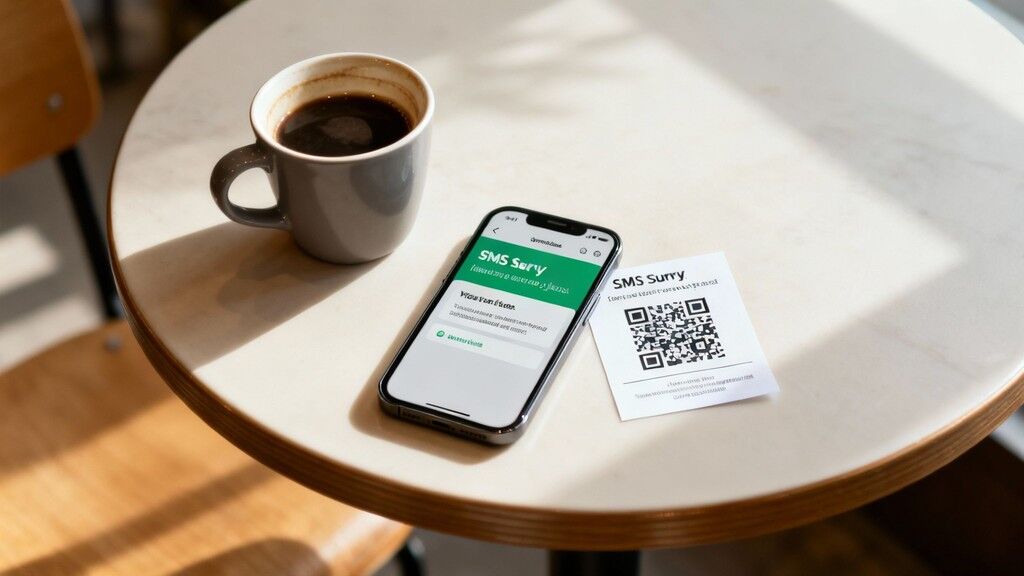
SMS Surveys: These are perfect for getting quick, in-the-moment feedback. With sky-high open rates often topping 90%, a simple CSAT or NPS question sent via text can get you an instant pulse check. To dig deeper into this powerful channel, check out our guide on SMS customer feedback.
In-Person QR Codes: An absolute must for restaurants, cafes, and front desks. Put a QR code on a receipt, table tent, or checkout counter. It makes it incredibly easy for a guest to scan and complete a survey on their phone while the experience is still fresh in their mind.
Automating Delivery for Perfect Timing
Trying to send surveys at the perfect moment for every single client is a recipe for failure if you’re doing it by hand. This is where automation becomes your secret weapon to collect smarter. By integrating your feedback platform with your core business systems, you can trigger surveys based on real-time events.
Imagine a guest checks out of your hotel. Your Mews PMS integration can fire off a personalized survey email an hour later, automatically. Or when a diner settles their bill using your Toast POS, a request for a quick rating pops up via SMS. This approach guarantees you engage every client when your service is top of mind.
This automated, event-driven feedback collection is where a Feedback Operating System shines. The Prompt to Survey feature seamlessly turns a positive online review into an invitation for a more detailed internal survey, letting you capture deeper insights from your happiest customers without lifting a finger.
Turning Raw Feedback Into Actionable Business Intelligence

Collecting client feedback is just the start. A mountain of raw data from your client satisfaction survey doesn’t do you much good if you can't quickly see what it all means for your business. To act faster, you have to turn all those scores, comments, and reviews into clear, actionable intelligence.
This is where manual analysis breaks down. Sifting through spreadsheets is painfully slow and riddled with human error, especially when managing feedback from Google, TripAdvisor, and your own surveys. A modern Feedback Operating System does this heavy lifting for you.
Unify and Analyze with AI
The first challenge is seeing the complete picture. Radar, our unified review intelligence dashboard, pulls every piece of client feedback—from public reviews to private surveys—into one central command center. No more jumping between a dozen different platforms to figure out what people are saying about your brand.
Once it's all in one place, you can use AI to get straight to the point. This is a game-changer for busy owners who need to make informed decisions without getting lost in the weeds.
Recent findings on global customer experience trends from forrester.com show an alarming trend: 21% of brands saw a decline in their customer experience quality, while only 6% improved. This gap highlights the urgency for tools that help you understand and act on feedback effectively.
Get Instant Insights with AI Summaries
With all your feedback consolidated, you can tap into powerful analytical tools. AI Summaries deliver instant insights & sentiment analysis, transforming pages of text into concise, actionable takeaways in seconds.
Identify Key Themes: Instantly see if "room cleanliness" or "check-in speed" is a recurring topic in your feedback without having to manually count mentions.
Track Sentiment: Understand the emotional tone—positive, negative, or neutral—behind customer comments at a glance.
Spot Trends: Detect emerging issues before they blow up into widespread problems, allowing you to be proactive instead of reactive.
Here’s a look at what an AI-powered insights dashboard looks like inside FeedbackRobot.
This dashboard immediately surfaces top praises like "delicious breakfast" alongside top complaints like "slow service," giving you a clear roadmap for what to fix and what to double down on. By using tools like this, you stop guessing and start making data-driven decisions that directly improve the guest experience and strengthen your business.
Using Automation to Improve Service Recovery and Loyalty
How you respond to a negative client satisfaction survey can be the difference between losing a customer for good or creating a loyal advocate for life. Closing the feedback loop isn't just about good manners; it's a powerful strategy for building a resilient brand. This is where you shift from just gathering data to actively managing client relationships.
The biggest challenge for any busy owner is speed. A slow response feels the same as no response at all, and it gives frustration time to fester. Automation is the secret to making sure every client feels heard instantly, giving your team the power to fix problems before they explode into public complaints or bad reviews.
Introducing Automated Service Recovery
This is where a tool built for rapid resolution becomes indispensable. The Resolutions Engine lets you design powerful workflows for automated service recovery. Instead of manually digging through scores and assigning tasks, you can set up rules that do the heavy lifting for you.
Think of this system as your first line of defense, guaranteeing both speed and consistency. For example, you can build a workflow that automatically fires off a personalized apology email the second a low score hits your inbox. You can get a closer look at how these intelligent automations work to make your service recovery process seamless.
This screenshot shows just how straightforward it is to build a rule in the Resolutions Engine to act on negative feedback.
The workflow is crystal clear: if a survey score dips below a set number, the system automatically sends a tailored email and pings the manager. No issue ever falls through the cracks.
Turning Dissatisfaction into Loyalty
By automating that first touchpoint, you buy your team precious time to dig into the issue and come back with a thoughtful, human solution. It immediately shows the client you're listening and taking them seriously—a critical first step in rebuilding trust.
This proactive approach is more crucial than ever. Fresh research from the Qualtrics XM Institute found that while overall customer satisfaction is holding steady, key loyalty metrics are slipping. Repurchase intent, for instance, dropped by 12%, and only 45% of consumers would go out of their way to recommend their favorite brands. This drives home the need for systems that actively cultivate loyalty.
With an automated system, you can set up workflows that not only apologize but also offer a path to resolution, like a discount on a future visit or a follow-up task assigned directly to a team member. This is how you grow stronger—by turning every piece of feedback, good or bad, into an opportunity to show exceptional care and build a reputation that keeps people coming back.
Putting Your Survey Strategy Into Action
You've got the blueprint. Now it's time to build. Moving from a well-laid plan to a real-world client satisfaction program is where the real growth happens. The path forward isn’t a one-time setup; it’s a cycle of continuous improvement that becomes part of your operational DNA.
The whole process really comes down to a few core, repeatable steps. It all starts with defining your goals with total clarity and picking the right metrics—like CSAT, NPS, or CES—to measure what actually matters to your business. From there, you craft smart, unbiased questions that encourage clients to give you the unvarnished truth.
From Blueprint to Business Growth
Next up is the most critical phase: automation. This is where you move from manual effort to a system that works for you. By integrating your feedback collection with the tools you already use, like your Mews PMS or Toast POS, you can send out surveys at the perfect moment automatically. It’s the secret to getting high response rates and capturing feedback while the experience is still fresh.
Once that data starts rolling in, the analysis begins. A true Feedback Operating System does the heavy lifting, using AI to instantly pull out the key insights and trends you'd otherwise miss.
Your goal isn't just to gather data. It's to create a business that listens, adapts, and gets better in real-time. This is what separates the brands that thrive from those that just get by.
Finally, you have to close the loop. This is non-negotiable. Using automated service recovery to instantly jump on negative feedback turns a bad experience into a chance to prove you care, building loyalty when it matters most. It’s this final step that elevates your survey program from a simple measurement tool into a powerful engine for growth.
This entire strategy is built on our core belief: collect smarter, act faster, and grow stronger.
Ready to turn client feedback into your most powerful growth engine? Start your Free Trial of FeedbackRobot today or be the first to see our new Spotlight: Feedback Wall and transform your best reviews into a compelling marketing asset.
Common Questions About Client Surveys
As a busy owner, I get it. Kicking off a new initiative like a client survey program can feel like one more thing on an already full plate. You want the results, but your time is gold. This section gives you quick, straight-up answers to the questions we hear most from leaders in hospitality and service.
The goal here is to arm you with practical know-how, so you can build a system that starts collecting smarter data from day one.
How Long Should a Client Satisfaction Survey Be?
Keep it short. The sweet spot is a survey that takes 3-5 minutes to complete. For most businesses, this translates to about 5-10 questions.
Your clients are busy, so every single question has to count. Make sure each one pulls its weight by giving you data you can actually act on.
A simple, effective structure looks like this:
Open with a core metric question. Start with your main goal—measuring loyalty (NPS), satisfaction (CSAT), or effort (CES).
Ask 3-5 specific follow-ups. Use multiple-choice or scaled questions to dig into key areas like cleanliness, staff friendliness, or the speed of service.
Finish with one open-ended question. A simple "Is there anything else you'd like to share?" is perfect. It gives clients the space to tell you things you never would have thought to ask.
What's a Good Survey Response Rate?
Response rates can swing wildly depending on your industry and, more importantly, how you ask for feedback. For email surveys, hitting a 10-15% response rate is a solid benchmark in the hospitality world.
But you can do much better. In-person or point-of-service methods—like a QR code on a receipt or at the front desk—often see rates of 20-30% or more. Why? Because you're catching them while the experience is still fresh. To really nail this, automate your survey delivery at those key moments so you're asking at the perfect time without any manual effort.
How Often Should I Send Surveys?
The right cadence really depends on what you're trying to measure. For transactional feedback, timing is everything. You want to send these surveys immediately after a specific interaction, like the moment a guest checks out or a diner pays their bill.
If you're measuring something bigger, like overall brand loyalty with an NPS survey, sending a request every 90 days or semi-annually is pretty standard. This gives you a consistent pulse on long-term sentiment without burning out your audience. The golden rule is to avoid hammering the same clients with surveys, which just leads to fatigue and tanks your response rates.
How Should I Handle Negative Feedback?
Negative feedback isn't a problem; it's an opportunity. It's your chance to turn a bad experience into a masterclass in customer care. The key is to act faster with a response that is quick, personal, and offers a clear way forward.
Acknowledge their specific issue, offer a sincere apology, and tell them exactly what you'll do to make it right. This isn't just about fixing a problem—it's about showing you listen and value their business.
This is where a Feedback Operating System is a game-changer. Using a feature like our Resolutions Engine for automated service recovery, you can instantly trigger an initial response so no negative comment ever gets ignored. This buys your team time to investigate and follow up with a human touch, helping you grow stronger by building a rock-solid reputation for accountability.
Ready to turn feedback into your most powerful growth engine? FeedbackRobot makes it simple.
Put this on autopilot
Client Satisfaction Survey
A ready-made FeedbackRobot automation that runs this for you — deploys free in under 5 minutes.
Stop reading about it. Let your agent handle it.
25 free AI actions · no credit card required
Start Free