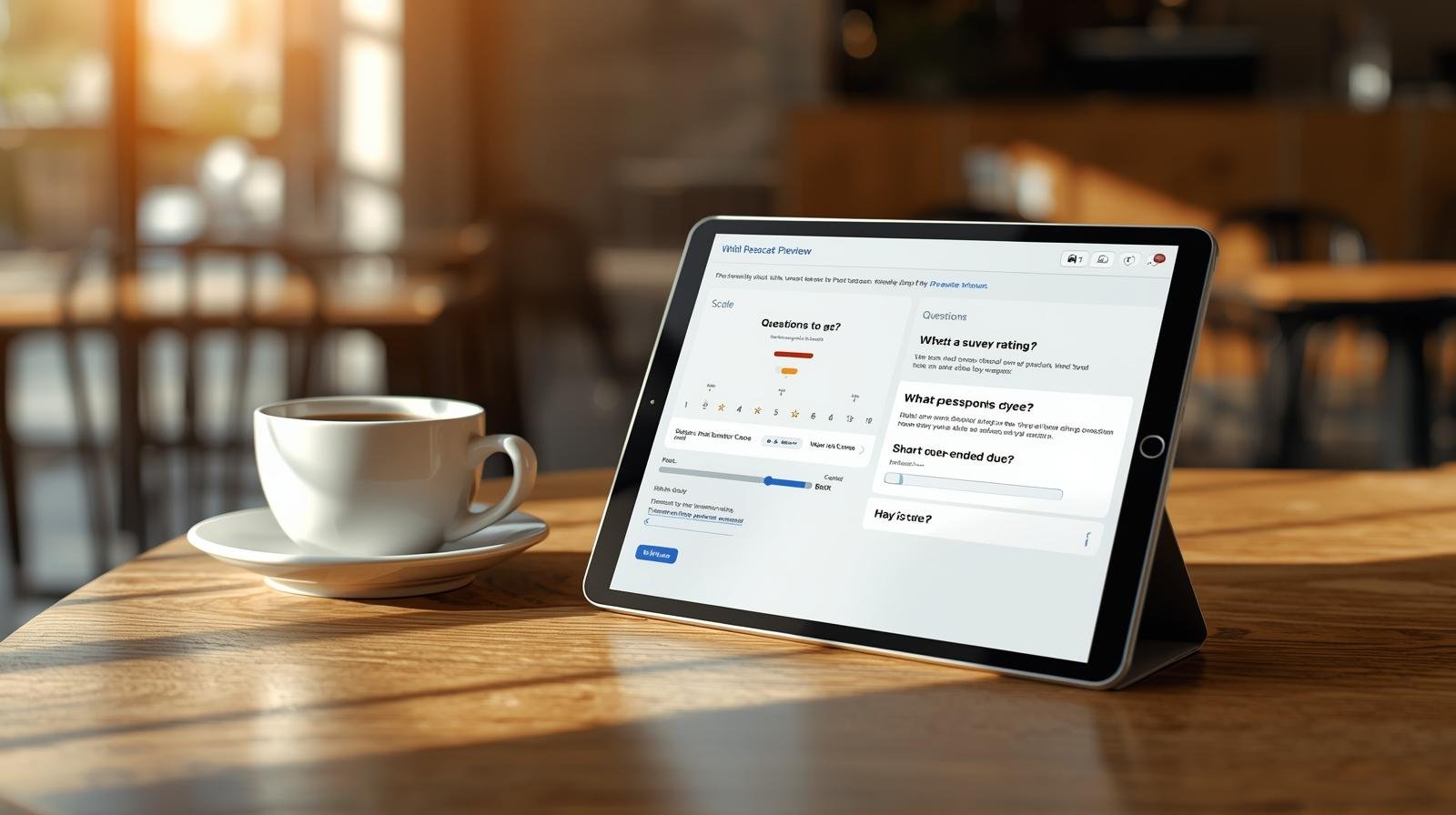

You're sitting on a mountain of feedback from guests and diners. What's next? To make that feedback work for you, you have to turn raw comments and ratings into a clear roadmap for growth. This means digging into the why behind the scores, spotting the trends that matter, and turning confusing spreadsheets into your next best move. It’s how you collect smarter, act faster, and grow stronger.
Stop Guessing and Start Growing with Survey Data
I get it. You're busy running your business, and sifting through feedback feels like one more thing on an endless to-do list. But inside that data is a goldmine. It holds the key to understanding what your customers really want, fixing what's broken before it costs you revenue, and doubling down on what you're already doing right.
It’s time to move from just collecting feedback to acting on it with confidence and speed.
This guide is built for you—the hands-on hospitality owner who doesn't have time for complex statistics. We’re talking about practical, actionable steps that turn customer voices into your biggest competitive advantage.

Why Analysing Your Data Matters Now More Than Ever
The stakes for customer experience have never been higher. Things have gotten tougher out there, and the data proves it. Forrester's 2025 Customer Experience Index shows a worrying downward trend that’s been going on for years.
In North America, the situation is particularly grim: 25% of brands saw their customer experience rankings drop for a second straight year, while only a tiny 7% actually improved. Even small gains in how customers feel about their experience can slash churn and boost what they spend with you. You can dive deeper into the CX trends from Forrester's 2025 research.
This isn't just about dodging bad reviews; it's about actively building loyalty. When you really dig into your survey data, you gain the power to:
Pinpoint Operational Strengths and Weaknesses: Discover exactly which parts of your service are knockouts and which need immediate attention.
Understand Customer Sentiment: Go beyond simple ratings to grasp the emotions behind the feedback. This helps you connect with people on a more human level.
Make Data-Driven Decisions: Swap guesswork for solid evidence when you're deciding on menu changes, staff training, or new services.
Personalize the Customer Journey: See the unique needs of different customer groups, from first-time visitors to your most loyal regulars.
A Modern Approach to Data Analysis
Forget spending days lost in spreadsheets. Modern tools are built to give you answers in minutes, not weeks. With a Feedback Operating System like FeedbackRobot, the whole process becomes smarter and more automated.
You can pull feedback from every channel—surveys, online reviews, direct messages—into one spot with Radar, our unified review intelligence dashboard. Instead of manually combing through every single comment, our AI Summaries provide instant insights & sentiment analysis. It tells you the story behind the data at a glance, surfacing the key themes and emotions driving your scores.
By turning analysis into an automated, real-time activity, you shift from reacting to old problems to proactively shaping future customer experiences. This is how you collect smarter, act faster, and grow stronger.
Before we get into the nitty-gritty, let's look at the big picture. Here’s a quick overview of the essential stages for turning raw survey responses into real business intelligence.
Key Stages in Survey Data Analysis
Stage | Objective | Key Activity |
|---|---|---|
Data Cleaning | Ensure accuracy and consistency | Removing duplicates, fixing typos, handling incomplete responses. |
Quantitative Analysis | Identify numerical patterns and trends | Calculating averages, frequencies, and cross-tabulating data. |
Qualitative Analysis | Understand context and sentiment | Coding open-ended comments, identifying themes, and analyzing emotion. |
Data Visualization | Communicate findings clearly | Creating charts, graphs, and dashboards to tell a story with data. |
Action Planning | Turn insights into improvements | Developing specific, measurable actions based on the analysis. |
Think of this table as your roadmap. Each stage builds on the last, taking you from a messy pile of responses to clear, confident decisions that will move your business forward.
Prepare Your Data for Meaningful Analysis
Before you can dig in and find those game-changing insights, you need to build a solid foundation. This is where so many busy managers and owners get stuck, but I promise, a little prep work here saves massive headaches later. Raw survey data is often a mess—full of incomplete answers, typos, and all sorts of inconsistent formatting.
Think of it like prepping ingredients in a kitchen. You wouldn't just throw everything in a pan without washing the vegetables and trimming the fat. In the same way, you can't get anything useful from your survey data until you clean it up.

Cleaning and Structuring Your Dataset
Your first job is to get everything into a clean, organized dataset. This isn't about becoming a data scientist; it's just about making your feedback easy to read so the patterns can actually emerge.
Start by getting rid of any junk responses. This means duplicates, half-finished surveys, or answers that are clearly nonsensical (like "asdfghjkl"). It's also critical to know how to handle missing data properly, as empty cells can skew your results if you're not careful.
Every single quality answer is precious, especially now. The average external digital survey response rate has dipped to between 20-30%. People are drowning in emails and are more concerned about privacy, so it’s essential to make sure the data you do get is as clean and reliable as possible.
From Raw Comments to Actionable Themes
Once your data is clean, you have to give it some structure. For the quantitative stuff—like star ratings or "yes/no" questions—this is pretty straightforward. The real gold, though, is hiding in the qualitative data: the open-ended comments.
This is where you manually "code" or "tag" the feedback. Don't let the term intimidate you. Just create simple categories that are relevant to your business.
For a restaurant, your list might look something like this:
Food Quality
Staff Friendliness
Ambiance
Wait Time
Cleanliness
Now, go through each comment and assign one or more of your tags. A comment like, "The pasta was delicious, but our server seemed rushed and unfriendly," would get tagged with Food Quality (positive) and Staff Friendliness (negative). See? This simple process turns a wall of text into organized themes you can actually count and track over time.
Of course, the best way to get clean data is to ask the right questions in the first place. For tips on that, check out our guide on how to create a questionnaire that pulls in clear, actionable feedback from the get-go.
A clean, well-structured dataset is the difference between a clear picture of your business and a confusing mess. It’s the essential first step to turning feedback into fuel for growth.
Getting this right upfront makes every other step of your analysis faster and far more accurate. When you can trust your data, you can act on the insights with confidence. Even better, using a tool like FeedbackRobot’s Prompt to Survey feature helps you design intelligent surveys that capture cleaner, more structured data from the very beginning, saving you a ton of valuable time.
Decode the Numbers to Uncover Quantitative Insights
With your data cleaned up and ready to go, we can get to the fun part: digging into the numbers. This is where you find the what in your customer feedback. We're talking about the hard data from ratings, scores, and multiple-choice questions that give you a performance snapshot at a glance.
Start with the basics. Calculating your average customer satisfaction (CSAT) score gives you a powerful, single-number baseline. Is it trending up or down over time? Just tracking this simple metric is the first step toward understanding your overall operational health.
But the real magic happens when you start slicing the data.
Go Deeper with Cross-Tabulation
Cross-tabulation sounds technical, but it’s just a simple way of comparing two different pieces of data to see how they relate. Honestly, it's one of the most effective ways to analyze survey results because it moves you from general observations to specific, actionable insights.
Let's walk through a common scenario. Imagine you just launched a new, slightly more expensive lunch menu. Your overall satisfaction score dipped a bit, but you're not sure why.
The Situation: You cross-tabulate your satisfaction scores with a question you asked about visit frequency.
The Insight: Boom. You discover that first-time visitors absolutely love the new menu, scoring it a 9/10. But your loyal regulars? They’re not happy, scoring it a 6/10.
The Action: Now you know the issue isn't the menu itself, but how a key customer segment is receiving it. You can act with precision—maybe by running a special for your regulars or asking them for more specific feedback.
Spotting Outliers and Why They Matter
While you're looking for broad trends, don't just brush past the outliers. These are the extremely high or low scores that stick out from the average.
That single ‘1 out of 5’ rating for cleanliness could be an early warning sign of a new problem. On the flip side, a glowing ‘5 out of 5’ might point to a service superstar on your team who deserves a shout-out.
Understanding the spread of your data is crucial. Tools like an IQR Calculator can help you quickly identify the variability and any potential outliers in your survey responses.
Instead of getting lost in spreadsheets to perform this analysis, modern tools do the heavy lifting. The dashboards in FeedbackRobot automatically calculate these key metrics and let you filter and cross-tabulate data with a few clicks.
This kind of automated approach frees you up to focus on what the numbers actually mean for your business. For a broader look at what's out there, check out our rundown of the top customer feedback analysis tools.
Find the Story Hidden in Customer Comments
Your ratings and scores tell you what is happening, but the real gold—the most actionable feedback—is almost always buried in your customers' written comments. This is where you find the why behind the numbers.
Think about it. A drop in your 'Ambiance' score from a solid 4.5 to a worrying 3.8 is one thing. But knowing it's because guests are finding the new lighting "too harsh" or the music "too loud" gives you a clear, immediate path to a solution.
For a busy owner or manager, manually reading every single comment just isn't realistic. This is where a smarter method called thematic analysis comes in. It sounds a bit academic, but it’s really just about grouping comments into recurring themes you already care about, like 'Staff Attitude,' 'Food Quality,' or 'Check-in Process.'
Let AI Do the Heavy Lifting
This process used to be a massive time sink, involving hours of manual work with spreadsheets and highlighters. But AI has become a genuine superpower for service businesses. Instead of you or a manager spending half a day tagging comments, a smart system can do it in seconds. This is precisely what FeedbackRobot's AI Summaries feature was built for.
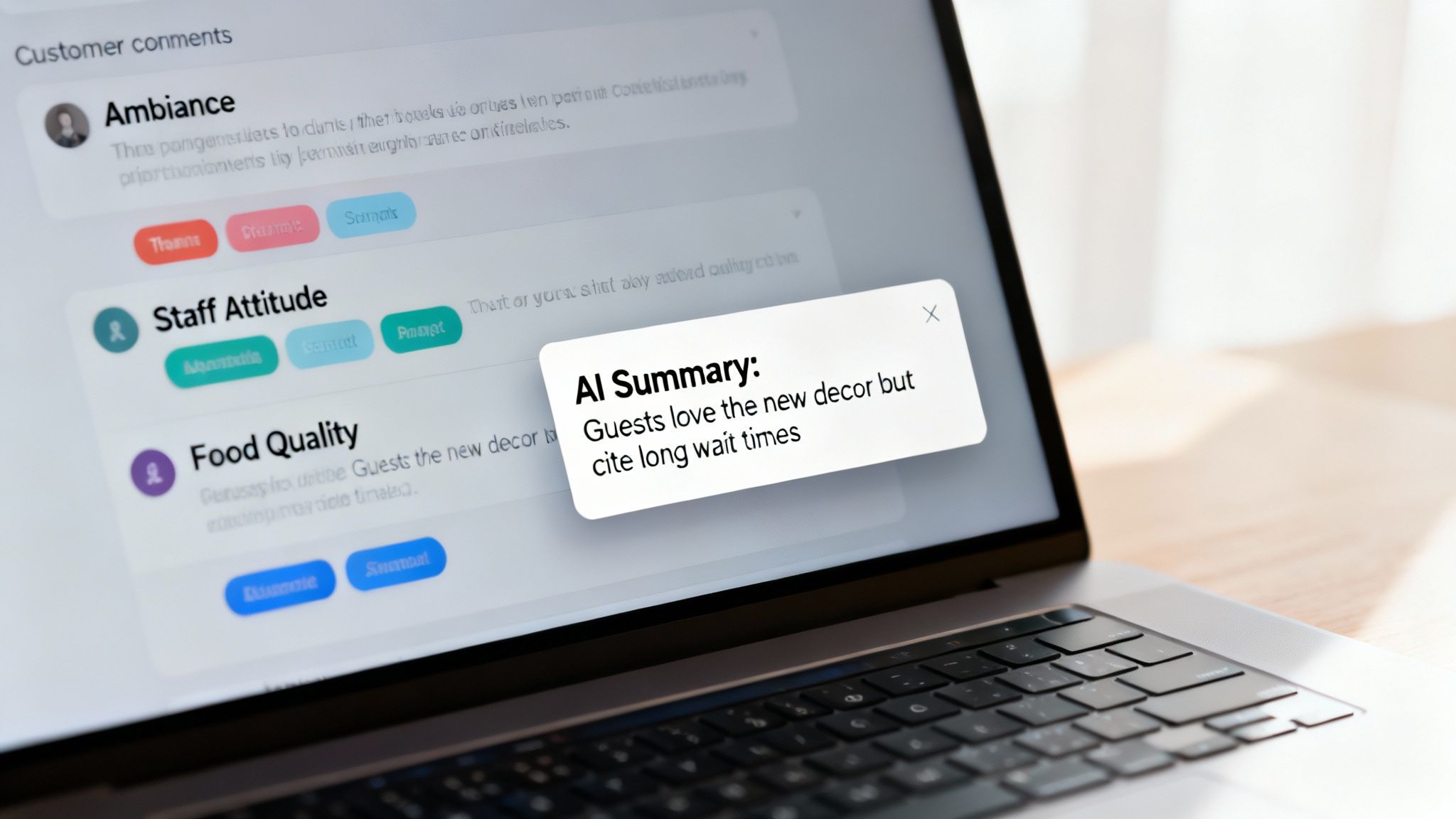
It automatically scans all your open-ended feedback from surveys, online reviews, and direct messages, providing instant insights & sentiment analysis. The AI immediately spots the key themes and tells you if the comments tied to those themes are positive, negative, or neutral. You can get a deeper look at how this all works in our guide to the AI review summarizer.
Instead of drowning in a wall of text, you get a one-glance summary that surfaces your most critical issues and biggest wins.
Imagine logging in and immediately seeing a clear insight: 'Guests consistently praise the new decor (positive sentiment), but many are frustrated with the long check-in times on weekends (negative sentiment).' This instantly turns a jumble of unstructured feedback into clear, actionable operational priorities.
From Vague Feelings to Specific Fixes
With this kind of clarity, you can pinpoint exactly what to celebrate with your team and what needs to be fixed right away. The AI doesn’t just tell you there’s a problem; it shows you the specific context straight from the customer's own words.
This approach helps you:
Identify Root Causes: Quickly get to the bottom of why certain scores are low.
Discover Hidden Gems: Find unexpected compliments about a team member or a small detail you’ve implemented.
Track Trends Over Time: See if the comments about 'slow service' are getting better or worse after that staff training session last month.
This isn't just about saving time; it's about making faster, more informed decisions. One study found that generative AI users save an average of 5.4% of their work hours—that’s over two hours in a standard 40-hour week. For you, that's more time to spend coaching your team and improving the guest experience, not stuck behind a screen trying to connect the dots.
Turn Your Insights into Action and Growth
Let's be honest: analysis without action is just a waste of time. This last step is where the magic happens, where you take all those hard-won findings and turn them into real, measurable improvements for your business.
Once you’ve dug through the data and found a clear issue—say, a recurring theme about slow drink service on Saturday nights—it’s time to move.
Don’t get bogged down in complexity. Just create a simple, clear action plan. Assign it to a specific team member, set a goal you can actually measure (like "cut average drink ticket times by two minutes"), and give it a realistic deadline. This is how you make sure your insights drive real change instead of just gathering dust in a report.

Respond Instantly with Automated Service Recovery
Seeing broad trends is great, but what about the individual customer who had a terrible experience yesterday? This is where service recovery is absolutely critical. A single negative review doesn't have to be the final word; it's a golden opportunity to show you're listening and that you genuinely care.
The biggest challenge is always speed. You can't possibly monitor every piece of feedback around the clock by hand. This is where automation becomes your secret weapon. With a tool like FeedbackRobot's Resolutions Engine, you can use automated service recovery to build workflows that turn negative experiences into moments that actually build loyalty.
Here’s how that plays out for a hotel operator:
The Trigger: A guest fills out a post-stay survey and rates 'room cleanliness' a 1 out of 5.
The Automation: The Resolutions Engine immediately springs into action.
The Actions: It instantly pings the head of housekeeping, logs the issue for tracking, and shoots an empathetic, pre-approved apology email to the guest—maybe even with a discount on their next stay.
That immediate, thoughtful response can completely flip a customer's perception. You've acknowledged their problem and made a real effort to make things right, often before they even think about blasting you in a public review.
Why Acting Fast Is No Longer Optional
In today's world, customer loyalty is incredibly fragile. New research shows a dangerous gap between what customers say about satisfaction and their actual loyalty, revealing just how quickly they'll walk away.
A shocking 86% of customers are willing to ditch a brand after just two bad service experiences. What's worse, 56% won't even complain—they just disappear and go to a competitor. On the flip side, 75% of consumers say they'll gladly spend more with businesses that get the experience right. You can dive into the full report on these global satisfaction and loyalty findings.
For any service business—from a boutique hotel integrated with Mews to a bustling restaurant running on Toast—this data is a serious wake-up call. Investing in rapid issue resolution isn't just about good service; it's a direct investment in customer lifetime value and long-term growth.
By automating your response and recovery process, you create a system that’s got your back even when you're not looking. It’s the ultimate expression of our core philosophy: collect smarter, act faster, and grow stronger.
Of course, here is the rewritten section, crafted to sound completely human-written and natural, following the style of the provided examples.
Your Top Questions About Survey Data, Answered
Even with the best game plan, a few questions always pop up when it's time to dig into the data. Let’s walk through some of the most common ones we hear from managers on the ground.
What's the Best Software for Analysing Survey Data?
Honestly, a spreadsheet works fine if you’re only looking at a handful of responses. But you'll hit its limits fast. Purpose-built platforms are just so much quicker at helping you find the real story in the noise.
For any hospitality or service business, the best tools go way beyond basic charts. You need something that automates the tedious work of sorting comments and spotting what’s really going on. That’s exactly why we built AI Summaries into FeedbackRobot. It gives you instant insights & sentiment analysis on all your qualitative feedback. You see the 'why' behind the scores in seconds, not hours.
How Do You Analyse Quantitative and Qualitative Data Together?
This is where the magic happens. The biggest breakthroughs come when you connect the 'what' (your scores and numbers) with the 'why' (your customer comments). Stop looking at them in separate reports. Instead, use your numbers to flag an issue, then dive into the text to understand it.
For example, did your Net Promoter Score (NPS) take a hit last month? Your next move should be filtering all the open-ended comments from detractors during that exact period. A unified platform is a total game-changer here. Our Radar feature provides unified review intelligence, pulling all your scores and comments from surveys, Google, and social media into one single dashboard. You can literally see a score dip and immediately read the verbatim comments driving that trend, connecting the dots on the spot.
The most powerful insights live at the intersection of numbers and narratives. Use your scores to identify a problem area, then use customer comments to understand the human experience behind it.
How Often Should I Analyse My Survey Data?
For any business where you’re face-to-face with customers, waiting for a monthly or quarterly report means you're already behind. The new standard is real-time, continuous analysis. You need to know about a problem with tonight's dinner service tonight, not in next month’s summary.
A continuous feedback loop lets you catch small issues before they become big problems. It empowers you to make tiny, daily adjustments that, over time, add up to a massive impact on guest satisfaction. This proactive approach is central to our philosophy of helping you collect smarter, act faster, and grow stronger. It’s all about building a system that turns daily feedback into your most valuable operational tool.
Ready to stop guessing and start acting on your customer feedback with speed and clarity? FeedbackRobot gives you the tools to turn insights into growth.