Voice of Customer Examples: 10 (Actionable) for 2026 Growth
Explore 10 Voice of Customer examples & strategies for 2026. Collect smarter feedback with AI insights to boost retention and reputation in hospitality.

Feb 23, 2026 · 16 min read
Free tool
Likert Scale Generator
Generate custom rating scales and survey questions tailored to your feedback needs.
In the hospitality and service industry, every guest interaction is a chance to win or lose loyalty. But how do you truly understand what your customers are thinking? You build a powerful Voice of Customer (VoC) program. This isn't about generic comment cards; it's about a system that captures precise feedback, reveals hidden trends, and empowers your team to act decisively. Guesswork leads to missed opportunities; listening leads to smarter decisions and sustainable growth.
This guide is your playbook, filled with actionable voice of customer examples specifically for busy owners like you. We'll break down proven methods for collecting feedback across every channel—from post-stay surveys to real-time website prompts. Forget data overload. We'll show you how to turn raw comments into clear directives that improve operations, train staff, and ultimately boost your bottom line.
A modern Feedback Operating System makes this simple. It's how you collect smarter, act faster, and grow stronger. We'll show you how tools like FeedbackRobot make this happen. For instance, Radar is our unified review intelligence feature that brings all your reviews into one dashboard. Our AI Summaries provide instant insights and sentiment analysis, pinpointing key themes without manual work. This isn't just about collecting data; it's about making every customer's voice your most valuable asset. Let's dive in.
1. Online Surveys and Questionnaires (including NPS)
Online surveys are your direct line to understanding customer sentiment at scale. These structured questionnaires, often sent via email, SMS, or QR codes on receipts, are a foundational method for gathering both quantitative ratings and qualitative feedback. They are powerful voice of customer examples because you can time them precisely to capture feedback at critical moments, like after a hotel stay or a support interaction.
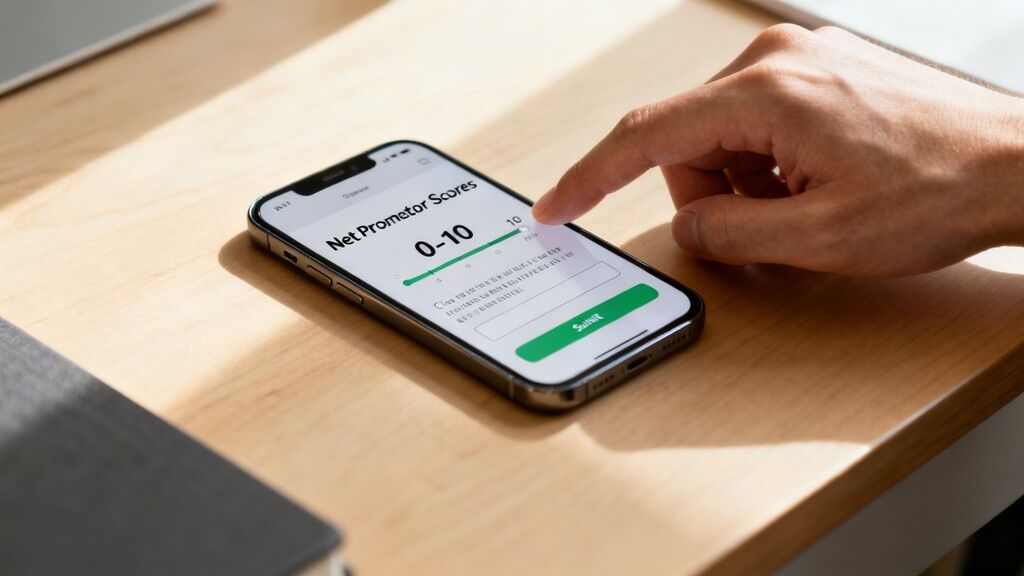
The Net Promoter Score (NPS) survey is a prime example. Its simple "How likely are you to recommend us?" question effectively segments customers into Promoters, Passives, and Detractors, giving you a clear, actionable metric for loyalty. A hotel group can use NPS to benchmark performance across properties and identify which locations are creating brand advocates versus those creating risks.
Actionable Tips for Implementation
To make your surveys effective, keep them brief and mobile-friendly; most customers respond on their phones. To act on the data, you need smart automation.
With FeedbackRobot, this becomes a strategic advantage. Our Prompt to Survey feature is a smart automation tool that invites guests who leave positive reviews on sites like Google to complete a more detailed internal NPS or CSAT survey. This helps you capture deeper insights from your biggest fans. Then, our AI Summaries provide instant insights & sentiment analysis, distilling thousands of responses into clear themes. This saves you hours of manual work and helps you act faster to address common pain points or double down on what customers love.
2. Customer Review Platforms and Monitoring
Customer reviews on platforms like Google, TripAdvisor, and Yelp remain a critical pulse point, but the landscape has fundamentally shifted from mere 'monitoring' to active, intelligent management. In 2026, ignoring the sheer volume and velocity of public feedback isn't just a missed opportunity—it's a reputation risk. What customers say about your brand in real-time, often unsolicited, now demands an immediate, professional, and consistent response across all channels. This isn't just about spotting trends; it's about automating the response lifecycle to protect your brand and drive loyalty, leveraging AI to distill thousands of opinions into actionable insights and professional resolutions before manual teams can even begin to sift through them.
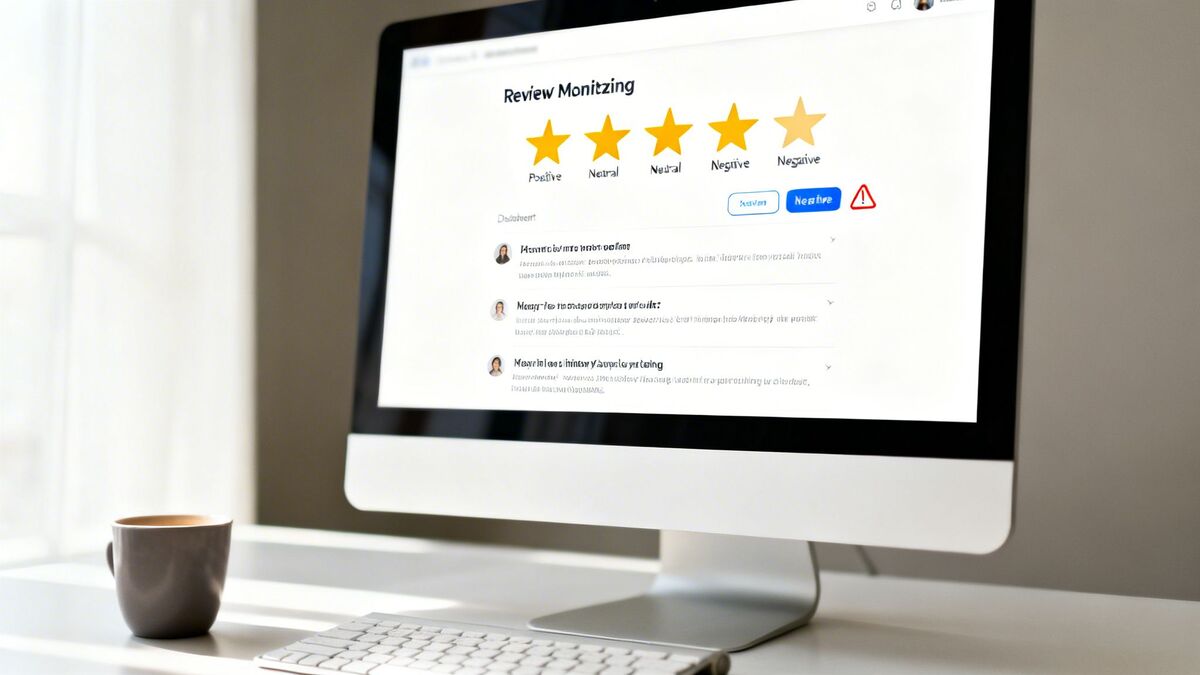
This method reveals operational strengths and weaknesses that internal surveys might miss. A restaurant chain can track Yelp reviews to spot a recurring complaint about slow service at a specific branch, signaling a need for staff training. This public feedback directly impacts your revenue, as new customers often use these reviews to make buying decisions.
Actionable Tips for Implementation
To make review monitoring effective, respond to all feedback within 24-48 hours, especially negative comments. Use this feedback to train staff and fix service gaps before they become major problems.
Managing dozens of platforms manually is impossible. This is where a Feedback Operating System is essential. Radar is our unified review intelligence feature that consolidates all your reviews from Google, TripAdvisor, and more into a single dashboard. Then, our AI Summaries provide instant insights & sentiment analysis, pinpointing recurring themes so you can stop manually reading every comment and start acting on clear, data-driven insights. This allows your team to move from reactive problem-solving to proactive operational improvements.
3. In-App and Website Feedback Widgets
In-app and website feedback widgets capture the customer's voice at the exact moment of their experience. These embedded tools let users share thoughts without leaving your site or app, providing immediate, relevant insights. These are effective voice of customer examples because they capture feedback during crucial interactions, such as checkout, a feature discovery, or right after a booking confirmation.

This method is both unobtrusive and highly targeted. A hotel's booking website can use a pop-up widget to ask about the booking experience right after a reservation is made. A restaurant app could trigger a feedback prompt after a mobile order. The key is capturing sentiment while the experience is fresh, leading to more accurate feedback than a survey sent days later. This immediate data is vital for fixing friction points in your digital journey.
Actionable Tips for Implementation
To maximize engagement, use behavioral triggers (like time on page) to display widgets intelligently. Keep the initial question simple, offering a path for more detail.
With FeedbackRobot, you can operationalize this feedback instantly. Our customizable widgets, like the Spotlight: Feedback Wall, capture specific information and feed it directly into your central dashboard. From there, our AI Summaries provide instant insights & sentiment analysis on this qualitative data, identifying recurring themes across thousands of submissions. This allows you to quickly fix issues, like a confusing checkout step, before they impact more customers.
4. Social media Listening and Engagement
Social media platforms are bustling, real-time focus groups where customers openly share experiences. Social listening involves monitoring these conversations for mentions of your brand, products, and competitors. These candid discussions are powerful voice of customer examples because they provide unfiltered insights into public perception, emerging trends, and urgent customer service issues.
Unlike surveys, social listening captures spontaneous opinions. A hotel can monitor Twitter for a guest complaining about a slow check-in and resolve it in the moment, turning a negative experience into a positive one. A restaurant might track Instagram hashtags to see user-generated photos of a new dish, gathering authentic reactions. This proactive approach helps you manage your reputation and engage customers directly.
Actionable Tips for Implementation
Set up alerts for your brand name and key industry terms. Respond to mentions, both positive and negative, to show you are paying attention. This builds community and trust.
You need a way to centralize this scattered feedback. With FeedbackRobot, Radar acts as your unified review intelligence hub, aggregating social media mentions alongside reviews from Google, TripAdvisor, and other sites into a single dashboard. Then, our AI Summaries provide instant insights & sentiment analysis on all this unstructured text, identifying sentiment and pinpointing recurring themes. This helps you act faster on critical insights that impact your brand’s reputation and growth.
5. Customer Interviews and Focus Groups
While surveys gather data at scale, interviews and focus groups provide the rich, qualitative context behind the numbers. These structured conversations allow you to dig deep into customer motivations, explore complex pain points, and understand the "why" behind their behavior. They are essential voice of customer examples for gathering detailed narratives that multiple-choice questions can't capture.
A luxury hotel might conduct one-on-one interviews with high-value guests to understand the subtle details that define a five-star experience. A restaurant group considering a major menu overhaul can use a focus group to test new concepts and gauge reactions to pricing before a costly rollout. This direct dialogue uncovers nuanced preferences and builds stronger customer relationships.
Actionable Tips for Implementation
Prepare a detailed guide but remain flexible enough to follow unexpected lines of inquiry. Recruit a diverse mix of customers, including loyal advocates and recent detractors, to ensure you hear a wide range of perspectives. Record and transcribe sessions to capture every detail for analysis.
Qualitative data from interviews is valuable but time-consuming to process. After identifying key themes from your conversations, use FeedbackRobot’s AI Summaries to cross-reference them with quantitative data from your surveys and reviews. This powerful combination validates your interview findings at scale, confirming if a pain point mentioned by one guest is a widespread issue reflected in thousands of other pieces of feedback. This connects deep, personal stories with broad data trends, giving you a complete picture to act upon.
6. Post-Transaction and Post-Service Feedback
Timing is everything. Post-transaction feedback is the most immediate way to get a clear, unfiltered impression. This involves sending an automated feedback request moments after a customer completes a purchase, finishes a meal, or checks out. By engaging customers while the experience is fresh, you receive highly accurate and contextual insights. These are crucial voice of customer examples because they link feedback directly to a specific event, enabling rapid issue identification and service recovery.
For example, a hotel can send a brief SMS survey one hour after checkout asking about the stay. A quick-service restaurant might text a single question about order accuracy right after a customer leaves, allowing management to spot recurring issues. This approach turns a routine transaction into a valuable data point for operational improvement. For businesses in the hospitality sector, understanding customer sentiment is crucial. Implementing effective post-transaction feedback mechanisms, such as those integrated into specific loyalty applications for restaurants, can provide invaluable insights.
Actionable Tips for Implementation
Timing is critical; send requests within 1-2 hours post-experience. Keep the survey extremely brief (1-3 questions) to increase completion rates. Use transaction-specific language to make the request feel personal.
Automation is key. With FeedbackRobot's Resolutions Engine, you get automated service recovery. You can create rules that automatically escalate negative feedback to a manager for immediate follow-up. This system can trigger a workflow, such as sending a personalized apology and an offer for their next visit, turning a poor experience into an opportunity to build loyalty. This shows you're listening and you care.
7. Customer Advisory Boards and Panels
For organizations focused on high-value, long-term relationships, a Customer Advisory Board (CAB) offers a direct, strategic channel for feedback. These organized groups of select customers meet regularly with company leadership to discuss strategy, review roadmaps, and co-create solutions. It is one of the most in-depth voice of customer examples, creating a formal dialogue with your most important partners, whether they are top hotel managers or multi-unit restaurant operators.
A CAB moves beyond reactive feedback to proactive collaboration. A professional services firm might use its client advisory council to validate a new service offering before a wide launch. A restaurant technology company could consult its panel of power users to prioritize features for its next software update. This approach builds deep-seated loyalty and turns key customers into genuine brand advocates.
Actionable Tips for Implementation
Select a diverse group of customers representing different segments to avoid groupthink. Prepare a clear agenda with specific questions and data-driven topics. Commit to documenting all insights and action items, and follow up with the board to show their input is valued.
A CAB provides the qualitative "why" behind your quantitative data. The insights from these deep conversations can be paired with broader trends identified by tools like FeedbackRobot. For example, if Radar, our unified review intelligence feature, identifies a recurring friction point in your booking process across thousands of reviews, you can bring this specific issue to your advisory board. They can provide the nuanced context needed to develop the perfect solution, helping you act with confidence.
8. Text and Sentiment Analysis of Feedback
Manually sifting through thousands of customer reviews, survey comments, and support chats is impossible. This is where text and sentiment analysis comes in, using AI to automatically process huge volumes of unstructured text. This powerful method is one of the most scalable voice of customer examples, as it extracts key themes, identifies sentiment (positive, negative, neutral), and pinpoints actionable insights from qualitative data that would otherwise remain hidden.
Imagine a hotel group analyzing thousands of guest reviews. Instead of reading each one, an AI can instantly categorize feedback into themes like "room cleanliness," "staff friendliness," and "breakfast quality," while also scoring the sentiment for each. This allows management to see that while staff is highly praised, breakfast quality is a consistent pain point. For raw text data, especially from conversational platforms, tools that can efficiently help you to summarize WhatsApp group chats with AI can be invaluable for distilling key insights.
Actionable Tips for Implementation
Begin with clear goals for what you want to learn. Are you looking for service gaps or competitive advantages? While the AI does the heavy lifting, it's wise to validate its initial output with some human spot-checking to ensure accuracy.
FeedbackRobot’s AI Summaries provide instant insights & sentiment analysis for exactly this purpose, turning massive amounts of qualitative feedback into clear, actionable reports. Our system automatically categorizes comments into relevant themes, saving your team hundreds of hours. This allows you to stop guessing and start making data-backed decisions, turning feedback into a direct driver for improvement. If you're new to the concept, you can get a deeper understanding of what is customer sentiment analysis and how it can be applied.
9. Customer Journey Mapping and Touchpoint Feedback
Instead of capturing feedback at a single point, customer journey mapping involves systematically collecting insights at every key stage of the customer experience. This method creates a comprehensive, step-by-step view of the entire relationship, from initial awareness to post-purchase follow-up. These are powerful voice of customer examples because they reveal critical pain points and "moments of truth" that a single survey might miss.
A hotel, for example, can map its guest journey from the online booking process, through pre-arrival communication, check-in, the in-room experience, and checkout. By gathering targeted feedback at each touchpoint, management can pinpoint exactly where service excels or falters. This approach helps identify inconsistencies, such as a seamless booking system followed by a frustratingly slow check-in.
Actionable Tips for Implementation
Map the journey from the customer's perspective, not your internal process flowchart. Identify the most critical touchpoints where the experience can make or break loyalty and deploy short, relevant feedback prompts there. Avoid overwhelming guests with too many requests.
The goal is to connect feedback across the entire journey. Radar, our unified review intelligence feature, consolidates this multi-channel feedback into a single dashboard, giving you a holistic view of the customer experience. Our AI Summaries can then analyze feedback from different stages, like "check-in" or "housekeeping," to instantly highlight recurring themes and service gaps. This allows you to stop guessing and start making precise, data-driven improvements to the parts of your service that matter most to guests.
10. Closed-Loop Feedback and Issue Resolution Tracking
Closing the loop means systematically acting on customer feedback and informing the customer of the resolution. This isn't just about collecting data; it's about turning insights into action and proving to customers that their voice matters. These structured issue resolution systems are essential voice of customer examples because they directly connect feedback to operational improvements and customer retention. When a hotel guest reports a faulty air conditioner, a closed-loop process ensures the issue is logged, assigned, fixed, and the guest is informed.
This method moves from passive listening to active problem-solving. For a multi-location restaurant, it means a complaint about food quality doesn't just get an apology. The feedback is tracked, routed to the specific kitchen manager, and a plan for retraining is implemented. Tracking these resolutions prevents recurring problems and builds trust.
Actionable Tips for Implementation
You need a clear, centralized system for tracking issues from intake to resolution. Establish ownership for different types of feedback so nothing falls through the cracks, and set clear timeframes for response.
A purpose-built system is crucial here. The Resolutions Engine in FeedbackRobot is your tool for automated service recovery. It can automatically create a service recovery ticket when negative feedback is detected in a review or survey. The ticket is routed to the right person with all the context needed to act fast. You can track every step and ensure accountability, turning a potential brand-damaging issue into an opportunity to win back a customer for life.
10 VoC Methods Compared
Method | Implementation complexity | Resource requirements | Expected outcomes | Ideal use cases | Key advantages |
|---|---|---|---|---|---|
Online Surveys and Questionnaires (including NPS) | Low–Medium — form design and basic integrations | Survey platform, CRM integration, minimal staff | Quantifiable metrics (NPS/CSAT), trendable benchmarks | Broad customer populations, routine satisfaction tracking | Scalable, cost‑effective, easily benchmarked |
Customer Review Platforms and Monitoring | Low–Medium — setup dashboards and response workflows | Monitoring tools, reputation management resources, staff time | Unsolicited qualitative insights, public ratings, early issue alerts | Local businesses, hospitality, retail with public profiles | Authentic social proof, SEO benefit, early detection of problems |
In-App and Website Feedback Widgets | Low–Medium — embed widgets and define triggers | Dev time for integration, real‑time routing, monitoring | Contextual, in‑moment feedback with higher response rates | Digital products, SaaS, checkout and UX testing | In‑context capture, low friction, rapid product iteration |
Social Media Listening and Engagement | Medium–High — keyword tuning and workflow integration | Listening tools, social/analytics team, continuous monitoring | Real‑time brand sentiment, trend and influencer identification | Brands active on social channels, crisis monitoring, marketing insight | Captures organic voice, identifies advocates, enables fast response |
Customer Interviews and Focus Groups | High — recruitment, moderation, and analysis | Skilled researchers/moderators, incentives, transcription | Deep, nuanced qualitative insights and motivations | New product discovery, complex behavior, strategic research | Reveals unarticulated needs and rich contextual detail |
Post-Transaction and Post-Service Feedback | Medium — automation triggers and short surveys | Automation platform, integration with transaction systems | Timely transaction‑specific feedback and recovery opportunities | Service industries, appointments, e‑commerce deliveries | High relevance timing, higher response rates, enables quick recovery |
Customer Advisory Boards and Panels | High — executive coordination and governance | Executive time, curated customer participants, facilitation | Strategic guidance, roadmap validation, stronger advocacy | B2B key accounts, product strategy validation, enterprise clients | Builds deep relationships and strategic market insight |
Text and Sentiment Analysis of Feedback | Medium–High — model tuning and integrations | NLP tools, data engineers/analysts, labeled data for training | Scalable theme extraction, sentiment trends, prioritized issues | Large volumes of reviews, support transcripts, omnichannel feedback | Processes scale of qualitative data, speeds insight discovery |
Customer Journey Mapping and Touchpoint Feedback | High — cross‑functional data integration and mapping | Workshops, analytics, multiple feedback sources, change teams | Holistic view of experience, prioritized touchpoint improvements | Organizations with complex end‑to‑end customer journeys | Aligns organization, identifies high‑impact improvements |
Closed-Loop Feedback and Issue Resolution Tracking | Medium–High — process design and ownership model | Ticketing/CRM, routing automation, accountable owners | Resolved issues, improved retention, measurable operational fixes | Service operations, companies focused on recovery and retention | Ensures action on feedback, builds trust, reduces repeat issues |
If you need ready-to-use resources, our voice of the customer templates page includes three free survey templates for hotels, restaurants, and retail — plus a comparison of 12 tools to automate collection and analysis.
Turn These Examples into Your Growth Engine with FeedbackRobot
These voice of customer examples prove one thing: your customers are constantly telling you how to win their business. The difference between market leaders and everyone else is who can listen and act the fastest.
The common thread is not just collecting feedback, but creating an operational rhythm around it. Manually tracking, analyzing, and acting on this flood of information across multiple channels is impossible to do at scale. This is where most businesses fall short, leaving valuable insights buried and customer relationships at risk.
From Manual Effort to Automated Excellence
A true Feedback Operating System bridges the gap between seeing these voice of customer examples and implementing them yourself. It automates the tedious work so your team can focus on the human element of service.
This is why we built FeedbackRobot. It’s designed to be the central nervous system for your customer feedback, enabling you to collect smarter, act faster, and grow stronger.
Radar (Unified Review Intelligence): Stop logging into a dozen different platforms. Our Radar feature provides a unified review intelligence dashboard, pulling in feedback from Google, TripAdvisor, and more. You get a single, clear view of your reputation.
Prompt to Survey: Don't let a great survey idea get stuck in draft mode. With Prompt to Survey, you can invite happy reviewers to complete a more detailed internal survey, giving you deeper insights from your best customers.
AI Summaries (Instant Insights & Sentiment Analysis): Drowning in comments? Our AI Summaries provide instant insights and sentiment analysis, digesting thousands of reviews to tell you exactly what customers love and what they don't. No more manual reading; just clear, actionable takeaways.
Resolutions Engine (Automated Service Recovery): A negative review is a critical moment. The Resolutions Engine automates your service recovery process. It can instantly route a complaint to the right manager and trigger a workflow to send a follow-up apology or a discount, turning a bad experience into incredible customer care.
By integrating with the systems you use daily, like Mews or Toast, we ensure feedback requests are sent at the perfect moment. You can finally stop chasing feedback and start building a loyal following.
Ready to transform these voice of customer examples into your daily operational reality? FeedbackRobot provides the tools to automate collection, uncover deep insights, and act on feedback in real-time.
Can you give a real-world VoC example for a restaurant?
A restaurant owner noticed a theme of 'music too loud' in their Friday night reviews. They lowered the volume by 10%, and their average rating for 'Atmosphere' jumped by 0.5 points in 30 days.
How do hotels use VoC to improve their operations?
Hotels often use 'Theme Analysis' to identify issues with specific room types or floors. If 'Room 402' consistently gets noise complaints, it signals a physical maintenance issue, not a service failure.
What is an example of 'Positive' VoC being used for growth?
If your VoC data shows that guests love your 'Signature Cocktail,' you should make that the centerpiece of your social media ads to attract more people with the same taste.
How does VoC help with menu engineering?
By analyzing which dishes get the most praise in reviews vs. which ones are never mentioned, you can identify 'Hidden Winners' and 'Dead Weight' to optimize your profitability.
Can VoC examples help train new staff?
Yes. Sharing real guest comments—both praise and criticism—during orientation helps new hires understand the specific expectations of your clientele from day one.
Stop reading about it. Let your agent handle it.
25 free AI actions · no credit card required
Start Free