How to Respond to Customer Complaints (10 Examples & Templates)
10 copy-paste examples for responding to customer complaints by email, letter, social and in person — plus the HEARD framework.

Nov 4, 2025 · 18 min read
Free tool
AI Negative Review Responder
Turn 1-star reviews into recovery opportunities with AI-crafted responses.
When a customer complains, your response needs to be three things: fast, empathetic, and decisive. Get this right, and you don't just solve a problem. You show the customer you value their business, turning a negative moment into a chance to earn their loyalty for good.
Looking for word-for-word scripts? Our library of negative review response examples covers 30+ ready-to-adapt responses by industry and severity.
As a busy hospitality or service owner, every minute counts. This guide starts with 10 copy-paste response examples you can send today, then covers the HEARD framework and the system for handling complaints at scale.
Want a response written for your exact complaint? Paste it into our free AI Review Responder and get a ready-to-send draft in seconds.
10 Customer Complaint Response Examples (Copy & Paste)
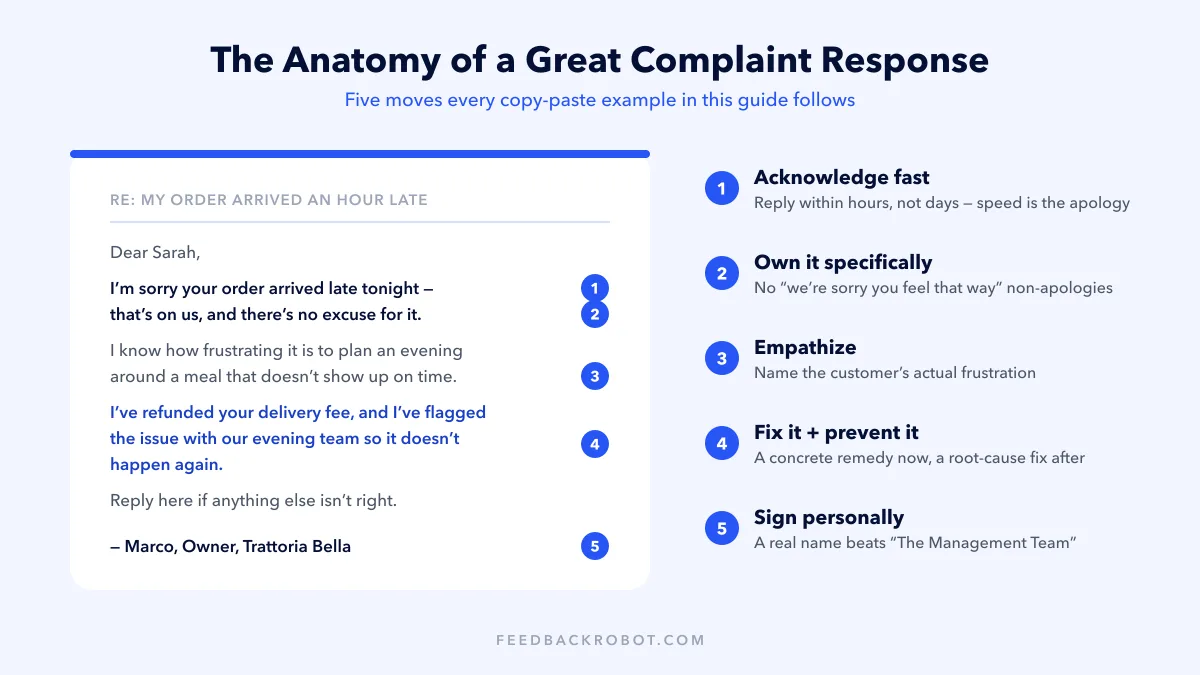
Every example below follows the same skeleton: acknowledge fast, own the specific issue, empathize, offer a concrete fix, and sign with a real name. Copy the one that matches your situation, swap the bracketed details, and send it while the complaint is still fresh.
1. Late or Wrong Order (Restaurant)
When to use it: The kitchen sent the wrong dish or the order arrived cold and late. Respond the same day — this is the most fixable complaint on this list.
Dear [Name], I'm so sorry we got your order wrong tonight — that's on us, and there's no excuse for it. I know how frustrating it is to look forward to a meal and receive something you didn't ask for. I've flagged this with our kitchen team so we can work out where the slip happened. Please reach out to me directly at [phone/email] and we'll make it right with a full refund or a fresh replacement, whichever you prefer. We'd genuinely love the chance to serve you the meal you actually ordered. — [Your name], [Restaurant name]
For the public-review version with four variations, see the wrong order review response template.
2. Rude Staff Complaint
When to use it: A customer reports rude or dismissive treatment from a team member. Own it fully — without publicly throwing your staff under the bus.
Dear [Name], thank you for telling us about this — I'm genuinely sorry this was your experience. The conduct you described is not something we accept at [Business name]. Every customer deserves to be treated with courtesy and respect, and it's clear we fell short of that on your visit. I've reviewed what happened with the team member involved and we've addressed it internally. I'd welcome the chance to talk this through personally — you can reach me at [contact]. I hope you'll give us the opportunity to show you the service we're actually known for. — [Your name], [Business name]
More versions, including complaints naming a specific employee, in the rude staff review response template.
3. Billing Error or Disputed Charge
When to use it: An unexpected charge, duplicate payment, or invoice dispute. Never debate the charge publicly — commit to verifying it, fast.
Dear [Name], thank you for raising this — I'm sorry the charge on your account wasn't what you expected. Pricing transparency matters to us, and I want to make sure this was handled correctly on our end. Could you reply with the date and amount of the charge, or call us at [contact]? We'll review your account today and, if there's been an error, correct it and refund the difference immediately. Either way, you'll hear back from us within one business day with a clear answer. — [Your name], [Business name]
Handling pricing complaints on public reviews? Use the billing complaint review response template.
4. Product Defect or Refund Request (Retail)
When to use it: A product arrived damaged or failed early. Decide refund-or-replace before you reply, so the customer only has to answer once.
Dear [Name], I'm sorry the [product] didn't hold up the way it should have — that's not the quality we stand behind. You shouldn't have to jump through hoops here: reply with a photo of the fault and your order number, and we'll ship a replacement or process a full refund the same day, your choice. There's no need to return the faulty item unless you'd prefer to. I've also passed your report to our team so we can catch this issue before it reaches anyone else. — [Your name], [Store name]
5. Slow Service Complaint (Hotel)
When to use it: A guest waited too long at check-in, for room service, or at the front desk. Name the fix you've made since — it's what separates an apology from an excuse.
Dear [Name], thank you for your feedback — and I'm sorry you had to wait as long as you did. Your time matters, and a wait like that isn't acceptable regardless of how busy we were. Since your stay, we've reviewed our front-desk staffing for peak check-in hours so this doesn't happen to the next guest. I'd love the chance to show you a much smoother experience — reach out to me at [contact] on your next booking and I'll personally make sure everything is ready before you arrive. — [Your name], [Hotel name]
Public-review version in the slow service review response template.
6. Appointment or Wait-Time Complaint (Clinic)
When to use it: A patient or client was kept waiting well past their booked time.
Dear [Name], thank you for sharing this — I'm sorry your appointment ran so far behind schedule. You booked a time slot and we should have honored it; I completely understand the frustration of rearranging your day and then waiting anyway. We've since reviewed how we schedule [appointment type] to build in more realistic buffers. If you're willing to give us another visit, contact us at [contact] and we'll book you into a first-of-the-day slot, which never runs late. — [Your name], [Practice name]
See also the wait time complaint review response template.
7. Public Social-Media Complaint (Take It Private)
When to use it: A complaint posted publicly on Instagram, Facebook, or X. Reply publicly in two sentences, then move the details to DMs — the public reply is for everyone else watching.
Hi [Name], we're really sorry to hear this — that's not the experience we want anyone to have. We've just sent you a DM so we can get the details and make this right today. Thank you for flagging it. — [Your name], [Business name]
In the DM itself, ask one specific question ("Can you tell me which location and roughly what time you visited?") and state your resolution offer up front, so the customer isn't dragged through a second interrogation.
8. Unreasonable or Abusive Complaint
When to use it: The complaint crosses into personal abuse or demands you can't meet. Stay calm, state what you can do, set a boundary, and leave the door open.
Dear [Name], I understand you're frustrated, and I do want to resolve this for you. To be direct about where we stand: [state what you can offer — e.g., a full refund of the service fee]. What I can't do is [the demand you're declining], and I also need our conversation to stay respectful so my team can help you properly. If you'd like to proceed with the resolution above, reply here or call us at [contact] and we'll action it the same day. — [Your name], [Business name]
9. Complaint About a Policy You Won't Change
When to use it: The customer is unhappy about a rule that exists for a reason — cancellation windows, deposits, no-refund policies. Explain the reason; don't apologize for the policy itself.
Dear [Name], thank you for taking the time to share this. I understand the [policy — e.g., 48-hour cancellation window] felt rigid in your situation. We keep that policy because [honest reason — e.g., late cancellations leave appointment slots we can't refill], but I recognize that doesn't make it less frustrating on your end. While I can't waive it retroactively, here's what I can do: [goodwill gesture — e.g., apply half the fee as credit toward your next visit]. If that works for you, just reply and I'll set it up. — [Your name], [Business name]
10. Follow-Up After Resolution (Closing the Loop)
When to use it: Send this 3–7 days after you've fixed the problem. It's the message almost nobody sends — and the one that turns a complaint into loyalty.
Dear [Name], I wanted to follow up personally now that [the issue — e.g., your refund has been processed / your replacement has arrived]. I hope everything was handled to your satisfaction — if anything still isn't right, reply to this email and it comes straight to me. Your complaint also led to a real change on our side: [what changed — e.g., we've retrained the evening team on order checks]. Thank you for giving us the chance to fix this rather than walking away quietly. We'd love to welcome you back. — [Your name], [Business name]
Why Every Customer Complaint Is a Hidden Opportunity
It’s easy to see a customer complaint as just another fire to put out. But in reality, it's a critical moment of truth. How you handle that interaction doesn't just fix one issue; it tells the world what your brand stands for. In an age where feedback is instant and public, this isn't just good service—it's a core business strategy.
The stakes are massive. Globally, poor customer experiences add up to a staggering $4.7 trillion in lost revenue each year. But there's an upside. When brands make a point to respond to complaints, especially on social media, customer advocacy can jump by up to 25%. On the flip side, ignoring them can slash advocacy by 50%, showing just how much your response matters.
A complaint is raw, unfiltered data about a friction point in your business. It's an invitation to improve your operations, training, or product before more customers are affected.
Treating complaints as free consulting is the first step toward operational excellence. They point you directly to what needs fixing, helping you collect smarter, act faster, and grow stronger. Think about it: a string of complaints about long wait times or a buggy feature isn't just noise. It's actionable intelligence you can use to refine your processes and stop the same problems from happening again.
The Real Cost of a Slow or Poor Response
In the hospitality and service world, the damage from a bungled complaint goes far beyond one lost customer. Negative reviews and bad word-of-mouth can chew away at your brand’s reputation. A quick, empathetic response, however, proves you care and are committed to quality—a powerful way to stand out.
The goal isn't just to say sorry. It's to validate the customer's frustration and rebuild their trust. When you successfully turn these situations around, you prove your business listens and adapts. That’s a quality that builds rock-solid loyalty and brings in new customers. To see this in action, check out these real-world examples of AI in customer experience that show how modern tools can help you respond with both speed and sincerity.
A Modern Framework for Complaint Resolution
Stop just reacting to customer complaints. It’s time to build a reliable system to manage them. Instead of constantly putting out fires, a structured framework gives you a consistent, thoughtful way to handle feedback—whether it’s a scathing Google review, a frustrated email, or a public call-out on social media.
This isn’t about memorizing rigid scripts. It's about having a repeatable process that empowers your team to act decisively and with empathy. A modern approach gives you actionable strategies for every step, from the first triage to the final follow-up.
Think of it as creating a Feedback Operating System. This is your central hub for streamlining the entire workflow. With a system like this, every complaint is logged, addressed, and—most importantly—learned from. It turns chaotic, multi-channel feedback into an organized, strategic process.
Listen First, Then Validate
Before you even think about offering a solution, your first job is to just listen. A customer who's taken the time to complain wants, more than anything, to feel heard and understood. Jumping straight into "fix-it" mode can come across as dismissive, which often makes a bad situation even worse.
Active listening means acknowledging their frustration and validating their feelings. Simple phrases like, "I can see why that would be so frustrating," or "You're absolutely right to be upset about this," can de-escalate tension almost immediately. You’re not admitting fault here; you’re simply showing empathy.
A fast response is important, but an empathetic one is what rebuilds trust. Always acknowledge the emotion before you try to solve the problem.
When you validate their experience, you subtly shift the dynamic from adversarial to collaborative. Suddenly, you’re not on opposite sides of a problem. You’re working together to find a resolution, laying the groundwork to turn a negative interaction into a positive one.
Acknowledge and Apologize Sincerely
Once the customer feels heard, a genuine apology is your next move. Steer clear of defensive language or those flimsy non-apologies like "we're sorry you feel that way." Take ownership. A straightforward, "I'm so sorry we let you down," is powerful and disarming.
Your apology should also be specific to their issue. This shows you’ve not only heard the complaint but have actually understood the details. It’s a sign of respect for the time and effort they took to bring the problem to your attention.
For a simple yet effective model, I often recommend the HEARD method. It’s a great way to structure that critical first response.
The HEARD Method for Empathetic Responses
Step | Action | Example Phrase |
|---|---|---|
Hear | Let the customer tell their full story without interruption. | "Thank you for sharing this with me. I want to make sure I understand everything..." |
Empathize | Acknowledge their feelings to show you understand their frustration. | "I can only imagine how frustrating that must have been. I'd be upset, too." |
Apologize | Offer a sincere and direct apology for the issue. | "I am truly sorry that we didn't meet your expectations. We messed up." |
Resolve | Take action and explain the immediate next steps. | "Here’s what I’m going to do right now to get this sorted out for you..." |
Diagnose | Figure out why the problem happened to prevent it in the future. | "Once this is resolved, I'll be speaking with our team to understand the root cause." |
This systematic approach of listening, validating, and apologizing forms the core of an effective resolution process. It ensures every customer feels respected from the start, setting the stage for a successful outcome that helps you collect smarter, act faster, and grow stronger.
Automate Complaint Responses at Scale
Everything above works when you're handling one complaint at a time. The challenge is volume. Complaints arrive as Google reviews, Instagram DMs, survey responses, and emails — and expectations are brutal: 72.1% of customers are more likely to stick around if their complaint is resolved quickly, and over a quarter expect a fix within 30 minutes. At that pace, you need a system, not heroics.
Start by pulling every channel into one place. A centralized team inbox for customer feedback means a Yelp review, a survey response, and a Facebook comment all land in the same queue, with AI summaries flagging what each complaint is about and how urgent it is — so your team triages by severity instead of by whichever tab happened to be open.
Then automate the first move. With customer service automations, a one-star review mentioning "cold food" can trigger a personalized apology and a recovery offer within minutes, and a negative public review can trigger a private survey invitation that moves the conversation out of public view. The system guarantees nobody waits; your team stays focused on fixing the root cause.
When complaints show up as Google reviews, response time matters for rankings as much as content. FeedbackRobot's Google integration flags new reviews instantly and drafts a response you can approve in one click.
For complaints that show up as public reviews across Google, Yelp, TripAdvisor, and other platforms, the same principles apply — with a few platform-specific differences. The guide to responding to negative reviews covers the full process, including how to handle fake reviews, factual errors, and the one-star ratings with no text.
When complaints land on Google specifically, the platform adds a layer of complexity — your response is public and permanent. How to respond to Google reviews covers the platform mechanics and templates. If the review crosses into fake or policy-violating territory, how to remove a Google review explains what Google will actually act on. And if your positive review count needs building, how to ask for Google reviews covers the ask process.
Balancing Automation with a Genuine Human Touch
Technology gives your business incredible speed, but genuine empathy is what builds lasting relationships. While a system like FeedbackRobot automates the grunt work, it’s the irreplaceable human touch your team provides that truly resolves deep-seated customer complaints and rebuilds trust.
The goal isn't to replace people but to blend AI-driven efficiency with authentic human connection. Let automation handle the triage, data collection, and initial responses. This frees up your team to focus their energy on delivering the empathy, understanding, and creative solutions that no machine can replicate. This is how you empower your people to handle tough conversations with confidence and grace.
Empower Your Team with the Right Tools and Training
Your team is your single greatest asset in turning a bad experience around. Investing in their training isn't just an expense; it's a direct investment in customer loyalty and your brand's reputation. Focus on practical skills that make a tangible difference when tensions are high.
Here are the key areas to focus on:
Active Listening: Train your staff to hear what the customer isn't saying. It's about listening for the underlying emotion—the frustration, disappointment, or stress—and validating those feelings before jumping to a solution.
Emotional Intelligence: Equip them to manage their own reactions when faced with anger. Role-playing difficult scenarios is a fantastic way to build the resilience needed to stay calm and professional under pressure.
De-escalation Techniques: Give them simple, effective phrases that can disarm a tense situation. Think of lines like, "I can completely understand why you feel that way," or "Let's figure out how we can make this right for you."
Technology should serve your team, not replace them. When you give your staff the right tools and the right training, you create a system where efficiency and empathy work hand-in-hand to turn unhappy customers into your most loyal advocates.
Ultimately, the costliest challenges in customer experience are often human-centered, not technological. Empathy is crucial. In fact, 76% of employees report higher engagement when their leaders demonstrate it—a trait that directly translates to better service quality.
When you think about the high cost of replacing a dissatisfied service agent, creating a supportive, well-equipped team isn't just good practice; it's a powerful financial strategy.
Ready to blend powerful automation with a world-class human touch? FeedbackRobot provides the tools your team needs to collect smarter, act faster, and grow stronger.
For automated review responses at scale, check out our Free AI Negative Review Responder.
What is an example of a good response to a customer complaint?
A good complaint response apologizes specifically, then commits to a fix: "Dear [Name], I'm sorry your order arrived late — that's on us. I've refunded your delivery fee and flagged the issue with our team so it doesn't happen again. Reply here if anything else isn't right." Short, specific, and personally signed.
What is the 'Golden Rule' of responding to complaints?
Speed and Empathy. Acknowledge the frustration immediately and apologize sincerely, even if the mistake wasn't yours. This de-escalates the situation instantly.
Should I respond to negative reviews publicly or privately?
Both. Post a brief, professional public response to show other customers you care, then move the detailed resolution to a private channel like email or phone.
How do I handle an abusive or aggressive customer complaint?
Set boundaries professionally. Acknowledge their frustration but state that you can only assist once the conversation remains respectful. Don't engage in a public 'flame war.'
Can AI help me write better responses to complaints?
AI is excellent for removing the 'defensive' tone humans often have when criticized. It can draft a neutral, empathetic starting point that you can then personalize.
Is it okay to offer a refund immediately?
Sometimes, but usually, a 'Genuine Solution' is better. Ask the customer how they would like the issue resolved; often they just want to be heard, not just paid off.
Stop reading about it. Let your agent handle it.
25 free AI actions · no credit card required
Start Free